
Peter Kreeft
Peter Kreeft is an American philosopher and prolific author of over eighty books on Christian theology, philosophy, and apologetics. A convert from Protestantism to Catholicism, his journey was shaped by his study of Church history, Gothic architecture, and Thomistic thought. He earned his BA from Calvin College, an MA and PhD from Fordham University, and pursued further studies at Yale. Since 1965, he has taught philosophy at Boston College and also at The King’s College. Kreeft is known for formulating “Twenty Arguments for the Existence of God” with Ronald K. Tacelli, featured in their Handbook of Christian Apologetics. A strong advocate for unity among Christians, he emphasizes shared belief in Christ over denominational differences.
29 Books Written

This book is for anyone who has ever wept and wondered, "Why?" Peter Kreeft observes that our world is full of billions of normal lives that have been touched by apparently pointless and random suffering. This account of a real and honest personal quest is both engaging and convincing. Written from a deep well of wisdom derived from experience and careful observation, Making Sense Out of Suffering is a book for empty hearts, not full ones. Read it if you are hungry for insight into the mystery of suffering. A Servant Book.

Handbook of Christian Apologetics: Hundreds of Answers to Crucial Questions
by Peter Kreeft
Rating: 4.2 ⭐
Reasonable, concise, witty and wise, Peter Kreeft and Ronald K. Tacelli have written an informative and valuable guidebook for anyone looking for answers to questions of faith and reason. Topics Whether you are asking the questions yourself or want to respond to others who are, here is the resource you have been waiting for.

Between Heaven and Hell: A Dialog Somewhere Beyond Death with John F. Kennedy, C. S. Lewis & Aldous Huxley
by Peter Kreeft
Rating: 3.9 ⭐
Combining logical argument with literary imagination, Peter Kreeft uses a dialogue between C.S. Lewis, John F. Kennedy and Aldous Huxley (all of whom died within hours of each other) to investigate the claims of Christ.

To learn more about J.R.R. Tolkien visit Wh ile nothing can equal or replace the adventure in reading Tolkien’s masterwork, The Lord of the Rings , Peter Kreeft says that the journey into its underlying philosophy can be another exhilarating adventure.Thus, Kreeft takes the reader on a voyage of discovery into the philosophical bones of Middle earth. He organizes the philosophical themes in The Lord of the Rings into 50 categories, accompanied by over 1,000 references to the text of Lord.Since many of the great questions of philosophy are included in the 50-theme outline, this book can also be read as an engaging introduction to philosophy. For each of the philosophical topics in Lord, Kreeft presents tools by which they can be understood. Illustrated.
Peter Kreeft brings his unique insights to this most important area of our spiritual lives. He claims he himself is still a beginner in prayer, and this book is for all those, like him, who feel that they are not good at praying but desire to become much better at it. Thus, Kreeft offers simple, but profound advice and practical steps for developing a prayer life based on the time-tested wisdom of the saints and great spiritual writers, especially the principles found in Brother Lawrence's classic, The Practice of the Presence of God. In short, straight-forward and unsentimental chapters, Kreeft covers all the key areas for understanding and developing that intimate form of communication with our Creator that we call prayer. He covers such areas as the necessity of prayer, various motives and methods, steps, patience, suffering, sin, faith, and grace.

Three Philosophies of Life - Ecclesiastes: Life As Vanity, Job: Life As Suffering, Song of Songs: Life As Love
by Peter Kreeft
Rating: 4.3 ⭐
"I've been a philosopher for all my adult life and the three most profound books of philosophy that I have ever read are Ecclesiastes, Job, and Song of Songs." These are the opening lines of Kreeft's Three Philosophies of Life. He reflects that there are ultimately only three philosophies of life and each one is represented by one of these books of the Bible—life is vanity; life is suffering; life is love.In these three books Kreeft shows how we have Dante's great epic The Divine Comedy played out, from Hell to Purgatory to Heaven. But it is an epic played out in our hearts and lives, here and now. Just as there is movement in Dante's epic, so there is movement in these books, from Ecclesiates to Job, from Job to Song of Songs. Love is the final answer to Ecclesiastes' quest, the alternative to vanity, and the true meaning of life. Finally, Kreeft sees in these books the epitome of theological virtues of faith, hope and love and "an essential summary of the spiritual history of the world".

Socrates Meets Jesus: History's Greatest Questioner Confronts the Claims of Christ
by Peter Kreeft
Rating: 4.0 ⭐
What would happen if Socrates--yes, the Socrates of ancient Athens--suddenly showed up on the campus of a major university and enrolled in its divinity school? What would he think of human progress since his day? How would he react to our values? To our culture? And what would he think of Jesus? Peter Kreeft, Christian philosopher and longtime admirer of the historic Socrates, imagines the result. In this drama Socrates meets such fellow students as Bertha Broadmind, Thomas Keptic and Molly Mooney. Throughout, Kreeft weaves an intriguing web as he brings Socrates closer and closer to a meeting with Jesus. Here is a startling and provocative portrayal of reason in search of truth. In a new introduction to this revised edition, Kreeft also highlights the inspiration for this book and the key questions of truth and faith it addresses.
Kreeft issues a clear call to all Christians to get back to their active pursuit of real virtue in their daily lives. This in-depth analysis of the meaning of the virtues and their connection with the Beatitudes also summarizes a scriptural and theological wisdom on leading a holy life. Includes the accumulated wisdom of St. Paul, C.S. Lewis, and many others.

The Best Things in Life: A Contemporary Socrates Looks at Power, Pleasure, Truth & the Good Life
by Peter Kreeft
Rating: 4.1 ⭐
What are the best things in life? Questions like that may boggle your mind. But they don't boggle Socrates. The indomitable old Greek brings his unending questions to Desperate State University. With him come the same mind-opening and spirit-stretching challenge that disrupted ancient Athens.What is the purpose of education?Why do we make love?What good is money?Can computers think like people?Is there a difference between Capitalism and Communism?What is the greatest good?Is belief in God like belief in Santa Claus?In twelve short, Socratic dialogues Peter Kreeft explodes contemporary values like success, power and pleasure. And he bursts the modern bubbles of agnosticism and subjectivism. He leaves you richer, wiser and more able to discern what the best things in life actually are.

Jesus Shock is the second in a series of short works on seminal concerns of the impact that Jesus Christ made in the world. The first work, The Philosophy of Jesus (St. Augustine’s Press, 2007), explored philosophy in light of Jesus, rather than the other way around. The present work investigates the reception Jesus received both in His lifetime and continuously to the present time, not only from His enemies, but from His friends, a reception of shock, astonishment, even disgust. Perhaps a few remarks from the book best explains The point of the The point of the Imagine a storm has downed a telephone wire so that everyone who touches it is shocked in every cell of his body. Well, the storm of God’s crazy love has “downed” (incarnated) Jesus, and everyone who touches this “live wire” is shocked in every cell of his soul. The question of the Why is “Jesus” the most non-neutral, the most controversial, the most embarrassing name in the world? Why is talking about Jesus like talking about sex? This whole book is really about a single movie line, the greatest line in the greatest movie in history. Bet you know what it is. Jesus-Shock is about the Real Presence of Christ in the Gospels and in the Eucharist. Itis not about the theology of the Real Presence, but about the experience of Him there, and about the experience of everyone in the Gospels who met Him. What was the bitterest controversy of the Protestant Reformation, both between Protestants and Catholics and between different Protestant denominations, the one that had both sides calling the other not just heretics but devils? It was not Justification by Faith, the hallmark of the Reformation, even though that question is about nothing less momentous than how to be saved, how to get to Heaven. It was not the relation between religion and politics, even though that was a matter of life or death (literally, on battlefields and at guillotines and hangings) and not just a matter of truth or falsity, or of good or evil. It was not about the sufficiency of the Bible, or the corruption in the Church, or the relation between the Bible and the Church. It was not about the Pope, and the governance of the Church. It was not about Mary or saints or angels or Purgatory. It was not about the Incarnation or the Trinity or the Atonement. It was about the Real Presence of Christ in the Eucharist. Jesus-Shock, in addressing this controversy forcefully and faithfully, shows the reasons why to this day the name of “Jesus” stirs up controversy, even revulsion, in polite society. In the true spirit of ecumenism, it also points the way toward a true rapprochement among His modern-day disciples.

The Unaborted Socrates: A Dramatic Debate on the Issues Surrounding Abortion
by Peter Kreeft
Rating: 4.1 ⭐
Is abortion a woman's right?When does human life begin?Should we legislate morality? What would happen if the Socrates of old suddenly appeared in modern Athens? Peter Kreeft imagines the dialog that might ensue with three worthy opponents--a doctor, a philosopher and a psychologist--about the arguments surrounding abortion. Kreeft uses Socratic technique to strip away the emotional issues and get to the heart of the rational objections to abortion. Logic joins humor as Socrates challenges the standard rhetoric and passion of the contemporary debate.
Christianity for Modern Pagans: Pascal's Pensées - Edited, Outlined & Explained
by Peter Kreeft
Rating: 4.4 ⭐
Peter Kreeft believes that Baise Pascal is the first post-medieval apologist. No writer in history, claims Kreeft, is a more effective Christian apologist and evangelist to today's uprooted, confused, secularized pagans (inside and outside the Church) than Pascal. He was a brilliant man--a great scientist who did major work in physics and mathematics, as well as an inventor--whom Kreeft thinks was three centuries ahead of his time. His apologetics found in his Pensees are ideal for the modern, sophisticated skeptic.
In response to actual questions many people have asked him about angels and demons, well-known author and philosophy professor Peter Kreeft separates fact from fantasy and myth from reality as he answers 100 common questions about these spiritual beings. Based on a very popular college course he teaches on this subject, this book responds to the incredible amount of interest in angelic beings and attempts to clear up some of the misinformation abounding in the numerous books today on what we know about these mysterious spirits.Drawing on the Bible, traditional Church teaching and St. Thomas Aquinas, Kreeft gives straight, clear answers to the perennial and philosophical questions asked about angels and demons throughout time. In his typical lucid, profound and sometimes humorous style, Kreeft answers such questions as ''What are angels made of'', ''How do angels communicate with God'', ''How do angels communicate with us'', ''Do demons, or devils, or evil spirits really exist?'' and many more. Includes angel art.

My title explains itself.But it's misleading.There are more than 40 reasons.In fact, there are at least ten to the 82nd power, which, I am told, is the number of atoms in the universe. And that's just in ordinary matter, which makes up only 4.9% of the universe, the rest being dark matter and dark energy.Each of my reasons is an independent point, so I have not organized this book by a succession of chapters or headings. After all, most readers only remember a few big ideas or separate points after reading a book. (I've never heard anyone say "Oh, that was a good continuous-process-of-logically-ordered-argumentation" but I've often heard people say, "Oh, that was a good point."Which takes me back to my main "Why are you a Catholic" is a good question.A good question deserves a good answer.Here are forty of mine.

Catholic Christianity: A Complete Catechism of Catholic Beliefs Based on the Catechism of the Catholic Church
by Peter Kreeft
Rating: 4.4 ⭐
For the first time in 400 years the Catholic Church has authorized an official universal catechism which instantly became an international best-seller, the Catechism of the Catholic Church. Using this official Catechism, the highly-regarded author and professor Peter Kreeft presents a complete compendium of all the major beliefs of Catholicism written in his readable and concise style. Since the Catechism of the Catholic Church was written for the express purpose of grounding and fostering catechisms based on it for local needs and ordinary readers, Kreeft does just that, offering a thorough summary of Catholic doctrine, morality, and worship in a popular format with less technical language. He presents a systematic, organic synthesis of the essential and fundamental Catholic teachings in the light of the Second Vatican Council and the whole of the Church's Tradition. This book is the most thorough, complete and popular catechetical summary of Catholic belief in print that is based on the universal Catechism.
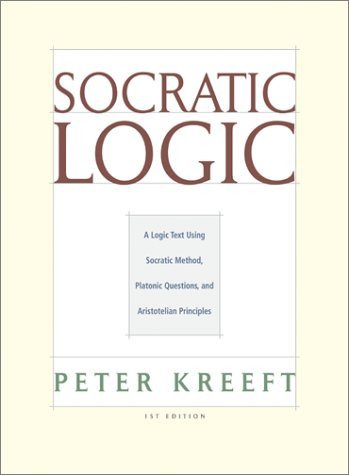
Socratic Logic: A Logic Text Using Socratic Method, Platonic Questions, and Aristotelian Principles
by Peter Kreeft
Rating: 4.3 ⭐
There are hundreds of logic tests in print, but none like this one. (1) This is the only complete system of classical Aristotelian logic in print. The "old logic" is still the natural logic of the four language arts (reading, writing, speaking, and listening). Symbolic, or "mathematical," logic may be superior to classical "ordinary-language" Aristotelian logic for the sciences, but not for the humanities, and is more sophisticated theoretically but not more useful practically. (How often have you heard non-philosophers argue in symbolic logic?) (2) This book is simple and user-friendly. It is highly interactive, with a plethora of exercises and a light, engaging style. Most beginners need a "back to basics" logic text rather than the latest overpriced one with state-of-the-art "bells and whistles" that they will never use outside class. (3) It is practical. It is designed for do-it-yourselfers as well as classrooms. It emphasizes topics in proportion to probable student e.g., interpreting ordinary language, not only analyzing but also constructing effective arguments, smoking out hidden assumptions, making "argument maps," and using Socratic method in various circumstances. It is divided into eighty-eight mini-chapters for maximum mix-and-match flexibility. (4) It is also philosophical. Its exercises expose students to many classical quotations, and additional chapters introduce philosophical issues in a Socratic manner and from a common-sense, realistic point of view. It prepares students for reading Great Books rather than Dick and Jane, and models Socrates as the beginner's ideal teacher and philosopher.

A Shorter Summa: The Essential Philosophical Passages of Saint Thomas Aquinas' Summa Theologica
by Peter Kreeft
Rating: 4.0 ⭐
A shortened version of Kreeft's much larger Summa of the Summa, which in turn was a shortened version of the Summa Theologica. The reason for the double shortening is pretty obvious: the original runs some 4000 pages! (The Summa of the Summa was just over 500.) The Summa is certainly the greatest, most ambitious, most rational book of theology ever written. In it, there is also much philosophy, which is selected, excerpted, arranged, introduced, and explained in footnotes here by Kreeft, a popular Thomist teacher and writer. St. Thomas Aquinas is universally recognized as one of the greatest philosophers who ever lived. His writings combine the two fundamental ideals of philosophical writing: clarity and profundity. He is a master of metaphysics and technical terminology, yet so full of both theoretical and practical wisdom. He is the master of common sense. The Summa Theologica is timeless, but particularly important today because of his synthesis of faith and reason, revelation and philosophy, and the Biblical and the classical Greco-Roman heritages. This little book is designed for beginners, either for classroom use or individually. It contains the most famous and influential passages of St. Thomas' philosophy with copious aids to understanding them.

"An enthusiastic admirer of the philosophy of Thomas Aquinas, professor and philosopher Peter Kreeft details the rational thought and precise literary talent that established Aquinas as the foremost thinker of his time—and as the most important philosopher for the almost two thousand years between Aristotle and Descartes. A landmark of philosophical achievement, Aquinas’s Summa Theologica has given theologians and philosophers much to discuss since the thirteenth century. Peter Kreeft explains why." (The Modern Scholar)

No issue is more fateful for civilization than moral relativism. History knows not one example of a successful society which repudiated moral absolutes. Yet most attacks on relativism have been either pragmatic (looking at its social consequences) or exhorting (preaching rather than proving), and philosophers' arguments against it have been specialized, technical, and scholarly. In his typical unique writing style, Peter Kreeft lets an attractive, honest, and funny relativist interview a "Muslim fundamentalist" absolutist so as not to stack the dice personally for absolutism. In an engaging series of personal interviews, every conceivable argument the "sassy Black feminist" reporter Libby gives against absolutism is simply and clearly refuted, and none of the many arguments for moral absolutism is refuted.

You Can Understand The Bible: A Practical And Illuminating Guide To Each Book In The Bible
by Peter Kreeft
Rating: 4.3 ⭐
Many people are often understandably intimidated or overwhelmed by the sheer size and complexity of the Bible. But now popular author and Boston College professor Peter Kreeft has written a clear road map of the Bible, focusing his keen insight and engaging wit on the core message of each book. It won't take long for you to understand why his guide to scripture has become a best-seller! Sparkling with intelligence and Kreeft's trademark humor, You Can Understand the Bible will transform dry study into spiritually satisfying adventures in God's Word. Regardless of how you approached- or didn't approach- the Bible before, you'll come away with a new appreciation of its depth and meaning. Kreeft also provides practical guidance for praying the scriptures every day, allowing the reader to delve into the messages of scripture in a manner that will surprise, delight, and reward.

Everything You Ever Wanted to Know About Heaven: But Never Dreamed of Asking
by Peter Kreeft
Rating: 4.0 ⭐
Answers common questions about the nature of heaven, examines the existence of hell, and discusses how to experience the joy of heaven on Earth

Open this book and begin an epic human journey--the journey toward truth. Enjoy a delightful and imaginative allegory of timeless wisdom as you travel along the road of true knowledge. Socrates, the thoroughly reasonable and wise philosopher of Athens, will accompany you much of the way. With sharp questions and canny wit he will coach you past the winsome, the wily and the half-wise spin-doctors of error posted along the ancient byways. Every tempting path will be exposed as a road best not taken. The Journey is an animated and topographical roadmap for modern pilgrims walking the ancient paths in search of reality. Crucial questions present decisive turns in the These and other essential questions provide guidance that delightfully entertains while directing your mind and spirit on the journey toward the freedom of truth.

Philosophy 101 by Socrates: An Introduction to Philosophy via Plato's Apology
by Peter Kreeft
Rating: 4.2 ⭐
After teaching philosophy for forty years, Peter Kreeft finds reading the Apology of Socrates to be the most effective way to help beginners "fall in love" with wisdom. In this volume, Kreeft uses three Socratic dialogues to introduce students to philosophy, especially Plato's Apology, which Kreeft calls the "Magna Carta of philosophy."

This is the first of a four-volume history of philosophy . . . on ancient, medieval, modern, and contemporary philosophy. After the fourth volume is produced in paper, a one-volume clothbound edition, containing all four paperbound editions, will be published. Kreeft focuses on the “big ideas” that have influenced present people and present times, and includes relevant biographical data, proportionate to its importance for each thinker. Moreover, the aim of the work is to stimulate philosophizing, controversy, and argument. It uses ordinary language and logic, not jargon and symbolic logic, and it is commonsensical (like Aristotle) and existential in the sense that it sees philosophy as something to be lived and experienced in life. Philosophy, after all, is not about philosophy but reality . . . about wisdom, life and death, good and evil, and God. Kreeft seeks to be simple and direct and clear. But it is not dumbed down and patronizing. It will stretch the reader, but it is meant for beginners, not just scholars. It can be used for college classes or do-it-yourselfers. It emphasizes surprises; remember, “philosophy begins in wonder.” And it includes visual charts, cartoons, line drawings, and drawings of each philosopher.

Kreeft considers all the fundamental elements of Christianity and Catholicism, explaining, defending and showing their relevance to our life and the world's yearnings. Here is a book to help you understand your faith more fully and to explain it to others more winningly. Like every religion, this faith has three aspects, corresponding to the three parts of the soul and filling the innate needs of all three parts. Kreeft uses these three divisions as the basic outline for his Christian apologetics. First, every religion has some beliefs , whether expressed in creeds or not, something for the intellect to know. Second, every religion has some duty or deed, some practice of program, some moral or ethical code, something for the will to choose. Finally, every religion has some liturgy , some worship, some church, something for the body and the concrete imagination and the aesthetic sense to work at. Creed, Code and Cult; Words, Works and Worship, are a most useful way of outlining any religious faith, including the Catholic Faith of Christians. "These essays were written for Catholics by a Catholic. But I believe that nearly everything I say here will be found by the orthodox Biblical Protestant reader to be his faith as That solid and substantial core that C.S. Lewis called "mere Christianity"�Peter Kreeft

Looking at Jesus as a complete human being and philosopher, explores the most radical revolution in the history of philosophy--the differences Jesus made to metaphysics, epistemology, anthropology, and philosophical ethics and politics.

How to Win the Culture War: A Christian Battle Plan for a Society in Crisis
by Peter Kreeft
Rating: 4.0 ⭐
THE BATTLE LINES HAVE BEEN DRAWN ... Many Christians have fallen into the trap of proclaiming Peace! Peace! when there is no peace. Hiding their eyes from the pressing issues of the day, they believe that resistance to the prevailing culture is useless. At the same time, other Christians have been too quick to declare war, mistaking battlefield casualties as enemies rather than victims. In How to Win the Culture War Peter Kreeft issues a rousing call to arms. Christians must understand the true nature of the culture war - a war between the culture of life and the culture of death. Kreeft identifies the real enemies facing the church today and maps out key battlefields. He then issues a strategy for engagement and equips Christians with the weapons needed for a successful campaign. Above all, Kreeft assures us that the war can be won - in fact, it will be won. For those who hope in Christ, victory is assured, because good triumphs over evil and life conquers death. Love never gives up. Neither must we. Peter Kreeft is professor of philosophy at Boston College and the author of many books, including Between Heaven and Hell, Socrates Meets Jesus and (with Ronald Tacelli) Handbook of Christian Apologetics (all IVP).

"Life, in the end, has only one not to have been a saint."– Léon BloyThe ever-popular and prolific Peter Kreeft says that the most important question he has written about is how one becomes holy; or to put it another way, how one becomes a saint. This question is central to all the great religions, Kreeft demonstrates, for striving toward holiness, moving toward perfect love, is the whole purpose of life.Kreeft admits that he is only a beginner on the climb to holiness, and it is to novices like him that he has written this engaging and encouraging book. Using the insights and experiences of saints and great spiritual writers throughout history, Kreeft shows what holiness is and how it can be achieved. He especially draws upon the spiritual classic Abandonment to Divine Providence by Jean-Pierre de Caussade, S.J. The core of Caussade's timeless gem is that God reveals himself to all of us through the daily events of our lives. The surest way toward spiritual growth, therefore, is by perceiving and accepting the merciful will of God in every situation.Kreeft stresses the simplicity of his approach to holiness, which focuses mainly on the virtue of love. Sanctity is love, he asserts, and only that can give us what we all long for—deep and lasting joy.

Symbol or Substance?: A Dialogue on the Eucharist with C. S. Lewis, Billy Graham and J. R. R. Tolkien
by Peter Kreeft
Rating: 4.3 ⭐
In this engaging fictional conversation, Peter Kreeft gives credible voices to C. S. Lewis, J. R. R. Tolkien, and Billy Graham as they discuss one of the most contentious questions in the history of Christianity: Is Jesus symbolically or substantially present in the Eucharist?These widely respected modern Christian witnesses represent three important Western theological traditions. Graham, an ordained Southern Baptist minister who traversed the world and the airwaves to spread the good news of salvation, represents evangelical Protestantism. Lewis, an Oxford professor, a prolific Christian apologist, and the author of The Chronicles of Narnia, was a member of the Church of England. Also an Oxford don, Tolkien was a friend of Lewis, the author of The Lord of the Rings, and a Roman Catholic.While Lewis and Tolkien likely discussed the Eucharist during their long friendship, the conversation in this book never took place—but it could have, says Kreeft, who faithfully presents the views of these three impressive men.