
Peter F. Drucker
Peter Ferdinand Drucker was a writer, management consultant and university professor. His writing focused on management-related literature. Peter Drucker made famous the term knowledge worker and is thought to have unknowingly ushered in the knowledge economy, which effectively challenges Karl Marx's world-view of the political economy. George Orwell credits Peter Drucker as one of the only writers to predict the German-Soviet Pact of 1939. The son of a high level civil servant in the Habsburg empire, Drucker was born in the chocolate capital of Austria, in a small village named Kaasgraben (now a suburb of Vienna, part of the 19th district, Döbling). Following the defeat of Austria-Hungary in World War I, there were few opportunities for employment in Vienna so after finishing school he went to Germany, first working in banking and then in journalism. While in Germany, he earned a doctorate in International Law. The rise of Nazism forced him to leave Germany in 1933. After spending four years in London, in 1937 he moved permanently to the United States, where he became a university professor as well as a freelance writer and business guru. In 1943 he became a naturalized citizen of the United States. He taught at New York University as a Professor of Management from 1950 to 1971. From 1971 to his death he was the Clarke Professor of Social Science and Management at Claremont Graduate University.
31 Books Written

The Effective Executive: The Definitive Guide to Getting the Right Things Done
by Peter F. Drucker
Rating: 4.1 ⭐
• 12 recommendations ❤️
What makes an effective executive? The measure of the executive, Peter F. Drucker reminds us, is the ability to "get the right things done." This usually involves doing what other people have overlooked as well as avoiding what is unproductive. Intelligence, imagination, and knowledge may all be wasted in an executive job without the acquired habits of mind that mold them into results. Drucker identifies five practices essential to business effectiveness that can, and must, be learned: Ranging widely through the annals of business and government, Peter F. Drucker demonstrates the distinctive skill of the executive and offers fresh insights into old and seemingly obvious business situations.

Peter Drucker's classic book on This is the first book to present innovation and entrepreneurship as a purposeful and systematic discipline that explains and analyzes the challenges and opportunities of America's new entrepreneurial economy. Superbly practical, Innovation and Entrepreneurship explains what established businesses, public service institutions, and new ventures need to know and do to succeed in today's economy.

Managing Oneself Managing Oneself

Father of modern management, social commentator, and preeminent business philosopher, Peter F. Drucker has been analyzing economics and society for more than sixty years. Now for readers everywhere who are concerned with the ways that management practices and principles affect the performance of the organization, the individual, and society, there is The Essential Drucker -- an invaluable compilation of management essentials from the works of a management legend.Containing twenty-six selections, The Essential Drucker covers the basic principles and concerns of management and its problems, challenges, and opportunities, giving managers, executives, and professionals the tools to perform the tasks that the economy and society of tomorrow will demand of them.

A classic since its publication in 1954, The Practice of Management was the first book to look at management as a whole and being a manager as a separate responsibility. The Practice of Management created the discipline of modern management practices. Readable, fundamental, and basic, it remains an essential book for students, aspiring managers, and seasoned professionals.

Management is an organized body of knowledge. "This book," in Peter Drucker'swords, "tries to equip the manager with the understanding, the thinking, the knowledge and the skills for today'sand also tomorrow's jobs." This management classic has been developed and tested during more than thirty years of teaching management in universities, in executive programs and seminars and through the author's close work with managers as a consultant for large and small businesses, government agencies, hospitals and schools. Drucker discusses the tools and techniques of successful management practice that have been proven effective, and he makes them meaningful and easily accessible.

The Five Most Important Questions You Will Ever Ask About Your Organization
by Peter F. Drucker
Rating: 3.9 ⭐
With Peter Drucker's five essential questions and the help of five of today's thought leaders, this little book will challenge readers to take a close look at the very heart of their organizations and what drives them. A tool for self-assessment and transformation, answering these five questions will fundamentally change the way you work, helping you lead your organization to an exceptional level of performance. Peter Drucker's five questions are: These essential questions, grounded in Peter Drucker's theories of management, will take readers on a exploration of organizational and personal self-discovery, giving them a means to assess how to be --how to develop quality, character, mind-set, values and courage. The questions lead to action. By asking these questions, readers can focus on why they are doing what they are doing in their work, and how to do it better. Designed for today's busy professionals, this brief, clear and accessible book will challenge readers to ask these provocative questions and it will stimulate spirited discussions and action within any organization, inspiring positive change and new levels of excellence, helping all to envision the future of theirs' or any organization.
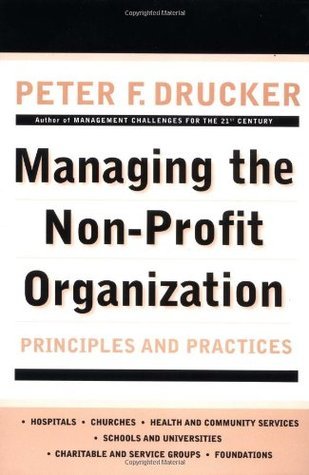
The service, or non-profit, sector of our society is growing rapidly (with more than 8 million employees and more than 80 million volunteers), creating a major need for guidelines and expert advice on how to manage these organizations effectively. Drucker gives examples and explanations of mission, leadership, resources, marketing, goals, people development, decision making, and much more. Included are interviews with nine experts that address key issues in the non-profit sector.

The Daily Drucker: 366 Days of Insight and Motivation for Getting the Right Things Done
by Peter F. Drucker
Rating: 4.1 ⭐
Revered management thinker Peter F. Drucker is our trusted guide in this thoughtful, day-by-day companion that offers his penetrating and practical wisdom. Amid the multiple pressures of our daily work lives, The Daily Drucker provides the inspiration and advice to meet the many challenges we face. With his trademark clarity, vision, and humanity, Drucker sets out his ideas on a broad swath of key topics, from time management, to innovation, to outsourcing, providing useful insights for each day of the year. These 366 daily readings have been harvested from Drucker's lifetime of work. At the bottom of each page, the reader will find an action point that spells out exactly how to put Drucker's ideas into practice. It is as if the wisest and most action-oriented management consultant in the world is in the room, offering his timeless gems of advice. The Daily Drucker is for anyone who seeks to understand and put to use Drucker's powerful words and ideas.

Peter F. Drucker discusses how the new paradigms of management have changed and will continue to change our basic assumptions about the practices and principles of management. Forward-looking and forward-thinking, Management Challenges for the 21st Century combines the broad knowledge, wide practical experience, profound insight, sharp analysis, and enlightened common sense that are the essence of Drucker's writings and "landmarks of the managerial profession." -- Harvard Business Review

The effective business, Peter Drucker observes, focuses on opportunities rather than problems. How this focus is achieved in order to make the organization prosper and grow is the subject of this companion to his classic, The Practice of Management . The earlier book was chiefly concerned with how management functions; this volume shows what the executive decision-maker must do to move his enterprise forward. One of the notable accomplishments of this book is its combining specific economic analysis with a grasp of the entrepreneurial force in business prosperity. For though it discusses "what to do" more than Drucker's previous works, the book stresses the qualitative aspect of every successful business requires a goal and spirit all its own. Peter Drucker again employs his particular genius for breaking through conventional outlooks and opening up new perspectives--for profits and growth.
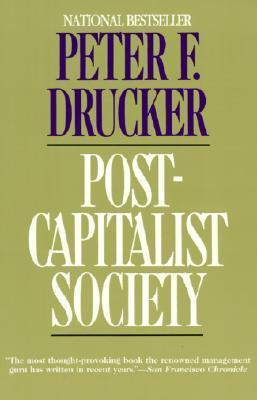
Business guru Peter Drucker provides an incisive analysis of the major world transformation taking place, from the Age of Capitalism to the Knowledge Society, and examines the radical affects it will have on society, politics, and business now and in the coming years. This searching and incisive analysis of the major world transformation now taking place shows how it will affect society,economics, business, and politics and explains how we are movingfrom a society based on capital, land, and labor to a society whoseprimary source is knowIedge and whose key structure is theorganization.

Classic Drucker: Wisdom from Peter Drucker from the Pages of Harvard Business Review
by Peter F. Drucker
Rating: 4.2 ⭐
For nearly half a century, Peter Drucker inspired and educated managers—and powerfully shaped the nature of business—with his landmark articles in Harvard Business Review . Here, framed by a thoughtful introduction from "HBR" editor Thomas A. Stewart, is a priceless collection of Drucker's most significant work. Through his unique lens, Drucker traces the evolution of the great shifts in organizations and the role of managers in the ongoing effort to balance change with continuity. He paints a clear, comprehensive picture of management thinking and practice—as it was and as it will be. Revealing a celebrated thinker at his best, Classic Drucker offers a wealth of insights and practical guidelines for managers seeking to address today's thorniest organizational challenges.For example, you'll find selections on how to enhance your company's innovative prowess, make effective decisions, raise knowledge workers' productivity, remain engaged and productive during a long work life, know when the assumptions on which your business was founded must change, and get the data you need to execute your company's competitive strategy. Doing what's right for your company will always be challenging. But thanks to the clear focus, broad vision, and practical wisdom of Peter Drucker, the task is now a little less daunting.

In his sixty-five-year consulting career, Peter F. Drucker, widely regarded as the father of modern management, identified eight practices that can make any executive effective. Leadership is not about charisma or extroversion. It’s about these Effective executives ask, “What needs to be done?” They also ask, “What is right for the enterprise?” They develop action plans. They take responsibility for decisions. They take responsibility for communicating. They focus on opportunities rather than problems. They run productive meetings. And they think and say “we” rather than “I.” Since 1922, Harvard Business Review has been a leading source of breakthrough ideas in management practice. The Harvard Business Review Classics series now offers you the opportunity to make these seminal pieces a part of your permanent management library. Each highly readable volume contains a groundbreaking idea that continues to shape best practices and inspire countless managers around the world.
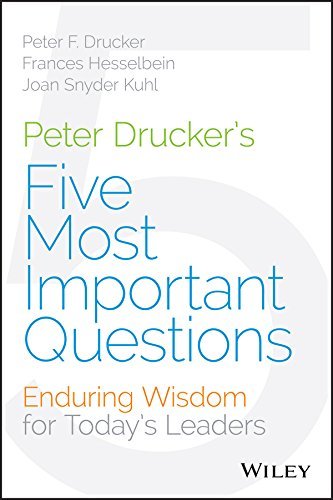
Peter Drucker's Five Most Important Questions: Enduring Wisdom for Today's Leaders
by Peter F. Drucker
Rating: 3.9 ⭐
Enduring Management Wisdom for Today's Leaders From Peter F. Drucker. Peter Drucker's Five Most Important Questions provides insightful guidance and stirring inspiration for today's leaders and entrepreneurs. By applying Drucker's leadership framework in the present context of today's leaders and those who lead with them, this book is an essential resource for people leading, managing and working in all three sectors—public, private and social. Readers will gain new perspectives and develop a solid foundation upon which to build a successful and bright future. They will learn how to focus on why they are doing what they're doing, how to do it better, and how to develop a realistic, motivational plan for achieving their goals. This brief, clear, and accessible guide — peppered with commentary from distinguished management gurus, contemporary entrepreneurs and dynamic millennial leaders —will challenge readers and stimulate spirited discussion and action within any organization, inspiring positive change and new levels of excellence. In addition to contributions from Jim Collins, Marshall Goldsmith, and Judith Rodin, the book features new insights from some of today's most influential leaders in business (GE and Salesforce.com), academia (Harvard Business School and Northwestern University), social enterprise (Levo League, Pencils of Promise and Why Millennials Matter) and the military (United States Military Academy), who have been directly influenced by Drucker's theory of management.
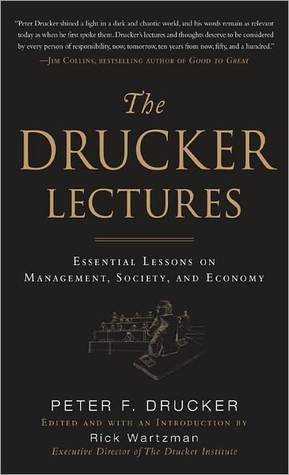
The Drucker Lectures: Essential Lessons on Management, Society and Economy
by Peter F. Drucker
Rating: 4.1 ⭐
Previously unpublished talks from the Father of Modern ManagementThroughout his professional life, Peter F. Drucker inspired millions of business leaders not only through his famous writings but also through his lectures and keynotes. These speeches contained some of his most valuable insights, but had never been published in book form—until now.The Drucker Lectures features more than 30 talks from one of management's most important figures. Drawn from the Drucker Archives at the Drucker Institute at Claremont Graduate University, the lectures showcase Drucker's wisdom, wit, profundity, and prescience on such topics Politics and economics of the environmentKnowledge workers and the Knowledge SocietyComputer and information literacyManaging nonprofit organizationsGlobalizationDuring his life, Drucker well understood that over the last 150 years the world had become a society of large institutions—and that they would only become larger and more powerful. He contended that unless these institutions were effectively managed and ethically led, the good health of society as a whole would be in peril. His prediction is unfolding before our eyes.The Drucker Lectures is a timely, instructive book proving that responsible behavior and good business can, in fact, exist hand in hand.

For nearly half a century, Peter Drucker has inspired and educated managers--and influenced the nature of business with his landmark articles in the Harvard Business Review . Here, gathered together and framed by a thoughtful introduction from the Review's editor Nan Stone, is a priceless collection of his most significant work. One of our leading thinkers on the practice and study of management, Drucker has sought out, identified, and examined the most important issues confronting managers, from corporate strategy to management style to social change. Through his unique lens, this volume gives us the rare opportunity to trace the evolution of the great shifts in our workplaces, and to understand more clearly the role of managers. Infused with a perspective that holds new relevance today, these essays represent Drucker at his direct, wise, and challenging. Peter Drucker on the Profession of Management , sure to be enjoyed, studied, and debated by everyone concerned with management, is a timely offering from one of the most respected and prolific authors to appear in the Harvard Business Review .
The nation's top management guru offers advice to executives for thriving in the global business environment of the future, covering such topics as team building, cutting costs in retail, changes in the U.S. economy, and doing business in Japan.
Managing in the Next Society: Lessons from the Renown Thinker and Writer on Corporate Management
by Peter F. Drucker
Rating: 3.9 ⭐
Following in the successful vein of Managing for the Future (1992) and Managing in a Time of Great Change (1995), the incomparable Peter Drucker is back with fresh thoughts, insights, and knowledge about the ever-changing business society around us and the ever-expanding management roles required of us all-chiefs, executives, managers, and knowledge workers alike.Two main themes are explored in many of the chapters in Managing in the Next Society : the rapidly expanding information shock wave that had its Internet Big Bang as recently as 1995; and the changing shape of our society to come-six major trends that are rapidly transforming our world into what Peter Drucker calls The Next Society.

The companion to Drucker's seminal work Management, completely revised and updatedManagement Cases, Revised Edition is a collection of thought-provoking case studies—each a timeless representative of a challenge that all managers will face at some point in their careers. Longtime Drucker colleague, collaborator, and eminent management professor Joseph A. Maciariello has organized the material to be used in conjunction with Management, Revised Edition, making the book particularly useful in undergraduate, MBA, and executive education classrooms.It contains fifteen completely new cases written especially for this edition plus another thirty-five revised and updated cases, ensuring that the book provides comprehensive coverage of the most important management dilemmas and most timeless leadership wisdom. An essential resource for business students and working professionals alike, the book will help readers test and hone their management skills.

The Effective Executive in Action: A Journal for Getting the Right Things Done
by Peter F. Drucker
Rating: 4.3 ⭐
The Effective Executive in Action is a journal based on Peter F. Drucker's classic and preeminent work on management and effectiveness -- The Effective Executive . Here Drucker and Maciariello provide executives, managers, and knowledge workers with a guide to effective action -- the central theme of Drucker's work. The authors take more than one hundred readings from Drucker's classic work, update them, and provide provocative questions to ponder and actions to take in order to improve your own work. Also included in this journal is a space for you to record your thoughts for later review and reflection. The Effective Executive in Action will teach you how to be a better leader and how to lead according to the five main pillars of Drucker's leadership philosophy.

A guide to management in an era of high interest rates discusses the full spectrum of today's concerns with an eye to the future
This book, the author explains, "is concerned with action rather than understanding, with decisions rather than analysis." It deals with the strategies needed to transform rapid changes into opportunities, to turn the threat of change into productive and profitable action that contributes positively to our society, the economy, and the individual.

Even in the flattest landscape there are passes where the road first climbs to a peak and then descends into a new valley. Most of these passes are simply topography with little or no difference in climate, language, or culture between the valleys on either side. But some passes are they are true divides. History too knows such divides. Once these divides have been crossed, the social and political landscape changes; the social and political climate is different, and so is the social and political language. Some time between 1965 and 1973 we passed over such a divide and entered "the next century." Challenging, insightful, and provocative, Peter Drucker's The New Realities anticipates the central issues of a rapidly changing world. When it was initially published, in 1989, some reviewers mistakenly thought The New Realities was a book about the future, or in other words, a series of predictions. But, as indicated in the title, the book discusses realities . Drucker argues that events of the next thirty to forty years, or even further on, had already largely been defined by events of the previous half-century. Thus, Drucker discusses episodes in world history that had not yet happened at the time of the book's initial publication, such the archaism of the hope for "salvation by society" in "The End of FDR's America"; the democratization of the Soviet Union in "When the Russian Empire is Gone"; the technology boom of the 1990s in "The Information-Based Organization"; and the evolution of management in "Management as Social Function and Liberal Art." Graced with a new preface by the author that discusses both reactions to the original publication of the book and how important it is for decision-makers to consider the past and present when planning for the future, The New Realities is mandatory reading for understanding politics, government, the economy, information technology, and business in an ever-changing world.

Concept of the Corporation was the first study ever of the constitution, structure, and internal dynamics of a major business enterprise. Basing his work on a two-year analysis of the company done during the closing years of World War II, Drucker looks at the General Motors managerial organization from within. He tries to understand what makes the company work so effectively, what its core principles are, and how they contribute to its successes. The themes this volume addresses go far beyond the business corporation, into a consideration of the dynamics of the so-called corporate state itself. When the book initially appeared, General Motors managers rejected it as unfairly critical and antibusiness. Yet, the GM concept of the corporation and its principles of organization later became models for organizations worldwide. Not only businesses, but also government agencies, research laboratories, hospitals, and universities have found in Concept of the Corporation a basis for effective organization and management. Because it offers a fundamental theory of corporate goals, this book is a valuable resource for business professionals and organization analysts. It will also be of interest to students and professionals in economics, public administration, and political science. Professional and technical readers who admire Peter Drucker's work will want to be certain this volume is in their personal library. At a time when everything from the size to the structure of corporations is being questioned, this classic should prove a valuable guide.

What is management? What is the relationship between management and the society and culture it seeks to direct? How is a business organised, and how can managers use people's strengths more effectively? These and many more questions are discussed in Peter Drucker's classic survey of management thought and practice. Spanning all the main dimensions of management, Drucker used his direct experience as an adviser to businesses, government departments, public institutions, and as a widely sought lecturer to examine evergreen topics in business thinking. People and Performance is the ideal volume for those who want to experience the essence of Drucker's early thinking in a series of short and cogent essays.

In The End of Economic Man, long recognized as a cornerstone work, Peter F. Drucker explains and interprets fascism and Nazism as fundamental revolutions. In some ways, this book anticipated by more than a decade the existentialism that came to dominate the European political mood in the postwar period. Drucker provides a special addition to the massive literature on existentialism and alienation since World War II. The End of Economic Man is a social and political effort to explain the subjective consequences of the social upheavals caused by warfare. Drucker concentrates on one specific historical event: the breakdown of the social and political structure of Europe which culminated in the rise of Nazi totalitarianism to mastery over Europe. He explains the tragedy of Europe as the loss of political faith, resulting from the political alienation of the European masses. The End of Economic Man is a book of great social import. It shows not only what might have helped the older generation avert the catastrophe of Nazism, but also how today's generation can prevent another such catastrophe. This work will be of special interest to political scientists, intellectual historians, and sociologists. The book was singled out for praise on both sides of the Atlantic, and is considered by the author to be his most prescient effort in social theory.

Peter F. Drucker argues that what underlies the current malaise of so many large and successful organizations worldwide is that their theory of the business no longer works. The story is a familiar one: a company that was a superstar only yesterday finds itself stagnating and frustrated, in trouble and, often, in a seemingly unmanageable crisis. The root cause of nearly every one of these crises is not that things are being done poorly. It is not even that the wrong things are being done. Indeed, in most cases, the right things are being done―but fruitlessly. What accounts for this apparent paradox? The assumptions on which the organization has been built and is being run no longer fit reality. These are the assumptions that shape any organization's behavior, dictate its decisions about what to do and what not to do, and define what an organization considers meaningful results. These assumptions are what Drucker calls a company's theory of the business.The Harvard Business Review Classics series offers you the opportunity to make seminal Harvard Business Review articles a part of your permanent management library. Each highly readable volume contains a groundbreaking idea that continues to shape best practices and inspire countless managers around the world―and will have a direct impact on you today and for years to come.

The Executive in Action : Managing for Results / Innovation and Entrepreneurship / The Effective Executive
by Peter F. Drucker
Rating: 4.2 ⭐
Three complete Drucker management books in one volume � Managing for Results, Innovation and Entrepreneurship, and The Effective Executive with a new preface by the author.In his preface, Peter F. Drucker says: "These three books should enable executives � whether high up in the organization or just beginning their career � to know the right things to do; � to know how to do them; and � to do them effectively.Together, these three books provide The Toolkit for Executive Action." Drucker identifies and explains the practices, decisions and priorities for achieving business performance and executive effectiveness. These books cover "the three dimensions of the successful practice of management." Managing for Results was the first book to explain business strategy. Drucker shows how the existing business has to focus on opportunities rather than problems to be effective, for it is the opportunities that will bring growth and performance. Innovation and Entrepreneurship analyzes the challenges and opportunities of America's new entrepreneurial economy. It is a superbly practical book that explains what established businesses, public service institutions and new ventures have to know, learn and do to prepare and create the successful businesses of tomorrow. In The Effective Executive, Drucker discusses the five practices and habits that must be learned for executive effectiveness. Ranging widely through business and government, he demonstrates the distinctive skill of the executive and offers fresh insights into old and seemingly obvious situations. Together, these three books have sold more than a million copies; they have been published throughout the world and continue to sell actively. These are essential works for the executive and manager by "the dean of this country's business and management philosophers." �Wall Street Journal

The closing decades of the twentieth century have been characterized as a period of disruption and discontinuity in which the structure and meaning of economy, polity, and society have been radically altered. In this volume Peter Drucker focuses with great clarity and perception on the forces of change that are transforming the economic landscape and creating tomorrow's society. Drucker discerns four major areas of discontinuity underlying contemporary social and cultural reality. These (1) the explosion of new technologies resulting in major new industries; (2) the change from an international to a world economy―an economy that presently lacks policy, theory, and institutions; (3) a new sociopolitical reality of pluralistic institutions that poses drastic political, philosophical, and spritual challenges; and (4) the new universe of knowledge based on mass education and its implications in work, leisure, and leadership. Peter Drucker brings to this work an intimate knowledge and objective view of the particular and general. The Age of Discontinuity is a fascinating and important blueprint for shaping a future already very much with us.

Knowledge management - the way companies generate, communicate, and leverage their intellectual assets - has only recently emerged as the information economy's essential source of competitive advantage. Harvard Business Review was among the first to identify the importance of knowledge management, and now the cutting-edge thinking and practical applications that are defining the field are conveniently close at hand in this timely and authoritative collection.