
Paul Bowles
Paul Frederic Bowles grew up in New York, and attended college at the University of Virginia before traveling to Paris, where became a part of Gertrude Stein's literary and artistic circle. Following her advice, he took his first trip to Tangiers in 1931 with his friend, composer Aaron Copeland. In 1938 he married author and playwright Jane Auer (see: Jane Bowles). He moved to Tangiers permanently in 1947, with Auer following him there in 1948. There they became fixtures of the American and European expatriate scene, their visitors including Truman Capote, Tennessee Williams and Gore Vidal. Bowles continued to live in Tangiers after the death of his wife in 1973. Bowles died of heart failure in Tangier on November 18, 1999. His ashes were interred near the graves of his parents and grandparents in Lakemont, New York.
30 Books Written

Audio edition of the landmark of 20th Century literature, by acclaimed author Paul Bowles In this classic work of psychological terror, Paul Bowles examines the ways in which Americans apprehend an alien culture -- and the ways in which their incomprehension destroys them. The story of three American travelers adrift in the cities and deserts of North Africa after World War II, The Sheltering Sky is at once merciless and heartbreaking in its compassion. It etches the limits of human reason and intelligence -- perhaps even the limits of human life -- when they touch the unfathomable emptiness and impassive cruelty of the desert.

In Let It Come Down , Paul Bowles plots the doomed trajectory of Nelson Dyar, a New York bank teller who comes to Tangier in search of a different life and ends up giving in to his darkest impulses. Rich in descriptions of the corruption and decadence of the International Zone in the last days before Moroccan independence, Bowles's second novel is an alternately comic and horrific account of a descent into nihilism.

The dilemma of the outsider in an alien society, and the gap in understanding between cultures, are recurrent themes of Paul Bowles’s writings. In this novel, set in Fez, Morocco during that country's 1954 nationalist uprising, they are dramatized with brutal honesty. Relevant to today’s political situation in the Middle East and elsewhere, richly descriptive of its setting, and uncompromising in its characterizations, The Spider’s House is possibly Bowles’s best, most beautifully subtle novel.

“Bowles’s tales are at once austere, witty, violent, and sensuous. They move with the inevitability of myth. His language has a purity of line, a poise and authority entirley its own.” —Tobias Wolff An American cult figure, Paul Bowles has fascinated such disparate talents as Norman Mailer, Allen Ginsberg, Truman Capote, William S. Burroughs, Gore Vidal, and Tobias Wolff. From “The Delicate Prey” to “Too Far from Home,” this definitive collection celebrates the Bowles’s masterful artistry in short fiction.

On the terrace of an elaborate hilltop apartment overlooking a Central American capital, four people sit making polite conversation. The American couple—an elderly physician and his young wife—are tourists. Their host, whom they have just met, is a young man of striking good looks and charm. The girl, his mistress, is very young and very beautiful. Sitting there, watching the sunset, the Slades seem to be enjoying the sort of fortunate chance encounter that travelers cherish. But amid the civilities and small talk, the host's casual remark to the American woman proves prophetic: "It's not exactly what you think."Masterfully—with the poetic control that has always characterized his work—Paul Bowles leads the reader beneath the surface of hospitality and luxury into a tortuous maze of human relationships and shifting moods, until what seems at first a merely casual encounter is seen to be one rooted in viciousness and horror.
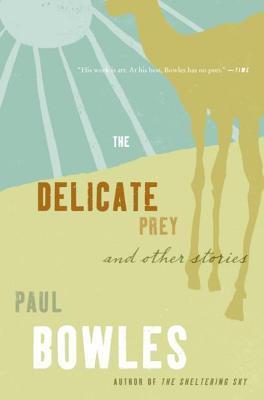
Paul Bowles once said that a story should remain taut throughout, like a piece of string. That tense, stretched tone is the key to this collection of 17 eerie tales by the author best known for The Sheltering Sky. The Delicate Prey is dedicated: "For my mother, who first read me the stories of Poe." If Poe had lived in Mexico, and he'd had ice water running in his veins to counteract his feverish romanticism, he might have crafted something like these odd vignettes about human frailty and cruelty. The setting is a world where palm trees are like "shiny green spiders," where bats reel silently overhead in a jet-black sky, where a hot, relentless wind blows across deserted plazas. As Tobias Wolff writes in Esquire, "The Delicate Prey is in fact one of the most profound, beautifully wrought, and haunting collections in our literature.... Bowles's tales are at once austere, witty, violent, and sensuous. They move with the inevitability of myth. His language has a purity of line, a poise and authority entirely its own, capable of instantly modulating from farce to horror without a ruffle."

In these hauntingly beautiful stories of abandonment and vengeance, extreme situations lead to disturbing conclusions. A missionary is sent to a place so distant he finds his God has no power there; a husband abandons his wife as they honeymoon in the South American jungle; a splash of water triggers an explosion of violence; and a boy's drug-induced transformation leads to cruelty enjoyed and suffered. Masterfully written, these are chilling tales from sun-drenched and brutal climes.

Their Heads are Green and Their Hands are Blue: Scenes from the Non-Christian World
by Paul Bowles
Rating: 4.0 ⭐
An engaging collection of travel essays by the author of The Sheltering Sky Their Heads are Green, Their Hands are Blue deals largely with places in the world that few Westerners have ever heard of, much less seen―places as yet unencumbered by the trappings, luxuries, and corruptions of modern civilization. Bowles is a sympathetic and discerning observer of these alien cultures, and his eyes and ears are especially alert both to what is bizarre and what is wise in the civilizations in which he settles. Above all, Bowles is a superb and observant traveler―a born wanderer who finds pleasure in the inaccessible and who cheerfully endures the concomitant hardships with resourcefulness, insight, and humor.

A Distant Episode contains the best of Paul Bowles's short stories, as selected by the author. An American cult figure, Bowles has fascinated such disparate talents as Norman Mailer, Allen Ginsberg, Truman Capote, William S. Burroughs, Gore Vidal, and Jay McInerney.

These are four tales of contemporary life in a land where cannabis, rather than alcohol, customarily provides a way out of the phenomenological world. Thus, of the men in these stories, Salam uses suggestions supplied by smoking kif to rid himself of a possible enemy. He of the Assembly catches himself up in the mesh of his own kif-dream and begins to act it out in reality; Idir's victory over Lahcen is the classical story of the kif-smoker's ability to outwit the drinker. Driss the soldier, with aid of kif, proves the existence of magic to his enlightened superior officer. For all of them the kif-pipe is the means to attaining a state of communication not only with others but above all with themselves."His work is art. At his best Paul Bowles has no peer." —Time"[W]riters and artists such as Williams, Jack Kerouac, Francis Bacon, Christopher Isherwood, Truman Capote, William S. Burroughs and Allen Ginsberg to Tangier. . .sought Bowles as an oracle, a writer whose work demonstrated its author as an original who saw farther, deeper, and clearer, and who refused to flinch."--The AustralianPaul Bowles (1910-1999) was an expatriate composer, author, and translator. His other famous literary works include The Sheltering Sky, Travels: Collected Writings 1950-1993, and Without Stopping

Inmore than forty essays and articles that range from Paris to Ceylon, Thailand to Kenya, and, of course, Morocco, the great twen-tieth-century American writer encapsulates his long and full life, and sheds light on his brilliant fiction. Whether he’s recalling the cold-water artists’ flats of Paris’s Left Bank or the sun-worshipping eccentrics of Tangier, Paul Bowles imbues every piece with a deep intelligence and the acute perspective of his rich experience of the world. Woven throughout are photographs from the renowned author’s private archive, which place him, his wife, the writer Jane Bowles, and their many friends and compatriots in the landscapes his essays bring so vividly to life.With an introduction by Paul Theroux and a chronology by Daniel Halpern

Paul Bowles had already established himself as an important American composer when, at the age of 38, he published The Sheltering Sky and became widely recognized as one of the most powerful writers of the postwar period. By the time of his death in 1999 he had become a unique and legendary figure in modern literary culture. From his base in Tangier he produced novels, stories, and travel writings in which exquisite surfaces and violent undercurrents mingle.This Library of America volume, containing his first three novels, with its companion Collected Stories and Later Writings, is the first annotated edition of Bowles’s work, offering the full range of his literary achievement: the portrait of an outsider who was one of the essential American writers of the last half century.The Sheltering Sky (1949), which remains Bowles’s most celebrated work, describes the unraveling of a young, sophisticated, and adventuresome married couple as they make their way into the Sahara. In a prose style of meticulous calm and stunning visual precision, Bowles tracks Port and Kit Moresby on a journey through the desert that culminates in death and madness.In Let It Come Down (1952), Bowles plots the doomed trajectory of Nelson Dyar, a New York bank teller who comes to Tangier in search of a different life and ends up giving in to his darkest impulses. Rich in descriptions of the corruption and decadence of the International Zone in the last days before Moroccan independence, Bowles’s second novel is an alternately comic and horrific account of a descent into nihilism.The Spider’s House (1955), the longest and most complex of Bowles’s novels, is set against the end of French rule in Morocco. Its characters—ranging from a Moroccan boy gifted with spiritual healing power to an American writer who regrets the passing of traditional ways—are caught up in the clash between colonial and nationalist factions, and are forced to confront cultural gulfs widened by political violence.Bowles—who once told an interviewer, “I’ve always wanted to get as far as possible from the place where I was born”—charts the collisions between “civilized” exiles and unfamiliar societies that they can never really grasp. In fiction of slowly gathering menace, he achieves effects of horror and dislocation with an elegantly spare style and understated wit.

"Na Primavera, regressámos a Fez e ficámos no Belvedere. Eu estava a terminar The Sheltering Sky e a Jane estava imersa na sua novela Camp Cataract. Ao raiar do dia, tomávamos o pequeno-almoço na cama no seu quarto. Depois, eu ia para o meu quarto, deixando a porta aberta para que pudéssemos comunicar, se assim o quiséssemos. Numa dada altura, ela estava em dificuldades com uma ponte que tentava construir sobre um desfiladeiro. «Bupple! O que é um cantilever, ao certo?» ou «Pode-se dizer que as pontes têm contrafortes?» Imerso na escrita dos meus capítulos finais, respondia-lhe o que me ocorresse, sem sair do meu estado voluntário de obsessão. Ela ficava calada durante um bocado, e depois voltava a chamar-me. A torrente do rio, mesmo por baixo das nossas janelas, deixava apenas ouvir os sons mais penetrantes; as comunicações tinham de ser bastante importantes, para que valesse a pena gritar. Após três ou quatro manhãs, apercebi-me de que algo estava errado; ela ainda estava na ponte. Levantei-me e entrei no seu quarto. Falámos sobre o problema durante um bocado, e confessei-me intrigado. «Porque é que tens de construir o diacho da coisa?», perguntei-lhe. «Porque não dizes apenas que estava ali, e pronto?» Ela abanou a cabeça. «Se não souber como foi construída, não consigo vê-la.» Achei isto incrível. Nunca me ocorrera que tais considerações pudessem estar implicadas no acto de escrever. Talvez pela primeira vez vislumbrasse o que a Jane queria dizer quando afirmava, como muitas vezes o fazia, que escrever era «tão difícil»."

Thirteen stories written in the five years between 1976 and 1981, "Midnight Mass" picks up where Bowles' Collected Stories left off, and includes the wonderful novella-length "Here to Learn", concerning a young Moroccan woman 'adopted' by various affluent Europeans.

In this intense and brilliant book Bowles focuses on Morocco, condensing experience, emotion, and the whole history of a people into a series of short, insightful vignettes. He distills for us the very essence of Moroccan culture. With extraordinary immediacy, he takes the reader on a journey through the Moroccan centuries, pausing at points along the way to create resonant images of the country, it's landscapes, and the beliefs and characteristics of its inhabitants.

Between 1987 and 1989, Paul Bowles, at the suggestion of a friend, kept a journal to record the daily events of his life. What emerges is not only just a record of the meals, conversations, and health concerns of the author of The Sheltering Sky but also a fascinating look at an artist at work in a new medium. Characterized by a refreshing informality, clear-sightedness, and passages of exquisite prose, these pages record with equal fascination the behavior of an itinerant spider, a brutal episode of violence in a Tangier marketplace, and the pageantry and excess of Malcolm Forbes's seventieth birthday party. In Days, a master observer of the foreign and obscure turns his attentions toward his own daily existence, giving us a startlingly candid portrait of his life in late twentieth-century Tangier.

For over forty-five years, Paul Bowles has been one of this century's most enigmatic and intriguing writers, best known for his novel The Sheltering Sky. This striking collection highlights Bowles's undeniable virtuosity and brings together for the first time his finest work including a new unpublished novella, Too Far From Home, and previously unpublished letters.

“The Library of America has made it easier for readers to enjoy Bowles’s exotic literary harvest.” — The Columbus DispatchPaul Bowles was a composer, writer, and an American expatriate who spent most of the last five decades of his life in Tangier. According The Boston Globe , he was “one of the literary class acts of the twentieth century.” This Library of America volume, containing his stories and travel writings, is one of two volumes in the first annotated edition of Paul Bowles’s work and is a “treasure trove for readers who haven’t explored beyond The Sheltering Sky ” ( The Seattle Times ).“All the tales are a variety of detective story,” wrote Bowles of his first collection, The Delicate Prey and Other Stories (1950), “in which the reader is the detective; the mystery is the motivation for the characters’ behavior.” In such stories as “A Distant Episode” and “How Many Midnights,” Bowles pushes human character beyond socially defined limits and maps a transformed (often horribly transformed) reality.A master of gothic terror and an acute and at times diabolically funny observer of manners and motives both American and Moroccan, Bowles confirmed his mastery of the short story in such volumes as A Hundred Camels in the Courtyard (1962), The Time of Friendship (1967), Things Gone and Things Still Here (1977), and Midnight Mass (1981), all included here along with a selection of his final stories.This volume also contains Up Above the World (1966), a frightening novella set in Latin America in which a trusting American couple are lured into an annihilating trap, and the informed and fascinating travel book Their Heads Are Green and Their Hands Are Blue (1963).LIBRARY OF AMERICA is an independent nonprofit cultural organization founded in 1979 to preserve our nation’s literary heritage by publishing, and keeping permanently in print, America’s best and most significant writing. The Library of America series includes more than 300 volumes to date, authoritative editions that average 1,000 pages in length, feature cloth covers, sewn bindings, and ribbon markers, and are printed on premium acid-free paper that will last for centuries.

Fiction. In these seven new stories Paul Bowles ranges widely in time, in form, and in geographic area-from Massachusetts to Morocco, from 1932 to the 1970s. Portraits and contemporary scenes mix conventional narration with experimental monologues, and the volume concludes with a tale presented as six letters written to a bitter, dying man. The formal versatility is as arresting as the content. The whole is proof (if it were needed) that, as Gore Vidal remarks, Bowle's art is as disturbing as ever.

The stories are set in North Africa, a sanguine, enigmatic environment where Western influences float like oil on the older deeper waters of more primitive cultures, never truly altering or disrupting them.;


This extraordinary collection of correspondence by Paul Bowles spans eight decades and provides an evolving portrait of an artist renowned for his privacy. From his earliest extant letter, written at the age of four, to his precocious effusions to Aaron Copeland and to Gertrude Stein; from his meditations on mescaline as relayed to Ned Rorem, to his intensely moving letters to Jane Bowles during her illness, In Touch fills in the lacunae left by previous biographers and offers a rare look at the many aspects of Bowles's brilliant career—as composer, novelist, short-story master, travel writer, translator, ethnographer, and literary critic.Here is Bowles on the genesis of his first novel, The Sheltering Sky; on his distaste for Western melodies and his dogged attempts to record indigenous Moroccan music; on the Beats, Gore Vidal, Truman Capote, and Tennessee Williams; on the nature and craft of writing; on Bernardo Bertolucci, David Byrne, and Sting; on the decline of American and the challenges of living in North Africa. Gossipy, reflective, enlightening, and always entertaining, In Touch stands as an epistolary autobiography of one of the legendary writers of our time, and a unique chronicle of the twentieth-century avant-garde.

73pp. Second printing. Very Good w/ minute rubbing on cover, faint tanning on spine. Binding is tight and inside clean.

Una donna abbandonata in una grotta in compagnia dei suoi incubi. Un padre e un figlio lontani alle regole e dalla civiltà. Due uomini nel deserto, vittima e carnefice di un delitto atroce. In tre racconti misteriosi e visionari, una natura selvaggia, bellissima e inquietante, fa da sfondo a paure recondite e desideri proibiti, e svela il lato più oscuro dell'animo umano.


A collection of the short stories of Paul Bowles, spanning almost half a century of his work and set in various areas of the world. The title story is one of alienation, in which a lonely widower murders a shopkeeper and then finds life in jail preferable to that on the outside.


Book by Bowles, Paul

In the Circular Valley lives a spirit, a mute presence: Atlajala. Thirsting for sensation, this spirit enters a moth, a panther, an eel, and feels what they feel - the cool darkness of water, the pleasure of a kill. Centuries old and indifferent to time, it enters man and discovers obsession for the first time. Yearning to be incarnate as man, it enters priests, soldiers and bandits. When an adulterous couple arrives in the valley, it slips into a woman. Finally, it feels complete. But as it possesses her, she grows restless and extreme, and her affair takes a darker, more sinister turn.

Claudio Bravo is one of the world's greatest hyperrealist painters, but such a label is too simple and insufficient for his dramatic, enigmatic work. He is known for his use of color, which seems to become more extravagant with the passage of time, and the increasingly mysterious arrangement of objects in his photo-perfect still lifes.Arranged in more or less chronological order, this newly updated volume traces Bravo's four decades of painting and drawing. The book also includes a catalogue raisonné, lists of exhibitions and collections, and bibliography, making it an invaluable resource for scholars as well as a highly readable profile of a remarkable man. "Bravo's paintings combine the precision of hyperrealism with the lush texture of a centuries-old classic, leaving one to ponder how, say, a rendering of a goat-each strand of hair taken into account-can mirror reality so acutely and, at the same time, transcend it." -New York Times Book Review