
Patrick O'Brian
Patrick O'Brian's acclaimed Aubrey-Maturin series of historical novels has been described as "a masterpiece" (David Mamet, New York Times), "addictively readable" (Patrick T. Reardon, Chicago Tribune), and "the best historical novels ever written" (Richard Snow, New York Times Book Review), which "should have been on those lists of the greatest novels of the 20th century" (George Will). Set in the Royal Navy during the Napoleonic Wars, O'Brian's twenty-volume series centers on the enduring friendship between naval officer Jack Aubrey and physician (and spy) Stephen Maturin. The Far Side of the World, the tenth book in the series, was adapted into a 2003 film directed by Peter Weir and starring Russell Crowe and Paul Bettany. The film was nominated for ten Oscars, including Best Picture. The books are now available in hardcover, paperback, and e-book format. In addition to the Aubrey-Maturin novels, Patrick O'Brian wrote several books including the novels Testimonies, The Golden Ocean, and The Unknown Shore, as well as biographies of Joseph Banks and Picasso. He translated many works from French into English, among them the novels and memoirs of Simone de Beauvoir, the first volume of Jean Lacouture's biography of Charles de Gaulle, and famed fugitive Henri Cherriere's memoir Papillon. O'Brian died in January 2000. The Aubrey-Maturin Series on Goodreads
30 Books Written

Ardent, gregarious British naval officer Jack Aubrey is elated to be given his first appointment as commander: the fourteen-gun ship HMS Sophie. Meanwhile—after a heated first encounter that nearly comes to a duel—Aubrey and a brilliant but down-on-his-luck physician, Stephen Maturin, strike up an unlikely rapport. On a whim, Aubrey invites Maturin to join his crew as the Sophie’s surgeon. And so begins the legendary friendship that anchors this beloved saga set against the thrilling backdrop of the Napoleonic Wars.Through every ensuing adventure on which Aubrey and Maturin embark, from the witty parley of their lovers and enemies to the roar of broadsides as great ships close in battle around them, O’Brian “provides endlessly varying shocks and surprises—comic, grim, farcical and tragic.… [A] whole, solidly living world for the imagination to inhabit” (A. S. Byatt).

“If Jane Austen had written rousing sea yarns, she would have produced something very close to the prose of Patrick O'Brian.” ― Time It’s 1802. The Treaty of Amiens has brought an end to the hostilities between Great Britain and France. Captain Jack Aubrey and his friend, naval surgeon Stephen Maturin, are enjoying the respite in the English countryside, besotted with two beautiful cousins, Sophie Williams and Diana Villiers―until Aubrey loses his fortune and they flee to France to escape his creditors. While in France, Napoleon smashes the Peace of Amiens and war begins anew. Aubrey and Maturin, now finding themselves behind enemy lines, make their way back to England. Maturin is sent to Spain on an intelligence-gathering mission and the now-solvent Aubrey assumes command of a strange warship, pursuing his quarry straight into the mouth of a French-held harbor. Amidst the rollicking adventures at sea and mishaps on land, Aubrey and Maturin’s friendship is tested by their romantic entanglements with the cousins in this brilliant second installment of the epic series.

In H.M.S. Surprise, British naval officer Jack Aubrey and surgeon Stephen Maturin face near-death and tumultuous romance in the distant waters ploughed by the ships of the East India Company. Tasked with ferrying a British ambassador to the Sultan of Kampong, they find themselves on a prolonged voyage aboard a Royal Navy frigate en route to the Malay Peninsula. In this new sphere, Aubrey is on the defensive, pitting wits and seamanship against an enemy who enjoys overwhelming local superiority. But somewhere in the Indian Ocean lies the prize that could secure him a marriage to his beloved Sophie and make him rich beyond his wildest dreams: the ships sent by Napoleon to attack the China Fleet.

Captain Jack Aubrey is ashore on half pay without a command—until Stephen Maturin arrives with secret orders for Aubrey to take a frigate to the Cape of Good Hope under a commodore's pennant, there to mount an expedition against the French-held islands of Mauritius and La Réunion. But the difficulties of carrying out his orders are compounded by two of his own captains—Lord Clonfert, a pleasure-seeking dilettante, and Captain Corbett, whose severity pushes his crew to the verge of mutiny.

"[O'Brian's] Aubrey-Maturin series, 20 novels of the Royal Navy in the Napoleonic Wars, is a masterpiece. It will outlive most of today's putative literary gems as Sherlock Holmes has outlived Bulwer-Lytton, as Mark Twain has outlived Charles Reade." —David Mamet, New York TimesCommissioned to rescue Governor Bligh of Bounty fame, Captain Jack Aubrey and his friend and surgeon Stephen Maturin sail the Leopard to Australia with a hold full of convicts. Among them is a beautiful and dangerous spy—and a treacherous disease that decimates the crew.

An essential of the truly gripping book for the narrative addict is the creation of a whole, solidly living world for the imagination to inhabit, and O'Brian does this with prodigal specificity and generosity." —A.S. ByattCaptain Jack Aubrey, R. N., arrives in the Dutch East Indies to find himself appointed to the command of the fastest and best-armed frigate in the Navy. He and his friend Stephen Maturin take passage for England in a dispatch vessel. But the War of 1812 breaks out while they are en route. Bloody actions precipitate them both into new and unexpected scenes where Stephen's past activities as a secret agent return on him with a vengeance.

"Vividly detailed 19th-century settings and dramatic tension punctuated with flashes of wry humor make O'Brian's nautical adventure a splendid treat." ― Publishers Weekly Jack Aubrey and Stephen Maturin are ordered home by dispatch vessel to bring the news of their latest victory to the government. But Maturin is a marked man for the havoc he has wrought in the French intelligence network in the New World, and the attention of two privateers soon becomes menacing. The chase that follows through the fogs and shallows of the Grand Banks is as tense, and as unexpected in its culmination, as anything Patrick O'Brian has written.

The inspiration for the major motion picture starring Russell Crowe. The war of 1812 continues, and Jack Aubrey sets course for Cape Horn on a mission after his own heart: intercepting a powerful American frigate outward bound to play havoc with the British whaling trade. Stephen Maturin has fish of his own to fry in the world of secret intelligence. Disaster in various guises awaits them in the Great South Sea and in the far reaches of the Pacific: typhoons, castaways, shipwrecks, murder, and criminal insanity.

All Patrick O'Brian's strengths are on parade in this novel of action and intrigue, set partly in Malta, partly in the treacherous, pirate-infested waters of the Red Sea. While Captain Aubrey worries about repairs to his ship, Stephen Maturin assumes the center stage for the dockyards and salons of Malta are alive with Napoleon's agents, and the admiralty's intelligence network is compromised. Maturin's cunning is the sole bulwark against sabotage of Aubrey's daring mission.

Captain Jack Aubrey, a brilliant and experienced officer, has been struck off the list of post-captains for a crime he did not commit. His old friend Stephen Maturin, usually cast as a ship's surgeon to mask his discreet activities on behalf of British Intelligence, has bought for Aubrey his former ship the Surprise to command as a privateer, more politely termed a letter of marque. Together they sail on a desperate mission against the French, which, if successful, may redeem Aubrey from the private hell of his disgrace.

"O'Brian is one author who can put a spark of character into the sawdust of time, and The Ionian Mission is another rattling good yarn." ―Stephen Vaughan, The Observer Jack Aubrey and Stephen Maturin, veterans now of many battles, return in this novel to the seas where they first sailed as shipmates. But Jack is now a senior captain commanding a line-of-battle ship in the Royal Navy's blockade of Toulon, and this is a longer, harder, colder war than the dashing frigate actions of his early days. A sudden turn of events takes him and Stephen off on a hazardous mission to the Greek Islands, where all his old skills of seamanship and his proverbial luck when fighting against odds come triumphantly into their own.

Captain Jack Aubrey, R. N., ashore after a successful cruise, is persuaded by a casual acquaintance to make certain investments in the City. This innocent decision ensnares him in the London criminal underground and in government espionage—the province of his friend Stephen Maturin. Is Aubrey's humiliation and the threatened ruin of his career a deliberate plot? This dark tale is a fitting backdrop to the brilliant characterization and sparkling dialogue which O'Brian's readers have come to expect.

Alternate Cover Edition can be found here. Shipwrecked on a remote island in the Dutch East Indies, Captain Aubrey, surgeon and secret intelligence agent Stephen Maturin, and the crew of the Diane fashion a schooner from the wreck. A vicious attack by Malay pirates is repulsed, but the makeshift vessel burns, and they are truly marooned. Their escape from this predicament is one that only the whimsy and ingenuity of Patrick O'Brian—or Stephen Maturin—could devise.In command now of a new ship, the Nutmeg, Aubrey pursues his interrupted mission. The dreadful penal colony in New South Wales, harrowingly described, is the backdrop to a diplomatic crisis provoked by Maturin's Irish temper, and to a near-fatal encounter with the wildlife of the Australian outback.

Captain Jack Aubrey sets sail for the South China Sea with a new lease on life. Following reinstatement into the Royal Navy. Maturin climbs the Thousand Steps of the sacred crater of the orangutans. A killer typhoon catches Aubrey and his crew trying to work the Diane off a reef. In the barbaric court of Pulo Prabang a diplomatic mission tries to prevent links between Bonaparte and the Malay princes which would put English merchant shipping at risk.

A British whaler has been captured by an ambitious chief in the sandwich islands at French instigation, and Captain Aubrey, R. N., Is dispatched with the Surprise to restore order. But stowed away in the cable-tier is an escaped female convict. To the officers, Clarissa Harvill is an object of awkward courtliness and dangerous jealousies. Aubrey himself is won over and indeed strongly attracted to this woman who will not speak of her past. But only Aubrey's friend, Dr. Stephen Maturin, can fathom Clarissa's secrets: her crime, her personality, and a clue identifying a highly placed English spy in the pay of Napoleon's intelligence service.In a thrilling finale, Patrick O'Brian delivers all the excitement his many readers expect: Aubrey and the crew of the Surprise impose a brutal pax Britannica upon the islanders in a pitched battle against a band of headhunting cannibals.

Having survived a long and desperate adventure in the Great South Sea, Captain Jack Aubrey and Stephen Maturin return to England to very different circumstances. For Jack it is a happy homecoming, at least initially, but for Stephen it is disastrous: his little daughter appears to be autistic, incapable of speech or contact, while his wife, Diana, unable to bear this situation, has disappeared, her house being looked after by the widowed Clarissa Oakes.Much of The Commodore takes place on land, in sitting rooms and in drafty castles, but the roar of the great guns is never far from our hearing. Aubrey and Maturin are sent on a bizarre decoy mission to the fever-ridden lagoons of the Gulf of Guinea to suppress the slave trade. But their ultimate destination is Ireland, where the French are mounting an invasion that will test Aubrey's seamanship and Maturin's resourcefulness as a secret intelligence agent.

At the outset of this adventure filled with disaster and delight, Jack Aubrey and Stephen Maturin pursue an American privateer through the Great South Sea. The strange color of the ocean reminds Stephen of Homer's famous description, and portends an underwater volcanic eruption that will create a new island overnight and leave an indelible impression on the reader's imagination.Their ship, the Surprise, is now also a privateer, the better to escape diplomatic complications from Stephen's mission, which is to ignite the revolutionary tinder of South America. Jack will survive a desperate open boat journey and come face to face with his illegitimate black son; Stephen, caught up in the aftermath of his failed coup, will flee for his life into the high, frozen wastes of the Andes; and Patrick O'Brian's brilliantly detailed narrative will reunite them at last in a breathtaking chase through stormy seas and icebergs south of Cape Horn, where the hunters suddenly become the hunted.

Life ashore may once again be the undoing of Jack Aubrey in The Yellow Admiral, Patrick O'Brian's best-selling novel and eighteenth volume in the Aubrey/Maturin series. Aubrey, now a considerable though impoverished landowner, has dimmed his prospects at the Admiralty by his erratic voting as a Member of Parliament; he is feuding with his neighbor, a man with strong Navy connections who wants to enclose the common land between their estates; he is on even worse terms with his wife, Sophie, whose mother has ferreted out a most damaging trove of old personal letters. Even Jack's exploits at sea turn sour: in the storm waters off Brest he captures a French privateer laden with gold and ivory, but this at the expense of missing a signal and deserting his post. Worst of all, in the spring of 1814, peace breaks out, and this feeds into Jack's private fears for his career.Fortunately, Jack is not left to his own devices. Stephen Maturin returns from a mission in France with the news that the Chileans, to secure their independence, require a navy, and the service of English officers. Jack is savoring this apparent reprieve for his career, as well as Sophie's forgiveness, when he receives an urgent dispatch ordering him to Gibraltar: Napoleon has escaped from Elba.

"One of the best novelists since Jane Austen… The Hundred Days may be the best installment yet." ― Philadelphia Inquirer Napoleon, escaped from Elba, pursues his enemies across Europe like a vengeful phoenix. If he can corner the British and Prussians before their Russian and Austrian allies arrive, his genius will lead the French armies to triumph at Waterloo. In the Balkans, preparing a thrust northwards into Central Europe to block the Russians and Austrians, a horde of Muslim mercenaries is gathering. They are inclined toward Napoleon because of his conversion to Islam during the Egyptian campaign, but they will not move without a shipment of gold ingots from Sheik Ibn Hazm which, according to British intelligence, is on its way via camel caravan to the coast of North Africa. It is this gold that Jack Aubrey and Stephen Maturin must at all costs intercept. The fate of Europe hinges on their desperate mission.

"The old master has us again in the palm of his hand." ― Los Angeles Times Napoleon has been defeated at Waterloo, and the ensuing peace brings with it both the desertion of nearly half of Captain Aubrey's crew and the sudden dimming of Aubrey's career prospects in a peacetime navy. When the Surprise is nearly sunk on her way to South America―where Aubrey and Stephen Maturin are to help Chile assert her independence from Spain―the delay occasioned by repairs reaps a harvest of strange consequences. The South American expedition is a desperate affair; and in the end Jack's bold initiative to strike at the vastly superior Spanish fleet precipitates a spectacular naval action that will determine both Chile's fate and his own.

To the delight of millions of Patrick O'Brian fans, here is the final, partial installment of the Aubrey/Maturin series, for the first time in paperback. Blue at the Mizzen (novel #20) ended with Jack Aubrey getting the news, in Chile, of his elevation to flag rank: Rear Admiral of the Blue Squadron, with orders to sail to the South Africa station. The next novel, unfinished and untitled at the time of the author's death, would have been the chronicle of that mission, and much else besides. The three chapters left on O'Brian's desk are presented here both in printed version-including his corrections to the typescript-and a facsimile of his manuscript, which goes several pages beyond the end of the typescript to include a duel between Stephen Maturin and an impertinent officer who is courting his fiancée. Of course we would rather have had the whole story; instead we have this proof that O'Brian's powers of observation, his humor, and his understanding of his characters were undiminished to the end.

Patrick O’Brian’s twenty-one-volume Aubrey/Maturin series has delighted generations of devoted fans, inspired a blockbuster film, and sold millions of copies in twenty-four languages. These five omnibus volumes, beautifully produced and boxed, contain 7,000 pages of what has often been described as a single, continuous narrative. They are a perfect tribute for such a literary achievement, and a perfect gift for the O’Brian enthusiast.

In the year 1740, Commodore (later Admiral) George Anson embarked on a voyage that would become one of the most famous exploits in British naval history. Sailing through poorly charted waters, Anson and his men encountered disaster, disease, and astonishing success. They circumnavigated the globe and seized a nearly incalcuable sum of Spanish gold and silver, but only one of the five ships survived.This is the background to the first novel Patrick O'Brian ever wrote about the sea, a precursor to the acclaimed Aubrey/Maturin series that shares the excitement and rich humor of those books. The protagonist is Peter Palafox, son of a poor Irish parson, who signs on as a midshipman, never before having seen a ship. Together with his lifelong friend Sean, Peter sets out to seek his fortune, embarking upon a journey of danger, disappointment, foreign lands, and excitement.Here is a tale certain to please not only admirers of O'Brian's work but also any reader with an adventurous soul.

Patrick O'Brian's first novel about the sea, The Golden Ocean, took inspiration from Commodore George Anson's fateful circumnavigation of the globe in 1740. In The Unknown Shore, O'Brian returns to this rich source and mines it brilliantly for another, quite different tale of exploration and adventure.The Wager was parted from Anson's squadron in the fierce storms off Cape Horn and struggled alone up the coast of Chile until she was driven against the rocks and sank. The survivors were soon involved in trouble of every kind. A surplus of rum, a disappearing stock of food, and a hard, detested captain soon drove them into drunkenness, mutiny, and bloodshed. After many months of privation, a handful of men made their way northward under the guidance of a band of Indians, at last finding safety in Valparaiso.This saga of survival is the background to the adventures of two young men aboard the Wager: midshipman Jack Byron and his friend Tobias Barrow, an alarmingly naive surgeon's mate. Patrick O'Brian's many devoted readers will take particular interest in this story, as Jack and Toby form a kind of blueprint for Jack Aubrey and Stephen Maturin, the famed heroes of the great Aubrey/Maturin series to come.
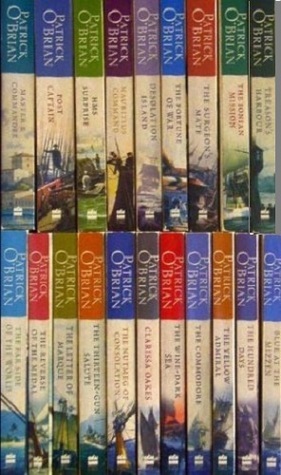
Comprising:Master & Commander;Post Captain;H.M.S. 'Surprise';The Mauritius Command;Desolation Island;The Fortune of War;The Surgeon's Mate;The Ionian Mission;Treason's Harbour;The Far Side of the World;The Reverse of the Medal;The Letter of Marque;The Thirteen-Gun Salute;The Nutmeg of Consolation;The Truelove/Clarissa Oakes;The Wine-Dark Sea;The Commodore;The Yellow Admiral;The Hundred Days;Blue at the Mizzen.

A concise overview, richly illustrated, of the historical background to the acclaimed Aubrey/Maturin novels. This book is a companion to Patrick O'Brian's sea novels, a straightforward exploration of what daily life in Nelson's navy was really like, for everyone from the captain down to the rawest recruit. What did they eat? What songs did they sing? What was the schedule of watches? How were the officers and crew paid, and what was the division of prize-money?These questions and many more are answered in Patrick O'Brian's elegant narrative, which includes wonderful anecdotal material on the battles and commanders that established Britain's naval supremacy. Line drawings and charts help us to understand the construction and rigging of the great ships, the types and disposition of the guns, and how they were operated in battle. A number of contemporary drawings and cartoons illustrate aspects of naval life from the press gang to the scullery. Finally, a generous selection of full-color paintings render the majesty and the excitement of fleet actions in the age of fighting sail. Photographs, drawings, cartoons, charts, and full-color paintings

This story begins where Patrick O'Brian's devoted fans would want it to, with a sloop in the South China Sea barely surviving a killer typhoon. But the time is the 1930s, and the protagonist a teenaged American boy whose missionary parents have just died. In the company of his rough seafaring uncle and an elderly English cousin, an eminent archaeologist, Derrick sets off in search of ancient treasures in central Asia.Along the way they encounter a charismatic Chinese bandit and a host of bad characters, including Russian agents fomenting unrest. (Most of these meet very bad ends.) The narrative—as in all of O'Brian's novels—touches on surprising subjects: astronomy, oriental philosophy, the correct identification of ancient Han bronzes, and some very local cuisine. It ends in an ice-bound valley, with the party caught between hostile Red-Hat monks and the Great Silent Ones, which is how the Tibetans designate the yeti.

Delmore Schwartz, the most influential critic in postwar America, wrote of Patrick O'Brian's first novel Testimonies: "A triumph...drawn forward by lyric eloquence and the story's fascination, [the reader] discovers in the end that he has encountered in a new way the sphinx and the riddle of existence itself." Schwartz' imagination was fired by this sinister tale of love and death set in Wales, a timeless story with echoes of Thomas Hardy and Mary Webb. Joseph Pugh, sick of Oxford and of teaching, decides to take some time off to live in a wild and beautiful Welsh farm valley. There he falls physically ill and is nursed back to health by Bronwen Vaughn, the wife of a neighboring farmer. Slowly, unwillingly, Bronwen and Pugh fall in love; and while that word is never spoken between them, their story is as passionate and as tragic as that of Vronsky and Anna Karenina.

Patrick O'Brian's outstanding biography of Picasso is here available in paperback for the first time. It is the most comprehensive yet written, and the only biography fully to appreciate the distinctly Mediterranean origins of Picasso's character and art.Everything about Picasso, except his physical stature, was on an enormous scale. No painter of the first rank has been so awe-inspiringly productive. No painter of any rank has made so much money. A few painters have rivaled his life span of ninety years, but none has attracted so avid, so insatiable, a public interest.Patrick O'Brian knew Picasso sufficiently well to have a strong sense of his personality. The man that emerges from this scholarly, passionate, and brilliantly written biography is one of many contradictions: hard and tender, mean and generous, affectionate and cold, private despite the relish of his fame. In his later years he professed communism, yet in O'Brian's view retained to the end of his life a residual Catholic outlook.Not that such matters were allowed to interfere with his vigorous sensuality. Sex and money, eating and drinking, friends and quarrels, comedies and tragedies, suicides and wars tumble one another in the vast chaos of his experience. he was "a man almost as lonely as the sun, but one who glowed with much the same fierce, burning life." It is with that impression of its subject that this book leaves its readers.

This novel is a powerful successor to Testimonies, Patrick O'Brian's first novel written for adults. It is set in that corner of France that became O'Brian's adopted home, where the long, dark wall of the Pyrenees runs headlong to meet the Mediterranean. Alain Roig returns to Saint-Féliu after years in the East and finds his family in crisis. His dour, middle-aged cousin Xavier, the mayor and most powerful citizen of the town, has fallen in love and plans to marry Madeleine, the young daughter of the local grocer. The Roig family property is threatened by this union, and Madeleine's relatives object on different grounds.Xavier is a tragic figure, damned by what he perceives as a lack of feeling; Madeleine is to be his salvation. Unfortunately she does not return his affection, and, as the feasts and harvest festivals of Saint-Féliu are played out, she finds herself falling in love with Alain.