
Patricia Highsmith
Patricia Highsmith was an American novelist who is known mainly for her psychological crime thrillers which have led to more than two dozen film adaptations over the years. She lived with her grandmother, mother and later step-father (her mother divorced her natural father six months before 'Patsy' was born and married Stanley Highsmith) in Fort Worth before moving with her parents to New York in 1927 but returned to live with her grandmother for a year in 1933. Returning to her parents in New York, she attended public schools in New York City and later graduated from Barnard College in 1942. Shortly after graduation her short story 'The Heroine' was published in the Harper's Bazaar magazine and it was selected as one of the 22 best stories that appeared in American magazines in 1945 and it won the O Henry award for short stories in 1946. She continued to write short stories, many of them comic book stories, and regularly earned herself a weekly $55 pay-check. During this period of her life she lived variously in New York and Mexico. Her first suspense novel 'Strangers on a Train' published in 1950 was an immediate success with public and critics alike. The novel has been adapted for the screen three times, most notably by Alfred Hitchcock in 1951. In 1955 her anti-hero Tom Ripley appeared in the splendid 'The Talented Mr Ripley', a book that was awarded the Grand Prix de Litterature Policiere as the best foreign mystery novel translated into French in 1957. This book, too, has been the subject of a number of film versions. Ripley appeared again in 'Ripley Under Ground' in 1970, in 'Ripley's Game' in 1974, 'The boy who Followed Ripley' in 1980 and in 'Ripley Under Water' in 1991. Along with her acclaimed series about Ripley, she wrote 22 novels and eight short story collections plus many other short stories, often macabre, satirical or tinged with black humour. She also wrote one novel, non-mystery, under the name Claire Morgan , plus a work of non-fiction 'Plotting and Writing Suspense Fiction' and a co-written book of children's verse, 'Miranda the Panda Is on the Veranda'. She latterly lived in England and France and was more popular in England than in her native United States. Her novel 'Deep Water', 1957, was called by the Sunday Times one of the "most brilliant analyses of psychosis in America" and Julian Symons once wrote of her "Miss Highsmith is the writer who fuses character and plot most successfully ... the most important crime novelist at present in practice." In addition, Michael Dirda observed "Europeans honoured her as a psychological novelist, part of an existentialist tradition represented by her own favorite writers, in particular Dostoevsky, Conrad, Kafka, Gide, and Camus." She died of leukemia in Locarno, Switzerland on 4 February 1995 and her last novel, 'Small g: a Summer Idyll', was published posthumously a month later. Gerry Wolstenholme July 2010
30 Books Written

Living on his posh French estate with his elegant heiress wife, Tom Ripley, on the cusp of middle age, is no longer the striving comer of The Talented Mr. Ripley. Having accrued considerable wealth through a long career of crime—forgery, extortion, serial murder—Ripley still finds his appetite unquenched and longs to get back in the game.In Ripley's Game, first published in 1974, Patricia Highsmith's classic chameleon relishes the opportunity to simultaneously repay an insult and help a friend commit a crime—and escape the doldrums of his idyllic retirement. This third novel in Highsmith's series is one of her most psychologically nuanced—particularly memorable for its dark, absurd humor—and was hailed by critics for its ability to manipulate the tropes of the genre. With the creation of Ripley, one of literature's most seductive sociopaths, Highsmith anticipated the likes of Norman Bates and Hannibal Lecter years before their appearance.

Now a Netflix SeriesIt’s here, in the first volume of Patricia Highsmith’s five-book Ripley series, that we are introduced to the suave Tom Ripley, a young striver seeking to leave behind his past as an orphan bullied for being a “sissy.” Newly arrived in the heady world of Manhattan, Ripley meets a wealthy industrialist who hires him to bring his playboy son, Dickie Greenleaf, back from gallivanting in Italy. Soon Ripley’s fascination with Dickie’s debonair lifestyle turns obsessive as he finds himself enraged by Dickie’s ambivalent affections for Marge, a charming American dilettante, and Ripley begins a deadly game.“Sinister and strangely alluring,” (Mark Harris, Entertainment Weekly) The Talented Mr. Ripley serves as an unforgettable introduction to this smooth confidence man, whose talent for self-invention is as unnerving—and unnervingly revealing of the American psyche—as ever.

"Strangers on a Train has lost none of its power to disturb…We will likely be reading Patricia Highsmith for the next one hundred years." ―Paula Hawkins Just in time for the centennial celebration of groundbreaking noir fiction writer Patricia Highsmith comes a reissue of her propulsive, engrossing debut, Strangers on a Train, with a new introduction by best-selling author Paula Hawkins. Guy Haines and Charles Anthony Bruno are passengers on the same train. Haines is a successful architect in the midst of a divorce, Bruno a mysterious smooth-talker with a sadistic proposal: he’ll murder Haines’s wife if Haines will murder Bruno’s father. As Bruno carries out his twisted plan, Guy finds himself trapped in Highsmith’s perilous world, where, under the right circumstances, ordinary people are capable of extraordinary crimes. The inspiration for Alfred Hitchcock’s classic 1951 film, Strangers on a Train launched Highsmith’s prolific career, proving her a master at depicting the unsettling forces that tremble beneath the surface of everyday life.

It's been six years since Ripley murdered Dickie Greenleaf and inherited his money. Now, in Ripley Under Ground (1970), he lives in a beautiful French villa, surrounded by a world-class art collection and married to a pharmaceutical heiress. All seems serene in Ripley's world until a phone call from London shatters his peace. An art forgery scheme he set up a few years ago is threatening to unravel: a nosy American is asking questions and Ripley must go to London to put a stop to it. In this second Ripley novel, Patricia Highsmith offers a mesmerizing and disturbing tale in which Ripley will stop at nothing to preserve his tangle of lies.
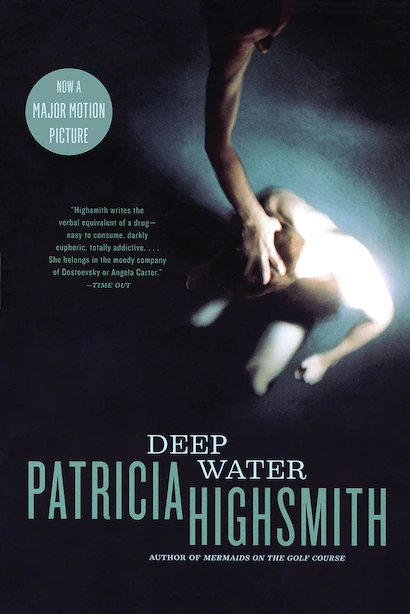
In Deep Water, set in the quiet, small town of Little Wesley, Patricia Highsmith has created a vicious and suspenseful tale of love gone sour. Vic and Melinda Van Allen's loveless marriage is held together only by a precarious arrangement whereby, in order to avoid the messiness of divorce, Melinda is allowed to take any number of lovers as long as she does not desert her family. Eventually, Vic can no longer suppress his jealousy and tries to win back his wife by asserting himself through a tall tale of murder — one that soon comes true. In this complex portrayal of a dangerous psychosis emerging in the most unlikely of places, Highsmith examines the chilling reality behind the idyllic facade of American suburban life.

The Boy Who Followed Ripley, the fourth novel in the Ripley series, is one of Patricia Highsmith's darkest and most twisted creations.Tom Ripley meets a young American runaway who has a dark secret that he is desperate to hide. Soon this unlikely pair is drawn into the seamy underworld of Berlin and a shocking kidnapping. In this masterful thriller, Highsmith shatters our perceptions of her most famous creation by letting us glimpse a more compassionate side of this amoral charmer."Ripley is an unmistakable descendant of Gatsby, that 'penniless young man without a past' who will stop at nothing."—Frank Rich, New York Times Magazine

Tom Ripley passes his leisured days at his French country estate tending the dahlias, practicing the harpsichord, and enjoying the company of his lovely wife, Heloise. Never mind the bloodstains on the basement floor.But some new neighbors have moved to Villeperce: the Pritchards, just arrived from America. they are a ghastly pair, with vulgar manners and even more vulgar taste. Most inconvenient, though, is their curiosity. Ripley does, after all, have a few things to hide. When menacing coincidences begin to occur, a spiraling contest of sinister hints and mutual terrorism ensues, resulting in one of Patricia Highsmith's most elegantly harrowing novels to date.

This "extraordinary story" (Julian Symons) begins with an act of naive voyeurism. Robert Forester, a depressed but fundamentally decent man, liked to watch Jenny through her kitchen window, a harmless palliative, as he saw it, to his lonely life and failed marriage. As he is drawn into her life, however, the recriminations of his simple pleasure shatter the deceptive calm of this small Pennsylvania town. With striking clarity and horrible inevitability, Forester is caught up in a series of deaths in which he is the innocent bystander, presumed guilty. Highsmith has once again, as Graham Greene wrote "created a world of her own, a world claustrophobic and irrational which we enter each time with a sense of personal danger". And that sense of danger grows from the first page to the sinister and chilling conclusion.

For two years, Walter Stackhouse has been a faithful and supportive husband to his wife, Clara. She is distant and neurotic, and Walter finds himself harboring gruesome fantasies about her demise. When Clara's dead body turns up at the bottom of a cliff in a manner uncannily resembling the recent death of a woman named Helen Kimmel who was murdered by her husband, Walter finds himself under scrutiny. He commits several blunders that claim his career and his reputation, cost him his friends, and eventually threaten his life. The Blunderer examines the dark obsessions that lie beneath the surface of seemingly ordinary people. With unerring psychological insight, Patricia Highsmith portrays characters who cross the precarious line separating fantasy from reality.NB: The title in England was changed to Lament for a Lover.

In This Sweet Sickness, Patricia Highsmith, in her own inimitable fashion, has created a complex psychological tale as suspenseful as The Talented Mr. Ripley.David Kelsey, a young scientist, has an unyielding conviction that life will turn out all right for him; he just has to fix the Situation: he is in love with a married woman. Obsessed with Annabelle and the life he has imagined for them—including the fully furnished cabin he maintains for her—David prepares to win her over, whatever it takes.In this riveting tale of a deluded loner, Highsmith reveals her uncanny ability to draw out the secret obsessions that overwhelm the human heart.

Three of them are waiting. Rydal Keener is waiting for something exciting to happen in his grubby little Athens hotel. At forty-odd, Chester MacFarland has been waiting much longer, expecting his life of stock manipulation and fraud to catch up with him. And Colette, Chester's wife, is waiting for something altogether different. After a nasty little incident in the hotel, they all wait together. As the stakes, and the tension, in their three-cornered waiting game mount, they learn that while passports and silence can be bought, other things can cost as much as your life.

Nowhere is Patricia Highsmith more edgy than in these mordantly hilarious sketches that make up Little Tales of Misogyny.Here you'll meet seemingly familiar women with the power to destroy both themselves and the men around them. In these stories Highsmith is at her most scathing as she draws out the mystery and menace of her once ordinary subject.

Sydney Bartleby has killed his wife, Alicia—at least he has thought about it, compulsively, over and over again, plotting schemes, designing escapes, forging alibis. Of course he has; he's a mystery-script writer. But when Alicia takes a long, unannounced vacation, Sydney seizes the opportunity to perfect his artistic method.With her characteristic precision and unrivaled sensitivity to the inner tremblings of human character, Patricia Highsmith shockingly portrays Sydney's descent into the treacherous world of his own fictions. Once again Highsmith proves herself to be a master at depicting the unsettling forces that boil beneath the surface of everyday life.

An expatriate is beset by dark temptations in this tale by the author of The Talented Mr. Ripley: "Her best novel" (The New Yorker). Set in Tunisia in the mid-1960s, this is the story of Howard Ingham, an American writer who has gone abroad to gather material for a movie too sordid to be set in America. Ingham is cool toward the girlfriend he left behind in New York-but his feelings start to change when she doesn't answer his increasingly aggravated letters, and the filmmaker who hired Ingham fails to show in Tunisia. Amid the tea shops and alleys of the souk, the sun-blasted architecture, and the beaches and hotels frequented by international tourists, Ingham tries to pass the time by working on a writing project. But a series of peculiar events-a hushed-up murder, a vanished corpse, secret broadcasts to the Soviet Union-will pull him in, and may finally put his increasingly fragile sense of morality to the test.

As Edith Howland's life becomes harsh, her diary entries only become brighter and brighter. She invents a happy life. As she knits for imaginary grandchildren, the real world recedes. Her descent into madness is subtle, appalling, and entirely believable.

Suave, agreeable, and completely amoral, Patricia Highsmith's hero, the inimitable Tom Ripley, stops at nothing--not even murder-- to accomplish his goals. In achieving for himself the opulent life that he was denied as a child, Ripley shows himself to be a master of illusion and manipulation and a disturbingly sympathetic combination of genius and psychopath. As Highsmith navigates the mesmerizing tangle of Ripley's deadly and sinister games, she turns the mystery genre inside out and takes us into the mind of a man utterly indifferent to evil. The Talented Mr. RipleyIn a chilling literary hall of mirrors, Patricia Highsmith introduces Tom Ripley. Like a hero in a latter-day Henry James novel, is sent to Italy with a commission to coax a prodigal young American back to his wealthy father. But Ripley finds himself very fond of Dickie Greenleaf. He wants to be like him--exactly like him. Suave, agreeable, and utterly amoral, Ripley stops at nothing--certainly not only one murder--to accomplish his goal. Turning the mystery form inside out, Highsmith shows the terrifying abilities afforded to a man unhindered by the concept of evil.Ripley Under GroundIn this harrowing illumination of the psychotic mind, the enviable Tom Ripley has a lovely house in the French countryside, a beautiful and very rich wife, and an art collection worthy of a connoisseur. But such a gracious life has not come easily. One inopportune inquiry, one inconvenient friend, and Ripley's world will come tumbling down--unless he takes decisive steps. In a mesmerizing novel that coolly subverts all traditional notions of literary justice, Ripley enthralls us even as we watch him perform acts of pure and unspeakable evil.Ripley's GameConnoisseur of art, harpsichord aficionado, gardener extraordinaire, and genius of improvisational murder, the inimitable Tom Ripley finds his complacency shaken when he is scorned at a posh gala. While an ordinary psychopath might repay the insult with some mild act of retribution, what Ripley has in mind is far more subtle, and infinitely more sinister. A social slight doesn't warrant murder of course-- just a chain of events that may lead to it.

Rife with overtones of Dostoyevsky, The Glass Cell combines a quintessential Highsmith mystery with a penetrating critique of the psychological devastation wrought by the prison system.In 1961, Patricia Highsmith received a fan letter from a prison inmate. A correspondence ensued between author and inmate, and Highsmith became fascinated with the psychological traumas that incarceration can inflict. Based on a true story, The Glass Cell is Highsmith's deeply disturbing fictionalization of everything she learned. Falsely convicted of fraud, the easy-going but naive Philip Carter is sent to prison. Despite his devotion to Hazel, his wife, and the support of David Sullivan, a lawyer and friend who tries to avenge the injustice done to him, Carter endures six lonely and drug-ravaged years. Upon his release, Carter is a much more discerning, suspicious, and violent man. For those around him, earning back his trust can mean the difference between life and death.

From the eerily outlandish to the dark and brutal, Eleven presents a gallery of bizarre characters, each driven by strange unspoken urges, whose cumulative effect is at least as unsettling as any of Highsmith's previous novels.Contains:-The Snail-Watcher-The Birds Poised to Fly-The Terrapin-When the Fleet was in at Mobile-The Quest for "Blank Claveringi"-The Cries of Love-Mrs. Afton, Among Thy Green Braes-The Heroine-Another Bridge to Cross-The Barbarians-The Empty Birdcage

"The book is as unusual as you might expect and hope for from Patricia Highsmith. An elegant creative writing guide, it’s also a goldmine for anyone hoping for insight into The Talented Mr Ripley – and its author."- The Guardian.

The honeymoon is over, as they say, the bride dead by her own hand. Ray Garrett, the grieving husband, convinces the police in Rome of his innocence, but not his thuggish father-in-law, an American painter named Ed Coleman, who shoots him at point-blank range and leaves him for dead. Ray survives, however, and follows Coleman to Venice, where the two fall into an eerie game of cat-and-mouse—Coleman obsessed with vengeance and Ray equally insistent on clearing his conscience, though each is at once the hunter and the hunted in a duel composed of tension, hiding, and guessing, and at times punctuated by violence that, even as each manages to walk away, draws them nearer to death.

Best known for her novels (The Talented Mr. Ripley, Strangers on a Train, A Suspension of Mercy, and others) Highsmith is an all-too-frequently forgotten master of the short story. These stories in this volume examine the dark soul of humanity in a deceptively simple voice that draws you in and won't let go. The sheer beauty of the streamlined prose disguises a complexity of character and situation that is the mark of a true master.Highsmith's ability to create believable characters with very little exposition, but rather through their behavior and dialog, is incredible. None of the stories in this volume is particularly long, but you're drawn in and seduced by the power of the prose. Whether it's a cat driven to commit murder to protect his mistress ("Ming's Biggest Prey"), a rat exacting a horrible revenge on a family that maimed him ("The Bravest Rat in Venice"), or a house party interrupted by something grisly ("Something the Cat Dragged In"), these stories are impossible to put down.A great example of Highsmith's artistry is "Mermaids on the Golf Course," about a presidential adviser who took an assassin's bullet to protect the president. This seemingly heroic man is slowly exposed throughout the story as something completely different, mainly through his dialogue and the reactions of his family to him. Highsmith deftly exposes the many layers in his character, shows that the surface we see often disguises the truth below, and asks the question, "How well do we know anyone?"Likewise, "The Female Novelist" is so consumed with herself and her craft that she destroys herself. "The Hand" is a chilling twist on the age-old custom of asking for someone's hand in marriage. Highsmith's stories linger on after they are read, and show that for true horror, you don't need the supernatural; you merely need to write about people.

When Ralph Linderman returns a stranger's wallet he found during a morning stroll through Greenwich Village, he is entirely unprepared for the complex maze of sexual obsession and disturbing psychological intrigue he is about to be drawn into. Patricia Highsmith, author of 'The Tremor of Forgery', 'Strangers on a Train', and 'The Cry of the Owl' has once again created an unsettling thriller that explores the bleakest alleyways of human desire. Highsmith has been called "one of the finest crime novelists" by the New York Times and is now considered one of the most original voices in twentieth-century American fiction.
Long out of print, this Highsmith classic resurfaces with a vengeance. The great revival of interest in Patricia Highsmith continues with the publication of this novel that will give dog owners nightmares for years to come. With an eerie simplicity of style, Highsmith turns our next-door neighbors into sadistic psychopaths, lying in wait among white picket fences and manicured lawns. In 'A Dog's Ransom', Highsmith blends a savage humor with brilliant social satire in this dark tale of a highminded criminal who hits a wealthy Manhattan couple where it hurts the most when he kidnaps their beloved poodle. This work attests to Highsmith's reputation as "the poet of apprehension" (Graham Greene).

Nowhere is Patricia Highsmith's affinity for animals more apparent than in The Animal-Lover's Book of Beastly Murder, for here she transfers the murderous thoughts and rages most associated with humans onto the animals themselves.You will meet, for example, in "In the Dead of Truffle Season," a truffle-hunting pig who tries to whet his own appetite for a while; or Jumbo in "Chorus Girl's Absolutely Final Performance," a lonely, old circus elephant who decides she's had enough of show business and cruel trainers for one lifetime. In this satirical reprise of Kafka, cats, dogs, and breeding rodents are no longer ordinary beings in the happy home, but actually have the power to destroy the world in which we live.

In a pitiless story of prying suburban self-righteousness, Patricia Highsmith introduces the Alderman family as they descend into moral crisis.When small-town insurance salesman Richard Alderman becomes a born-again Christian, his once tight-knit family quickly begins to rip apart at the seams. He and his youngest son, Robbie, embrace their newfound faith, while his elder son Arthur rejects it. Caught in the middle of the ensuing web of lies, his wife, Lois tries to keep the family together, but when the church elders start to interfere in Arthur's love life, events spiral toward violence. In this masterful late work, Highsmith weaves a powerful tale about blind faith and the peculiar ideas of justice that lie underneath the veneer of respectability.

Nothing That Meets the Eye: The Uncollected Stories of Patricia Highsmith
by Patricia Highsmith
Rating: 4.2 ⭐
'Nothing That Meets the Eye' confirms Patricia Highsmith as a great American writer.If only Patricia Highsmith (1921-1995) had been alive to see the thunderous critical response to the publication of the best-selling 'The Selected Stories of Patricia Highsmith' in 2001. Now the Highsmith renaissance continues with this brilliant collection of 28 short stories, a great majority of which have never been seen before. The stories assembled in 'Nothing That Meets the Eye', written between 1938 and 1982, are vintage Highsmith: a gigolo-like psychopath preys on unfulfilled career women; a lonely spinster's fragile hold on reality is tethered to the bottle; an estranged postal worker invents homicidal fantasies about his coworkers. While some stories anticipate the diabolical narratives of the Ripley novels, others possess a Capra-like sweetness that forces us to see the author in a new light. From this new collection, a remarkable portrait of the American psyche at mid-century emerges, unforgettably distilled by the inimitable eye of Patricia Highsmith. Patricia Highsmith is the author of such classics as 'Strangers on a Train' and 'The Talented Mr. Ripley'. Born in Fort Worth, Texas, she died in 1995 in Locarno, Switzerland.

Ramón mends furniture. Theodore paints. A devout Catholic, Ramón lives in Mexico City, not far from where he was born into poverty. Theodore, a rich German transplanted to a country where money buys some comfort but no peace, believes in nothing at all. You'd think the two had nothing in common. Except, of course, that both had slept with Lelia. The two were good friends, so neither minded sharing her affections. They did mind, however, when Lelia was found raped, murdered, and horribly mutilated. The two friends, suspects both, twist in a limbo of tension and doubt, each seeking his own form of solace and truth.

Finally published in the United States ten years after Patricia Highsmith's death, Small g, in the words of her biographer Andrew Wilson, is an "extended fairy tale suggesting that…happiness is precarious and…romance should be embraced."In unmistakable Highsmithian fashion, the novel opens in a seedy Zurich bar with the brutal murder of Peter Ritter. Unraveling the vagaries of love, sexuality, jealousy, and death, Highsmith weaves a mystery both hilarious and astonishing, a classic tale executed with her characteristic penchant for darkness. Small g is at once an exorcism of Highsmith's literary demons and a revelatory capstone to a wholly remarkable career. It is a delightfully incantatory work that, in the tradition of Shakespeare's A Midsummer Night's Dream, shows us how bizarre and unpredictable love can be.

Horrific tragedy becomes disturbingly ordinary in The Black House, a masterful collection of short stories, written during a particularly dark time in Patricia Highsmith's life. As readers will discover, the work eerily evokes the warm familiarities of suburban life: the manicured lawns, the white picket fences, and the local pubs, each providing the backbone for her chilling portraits. Seemingly small indiscretions and infidelities—along with love affairs and murder—consume the characters that commit them. Cycles of destructive jealousy overwhelm the cheating protagonists of "Blow It" and "When In Rome," and the title story explores small-town male camaraderie and the destructive secret it masks. This enthralling collection of eleven stories presents Highsmith at her finest: melancholy, suspenseful, and sizzling with a powerful awareness of human emotion.
Slowly, Slowly in the Wind brilliantly assembles many of Patricia Highsmith's most nuanced and psychologically suspenseful works.Rarely has an author articulated so well the hypocrisies of the Catholic Church while conveying the delusions of a writer's life and undermining the fantasy of suburban bliss. Each of these twelve pieces, like all great short fiction, is a crystal-clear snapshot of lives both static and full of chaos. In "The Pond" Highsmith explores the unforeseen calamities that can unalterably shatter a single woman's life, while "The Network" finds sinister loneliness and joy in the mundane yet engrossing friendships of a small community of urban dwellers. In this enduring and disturbing collection, Highsmith evokes the gravity and horror of her characters' surroundings with evenhanded prose and a detailed imagination.