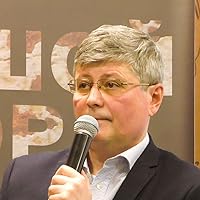
Oleg V. Khlevniuk
Oleg Vitalyevich Khlevniuk Ukrainian and Russian historian of Stalinism and the Soviet Union. His position as senior researcher of the State Archive of the Russian Federation has given him unprecedented access to source documents kept strictly secret until the fall of Communism in 1991, and he has done much to study the materials and make them available to other scholars.
5 Books Written

The most authoritative and engrossing biography of the notorious dictator ever written, w inner of the 2016 PROSE Award for Biography & Autobiography"Enthralling, brilliant, and groundbreaking, this book confirms Khlevniuk as probably the greatest living expert on Stalin. Essential reading."—Simon Sebag Montefiore, author of the Court of the Red TsarJosef Stalin exercised supreme power in the Soviet Union from 1929 until his death in 1953. During that quarter-century, by Oleg Khlevniuk’s estimate, he caused the imprisonment and execution of no fewer than a million Soviet citizens per year . Millions more were victims of famine directly resulting from Stalin's policies. What drove him toward such ruthlessness? This essential biography, by the author most deeply familiar with the vast archives of the Soviet era, offers an unprecedented, fine-grained portrait of Stalin the man and dictator. Without mythologizing Stalin as either benevolent or an evil genius, Khlevniuk resolves numerous controversies about specific events in the dictator’s life while assembling many hundreds of previously unknown letters, memos, reports, and diaries into a comprehensive, compelling narrative of a life that altered the course of world history. In brief, revealing prologues to each chapter, Khlevniuk takes his reader into Stalin’s favorite dacha, where the innermost circle of Soviet leadership gathered as their vozhd lay dying. Chronological chapters then illuminate major Stalin’s childhood, his involvement in the Revolution and the early Bolshevik government under Lenin, his assumption of undivided power and mandate for industrialization and collectivization, the Terror, World War II, and the postwar period. At the book’s conclusion, the author presents a cogent warning against nostalgia for the Stalinist era.

The History of the Gulag: From Collectivization to the Great Terror
by Oleg V. Khlevniuk
Rating: 3.8 ⭐
The human cost of the Gulag, the Soviet labor camp system in which millions of people were imprisoned between 1920 and 1956, was staggering. Aleksandr Solzhenitsyn and others after him have written movingly about the Gulag, yet never has there been a thorough historical study of this unique and tragic episode in Soviet history. This groundbreaking book presents the first comprehensive, historically accurate account of the camp system. Russian historian Oleg Khlevniuk has mined the contents of extensive archives, including long-suppressed state and Communist Party documents, to uncover the secrets of the Gulag and how it became a central component of Soviet ideology and social policy.Khlevniuk argues persuasively that the Stalinist penal camps created in the 1930s were essentially different from previous camps. He shows that political motivations and paranoia about potential enemies contributed no more to the expansion of the Gulag than the economic incentive of slave labor did. And he offers powerful evidence that the Great Terror was planned centrally and targeted against particular categories of the population. Khlevniuk makes a signal contribution to Soviet history with this exceptionally informed and balanced view of the Gulag.

Based on meticulous research in previously unavailable documents in the Soviet archives, this compelling book illuminates the secret inner mechanisms of power in the Soviet Union during the years when Stalin established his notorious dictatorship. Oleg V. Khlevniuk focuses on the top organ in Soviet Russia’s political hierarchy of the 1930s—the Political Bureau of the Central Committee of the Communist Party—and on the political and interpersonal dynamics that weakened its collective leadership and enabled Stalin’s rise.Khlevniuk’s unparalleled research challenges existing theories of the workings of the Politburo and uncovers many new findings regarding the nature of alliances among Politburo members, Sergei Kirov’s murder, the implementation of the Great Terror, and much more. The author analyzes Stalin’s mechanisms of generating and retaining power and presents a new understanding, unmatched in texture and depth, of the highest tiers of the Communist Party in a crucial era of Soviet history.

In the voluminous secret history of the 1930s, one episode that still puzzles researchers is the death in 1937 of one of Stalin's key allies - his fellow Georgian, G.K. Ordzhonikidze. Whether he took his own life or, like Kirov, was murdered, the case of Ordzhonikidze intersects several long-debated problems in Soviet political history. What role did Politburo members play in decision making during the Stalin era? What formed the basis of Stalin's alliances? Were there conflicts between Stalin and his comrades and, if so, how far did they go? Was there in fact opposition to Stalin? These and other questions are addressed by one of Russia's best young historians whose pioneering work in previously closed party and government archives is refining our understanding of the political history of the Stalin era.

Stalin i Ordzhonikidze: Konflikty v Politbi͡u︡ro v 30-e gody
by Oleg V. Khlevniuk