
Northrop Frye
Born in Quebec but raised in New Brunswick, Frye studied at the University of Toronto and Victoria University. He was ordained to the ministry of the United Church of Canada and studied at Oxford before returning to UofT. His first book, Fearful Symmetry, was published in 1947 to international acclaim. Until then, the prophetic poetry of William Blake had long been poorly understood, considered by some to be delusional ramblings. Frye found in it a system of metaphor derived from Paradise Lost and the Bible. His study of Blake's poetry was a major contribution. Moreover, Frye outlined an innovative manner of studying literature that was to deeply influence the study of literature in general. He was a major influence on, among others, Harold Bloom and Margaret Atwood. In 1974-1975 Frye was the Norton professor at Harvard University. Frye married Helen Kemp, an educator, editor and artist, in 1937. She died in Australia while accompanying Frye on a lecture tour. Two years after her death in 1986 he married Elizabeth Brown. He died in 1991 and was interred in Mount Pleasant Cemetery in Toronto, Ontario. The Northrop Frye Centre at Victoria College at the University of Toronto was named in his honour. See also http://en.wikipedia.org/wiki/Northrop...
30 Books Written

An examination of the influence of the Bible on Western art and literature and on the Western creative imagination in general. Frye persuasively presents the Bible as a unique text distinct from all other epics and sacred writings. “No one has set forth so clearly, so subtly, or with such cogent energy as Frye the literary aspect of our biblical heritage” (New York Times Book Review). Indices.
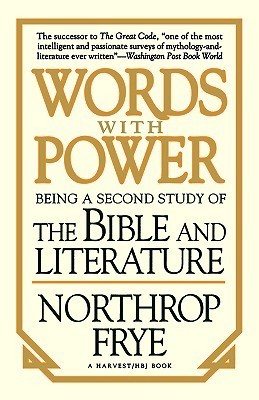
Words with Power: Being a Second Study of the Bible and Literature
by Northrop Frye
Rating: 4.1 ⭐
• 2 recommendations ❤️
Frye continues his exploration, begun in The Great Code, of the influence of Biblical themes and forms of expression on Western literature, with discussions of authors ranging from Chaucer and Shakespeare to Yeats and Eliot. Frye identifies four key elements found in the Bible-the mountain, the garden, the cave, and the furnace-and describes how they recur in later secular writings. Indices.

Striking out at the conception of criticism as restricted to mere opinion or ritual gesture, Northrop Frye wrote this magisterial work proceeding on the assumption that criticism is a structure of thought and knowledge in its own right. Employing examples of world literature from ancient times to the present, he provides a conceptual framework for the examination of literature. In four brilliant essays on historical, ethical, archetypical, and rhetorical criticism, he applies "scientific" method in an effort to change the character of criticism from the casual to the causal, from the random and intuitive to the systematic.Harold Bloom contributes a fascinating and highly personal preface that examines Frye's mode of criticism and thought (as opposed to Frye's criticism itself) as being indispensable in the modern literary world.

Addressed to educators as well as the general reader, this important yet lively and readable book explores the value and uses of literature and its study in our scientific age, and offers a broad program for the teaching of literature in elementary and secondary schools.

Published in 1947, Fearful Symmetry was Northrop Frye's first book and the product of over a decade of intense labour. Drawing readers into the imaginative world of William Blake, Frye succeeded in making Blake's voice and vision intelligible to the wider public. Distinguished by its range of reference, elegance of expression, comprehensiveness of coverage, coherence of argument, and sympathy to its subject, Fearful Symmetry was immediately recognized as a landmark of Blake criticism. Fifty years later, it is still recognized as having ensured the acceptance of Blake as a canonical poet by permanently dispelling the widespread notion that he was the mad creator of an incomprehensible private symbolism.For this new edition, the text has been revised and corrected in accordance with the principles of the Collected Works of Northrop Frye series. Frye's original annotation has been supplemented with references to currently standard editions of Blake and others, and many new notes have been provided, identifying quotations, allusions, and cultural references. An introduction by Ian Singer provides biographical and critical context for the book, an overview of its contents, and an account of its reception.

One of the greatest literary critics of our time here provides a remarkable introduction to the genius of William Shakespeare through a study of ten of Shakespeare’s most popular A Midsummer Night’s Dream, Romeo and Juliet, Richard II, Henry IV, Measure for Measure, Hamlet, King Lear, Antony and Cleopatra, The Winter’s Tale, and The Tempest . The outgrowth of a lifetime of study and teaching, Frye’s insights will inform and delight both the expert and the first-time reader of Shakespeare.“The sensibility and wisdom informing the book make it a delight.”―S. Schoenbaum, New York Times Book Review“The most accessible and sheerly enjoyable of [Frye’s] books….The effect is that of listening to a fluent, genial conversationalist who loves Shakespeare and unabashedly celebrates him in that high aspect of criticism well called ‘appreciation.’”―Edmund Fuller, Wall Street Journal“A boon to both Shakespearean scholars and readers dipping into the Bard’s work for the first time. … Written with verve, erudition and more-than-occasional humor, this ‘summing-up’ of 50 years of scholarship will be read with pleasure, profit and gratitude by drama lovers for years to come.”― Kirkus ReviewsNorthrop Frye, professor of English, has been on the faculty of the University of Toronto for almost fifty years. He is the author of numerous books, including the seminal work Anatomy of Criticism

Northrop Frye’s thinking has had a pervasive impact on contemporary interpretations of our literary and cultural heritage. In his Anatomy of Criticism, a landmark in the history of modern critical theory, he demonstrated his genius for mapping out the realm of imaginative creation. In The Secular Scripture he turns again to the task of establishing a broad theoretical framework, bringing to bear his extraordinary command of the whole range of literature from antiquity to the present.Romance, a mode of literature trafficking in such plot elements as mistaken identity, shipwrecks, magic potions, the rescue of maidens in distress, has tended to be regarded as hardly deserving of serious consideration; critics praise other aspects of the Odyssey, The Faerie Queene, Shakespeare’s last plays, and Scott’s Waverley novels, for example, while forgiving the authors’ indulgence in childishly romantic plots. Frye, however, discerns in the innumerable romantic narratives of the Western tradition an imaginative universe stretching from an idyllic world to a demonic one, and a pattern of action taking the form of a cyclical descent into and ascent out of the demonic realm. Romance as a whole is thus seen as forming an integrated vision of the world, a “secular scripture” whose hero is man, paralleling the sacred scripture whose hero is God.The clarity of Northrop Frye’s perception, the scope and suggestiveness of his conceptualizing, the wit and grace of his style, have won him universal admiration.

A Natural Perspective: The Development of Shakespearean Comedy and Romance
by Northrop Frye
Rating: 4.2 ⭐
This collection of four essays, by one of the most distinguished critics writing in English, is concerned with principles of criticism and with the enjoyment of Shakespeare's comedies. It is the author's thesis that Shakespeare's comedy is widely misunderstood and underestimated, and that the four romances are the inevitable and genuine culmination of the poet's achievement. Taking a perspective that retreats from the usual commentary on individual plays, Professor Frye considers the comedies as a group unified by recurring images and structural devices. "From this point of view," he writes, "they seem more like a number of simultaneous chess games played by a master who wins them all by devices familiar to him, and gradually, with patient study, to us, but which remain mysteries of an unfathomable skill. More important, the reader is led from the characteristics of the individual play, the vividness of characterization, the texture of imagery, and the like, to consider what kind of a form comedy is, and what its place is in literature."

In this outstanding collection of sixteen essays, the world-renowned critic and scholar discusses various works in the central tradition of English mythopoeic poetry, paying particular attention to the centrality of Romanticism.

The publication in 1982 of Northrop Frye's The Great The Bible and Literature was a literary event of major significance. Frye took what he called 'a fresh and firsthand look' at the Bible and analysed it as a literary critic, exploring its relation to Western literature and its impact on the creative imagination. Through an examination of such key aspects of language as myth, metaphor, and rhetoric he conveyed to the reader the results of his own encounter with the Bible and his appreciation of its unified structure of narrative and imagery. Shortly before his death in January 1991, Frye characterized The Double Vision as 'something of a shorter and more accessible version' of The Great Code and its sequel, Words with Power. In simpler context and briefer compass, it elucidates and expands on the ideas and concepts introduced in those books. The 'double vision' of the title is a phrase borrowed from William Blake indicating that mere simple sense perception is not enough for reliable interpretation of the meaning of the world. In Frye's 'the conscious subject is not really perceiving until it recognizes itself as part of what it perceives.' In four very readable, engaging chapters, Frye contrasts the natural or physical vision of the world with the inward, spiritual one as each relates to language, space, time, history, and the concept of God. Throughout, he reiterates that the true literal sense of the Bible is metaphorical and that this conception of a metaphorical literal sense is not new, or even modern. He emphasizes the fact that the literary language of the Bible is not intended, like literature itself, simply to suspend judgement, but to convey a vision of spiritual life that contineus to transform and expand our own. Its myths become, as purely literary myths cannot, myths to live by. Its metaphors become, as purely literary metaphors cannot, metaphors to live in. The Double Vision originated in lectures delivered at Emmanuel College in the University of Toronto, the texts of which were revised and augmented. It will appeal to scholars, students, and general readers alike who enjoyed Frye's earlier works or who are interested in the Bible, literature, literary theory and criticism, and religion.

"It is worth a hundred ordinary critical studies..." - George P. Elliot, The Hudson ReviewFew lovers of literature, students, or even scholars are trained in the art of criticism. While our universities emphasize research and specialization, the student, as a critic, is largely self-taught. In this book Mr. Frye establishes some basic tools for criticism because "without the possibility of criticism as a structure of knowledge, culture, and society with it, would be condemned to morbid antagonism between the supercilious refined and the resentful un-refined." These critical principles may enable the well-read layman as well as the literary researcher to respond to works of literature of widely divergent styles and allow his critical judgment to relate them to literary culture as a whole.

In the Alexander Lectures for 1965-66 at the University of Toronto, Dr. Frye describes the basis of the tragic vision as "being in time," in which death as "the essential event that gives shape and form to life ... defines the individual, and marks him off from the continuity of life that flows indefinitely between the past and the future." In Dr. Frye's view, three general types can be distinguished in Shakespearean tragedy, the tragedy of order, the tragedy of passion, and the tragedy of isolation, in all of which a pattern of "being in time" shapes the action. In the first type, of which Julius caesar, Macbeth, and Hamlet are examples, a strong ruler is killed, replaced by a rebel-figure, and avenged by a nemesis-figure; in the second, represented by Romeo and Juliet, Anthony and Cleopatra, and Troilus and Cressida, authority is split and the hero is destroyed by a conflict between social and personal loyalties; and in the third, Othello, King Lear, and Timon of Athens , the central figure is cut off from his world, largely as a result of his failure to comprehend the dynamics of that world. What all these plays show us, Dr. Frye maintains, is "the impact of heroic energy on the human situation" with the result that the "heroic is normally destroyed ... and the human situation goes on surviving." Fools of Time will be welcomed not only by many scholars who are familiar with Dr. Frye's keen critical insight but also by undergraduates, graduates, high-school and university teachers who have long valued his work as a means toward a firmer grasp and deeper understanding of English literature.

Biblical and Classical Myths: The Mythological Framework of Western Culture
by Northrop Frye
Rating: 3.8 ⭐
In the 1970s and 80s, Northrop Frye and Jay Macpherson co-taught a very influential course at the University of Toronto's Victoria College on the history of Western mythology - Frye focusing on the biblical myths; Macpherson on the classical. Biblical and Classical Myths recreates the thought behind that course, with Frye's lectures - unpublished until very recently - supplemented by Macpherson's popular 1962 textbook on classical mythology, Four The Classical Myths . Frye's lectures on the Bible make up the first half of the book. He expounds on an array of topics, including translations of the bible, sexual imagery, pastoral and agricultural imagery, and law and revolution in the bible. Four Ages makes up the second half. Macpherson narrates the major classical myths from stories of creation to the myths' survival in later European traditions. By complementing the biblical tradition with the classical, this volume imparts a comprehensive understanding of western mythology. With a preface by Alvin Lee, general editor of the Collected Works of Northrop Frye, Biblical and Classical Myths is an essential volume and represents a unique achievement in scholarship.

Originally published by Anansi in 1971, this attractive new edition of Frye's timeless essays on literature and painting features an introduction by Canadian literature scholar Linda Hutcheon.

This collection of twenty-four of Northrop Frye's essays, nine of which have never been published and several of which have appeared only in obscure sources, focuses on the fundamental themes that have dominated Frye's career and made him one of the world's most influential critics.

T. S. Eliot (Writers and critics) [Jan 01, 1972] Frye, Northrop …

This collection of a dozen major essays written in recent year is vintage Frye―the fine distillation of a lifetime of originative thinking about literature and its context. The essays in Spiritus Mundi―the title comes from one of Yeat's best known poems, "The Second Coming," and refers to the book that was supposedly the source of Yeat's apocalyptic vision of a "great beast, slouching toward Bethlehem"―are arranges in three groups of four essays each. The first four are about the "contexts of literature," the second are about the "mythological universe," and the last are studies of four of the great visionary or myth-making poets who have been enduring sources of interest for Milton, Blake, Yeats, and Wallace Stevens.The volume is full of agreeable a delightful piece on charms and riddles is followed by an illuminating essay on Shakespearean romance. Like most of the other essays in the book, these two are compressed and elegant expositions of ideas that in the hands of a lesser writer would have required a book. In another selection Frye rescues Spengler from neglect and argues for the inclusion of The Decline of the West among the major imaginative books produced by the Western world. Elsewhere he advances the case for placing Copernicus in a pantheon composed primarily of literary figures. OF particular interest are several essays in which Frye comments personally and reflectively on the influence he has had on the study of literature and the reactions elicited by his work. In "The Renaissance of Books" he dissents from the opinion of the McLuhanites that the written word is showing signs of obsolescence and argues that books are "the technological instrument that makes democracy possible."As the dozen essays collected here amply attest, Northrop Frye continues to be the most perceptive and most persuasive exponent of the power of mythological imagination―or as he himself calls it, "the mythological habit of mind"―written in English.

In this classic book, the resouces of an exceptional critic are brought to bear on questions of prime importance in modern life. Frye presents a brilliant array of ideas and observations on the methodology of our day and its central elements, alienation, and progress; the effects of anthologyon the structured society; characteristics commonly associated with the `modern'; antisocial attitudes in modern culture; the role of the arts in informing the contemporary imagination; and finally the way in which the creative arts are absorbed into society through education.


Originally delivered as the 1980 Larkin-Stuart Lectures, this book provides an intriguing and provocative insight into the notion of creation and of the relationship in creativity between the human and the divine.

Throughout a luminous career, Northrop Frye has brought the focus of his critical perceptions to bear on a topic of fundamental importance not only to literary criticism but to the life of the mind. The topic is education. Spanning forty years, On Education is a landmark collection of Dr. Frye's essays on educational theory. The pieces have been garnered from a variety of sources not readily available to the reader. They are an absorbing portrait of continuity and change - in the theory and practice of education, and in the thinking of this great teacher. The degree to which the context for some of the pieces has changed over the years serves to underscore the timelessness of Dr. Frye's central thesis: much of what we respect as intelligence is the ability to manipulate words and numbers; a truly basic education teaches that language is a way of thinking.
Book by Frye, Northrop

Presented informally, The Return of Eden is filled with the vast learning and demonstrates the imaginative magnitude we have come to expect of this distinguished the brilliant argument and the pleasantly witty presentation will inform and delight.
Well read. Complete. Some corner curl, but otherwise nice and clean.

The Educated Imagination and Other Writings on Critical Theory 1933-1963
by Northrop Frye
Rating: 3.9 ⭐
In 1933, Northrop Frye was a recent university graduate, beginning to learn his craft as a literary essayist. By 1963, with the publication of The Educated Imagination , he had become an international academic celebrity. In the intervening three decades, Frye wrote widely and prodigiously, but it is in the papers and lectures collected in this installment of the Collected Works of Northrop Frye, that the genesis of a distinguished literary critic can be seen. Here is Frye tracing the first outlines of a literary cosmology that would culminate in The Anatomy of Criticism (1958) and shape The Great Code (1982) and Words with Power (1990). At the same time that Frye garnered such international acclaim, he was also a working university teacher, lecturing in the University of Toronto's English Language and Literature program. In her lively introduction, Germaine Warkentin links Frye's evolution as a critic with his love of music, his passionate concern for his students, and his growing professional ambition. The writings included in this volume show how Frye integrated ideas into the work that would consolidate the fame that Fearful Symmetry (1947) had first established.

"Thirteen essays and addresses on Canadian writing, teaching, and society by one of the most influential critical thinkers of the century."

"There is no Canadian writer of whom we can say … that their readers can grow up inside their work without ever being aware of a circumference." Northrop Frye came to that conclusion after a detailed study of the imaginative achievements of Canada's writers from the earliest period to 1965, when that sentence from his study first appeared in print. Over the decades since then, the statement has come to be regarded as a benchmark of individual and national literary achievement.The Northrop Frye Quote Book is a specialized dictionary of quotations on all subjects that is based on the thoughts and writings of one person. It is the handiwork of a single contributor, albeit the cogitations of a remarkable one. It is also evidence that there is a Canadian writer of whom it may be said that we can grow up inside his work "without ever being aware of a circumference."John Robert Colombo has written, translated, edited, or compiled over two hundred books, including seven dictionaries of quotations. He is a graduate of the University of Toronto and a Fellow of the Frye Centre at Victoria University.Jean O’Grady, a graduate of the University of Toronto, served as the associate editor of The Collected Works of Northrop Frye. She is also the author of the biography of Margaret Addison, the first dean of women at Victoria College.

Thirteen of the essays in this volume were selected from sixty-one papers delivered at the 1962 joint meeting of the Midwest Modern Language Association and the Central Renaissance Conference. Two essays, “The Road of Excess” by Northrop Frye and “ King Lear as Metaphor” by L. C. Knights, were originally presented as major lectures during the conference, whose central theme was criticism in relation to myth and symbol. Edited with a foreword by Bernice Slote, this book, as Miss Slote writes, is “an experiment in by repeated views from somewhat different vantage points, the essays present definitions and illustrate forms of a comparatively new way of considering literature—a concentration on myth and symbol.”
This wonderful The Stubborn Essays on Criticism and society by Northrop Frye is a joy. This volume is made up of some of his most important recent essays, and contain some of his central ideas and most pointed prose.