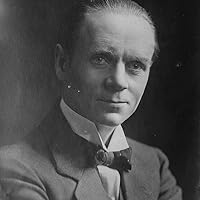
Norman Angell
British politician Sir Norman Angell won the Nobel Prize of 1933 for peace. This most famous author in 1909 wrote The Great Illusion , a best-selling publication, which sold more than a million copies, translated into 25 languages. https://en.wikipedia.org/wiki/Norman_...
30 Books Written

The Great Illusion A Study of the Relation of Military Power to National Advantage
by Norman Angell
• 2 recommendations ❤️
American interest in the problems discussed here is hardly less vital than that of Europe. Being more persuaded than when the first American edition of this book was issued in 1910, it is certain that opinion in America will not be equiped for dealing with the problems arising out of the relations with the Spanish American states; with Japan; and with the Philippians; unless it has some fair understanding of the principles with which this book deals. Its general interest even goes farther than this; no great community like that of modern America can remain indifferent to the drift of general opinion throughout the world on matters wrapped up with issues so important as those of war and peace. That the tangible commercial and business interest of America are involved in these European events is obvious from the very factors of financial and commercial interdependence which forms the basis of the argument. That the interest of Americans are inextricably, if indirectly, bound up with those of Europe has become increasingly clear as can be proven by the barest investigation of the trend of political thought in this country.

With Eastern Europe a political powder keg in the early years of the 20th century, this plea for reasoned pacifism-first published in 1912-seems entirely prescient in hindsight, with our foreknowledge of the dreadful war to engulf the continent two years later. A classic of political theory, Peace Theories and the Balkan War discusses: . the inadequacies of the terms "war" and "peace" . the economic motives for war . the impossibility of separating the moral and the material . the danger of war to be found in its illusions . war and religion . and much more. British journalist and politician SIR RALPH NORMAN ANGELL (1872-1967) was an executive for the World Committee against War and Fascism and a member of the executive committee of the League of Nations Union. Knighted in 1931, he was awarded the Nobel Peace Prize in 1933. From 1905 to 1912, he was the Paris editor for the Daily Mail, and served as a Labour MP from 1929 to 1931. He is also the author of The Fruits of Victory.

It is a story, written for the layman, of man's experiences with the device of money: some of the outstanding experiments: some of the ideas he has had concerning it: some of the mistakes that he has made about it.

Many of the earliest books, particularly those dating back to the 1900s and before, are now extremely scarce and increasingly expensive. We are republishing these classic works in affordable, high quality, modern editions, using the original text and artwork.


War is dangerous for children and other living things. That 1960s antinuke cry is echoed here, in the past, in this 1921 classic of pacifistic philosophy. A sequel to the author's work The Great Illusion, this little-known but essential volume examines the psychological impulse to war and the economic futility of military power. Writing in the period between the world wars, the author discusses: . the old economy and the postwar state . nationality, economics, and the assertion of right . military predominance-and insecurity . patriotism and power in war and peace: the social outcome . and much more British journalist and politician SIR RALPH NORMAN ANGELL (1872-1967) was an executive for the World Committee against War and Fascism and a member of the executive committee of the League of Nations Union. Knighted in 1931, he was awarded the Nobel Peace Prize in 1933. From 1905 to 1912, he was the Paris editor for the Daily Mail, and served as a Labour MP from 1929 to 1931. He is also the author of Peace Theories and the Balkan War.
This consists of a book plus a game which is the precursor to Monopoly.

The British Revolution and the American Democracy: An Interpretation of British Labour Programmes
by Norman Angell
Rating: 2.0 ⭐
Excerpt from The British Revolution and the American DemocracyTO know what a book is not, and does not profess to be, is often as indispensable to its due understand ing as to know its positive purpose.

Excerpt from To the American StudentAbout the PublisherForgotten Books publishes hundreds of thousands of rare and classic books.This book is a reproduction of an important historical work. Forgotten Books uses state-of-the-art technology to digitally reconstruct the work, preserving the original format whilst repairing imperfections present in the aged copy. In rare cases, an imperfection in the original, such as a blemish or missing page, may be replicated in our edition. We do, however, repair the vast majority of imperfections successfully; any imperfections that remain are intentionally left to preserve the state of such historical works. This text has been digitally restored from a historical edition. Some errors may persist, however we consider it worth publishing due to the work's historical value.The digital edition of all books may be viewed on our website before purchase.

Excerpt from The Press and the Organization of SocietyThe earlier pages of this book deal with the problem of the' Press in its general social aspect; as one of the problems, that is to say, which any form of society must face and solve if it is to avoid progressive moral deterioration and to become increasingly capable of self-government and be generally worth while.The later pages deal with the problem from the Special point of View of the Labour movement, as one of the particular difficulties with which a Labour Government would have to deal on coming into power. These later pages contain certain concrete suggestions concerning measures which a more socialised society than that which we constitute at present might take with reference to the Press.About the PublisherForgotten Books publishes hundreds of thousands of rare and classic books. Find more at www.forgottenbooks.comThis book is a reproduction of an important historical work. Forgotten Books uses state-of-the-art technology to digitally reconstruct the work, preserving the original format whilst repairing imperfections present in the aged copy. In rare cases, an imperfection in the original, such as a blemish or missing page, may be replicated in our edition. We do, however, repair the vast majority of imperfections successfully; any imperfections that remain are intentionally left to preserve the state of such historical works.

Excerpt from The Foundations of International PolityAlthough the six chapters of this book appear in the form of various addresses delivered to audiences having apparently as little in common as those at the Royal United Service Institution, the Institute of Bankers of Great Britain, and a group of German Universities, the papers have been so selected as to represent the natural development and elaboration of an underlying general principle and to make a connected whole. I have attempted to render this unity still plainer by summarizing the entire argument in an introductory paper of some length. A part of one of these addresses (a portion of that to the Institute of Bankers) has already appeared in the later editions of a previous work of mine, but not in the earlier editions; nowhere has the Whole address found a permanent record, and its natural place is that which I have given it in this sequence of papers.

America and the New World-State: A Plea for American Leadership in International Organization
by Norman Angell
Rating: 2.0 ⭐
Excerpt from America and the New World-StateThis book is published in the hope that it may contribute, in however small measure, to forming on the part of the American people that Will (without which no way can be devised) to take the leadership in the civilization of Christendom, for which its situation and the happy circumstances of its history furnish so good an opportunity. The leadership here contemplated is of a new kind: it is not military, it is not imposed upon unwilling peoples, but it would be leadership none the less; and if the American people can but achieve the inspiration and form this Will, it would mark a chapter in the history of human society as important as the invention of printing, the Reformation, or the discoveries of Columbus.

This is a reproduction of a book published before 1923. This book may have occasional imperfections such as missing or blurred pages, poor pictures, errant marks, etc. that were either part of the original artifact, or were introduced by the scanning process. We believe this work is culturally important, and despite the imperfections, have elected to bring it back into print as part of our continuing commitment to the preservation of printed works worldwide. We appreciate your understanding of the imperfections in the preservation process, and hope you enjoy this valuable book.

The Balkans
by Norman Angell
Notice: This Book is published by Historical Books Limited (www.publicdomain.org.uk) as a Public Domain Book, if you have any inquiries, requests or need any help you can just send an email to publications@publicdomain.org.uk This book is found as a public domain and free book based on various online catalogs, if you think there are any problems regard copyright issues please contact us immediately via DMCA@publicdomain.org.uk


Germany To The Presant
by Norman Angell
This work has been selected by scholars as being culturally important, and is part of the knowledge base of civilization as we know it. This work was reproduced from the original artifact, and remains as true to the original work as possible. Therefore, you will see the original copyright references, library stamps (as most of these works have been housed in our most important libraries around the world), and other notations in the work. This work is in the public domain in the United States of America, and possibly other nations. Within the United States, you may freely copy and distribute this work, as no entity (individual or corporate) has a copyright on the body of the work. As a reproduction of a historical artifact, this work may contain missing or blurred pages, poor pictures, errant marks, etc. Scholars believe, and we concur, that this work is important enough to be preserved, reproduced, and made generally available to the public. We appreciate your support of the preservation process, and thank you for being an important part of keeping this knowledge alive and relevant.

Nationalism, war and Society: A Study of Nationalism and its Concomitant, war, in Their Relation To
by Norman Angell
This work has been selected by scholars as being culturally important, and is part of the knowledge base of civilization as we know it. This work was reproduced from the original artifact, and remains as true to the original work as possible. Therefore, you will see the original copyright references, library stamps (as most of these works have been housed in our most important libraries around the world), and other notations in the work. This work is in the public domain in the United States of America, and possibly other nations. Within the United States, you may freely copy and distribute this work, as no entity (individual or corporate) has a copyright on the body of the work. As a reproduction of a historical artifact, this work may contain missing or blurred pages, poor pictures, errant marks, etc. Scholars believe, and we concur, that this work is important enough to be preserved, reproduced, and made generally available to the public. We appreciate your support of the preservation process, and thank you for being an important part of keeping this knowledge alive and relevant.

America and the European War
by Norman Angell
The digital edition of all books may be viewed on our website before purchase. Excerpt from America and the European War (Classic Reprint)About the PublisherForgotten Books publishes hundreds of thousands of rare and classic books.This book is a reproduction of an important historical work. Forgotten Books uses state-of-the-art technology to digitally reconstruct the work, preserving the original format whilst repairing imperfections present in the aged copy. In rare cases, an imperfection in the original, such as a blemish or missing page, may be replicated in our edition. We do, however, repair the vast majority of imperfections successfully; any imperfections that remain are intentionally left to preserve the state of such historical works. This text has been digitally restored from a historical edition. Some errors may persist, however we consider it worth publishing due to the work's historical value.The digital edition of all books may be viewed on our website before purchase.
The Problems of the War--& the Peace; a Handbook for Students
by Norman Angell
This work has been selected by scholars as being culturally important, and is part of the knowledge base of civilization as we know it. This work was reproduced from the original artifact, and remains as true to the original work as possible. Therefore, you will see the original copyright references, library stamps (as most of these works have been housed in our most important libraries around the world), and other notations in the work. This work is in the public domain in the United States of America, and possibly other nations. Within the United States, you may freely copy and distribute this work, as no entity (individual or corporate) has a copyright on the body of the work. As a reproduction of a historical artifact, this work may contain missing or blurred pages, poor pictures, errant marks, etc. Scholars believe, and we concur, that this work is important enough to be preserved, reproduced, and made generally available to the public. We appreciate your support of the preservation process, and thank you for being an important part of keeping this knowledge alive and relevant.

America and the European War Vol V. No.1
by Norman Angell
This work has been selected by scholars as being culturally important, and is part of the knowledge base of civilization as we know it. This work was reproduced from the original artifact, and remains as true to the original work as possible. Therefore, you will see the original copyright references, library stamps (as most of these works have been housed in our most important libraries around the world), and other notations in the work.This work is in the public domain in the United States of America, and possibly other nations. Within the United States, you may freely copy and distribute this work, as no entity (individual or corporate) has a copyright on the body of the work.As a reproduction of a historical artifact, this work may contain missing or blurred pages, poor pictures, errant marks, etc. Scholars believe, and we concur, that this work is important enough to be preserved, reproduced, and made generally available to the public. We appreciate your support of the preservation process, and thank you for being an important part of keeping this knowledge alive and relevant.

America And The European War, Volume 5
by Norman Angell
This work has been selected by scholars as being culturally important, and is part of the knowledge base of civilization as we know it. This work was reproduced from the original artifact, and remains as true to the original work as possible. Therefore, you will see the original copyright references, library stamps (as most of these works have been housed in our most important libraries around the world), and other notations in the work.This work is in the public domain in the United States of America, and possibly other nations. Within the United States, you may freely copy and distribute this work, as no entity (individual or corporate) has a copyright on the body of the work.As a reproduction of a historical artifact, this work may contain missing or blurred pages, poor pictures, errant marks, etc. Scholars believe, and we concur, that this work is important enough to be preserved, reproduced, and made generally available to the public. We appreciate your support of the preservation process, and thank you for being an important part of keeping this knowledge alive and relevant.

To The American Business Man: An Open Letter
by Norman Angell
This work has been selected by scholars as being culturally important, and is part of the knowledge base of civilization as we know it. This work was reproduced from the original artifact, and remains as true to the original work as possible. Therefore, you will see the original copyright references, library stamps (as most of these works have been housed in our most important libraries around the world), and other notations in the work.This work is in the public domain in the United States of America, and possibly other nations. Within the United States, you may freely copy and distribute this work, as no entity (individual or corporate) has a copyright on the body of the work.As a reproduction of a historical artifact, this work may contain missing or blurred pages, poor pictures, errant marks, etc. Scholars believe, and we concur, that this work is important enough to be preserved, reproduced, and made generally available to the public. We appreciate your support of the preservation process, and thank you for being an important part of keeping this knowledge alive and relevant.

The Intelligent Mans Way To Prevent War
by Norman Angell
This work has been selected by scholars as being culturally important, and is part of the knowledge base of civilization as we know it. This work was reproduced from the original artifact, and remains as true to the original work as possible. Therefore, you will see the original copyright references, library stamps (as most of these works have been housed in our most important libraries around the world), and other notations in the work.This work is in the public domain in the United States of America, and possibly other nations. Within the United States, you may freely copy and distribute this work, as no entity (individual or corporate) has a copyright on the body of the work.As a reproduction of a historical artifact, this work may contain missing or blurred pages, poor pictures, errant marks, etc. Scholars believe, and we concur, that this work is important enough to be preserved, reproduced, and made generally available to the public. We appreciate your support of the preservation process, and thank you for being an important part of keeping this knowledge alive and relevant.

What is "national Honor"? the Challenge of the Reconstruction
by Norman Angell
This work has been selected by scholars as being culturally important, and is part of the knowledge base of civilization as we know it. This work was reproduced from the original artifact, and remains as true to the original work as possible. Therefore, you will see the original copyright references, library stamps (as most of these works have been housed in our most important libraries around the world), and other notations in the work.This work is in the public domain in the United States of America, and possibly other nations. Within the United States, you may freely copy and distribute this work, as no entity (individual or corporate) has a copyright on the body of the work.As a reproduction of a historical artifact, this work may contain missing or blurred pages, poor pictures, errant marks, etc. Scholars believe, and we concur, that this work is important enough to be preserved, reproduced, and made generally available to the public. We appreciate your support of the preservation process, and thank you for being an important part of keeping this knowledge alive and relevant.

If Britain Is to Live
by Norman Angell
Excerpt from If Britain Is to LiveThis little book is an attempt to summarise, as briefly and simply as possible, and to apply to the present circumstances Of Britain, an argument that has been more fully and more abstractly developed in the author's earlier writings.About the PublisherForgotten Books publishes hundreds of thousands of rare and classic books. Find more at www.forgottenbooks.comThis book is a reproduction of an important historical work. Forgotten Books uses state-of-the-art technology to digitally reconstruct the work, preserving the original format whilst repairing imperfections present in the aged copy. In rare cases, an imperfection in the original, such as a blemish or missing page, may be replicated in our edition. We do, however, repair the vast majority of imperfections successfully; any imperfections that remain are intentionally left to preserve the state of such historical works.
The Steep Places
by Norman Angell
5 5/8"x8 1/4" hardcover book. Publisher-Harper & Brothers in 1947-Stated First Edition. "An examination of political tendencies"
The Defence Of The Empire
by Norman Angell
Many of the earliest books, particularly those dating back to the 1900s and before, are now extremely scarce and increasingly expensive. Hesperides Press are republishing these classic works in affordable, high quality, modern editions, using the original text and artwork.

This work has been selected by scholars as being culturally important, and is part of the knowledge base of civilization as we know it. This work was reproduced from the original artifact, and remains as true to the original work as possible. Therefore, you will see the original copyright references, library stamps (as most of these works have been housed in our most important libraries around the world), and other notations in the work. This work is in the public domain in the United States of America, and possibly other nations. Within the United States, you may freely copy and distribute this work, as no entity (individual or corporate) has a copyright on the body of the work.As a reproduction of a historical artifact, this work may contain missing or blurred pages, poor pictures, errant marks, etc. Scholars believe, and we concur, that this work is important enough to be preserved, reproduced, and made generally available to the public. We appreciate your support of the preservation process, and thank you for being an important part of keeping this knowledge alive and relevant.
You and the Refugee
by Norman Angell