
Nicholas A. Christakis
Nicholas A. Christakis, MD, PhD, MPH, is the Sterling Professor of Social and Natural Science at Yale University, with appointments in the departments of Sociology, Ecology and Evolutionary Biology, Statistics and Data Science, Biomedical Engineering, and Medicine. Previously, he conducted research and taught for many years at Harvard University and at the University of Chicago. He was on Time magazine's list of the 100 most influential people in the world in 2009. He worked as a hospice physician in underserved communities in Chicago and Boston until 2011. Nowadays, he spends most of his time in the Human Nature Lab, where his team explores a broad set of ideas, including: understanding the evolutionary, genetic, and physiological bases of friendship; encouraging villages in the developing world to adopt new public health practices (working in locations in Honduras, India, and Uganda); mapping social networks in settings around the world; arranging people into online groups so that they behave better (such as being more cooperative and more truthful); developing artificial intelligence that helps humans address challenges in collective action; exploring the effect of social interactions on the human microbiome; and more. When he is not in the lab, he teaches at Yale University. Christakis was elected a Fellow to the National Academy of Medicine of the National Academy of Sciences in 2006, to the American Association for the Advancement of Science in 2010, and to the American Academy of Arts and Sciences in 2017.
6 Books Written

Blueprint: The Evolutionary Origins of a Good Society
by Nicholas A. Christakis
Rating: 4.0 ⭐
• 2 recommendations ❤️
For too long, scientists have focused on the dark side of our biological heritage: our capacity for aggression, cruelty, prejudice, and self-interest. But natural selection has given us a suite of beneficial social features, including our capacity for love, friendship, cooperation, and learning. Beneath all of our inventions -- our tools, farms, machines, cities, nations -- we carry with us innate proclivities to make a good society.In Blueprint, Nicholas A. Christakis introduces the compelling idea that our genes affect not only our bodies and behaviors, but also the ways in which we make societies, ones that are surprisingly similar worldwide.With many vivid examples -- including diverse historical and contemporary cultures, communities formed in the wake of shipwrecks, commune dwellers seeking utopia, online groups thrown together by design or involving artificially intelligent bots, and even the tender and complex social arrangements of elephants and dolphins that so resemble our own -- Christakis shows that, despite a human history replete with violence, we cannot escape our social blueprint for goodness.In a world of increasing political and economic polarization, it's tempting to ignore the positive role of our evolutionary past. But by exploring the ancient roots of goodness in civilization, Blueprint shows that our genes have shaped societies for our welfare and that, in a feedback loop stretching back many thousands of years, societies are still shaping our genes today.
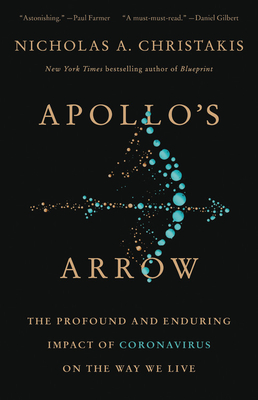
Apollo's Arrow: The Profound and Enduring Impact of Coronavirus on the Way We Live
by Nicholas A. Christakis
Rating: 4.0 ⭐
A piercing and scientifically grounded look at the emergence of the coronavirus pandemic and how it will change the way we live—"excellent and timely." ( The New Yorker ) Apollo's Arrow offers a riveting account of the impact of the coronavirus pandemic as it swept through American society in 2020, and of how the recovery will unfold in the coming years. Drawing on momentous (yet dimly remembered) historical epidemics, contemporary analyses, and cutting-edge research from a range of scientific disciplines, bestselling author, physician, sociologist, and public health expert Nicholas A. Christakis explores what it means to live in a time of plague—an experience that is paradoxically uncommon to the vast majority of humans who are alive, yet deeply fundamental to our species.Unleashing new divisions in our society as well as opportunities for cooperation, this 21st-century pandemic has upended our lives in ways that will test, but not vanquish, our already frayed collective culture. Featuring new, provocative arguments and vivid examples ranging across medicine, history, sociology, epidemiology, data science, and genetics, Apollo's Arrow envisions what happens when the great force of a deadly germ meets the enduring reality of our evolved social nature.
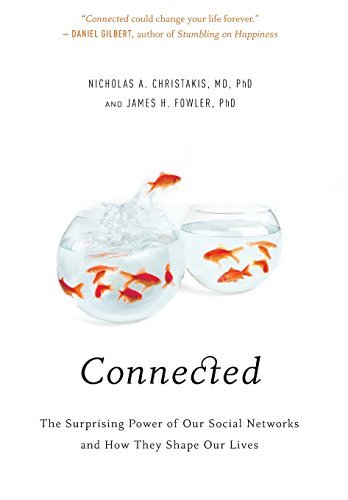
Connected: The Surprising Power of Our Social Networks and How They Shape Our Lives
by Nicholas A. Christakis
Rating: 3.7 ⭐
Celebrated scientists Nicholas Christakis and James Fowler explain the amazing power of social networks and our profound influence on one another's lives.Your colleague's husband's sister can make you fat, even if you don't know her. A happy neighbor has more impact on your happiness than a happy spouse. These startling revelations of how much we truly influence one another are revealed in the studies of Dr. Christakis and Fowler, which have repeatedly made front-page news nationwide.In Connected , the authors explain why emotions are contagious, how health behaviors spread, why the rich get richer, even how we find and choose our partners. Intriguing and entertaining, Connected overturns the notion of the individual and provides a revolutionary paradigm-that social networks influence our ideas, emotions, health, relationships, behavior, politics, and much more. It will change the way we think about every aspect of our lives.

This groundbreaking book explains prognosis from the perspective of doctors, examining why physicians are reluctant to predict the future, how doctors use prognosis, the symbolism it contains, and the emotional difficulties it involves. Drawing on his experiences as a doctor and sociologist, Nicholas Christakis interviewed scores of physicians and searched dozens of medical textbooks and medical school curricula for discussions of prognosis in an attempt to get to the core of this nebulous medical issue that, despite its importance, is only partially understood and rarely discussed."Highly recommended for everyone from patients wrestling with their personal prognosis to any medical practitioner touched by this bioethical dilemma."— Library Journal, starred review"[T]he first full general discussion of prognosis ever written. . . . [A] manifesto for a form of prognosis that's equal parts prediction-an assessment of likely outcomes based on statistical averages-and prophecy, an intuition of what lies ahead."—Jeff Sharlet, Chicago Reader"[S]ophisticated, extraordinarily well supported, and compelling. . . . [Christakis] argues forcefully that the profession must take responsibility for the current widespread avoidance of prognosis and change the present culture. This prophet is one whose advice we would do well to heed."—James Tulsky, M.D., New England Journal of Medicine

People are interconnected, and so their health is interconnected. In recognition of this social fact, there has been growing conceptual and empirical attention over the past decade to the impact of social networks on health. This article reviews prominent findings from this literature. After drawing a distinction between social network studies and social support studies, we explore current research on dyadic and supradyadic network influences on health, highlighting findings from both egocentric and sociocentric analyses. We then discuss the policy implications of this body of work, as well as future research directions. We conclude that the existence of social networks means that people's health is interdependent and that health and health care can transcend the individual in ways that patients, doctors, policy makers, and researchers should care about.
![[Death Foretold: Prophecy and Prognosis in Medical Care] [By: Christakis, Nicholas A.] [April, 2001]](/placeholder.svg?height=400&width=300)
[Death Foretold: Prophecy and Prognosis in Medical Care] [By: Christakis, Nicholas A.] [April, 2001]
by Nicholas A. Christakis