
N.A.M. Rodger
Nicholas Andrew Martin Rodger, FBA, is a historian of the British Royal Navy and Senior Research Fellow of All Souls College, Oxford.
14 Books Written

The Command of the Ocean: A Naval History of Britain 1649-1815
by N.A.M. Rodger
Rating: 4.1 ⭐
• 2 recommendations ❤️
The Command of the Ocean describes with unprecedented authority and scholarship the rise of Britain to naval greatness, and the central place of the Navy and naval activity in the life of the nation and government. It describes not just battles, voyages and cruises but how the Navy was manned, how it was supplied with timber, hemp and iron, how its men (and sometimes women) were fed, and above all how it was financed and directed. It was during the century and a half covered by this book that the successful organizing of these last three - victualling, money and management - took the Navy to the heart of the British state. It is the great achievement of the book to show how completely integrated and mutually dependent Britain and the Navy then became.

"[An] awesomely scholarly study. . . . The importance of this book is not only in its intrinsic interest, or its usefulness as a superb resource, but its demonstration that [Britain's] story cannot be told without a thorough knowledge of what happened at sea."―Alan Judd, Sunday Times [London] Throughout the chronicle of Britain's history, one factor above all others has determined the fate of kings, the security of trade, and the integrity of the realm. Without its navy, Britain would have been a weakling among the nations of Europe, could never have built or maintained the empire, and in all likelihood would have been overrun by the armies of Napoleon and Hitler. Now, for the first time in nearly a century, a prominent naval historian has undertaken a comprehensive account of the history and traditions of this most essential institution. N. A. M. Rodger has produced a superb work, combining scholarship with narrative, that demonstrates how the political and social history of Britain has been inextricably intertwined with the strength-or weakness-of her seapower. From the early military campaigns against the Vikings to the defeat of the great Spanish Armada in the reign of Elizabeth I, this volume touches on some of the most colorful characters in British history. It also provides fascinating details on naval construction, logistics, health, diet, and weaponry. "A splendid book. It combines impressively detailed research with breadth of perception....[Rodger] has prepared an admirable historical record that will be read and reread in the years ahead."― Times [London] 24 pages of illustrations

From the award-winning naval scholar N. A. M. Rodger comes the most revealing account yet of the mighty Georgian navy and British naval society of the eighteenth century. Meticulously researched, Rodger's portrait draws the reader into this fascinatingly complex world with vivid, entertaining characters and full details of life below the decks. The Wooden World provides the most complete history of a navy at any age, and is sure to be an indispensable volume for all fans of Patrick O'Brian, English history, and naval history.

The final instalment of N.A.M. Rodger's definitive, authoritative trilogy on Britain's naval historyAt the end of the French and Napoleonic wars, British sea-power was at its apogee. But by 1840, as one contemporary commentator put it, the Admiralty was full of ‘intellects becalmed in the smoke of Trafalgar’. How the Royal Navy reformed and reinvigorated itself in the course of the nineteenth century is just one thread in this magnificent book, which refuses to accept standard assumptions and analyses.All the great actions are here, from Navarino in 1827 (won by a daringly disobedient Admiral Codrington) to Jutland, D-Day, the Battle of the Atlantic and the battles in the Pacific in 1944/45 in concert with the US Navy. The development and strategic significance of submarine and navy air forces is superbly described, as are the rapid evolution of ships (from classic Nelsonic type, to hybrid steam/sail ships, then armour-clad and the fully armoured Dreadnoughts and beyond) and weapons. The social history of officers and men – and sometimes women – always a key part of the author’s work, is not neglected.Rodger sets all this in the essential context of politics and geo-strategy. The character and importance of leading admirals – Beatty, Fisher, Cunningham – is assessed, together with the roles of other less famous but no less consequential figures. Based on a lifetime’s learning, it is the culmination of one of the most significant British historical works in recent decades.Naval specialists will find much that is new here, and will be invigorated by the originality of Rodger’s judgements; but everyone who is interested in the one of the central threads in British history will find it rewarding.

Here is a book that is essential reading for anyone interested in the history of England's navy and of the eighteenth century in general. Its thorough scholarship does not in the least impede, but rather facilitates, its readability. It is masterly without being didactic.No historical figure of eighteenth-century England has been more grossly misrepresented than the inventor of our favorite fast food. The stereotype is well known: an unscrupulous man of pleasure whose mistress, a courtesan, was murdered on the steps of the Admiralty, inside which her lover was carelessly mismanaging the War of American Independence.It is refreshing to read a biography that explodes this long-accepted view. Martha Ray was not a courtesan but rather the Joan Sutherland of her day, whose rendering of "I know that my Redeemer liveth" was admired by the most discriminating critics. It was, appropriately, outside Covent Garden after attending a performance (not outside the Admiralty) that she was murdered by an unhinged admirer; she had lived for many years with and had borne children to John, fourth Earl of Sandwich. As to his mismanagement of naval affairs, Nicholas Rodger, the outstanding historian of the eighteenth-century navy, demonstrates in this brilliant and extremely readable book that as First Lord of the Admiralty he was in a class by himself.This was by no means his only distinction. As a diplomat he displayed extraordinary powers and won from foreign statesman the admiration and trust that his own countrymen then and subsequently have largely denied him. As a parliamentary manager of the constituencies that he was in a position to influence, he shared an energy, skill and wonderful tact in handling all sorts and conditions of men - qualities that were acknowledged and praised by his most unrelenting denigrators. As a young man he had been an adventurous traveler with a title to a place in the history of Greek epigraphy. His lifelong passion for music, especially in championing and reviving the then-unfashionable oratorios of Handel, has given him, in the present biographer's opinion, his nearest connection to the life of our own time.For it is the special pleasure of this absorbing book that though it is written by one of England's foremost naval historians, it is not in the least restricted to the dockyards and quarterdecks of the Georgian navy. The political analysis is subtle, original, and well-argued. The intellectual and artistic background is part of a strikingly new view of the tall, lounging figure that surveys us from Gainsborough's great portrait now in the Maritime Museum. Above all, the human quality of a man whose domestic life was blighted by the madness of a dearly loved wife is brought before us.


Essays in Naval History, from Medieval to Modern
by N.A.M. Rodger
The articles collected here (two appearing for the first time in English) cover a number of topics central to naval history and illustrate the author's contention that this is not only, or even chiefly, a distinct area of special study, but rather a central theme running through the history of England, and of the whole British Isles. Though the subjects and the styles vary a good deal, the studies are linked by a common approach and some common ideas. Hence many examine ways in which naval history has formed a key element in such subjects as intellectual, religious, administrative or medical history and explored the nature and meaning of sea power as a theme. At the same time naval history is a technical subject, which demands a willingness to understand warships - the most complex artefacts - and the structure of large and complex organisations. Detailed evidence about ships and weapons can build large conclusions, for example about late Anglo-Saxon government and military organisation, or about the nature of warfare at sea in the Renaissance era. While mostly written from the British point of view, several essays explicitly survey naval developments over a range of countries, and even the most narrowly focused are at least implicitly aware of the wider world of war at sea.

The Safeguard of the Sea: A Naval History of Britain Vol III
by N.A.M. Rodger
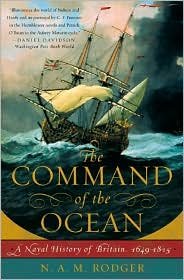
The Command of the Ocean 1st (first) edition Text Only
by N.A.M. Rodger
Excellent Book
![By N. A. M. Rodger - The Command of the Ocean: A Naval History of Britain, 1649¶ð-1815 (New Edition) (2005-05-02) [Hardcover]](https://m.media-amazon.com/images/S/compressed.photo.goodreads.com/books/1697842521i/147720557.jpg)
By N. A. M. Rodger - The Command of the Ocean: A Naval History of Britain, 1649¶ð-1815 (New Edition) (2005-05-02) [Hardcover]
by N.A.M. Rodger
2 VOLUMES : A NAVAL HISTORY OF BRITAIN :THE SAFEGUARD OF THE SEA (660-1649) & THE COMMAND OF THE OCEAN
by N.A.M. Rodger
The Sageguard of the Sea: A Naval History of Britain Vol II
by N.A.M. Rodger