
Michael Shermer
Michael Brant Shermer (born September 8, 1954 in Glendale, California) is an American science writer, historian of science, founder of The Skeptics Society, and Editor in Chief of its magazine Skeptic, which is largely devoted to investigating and debunking pseudoscientific and supernatural claims. The Skeptics Society currently has over 55,000 members. Shermer is also the producer and co-host of the 13-hour Fox Family television series Exploring the Unknown. Since April 2004, he has been a monthly columnist for Scientific American magazine with his Skeptic column. Once a fundamentalist Christian, Shermer now describes himself as an agnostic nontheist and an advocate for humanist philosophy. more info: http://us.macmillan.com/author/michae... http://en.wikipedia.org/wiki/Michael_...
28 Books Written

The Moral Arc: How Science Makes Us Better People
by Michael Shermer
Rating: 4.0 ⭐
• 2 recommendations ❤️
Bestselling author Michael Shermer's exploration of science and morality that demonstrates how the scientific way of thinking has made people, and society as a whole, more moralFrom Galileo and Newton to Thomas Hobbes and Martin Luther King, Jr., thinkers throughout history have consciously employed scientific techniques to better understand the non-physical world. The Age of Reason and the Enlightenment led theorists to apply scientific reasoning to the non-scientific disciplines of politics, economics, and moral philosophy. Instead of relying on the woodcuts of dissected bodies in old medical texts, physicians opened bodies themselves to see what was there; instead of divining truth through the authority of an ancient holy book or philosophical treatise, people began to explore the book of nature for themselves through travel and exploration; instead of the supernatural belief in the divine right of kings, people employed a natural belief in the right of democracy.In The Moral Arc , Shermer will explain how abstract reasoning, rationality, empiricism, skepticism--scientific ways of thinking--have profoundly changed the way we perceive morality and, indeed, move us ever closer to a more just world.

Conspiracy: Why the Rational Believe the Irrational
by Michael Shermer
Rating: 4.0 ⭐
• 1 recommendation ❤️
"A well-written and essential tool for those navigating today's complicated geopolitical landscape."― Library Journal Best-selling author Michael Shermer presents an overarching theory of conspiracy theories―who believes them and why, which ones are real, and what we should do about them. Nothing happens by accident, everything is connected, and there are no that is the essence of conspiratorial thinking. Long a fringe part of the American political landscape, conspiracy theories are now 147 members of Congress voted in favor of objections to the 2020 presidential election based on an unproven theory about a rigged electoral process promoted by the mysterious group QAnon. But this is only the latest example in a long history of ideas that include the satanic panics of the 1980s, the New World Order and Vatican conspiracy theories, fears about fluoridated water, speculations about President John F. Kennedy's assassination, and the notions that the Sandy Hook massacre was a false-flag operation and 9/11 was an inside job. In Conspiracy , Michael Shermer presents an overarching review of conspiracy theories―who believes them and why, which ones are real, and what we should do about them. Trust in conspiracy theories, he writes, cuts across gender, age, race, income, education level, occupational status―and even political affiliation. One reason that people believe these conspiracies, Shermer argues, is that enough of them are real that we should be constructively elections have been rigged (LBJ's 1948 Senate race); medical professionals have intentionally harmed patients in their care (Tuskegee); your government does lie to you (Watergate, Iran-Contra, and Afghanistan); and, tragically, some adults do conspire to sexually abuse children. But Shermer reveals that other factors are also in anxiety and a sense of loss of control play a role in conspiratorial cognition patterns, as do certain personality traits. This engaging book will be an important read for anyone concerned about the future direction of American politics, as well as anyone who's watched friends or family fall into patterns of conspiratorial thinking.

Collected essays from bestselling author Michael Shermer's celebrated columns in Scientific AmericanFor fifteen years, bestselling author Michael Shermer has written a column in Scientific American magazine that synthesizes scientific concepts and theory for a general audience. His trademark combination of deep scientific understanding and entertaining writing style has thrilled his huge and devoted audience for years. Now, in Skeptic , seventy-five of these columns are available together for the first time; a welcome addition for his fans and a stimulating introduction for new readers.

Why People Believe Weird Things: Pseudoscience, Superstition, and Other Confusions of Our Time
by Michael Shermer
Rating: 3.9 ⭐
"This sparkling book romps over the range of science and anti-science." --Jared Diamond, author of Guns, Germs, and SteelRevised and Expanded Edition.In this age of supposed scientific enlightenment, many people still believe in mind reading, past-life regression theory, New Age hokum, and alien abduction. A no-holds-barred assault on popular superstitions and prejudices, with more than 80,000 copies in print, Why People Believe Weird Things debunks these nonsensical claims and explores the very human reasons people find otherworldly phenomena, conspiracy theories, and cults so appealing. In an entirely new chapter, "Why Smart People Believe in Weird Things," Michael Shermer takes on science luminaries like physicist Frank Tippler and others, who hide their spiritual beliefs behind the trappings of science.Shermer, science historian and true crusader, also reveals the more dangerous side of such illogical thinking, including Holocaust denial, the recovered-memory movement, the satanic ritual abuse scare, and other modern crazes. Why People Believe Strange Things is an eye-opening resource for the most gullible among us and those who want to protect them.

The Believing Brain: From Ghosts and Gods to Politics and Conspiracies How We Construct Beliefs and Reinforce Them as Truths
by Michael Shermer
Rating: 3.9 ⭐
首先是信念,然後才是對信念的解釋。我們的大腦是信念引擎。從透過感官流入的感官數據,大腦會自然地尋找和發現模式,然後為這些模式賦予主體性、注入意義。一旦這些模式形成了信念,大腦便開始尋找支持這些信念的證據,如此加速鞏固信念的過程,這個過程周而復始地進入信念確認的正回饋循環;而我們的大腦用以鞏固信念的認知工具,數量非常眾多。本書以五個部分,說明我們何以相信奇怪的事物,更相信任何事物;書中從懷疑論角度切入,從政治、經濟、宗教領域,到陰謀論、超自然現象,以及人類為何相信不明飛行物、相信外星人綁架、相信超自然事物、相信讀心術等等,為什麼人們總相信自己是對的,別人都是錯的。透過對這些現象的分析,謝爾默期許,能為長期相信某個觀點或信仰的人帶來不同的思辨角度。也強調了我們之所以需要科學,就是因為科學是有史以來確定信念是否符合現實的最佳工具。

A creationist-turned-scientist demonstrates the facts of evolution and exposes Intelligent Design's real agendaScience is on the defensive. Half of Americans reject the theory of evolution and "Intelligent Design" campaigns are gaining ground. Classroom by classroom, creationism is overthrowing biology.In Why Darwin Matters , bestselling author Michael Shermer explains how the newest brand of creationism appeals to our predisposition to look for a designer behind life's complexity. Shermer decodes the scientific evidence to show that evolution is not "just a theory" and illustrates how it achieves the design of life through the bottom-up process of natural selection. Shermer, once an evangelical Christian and a creationist, argues that Intelligent Design proponents are invoking a combination of bad science, political antipathy, and flawed theology. He refutes their pseudoscientific arguments and then demonstrates why conservatives and people of faith can and should embrace evolution. He then appraises the evolutionary questions that truly need to be settled, building a powerful argument for science itself.Cutting the politics away from the facts, Why Darwin Matters is an incisive examination of what is at stake in the debate over evolution.

A new edition covering the latest scientific research on how the brain makes us believers or skepticsRecent polls report that 96 percent of Americans believe in God, and 73 percent believe that angels regularly visit Earth. Why is this? Why, despite the rise of science, technology, and secular education, are people turning to religion in greater numbers than ever before? Why do people believe in God at all?These provocative questions lie at the heart of How We Believe , an illuminating study of God, faith, and religion. Bestselling author Michael Shermer offers fresh and often startling insights into age-old questions, including how and why humans put their faith in a higher power, even in the face of scientific skepticism. Shermer has updated the book to explore the latest research and theories of psychiatrists, neuroscientists, epidemiologists, and philosophers, as well as the role of faith in our increasingly diverse modern world.Whether believers or nonbelievers, we are all driven by the need to understand the universe and our place in it. How We Believe is a brilliant scientific tour of this ancient and mysterious desire.
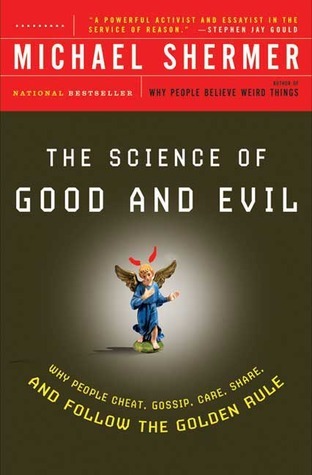
The Science of Good and Evil: Why People Cheat, Gossip, Care, Share, and Follow the Golden Rule
by Michael Shermer
Rating: 3.9 ⭐
From bestselling author Michael Shermer, an investigation of the evolution of morality that is "a paragon of popularized science and philosophy" The Sun (Baltimore)A century and a half after Darwin first proposed an "evolutionary ethics," science has begun to tackle the roots of morality. Just as evolutionary biologists study why we are hungry (to motivate us to eat) or why sex is enjoyable (to motivate us to procreate), they are now searching for the very nature of humanity.In The Science of Good and Evil, science historian Michael Shermer explores how humans evolved from social primates to moral primates; how and why morality motivates the human animal; and how the foundation of moral principles can be built upon empirical evidence.Along the way he explains the implications of scientific findings for fate and free will, the existence of pure good and pure evil, and the development of early moral sentiments among the first humans. As he closes the divide between science and morality, Shermer draws on stories from the Yanamamö, infamously known as the "fierce people" of the tropical rain forest, to the Stanford studies on jailers' behavior in prisons. The Science of Good and Evil is ultimately a profound look at the moral animal, belief, and the scientific pursuit of truth.

Conspiracies & Conspiracy Theories: What We Should and Shouldn't Believe - and Why
by Michael Shermer
Rating: 3.8 ⭐
Listening Length: 6 hours and 30 minutesThe stuff of conspiracy theories makes for great, entertaining stories in movies, books, and television. And there is no shortage of subjects: from who really killed JFK to the truth behind 9/11. And then, there are subjects from alien invasions to the Moon landing was simulated - theories that are truly out of this world, which according to some, is flat. Many of these crazy concepts have jumped off the pages or screens to become so pervasive in our culture that thousands - even millions - subscribe to them as reality. Does the idea that millions of Americans buy into conspiracy theories feel like a ... conspiracy? Consider that: 81 percent believes more than one person was responsible for the assassination of John F. Kennedy;One-third of this country believes 9/11 was an "inside job" by the Bush administration; 21 percent believes aliens crash-landed in Roswell and are being hidden in Area 51; andSeven percent believes the Moon landing was faked. What causes people, frequently well-educated and highly regarded people, to advocate these unfounded - often disproven - ideas as reality? And more disturbing, why is the power of conspiracies so compelling - powerful enough to motivate people to act, to even participate in horrific undertakings?In this eye-opening Audible Original, Professor Michael Shermer takes you through some of the most prevalent conspiracy theories of history, giving you a foundational understanding of how and why they came about, who was likely to believe and perpetuate them, and the reality behind the beliefs. Whether you are looking for the truth that is out there; fascinated by the psychology of why people buy into conspiracy theories; or interested in how conspiracy theories shaped and were shaped, by history, this course will provide you with all the tools you need to better understand the pervasiveness of conspiracy theories in our culture.

The Mind of the Market: Compassionate Apes, Competitive Humans, and Other Tales from Evolutionary Economics
by Michael Shermer
Rating: 3.5 ⭐
Bestselling author Michael Shermer explains how evolution shaped the modern economy--and why people are so irrational about money How did we make the leap from ancient hunter-gatherers to modern consumers and traders? Why do people get so emotional and irrational about bottom-line financial and business decisions? Is the capitalist marketplace a sort of Darwinian organism, evolved through natural selection as the fittest way to satisfy our needs? In this eye-opening exploration, author and psychologist Michael Shermer uncovers the evolutionary roots of our economic behavior.Drawing on the new field of neuroeconomics, Shermer investigates what brain scans reveal about bargaining, snap purchases, and establishing trust in business. He scrutinizes experiments in behavioral economics to understand why people hang on to losing stocks, why negotiations disintegrate into tit-for-tat disputes, and why money does not make us happy. He brings together astonishing findings from psychology, biology, and other sciences to describe how our tribal ancestry makes us suckers for brands, why researchers believe cooperation unleashes biochemicals similar to those released during sex, why free trade promises to build alliances between nations, and how even capuchin monkeys get indignant if they don't get a fair reward for their work.

Despite our best efforts, we're all vulnerable to believing things without using logic or having proper evidence-and it doesn't matter how educated or well read we are. But there is a method for avoiding such pitfalls of human nature, and it's called skepticism. By using rational inquiry and seeing subjects from a scientific perspective, we can approach even the most sensitive claims with clear eyes to ultimately arrive at the truth. During 18 lectures that will surprise, challenge, and entertain you, you will learn how to think, not just what to think-and you'll come to understand why extraordinary claims require extraordinary evidence.You'll discover how skepticism can help differentiate between real science and pseudoscience, as well as between "scientific" history and pseudohistory-distinctions that have serious educational and political implications.Fascinating case studies illustrate how you can apply the methods of skepticism to detect specious claims and faulty logic in any scenario you encounter such as:•The methodology employed by Holocaust deniers•Arguments made by proponents of creationism•The biology of near-death experiences and the sensed-presence effect•Psychic abilities and other "paranormal" phenomena.As you learn how our brains work to form beliefs, you'll examine the classic fallacies of thought that lead us to experience mistakes in thinking and to form bad arguments in favor of our beliefs.Is there a God? Is there life after death? Is there a basis for morality without God? Skepticism 101 doesn't shy away from controversial questions, nor does it give final answers. What it offers are methods and hard evidence for rationally evaluating various claims and positions, and an opportunity to understand why you believe what you believe.Listening Length: 9 hours and 10 minutes. Narrated by the author.

Heavens on Earth: The Scientific Search for the Afterlife, Immortality, and Utopia
by Michael Shermer
Rating: 3.8 ⭐
A scientific exploration into humanity’s obsession with the afterlife and quest for immortality from the bestselling author and skeptic Michael Shermer In his most ambitious work yet, Shermer sets out to discover what drives humans’ belief in life after death, focusing on recent scientific attempts to achieve immortality by radical life extentionists, extropians, transhumanists, cryonicists, and mind-uploaders, along with utopians who have attempted to create heaven on earth. For millennia, religions have concocted numerous manifestations of heaven and the afterlife, the place where souls go after the death of the physical body. Religious leaders have toiled to make sense of this place that a surprising 74% of Americans believe exists, but from which no one has ever returned to report what it is really like. Heavens on Earth concludes with an uplifting paean to purpose and progress and what we can do in the here-and-now, whether or not there is a hereafter.

In "The Borderlands of Science," Michael Shermer takes us to the place where real science, borderline science - and just plain nonsense - collide. Shermer argues that while science is the best lens through which to view the world, it is often difficult to decipher where valid science leaves off and borderland, or "fuzzy." science begins. To solve this dilemma, he looks at a range of topics that put this boundary line in high relief. For instance, he debunks the many "theories of everything" that try to reduce the complexity of the world to a single principle. He examines the work of Darwin and Freud, explaining why one is among the great scientists in history, while the other has become nothing more than a historical curiosity. And he reveals how scientists themselves can be led astray, as seen in the infamous Piltdown hoax - the set of ancient hominid bones discovered in England that after decades turned out to be nothing more than an enormous forgery.From SETI and acupuncture to hypnosis and human cloning, this enlightening book will help readers stay grounded in common sense amid the flurry of supposedly scientific theories that inundate us every day.

Denying History: Who Says the Holocaust Never Happened & Why Do They Say It?
by Michael Shermer
Rating: 4.0 ⭐
Denying History takes an in-depth look at those claiming the Holocaust never happened, exploring their motivations. While many dismiss Holocaust deniers as antisemitic neo-Nazis not deserving response, historians Michael Shermer & Alex Grobman have immersed themselves in their minds & culture. They've interviewed deniers, read their literature, monitored their Web sites, attended their conferences, debated them, even traveled thru Europe to conduct research at the extermination camps. Uncovering a complex social movement, the authors go deeper than ever before in not only trying to understand deniers' motives, but also refuting their points. In the process, they show how one can be certain the Holocaust happened &, for that matter, how one confirms any historical event.List of IllustrationsForewordA Note on TerminologyAcknowledgmentsIntroductionFree Speech & HistoryInside the Denial MovementArguments & RefutationsTruth & HistoryEpilogueNotesBibliographyIndex

"Michael Shermer has given a lot of things a lot of thought. If your perceptions have ever rubbed you the wrong way, you'll find Science Friction fascinating." —Bill Nye, The Science GuyA scientist pretends to be a psychic for a day—and fools everyone. An athlete discovers that good-luck rituals and getting into "the zone" may, or may not, improve his performance. A son explores the possiblities of alternative and experimental medicine for his cancer-ravaged mother. And a skeptic realizes that it is time to turn the skeptical lens onto science itself. In each of the fourteen essays in Science Friction, bestselling author Michael Shermer explores the very personal barriers and biases that plague and propel science, especially when scientists push against the unknown. What do we know and what do we not know? How does science respond to controversy, attack, and uncertainty? When does theory become accepted fact? As always, Shermer delivers a thought-provoking, fascinating, and entertaining view of life in the scientific age."Meaty accounts [and] entertaining discussion . . . well worth having." —The Washington Post Book World"[Shermer's] main obsession is the truth . . . Amateur skeptics will learn from his matter-of-fact dismissals of astrology and creationism." —Psychology Today"Extremely entertaining." —Science News

Who is the 'Devil'? And what is he due? The Devil is anyone who disagrees with you. And what he is due is the right to speak his mind. He must have this for your own safety's sake because his freedom is inextricably tied to your own. If he can be censored, why shouldn't you be censored? If we put barriers up to silence 'unpleasant' ideas, what's to stop the silencing of any discussion? This book is a full-throated defense of free speech and open inquiry in politics, science, and culture by the New York Times bestselling author and skeptic Michael Shermer. The new collection of essays and articles takes the Devil by the horns by tackling five key free thought and free speech, politics and society, scientific humanism, religion, and the ideas of controversial intellectuals. For our own sake, we must give the Devil his due.

Virtually unknown today, Alfred Russel Wallace was the co-discoverer of natural selection with Charles Darwin and an eminent scientist who stood out among his Victorian peers as a man of formidable mind and equally outsized personality. Now Michael Shermer rescues Wallace from the shadow of Darwin in this landmark biography.Here we see Wallace as perhaps the greatest naturalist of his age--spending years in remote jungles, collecting astounding quantities of specimens, writing thoughtfully and with bemused detachment at his reception in places where no white man had ever gone. Here, too, is his supple and forceful intelligence at work, grappling with such arcane problems as the bright coloration of caterpillars, or shaping his 1858 paper on natural selection that prompted Darwin to publish (with Wallace) the first paper outlining the theory of evolution. Shermer also shows that Wallace's self-trained intellect, while powerful, also embraced surprisingly naive ideas, such as his deep interest in the study of spiritual manifestations and seances. Shermer shows that the same iconoclastic outlook that led him to overturn scientific orthodoxy as he worked in relative isolation also led him to embrace irrational beliefs, and thus tarnish his reputation.As author of Why People Believe Weird Things and founding publisher of Skeptic magazine, Shermer is an authority on why people embrace the irrational. Now he turns his keen judgment and incisive analysis to Wallace's life and his contradictory beliefs, restoring a leading figure in the rise of modern science to his rightful place.

An exciting book of discovery, Teach Your Child Science introduces such subjects as physics, geology, and biology in terms that parents can easily share with their children.

In recent years, brain science has converged on a surprising framework for how we believe the things we believe. It appears that the origin of belief is emotive, rooted in things like group allegiance or the affinities we may have for certain patterns of moral values. Only later does our rationality speak up. "Motivated reasoning" is the term psychology has given this process, although a cynic might possibly be forgiven for calling it "bias."Where does this leave our beliefs about politics? On the one hand, we may have some cause for despair, as our beliefs may not be as objectively justified as we like to imagine. On the other, the emerging science of mind may yield effective ways to correct our biases, or at least to understand their origins. If so, a new, more sophisticated political science may be in order, one rooted firmly in brain science.To discuss these issues, we've recruited an eclectic panel, even by our standards. Libertarian science writer Michael Shermer leads with a taste from his new book The Believing From Ghosts and Gods to Politics and Conspiracies—How We Construct Beliefs and Reinforce Them as Truths. He will be answered by Artificial Intelligence expert Eliezer Yudkowsky, perhaps best known for his work at the group blog LessWrong.com; Christian blogger and cultural critic Joe Carter; and Reason magazine's science columnist Ronald Bailey.

Race Across America: The Agonies and Glories of the World's Longest and Cruelest Bicycle Race
by Michael Shermer
Rating: 3.7 ⭐
Book by Shermer, Michael

Yaratılışçıların sosyal sorunlar listesi – önüne gelenle yatmak, pornografi, çocuk düşürme, yeni doğan çocuğu öldürme, ırkçılık vb – açıkça Darwin ve evrim teorisinden çok uzun süre önce vardı. Darwin'in ortaya çıkışından önce, birkaç bin yıldır, Yahudilik, Hıristiyanlık ve diğer örgütlü dinler, bu sosyal sorunları çözmede başarısızdır. Evrim biliminin düşüş göstermesinin, toplumsal kötülükleri azalttığı ya da yok ettiği konusunda hiçbir kanıt yoktur. Kendi toplumsal ve ahlaki sorunlarımız için Darwin'i, evrim teorisini ve bilimi suçlamak, bu karmaşık sosyal konuları, daha derin şekilde analiz etme ve daha iyi anlama konusunda bizi engeller.Evrim teorisi, inanç ve dinin yerini alamaz ve bilimin, bunu yapabiliyormuş gibi görünmekte hiçbir çıkarı yoktur. Evrim teorisi, bilimsel bir teoridir, dini bir doktrin değildir. Sadece kanıtla ayakta durur ya da çöker. Dini inanç, tanım gereği, kanıt yokken ya da önemsizken inanca dayanır. Onlar, insan ruhunda farklı yerleri doldururlar.Evrim teorisinden korkmak, insanın dini inancının haklı çıkması için bilimsel kanıt araması gibi, bir insanın inancındaki yetersizliğinin göstergesidir. Eğer yaratılışçıların kendi dinlerine gerçek bir inancı varsa, bilim adamlarının ne düşündüğü ya da dediği önemli olmamalıdır. Ve tanrının bilimsel kanıtı ya da İncilsel öykülerle ilgilenilmemelidir.

Publisher's Summary from Audible: This is a sweeping look at science, its history and philosophy from the Middle Ages to the present, with special emphasis on defining science within the cultural context of the age, who was doing science at the time, and what their goals were in conducting science. This course reflects Dr. Shermer's doctoral training at Claremont Graduate School.

Offers advice on training routines, nutrition, riding style, clothing, advanced equipment, and safety, and includes tips on gaining the psychological edge

A long-distance cyclist offers practical advice on training, massage, stretches, gearing systems, training aids, and riding positions, and discusses his racing experiences

In The Soul of Science, Michael Shermer asks, "Can we find spiritual meaning and purpose in a scientific worldview?" Spirituality is a way of being in the world, a sense of one's place in the cosmos, a relationship to that which extends beyond ourselves. There are many sources of spirituality; religion may be the most common, but it is by no means the only. Anything that generates a sense of awe may be a source of spirituality. Science does this in spades.

This 16-page booklet is designed to hone your critical thinking skills. It includes suggestions on what questions to ask, what traps to avoid, specific examples of how the scientific method is used to test pseudoscience and paranormal claims, and a how-to guide for developing a class in critical thinking.Plus, you’ll also find:Sagan’s Ten Tools for Baloney Detection and Shermer’s Ten Questions For Baloney DetectionHow Thinking Goes Wrong: The 25 Fallacies of ThinkingProblems in Scientific ThinkingTheory Influences ObservationsThe Observer Changes the ObservedEquipment Construct ResultsProblems in Pseudoscientific ThinkingAnecdotes Do Not Make a ScienceScientific Language Does Not Make a ScienceBold Statements Do Not Make True ClaimsHeresy Does Not Equal CorrectnessBurden of ProofRumors Do Not Equal RealityUnexplained is Not InexplicableFailures are RationalizedAfter-the-Fact ReasoningCoincidenceRepresentativenessLogical Problems in ThinkingEmotive Words and False AnalogiesAd IgnorantiamAd Hominem and Tu QuoqueHasty GeneralizationOver-reliance on AuthoritiesEither-OrCircular ReasoningReductio ad Absurdum and the Slippery SlopePsychological Problems in ThinkingEffort Inadequacies and the Need forProblem-Solving InadequaciesIdeological Immunity, or The Planck ProblemEight Sample Syllabi: How to Teach a Course in Science & PseudoscienceThe Most Recommended Skeptical BooksScience and Skepticism: Science, Scientific Method and Skepticism — How They Contribute to Rational and Critical Thinking

Vtg Why People Do Weird Things - Michael Shermer [Paperback] Mchael Shermer
by Michael Shermer
Rating: 4.0 ⭐
This rare and vintage book is a perfect addition to any bibliophile's collection