
Max Hastings
Sir Max Hugh Macdonald Hastings, FRSL, FRHistS is a British journalist, editor, historian and author. His parents were Macdonald Hastings, a journalist and war correspondent, and Anne Scott-James, sometime editor of Harper's Bazaar. Hastings was educated at Charterhouse School and University College, Oxford, which he left after a year.After leaving Oxford University, Max Hastings became a foreign correspondent, and reported from more than sixty countries and eleven wars for BBC TV and the London Evening Standard. Among his bestselling books Bomber Command won the Somerset Maugham Prize, and both Overlord and The Battle for the Falklands won the Yorkshire Post Book of the Year Prize. After ten years as editor and then editor-in-chief of The Daily Telegraph, he became editor of the Evening Standard in 1996. He has won many awards for his journalism, including Journalist of The Year and What the Papers Say Reporter of the Year for his work in the South Atlantic in 1982, and Editor of the Year in 1988. He stood down as editor of the Evening Standard in 2001 and was knighted in 2002. His monumental work of military history, Armageddon: The Battle for Germany 1944-1945 was published in 2005. He is also a Fellow of the Royal Society of Literature. Sir Max Hastings honoured with the $100,000 2012 Pritzker Military Library Literature Award for Lifetime Achievement in Military Writing.
30 Books Written

With an introduction read by Max Hastings. A companion volume to his best-selling Armageddon, Max Hastings' account of the battle for Japan is a masterful military history.Featuring the most remarkable cast of commanders the world has ever seen, the dramatic battle for Japan of 1944-45 was acted out across the vast stage of Asia: Imphal and Kohima, Leyte Gulf and Iwo Jima, Okinawa, and the Soviet assault on Manchuria.In this gripping narrative, Max Hastings weaves together the complex strands of an epic war, exploring the military tactics behind some of the most triumphant and most horrific scenes of the 20th century. The result is a masterpiece that balances the story of command decisions, rivalries, and follies with the experiences of soldiers, sailors, and airmen of all sides as only Max Hastings can.
![Abyss World on the Brink The Cuban Missile Crisis 1962, War on Peace [Hardcover], War How Conflict Shaped Us [Hardcover] 3 Books Collection Set](/placeholder.svg?height=400&width=300)
Please Note That The Following Individual Books As Per Original ISBN and Cover Image In this Listing shall be Dispatched Titles In This War How Conflict Shaped Us [Hardcover] War on Peace [Hardcover] World on the Brink, The Cuban Missile Crisis 1962 Abyss World on the Brink The Cuban Missile Crisis 1962, War on Peace [Hardcover], War How Conflict Shaped Us [Hardcover] 3 Books Collection War How Conflict Shaped Us [Hardcover]: In War, Professor Margaret MacMillan explores the deep links between society and war and the questions they raise. We learn when war began - whether among early homo sapiens or later, as we began to organise ourselves into tribes and settle in communities. We see the ways in which war reflects changing societies and how war has brought change - for better and worse. War on Peace [Hardcover]: In an astonishing journey from the corridors of power in Washington, DC, to some of the most remote and dangerous places on earth – Afghanistan, Somalia, and North Korea among them acclaimed investigative journalist Ronan Farrow illuminates one of the most consequential and poorly understood changes in American history. World on the Brink, The Cuban Missile Crisis 1962: Max Hastings’s graphic new history tells the story from the viewpoints of national leaders, Russian officers, Cuban peasants, American pilots and British disarmers. Max Hastings deploys his accustomed blend of eye-witness interviews, archive documents and diaries, White House tape recordings, top-down analysis, first to paint word-portraits.

From one of our finest military historians, a monumental work that shows us at once the truly global reach of World War II and its deeply personal consequences.World War II involved tens of millions of soldiers and cost sixty million lives—an average of twenty-seven thousand a day. For thirty-five years, Max Hastings has researched and written about different aspects of the war. Now, for the first time, he gives us a magnificent, single-volume history of the entire war.Through his strikingly detailed stories of everyday people—of soldiers, sailors and airmen; British housewives and Indian peasants; SS killers and the citizens of Leningrad, some of whom resorted to cannibalism during the two-year siege; Japanese suicide pilots and American carrier crews—Hastings provides a singularly intimate portrait of the world at war. He simultaneously traces the major developments—Hitler’s refusal to retreat from the Soviet Union until it was too late; Stalin’s ruthlessness in using his greater population to wear down the German army; Churchill’s leadership in the dark days of 1940 and 1941; Roosevelt’s steady hand before and after the United States entered the war—and puts them in real human context.Hastings also illuminates some of the darker and less explored regions under the war’s penumbra, including the conflict between the Soviet Union and Finland, during which the Finns fiercely and surprisingly resisted Stalin’s invading Red Army; and the Bengal famine in 1943 and 1944, when at least one million people died in what turned out to be, in Nehru’s words, “the final epitaph of British rule” in India.Remarkably informed and wide-ranging, Inferno is both elegantly written and cogently argued. Above all, it is a new and essential understanding of one of the greatest and bloodiest events of the twentieth century.

An absorbing and definitive modern history of the Vietnam War from the acclaimed New York Times bestselling author of The Secret War.Vietnam became the Western world’s most divisive modern conflict, precipitating a battlefield humiliation for France in 1954, then a vastly greater one for the United States in 1975. Max Hastings has spent the past three years interviewing scores of participants on both sides, as well as researching a multitude of American and Vietnamese documents and memoirs, to create an epic narrative of an epic struggle. He portrays the set pieces of Dienbienphu, the 1968 Tet offensive, the air blitz of North Vietnam, and also much less familiar miniatures such as the bloodbath at Daido, where a US Marine battalion was almost wiped out, together with extraordinary recollections of Ho Chi Minh’s warriors. Here are the vivid realities of strife amid jungle and paddies that killed two million people.Many writers treat the war as a US tragedy, yet Hastings sees it as overwhelmingly that of the Vietnamese people, of whom forty died for every American. US blunders and atrocities were matched by those committed by their enemies. While all the world has seen the image of a screaming, naked girl seared by napalm, it forgets countless eviscerations, beheadings, and murders carried out by the communists. The people of both former Vietnams paid a bitter price for the Northerners’ victory in privation and oppression. Here is testimony from Vietcong guerrillas, Southern paratroopers, Saigon bargirls, and Hanoi students alongside that of infantrymen from South Dakota, Marines from North Carolina, and Huey pilots from Arkansas.No past volume has blended a political and military narrative of the entire conflict with heart-stopping personal experiences, in the fashion that Max Hastings’ readers know so well. The author suggests that neither side deserved to win this struggle with so many lessons for the twenty-first century about the misuse of military might to confront intractable political and cultural challenges. He marshals testimony from warlords and peasants, statesmen and soldiers, to create an extraordinary record.

In September 1944, the Allies believed that Hitler’s army was beaten and expected the bloodshed to end by Christmas. Yet a series of mistakes and setbacks, including the Battle of the Bulge, drastically altered this timetable and led to eight more months of brutal fighting. With Armageddon, the eminent military historian Max Hastings gives us memorable accounts of the great battles and captures their human impact on soldiers and civilians. He tells the story of both the Eastern and Western Fronts, raising provocative questions and offering vivid portraits of the great leaders. This rousing and revelatory chronicle brings to life the crucial final months of the twentieth century’s greatest global conflict.

A magisterial chronicle of the calamity that crippled Europe in 1914.1914: a year of unparalleled change. The year that diplomacy failed, Imperial Europe was thrown into its first modernised warfare and white-gloved soldiers rode in their masses across pastoral landscapes into the blaze of machine–guns. What followed were the costliest days of the entire War. But how had it happened?In Catastrophe: 1914 Max Hastings, best-selling author of the acclaimed All Hell Let Loose, answers at last how World War I could ever have begun. Ranging across Europe, from Paris to St. Petersberg, from Kings to corporals, Catastrophe 1914 traces how tensions across the continent kindled into a blaze of battles; not the stalemates of later trench-warfare but battles of movement and dash where Napoleonic tactics met with weapons from a newly industrialised age. A searing analysis of the power-brokering, vanity and bluff in the diplomatic maelstrom reveals who was responsible for the birth of this catastrophic world in arms. Mingling the experiences of humbler folk with the statesmen on whom their lives depended, Hastings asks: whose actions were justified?From the out-break of war through to its terrible making, and the bloody gambles in Sarajevo and Mons, Le Cateau, Marne and Tannenberg, this is the international story of World War I in its most severe and influential period. Published to coincide with its 100th Anniversary, Catastrophe: 1914 explains how and why this war, which shattered and changed the Western world for ever, was fought.

On June 6, 1944, American and British troops staged the greatest amphibious landing in history to begin Operation Overlord, the battle to liberate Europe from the scourge of the Third Reich. With gut-wrenching realism and immediacy, Hastings reveals the terrible human cost that this battle exacted. Moving beyond just the storming of Omaha beach and D-Day, he explores the Allies’ push inward, with many British and American infantry units suffering near 100 percent casualties during the course of that awful summer. Far from a gauzy romanticized remembrance, Hastings details a grueling ten week battle to overpower the superbly trained, geographically entrenched German Wehrmacht. Uncompromising and powerful in its depiction of wartime, this is the definitive book on D-Day and the Battle of Normandy.

It was the first war we could not win. At no other time since World War II have two superpowers met in battle. Now Max Hastings, preeminent military historian, takes us back to the bloody, bitter, struggle to restore South Korean independence after the Communist invasion of June 1950. Using personal accounts from interviews with more than 200 vets - including the Chinese - Hasting follows real officers and soldiers through the battles. He brilliantly captures the Cold War crisis at home - the strategies and politics of Truman, Acheson, Marshall, MacArthur, Ridgeway, and Bradley - and shows what we should have learned in the war that was the prelude to Vietnam.

Bestselling author Max Hastings offers a welcome re-evaluation of one of the most gripping and tense international events in modern history—the Cuban Missile Crisis—providing a people-focused narrative that explores the attitudes and conduct of Russians, Cubans, Americans, and a terrified world that followed each moment as it unfolded.In The Abyss, Max Hastings turns his focus to one of the most terrifying events of the mid-twentieth century—the thirteen days in October 1962 when the world stood on the brink of nuclear war. Hastings looks at the conflict with fresh eyes, focusing on the people at the heart of the crisis—America President John F. Kennedy, Soviet First Secretary Nikita Khrushchev, Cuban Prime Minister Fidel Castro, and a host of their advisors.Combining in-depth research with Hasting’s well-honed insights, The Abyss is a human history that unfolds on a wide, colorful canvas. As the action moves back and forth from Moscow to Washington, DC, to Havana, Hastings seeks to explain, as much as to describe, the attitudes and conduct of the Soviets, Cubans, and Americans, and to recreate the tension and heightened fears of countless innocent bystanders whose lives hung in the balance. Reflecting on the outcome of these events, he reveals how the aftermath of this momentous crisis continues to reverberate today.Powerful, and riveting, filled with compelling detail and told with narrative flair, The Abyss is history at its finest.

Examining the espionage and intelligence stories in World War II, on a global basis, bringing together the British, American, German, Russian and Japanese histories.There were two Second World Wars: one fought on the battlefields, and another conducted by men and women few of whom ever fired a weapon in anger, but whose efforts vastly influenced the conflict.‘The Secret War 1939-45’ examines that other war waged by British, American, German, Russian and Japanese intelligence-gathering personnel. Moving chronologically through the conflict, Max Hastings charts the successes and failures of allied and axis forces, espionage and counterespionage.Observing how the evolution of electronic communications dramatically increased the possibilities and significance of these secret battles, this is the story of intelligence beyond Bletchley to the FBI, Russia and the spies of axis dictatorships. For the first time since his best-selling ‘All Hell Let Loose’, Max Hastings returns to the Second World War, this time to chronicle its second, untold story.

"Must be read by all our military people and anyone who wants to find out what really happened on the Falkland Islands." - James M. Gavin

Renowned historian Max Hastings recreates one of the most thrilling events of World War II: Operation Pedestal, the British action to save its troops from starvation on Malta—an action-packed tale of courage, fortitude, loss, and triumph against all odds.In 1940, Hitler had two choices when it came to the Mediterranean region: stay out, or commit sufficient forces to expel the British from the Middle East. Against his generals’ advice, the Fuhrer committed a major strategic blunder. He ordered the Wehrmacht to seize Crete, allowing the longtime British bastion of Malta to remain in Allied hands. Over the fall of 1941, the Royal Navy and RAF, aided by British intelligence, used the island to launch a punishing campaign against the Germans, sinking more than 75 percent of their supply ships destined for North Africa.But by spring 1942, the British lost their advantage. In April and May, the Luftwaffe dropped more bombs on Malta than London received in the blitz. A succession of British attempts to supply and reinforce the island by convoy during the spring and summer of 1942 failed. British submarines and surface warships were withdrawn, and the remaining forces were on the brink of starvation.Operation Pedestal chronicles the ensuing British mission to save those troops. Over twelve days in August, German and Italian forces faced off against British air and naval fleets in one of the fiercest battles of the war, while ships packed with supplies were painstakingly divided and dispersed. In the end only a handful of the Allied ships made it, most important among them the SS Ohio, carrying the much-needed fuel to the men on Malta.As Hastings makes clear, while the Germans claimed victory, it was the British who ultimately prevailed, for Malta remained a crucial asset that helped lead to the Nazis’ eventual defeat. While the Royal Navy never again attempted an operation on such scale, Hasting argues that without that August convoy the British on Malta would not have survived. In the cruel accountancy of war, the price was worth paying.

A vivid and incisive portrait of Winston Churchill during wartime from acclaimed historian Max Hastings, Winston’s War captures the full range of Churchill’s endlessly fascinating character. At once brilliant and infuriating, self-important and courageous, Hastings’s Churchill comes brashly to life as never before.Beginning in 1940, when popular demand elevated Churchill to the role of prime minister, and concluding with the end of the war, Hastings shows us Churchill at his most intrepid and essential, when, by sheer force of will, he kept Britain from collapsing in the face of what looked like certain defeat. Later, we see his significance ebb as the United States enters the war and the Soviets turn the tide on the Eastern Front. But Churchill, Hastings reminds us, knew as well as anyone that the war would be dominated by others, and he managed his relationships with the other Allied leaders strategically, so as to maintain Britain’s influence and limit Stalin’s gains.At the same time, Churchill faced political peril at home, a situation for which he himself was largely to blame. Hastings shows how Churchill nearly squandered the miraculous escape of the British troops at Dunkirk and failed to address fundamental flaws in the British Army. His tactical inaptitude and departmental meddling won him few friends in the military, and by 1942, many were calling for him to cede operational control. Nevertheless, Churchill managed to exude a public confidence that brought the nation through the bitter war.Hastings rejects the traditional Churchill hagiography while still managing to capture what he calls Churchill’s “appetite for the fray.” Certain to be a classic, Winston’s War is a riveting profile of one of the greatest leaders of the twentieth century.
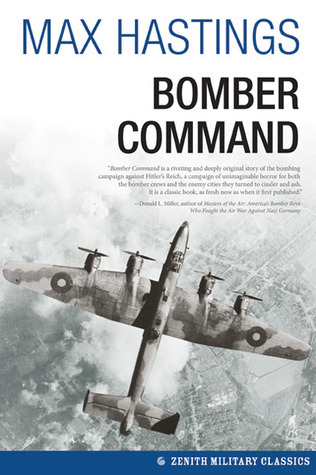
Bomber Command’s air offensive against the cities of Nazi Germany was one of the most epic campaigns of World War II. More than 56,000 British and Commonwealth aircrew and 600,000 Germans died in the course of the RAF’s attempt to win the war by bombing. The struggle in the air began meekly in 1939 with only a few Whitleys, Hampdens, and Wellingtons flying blindly through the night on their ill-conceived bombing runs. It ended six years later with 1,600 Lancasters, Halifaxes, and Mosquitoes, equipped with the best of British wartime technology, razing whole German cities in a single night. Bomber Command, through fits and starts, grew into an effective fighting force.In Bomber Command, originally published to critical acclaim in the U.K., famed British military historian Sir Max Hastings offers a captivating analysis of the strategy and decision-making behind one of World War II’s most violent episodes. With firsthand descriptions of the experiences of aircrew from 1939 to 1945—based on one hundred interviews with veterans—and a harrowing narrative of the experiences of Germans on the ground during the September 1944 bombing of Darmstadt, Bomber Command is widely recognized as a classic account of one of the bloodiest campaigns in World War II history. Now back in print in the U.S., this book is an essential addition to any history reader’s bookshelf.

Operation Chastise, the destruction of the Mohne and Eder dams in north-west Germany by the RAF’s 617 Squadron on the night of 16/17 May 1943, was an epic that has passed into Britain’s national legend.Max Hastings grew up embracing the story, the classic 1955 movie and the memory of Guy Gibson, the 24-year-old wing-commander who led the raid. In the 21st Century, however, he urges that we should see the dambusters in much more complex shades. The aircrew’s heroism was entirely real, as was the brilliance of Barnes Wallis, inventor of the ‘bouncing bombs’. But commanders who promised their young fliers that success could shorten the war fantasised as ruthlessly as they did about the entire bomber offensive. Some 1,400 civilians perished in the biblical floods that swept through the Mohne valley, more than half of them Russian and Polish women, slave labourers.Hastings vividly describes the evolution of Wallis’ bomb, and of the squadron which broke the dams. But he also portrays in harrowing detail those swept away by the torrents. He argues that what modern Germans call the Mohnekatastrophe imposed on the Nazi war machine temporary disruption, rather than a crippling blow. Ironically, Air Marshal Sir Arthur ‘Bomber’ Harris gained much of the public credit, though he bitterly opposed Chastise as a distraction from his city-burning blitz. Harris also made perhaps the operation’s biggest mistake – failure to launch a conventional attack on the huge post-raid repair operation which could have transformed the impact of the dam breaches on Ruhr industry.Here once again is a dramatic retake on familiar history by a master of the art. Hastings sets the Dams Raid in the big picture of the bomber offensive and of the Second World War, with moving portraits of the young airmen, so many of whom died; of Barnes Wallis; the monstrous Harris; the tragic Guy Gibson, together with superb narrative of the action of one of the most extraordinary episodes in British history.

Das Reich: The March of the 2nd SS Panzer Division Through France, June 1944
by Max Hastings
Rating: 4.0 ⭐
World-renowned British historian Sir Max Hastings recounts one of the most horrific months of World War II.June 1944, the month of the D-Day landings carried out by Allied forces in Normandy, France. Germany’s 2nd SS Panzer Division, one of Adolf Hitler’s most elite armor units, had recently been pulled from the Eastern Front and relocated to France in order to regroup, recruit more troops, and restock equipment. With Allied forces suddenly on European ground, the division—Das Reich —was called up to counter the invasion. Its march northward to the shores of Normandy, 15,000 men strong, would become infamous as a tale of unparalleled brutality in World War II.Das Reich is Sir Max Hastings’s narrative of the atrocities committed by the 2nd SS Panzer Division during June of 1944: first, the execution of 99 French civilians in the village of Tulle on June 9; and second, the massacre of 642 more in the village of Oradour-sur-Glane on June 10. Throughout the book, Hastings expertly shifts perspective between French resistance fighters, the British Secret Service (who helped coordinate the French resistance from afar and on the ground), and the German soldiers themselves. With its rare, unbiased approach to the ruthlessness of World War II, Das Reich explores the fragile moral fabric of wartime mentality.

Operation Biting was one of the most thrilling British commando raids of World War II, and probably the most successful.

Heroism in battle has been celebrated throughout history, yet it is one of the least understood virtues. What makes some men and women perform extraordinary deeds on the battlefield? What makes them risk their lives in the pursuit of victory?Max Hastings, one of our foremost military historians, has seen combat up close and written about it for decades. In Warriors , he brings us the experiences of fourteen soldiers who fought in the wars of the nineteenth and twentieth centuries. From an exuberant cavalry officer in Napoleon’s army to an abused orphan who in World War II became America’s youngest general since Custer, to an Israeli officer who recovered from a devastating injury to save his country, each portrait depicts a unique and remarkable story. A tribute to soldierly valor and a deeply insightful study of combat, this is an essential book for anyone who wishes to understand what it means to be at war.

Max Hastings grew up with romantic dreams of a life amongst warriors. But after his failure as a parachute soldier in Cyprus in 1963, he became a journalist instead. Before he was 30 he had reported conflicts in Northern Ireland, Biafra, Vietnam, Cambodia, the Middle East, Cyprus, Rhodesia, India and a string of other trouble spots. His final effort was as a war correspondent during the Falklands War. Going to the Wars is a story of his experiences reporting from these battlefields. It is also the story of a self-confessed a writer with heroic ambitions who found himself recording the acts of heroes. 'Max Hastings is one of the greatest living war correspondents.' John Keegan 'A wonderful account of the wars of our times.' William Shawcross, Literary Review 'His memoirs have ...honesty, pace and readability.' Jeremy Paxman 'The chapters on the Falklands War are ...one of the best things written about warfare in half a century.' John Simpson, Daily Telegraph 'This memoir is a first-class piece of reportage.' Jon Swain, Sunday Times

From the best-selling military historian, a thrilling account of the valiant British role in the D-Day invasion.Between 1941 and 1944, the British army contributed relatively little to World War II. On D-Day (June 6, 1944) that changed—35,000 British infantrymen, airmen, and special service operatives were sent headfirst into the whitest heat of war, almost overnight.Max Hastings’ Sword Beach tells the story of a handful of British soldiers and their critical role in D-Day’s parachute and seaborne offensive. On Sword, the codename of one of the two beaches assaulted by the British, scores of soldiers were killed by the first shots that they ever heard fired in anger. One British corporal insisted on apologizing to his enemy prisoners, and the Free French troops, 120-men strong, suffered 60 percent losses in the first days of fighting. In granular detail, Sword Beach describes a small number of men on a single day who faced the transition from make-believe battle to war at its most violent.

Soldiers is a very personal gathering of sparkling, gripping tales by many writers, about men and women who have borne arms, reflecting bestselling historian Max Hastings’s lifetime of studying war. It rings the changes through the centuries, between the heroic, tragic and comic; the famous and the humble. The nearly 350 stories illustrate vividly what it is like to fight in wars, to live and die as a warrior, from Greek and Roman times through to recent conflicts in Iraq and Afghanistan.Here you will meet Jewish heroes of the Bible, Rome’s captain of the gate, Queen Boudicca, Joan of Arc, Cromwell, Wellington, Napoleon’s marshals, Ulysses S. Grant, George S. Patton and the modern SAS. There are tales of great writers who served in uniform including Cobbett and Tolstoy, Edward Gibbon and Siegfried Sassoon, Marcel Proust and Evelyn Waugh, George Orwell and George MacDonald Fraser. Here are also stories of the female ‘abosi’ fighters of Dahomey and heroic ambulance drivers of World War I, together with the new-age women soldiers who have served in Iraq and Afghanistan. The stories reflect a change of mood towards warfare through the ages: though nations and movements continue to inflict terrible violence upon each other, most of humankind has retreated from the old notion of war as a sport or pastime, to acknowledge it as the supreme tragedy.This is a book to inspire in turn fascination, excitement, horror, amazement, occasionally laughter. Max Hastings mingles respect for the courage of those who fight with compassion for those who become their victims, above all civilians, and especially in the twenty-first century, which some are already calling ‘the Post-Heroic Age’.

In February 2002 Max Hastings retired from his position as a 'Fleet Street' Editor. His is an enormously illustrious career which started in 1985, when he was offered the Editorship of a national institution - the Daily Telegraph - in a surprise move by its owners. This candid memoir tells the story of what happened to him, and to a great newspaper, over the next decade. It is all here: the rows with prime ministers, the coverage of great events, the daily routine. Max Hastings describes his complex relationship with his proprietor, Conrad Black. He offers an extraordinary perspective on the decline of John Major, the troubles of the Royal Family, the difficulties of dealing with lawyers and celebrities, statesmen and stars. It is above all the story of the excitement and exhilaration of almost 10 years at the helm of one of the greatest newspapers in the world.

A two-book collection of Max Hastings’ bestselling works about the 20th century’s most terrible global conflicts.‘ Europe Goes to War 1914’: In this centenary year, Hastings’ thrilling and also deeply moving account seeks to explain both how Europe plunged into what was then called ‘The Great War’, what befell the millions of people of many nations caught up in the first months on the battlefield and as civilian victims.‘All Hell Let The World at War 1939-1945’: This is ‘everyman’s story’ of 1939-45 from a host of viewpoints across the world- British fighter pilots and Russians tanker crew, Chinese peasants and French housewives, American naval gunners and Italian partisans. Here, with an extraordinary blend of top-down and bottom-up testimony is Hastings’s acclaimed answer to the question ‘what was World War II like?’

Illustrated with two hundred color stills of film footage of the Allied Armies' advance through Europe

Paying tribute to all who fought and died, this chronologically structured collection of photographs covers all the major events of the Second World War-from the blitzkrieg to the Battle of Britain, from the invasion of Poland to Pearl Harbor. Many of the images capture harrowing combat scenes of conflict, brutality, suffering, and slaughter, but these pictures also include poignant and uplifting scenes of civilians, nurses, and doctors fighting their own battles. Whether for those old enough to remember the events themselves, or those fortunate enough not to, this is a lasting and important document that depicts every aspect of this very modern war in images that will inform, shock, move, and engage.

The author is the son of broadcaster and adventurer Macdonald Hastings and journalist and gardening writer Anne Scott-James. One of his grandfathers was a literary editor while the other wrote plays and essays, and penned an enchanting memoir of his own Victorian childhood. His great-uncle was an African hunter who wrote poetry and became one of Max's heroes. The author tells a richly picaresque story, featuring guest appearances by a host of celebrities from Thomas Hardy and Joseph Conrad to John Betjeman and Osbert Lancaster, who became Anne Scott-James's third husband. 'All families are dysfunctional', Anne asserted impenitently to Max, but the Hastingses managed to be more dysfunctional than most. His father roamed the world for newspapers and as a presenter for BBC TV's legendary Tonight programme, while his mother edited ‘Harper's Bazaar’, became a famous columnist and wrote best-selling gardening books.Here, the author brings together this remarkable cast of forebears, 'a tribe of eccentrics', as he himself characterises them. By turns moving, dramatic and comic, the book portrays Max's own childhood fraught with rows and explosions, in which the sudden death of a television set was only one highlight. His story will make a lot of people laugh and perhaps a few cry. It helps to explain why Max Hastings, whose family has produced more than eighty books over three generations, felt bound to follow their path of high adventure and popular journalism.


Preeminent military historian Max Hastings presents Winston Churchill as he has never been seen before. Winston Churchill was the greatest war leader Britain ever had. In 1940, the nation rallied behind him in an extraordinary fashion. But thereafter, argues Max Hastings, there was a deep divide between what Churchill wanted from the British people and their army, and what they were capable of delivering. Himself a hero, he expected others to show themselves heroes also, and was often disappointed. It is little understood how low his popularity fell in 1942, amid an unbroken succession of battlefield defeats. Some of his closest colleagues joined a clamour for him to abandon his role directing the war machine. Hastings paints a wonderfully vivid image of the Prime Minister in triumph and tragedy. He describes the ‘second Dunkirk’, in 1940, when Churchill’s impulsiveness threatened to lose Britain almost as many troops in north-west France as had been saved from the beaches; his wooing of the Americans, and struggles with the Russians. British wartime unity was increasingly tarnished by workers’ unrest, with many strikes in mines and key industries. By looking at Churchill from the outside in, through the eyes of British soldiers, civilians and newspapers―and also those of Russians and Americans―Hastings provides new perspectives on the greatest Englishman. He condemns as folly Churchill’s attempt to promote mass uprisings in occupied Europe, and details ‘Unthinkable’―his amazing 1945 plan for an Allied offensive against the Russians to liberate Poland. Here is an intimate and affectionate portrait of Churchill as Britain’s saviour, but also an unsparing examination of the wartime nation which he led and the performance of its armed forces. Max Hastings studied at Charterhouse and Oxford and became a foreign correspondent, reporting from more than 60 countries and 11 wars for BBC TV and the London Evening Standard . He has won many awards for his journalism. Among his bestselling books, Bomber Command won the Somerset Maugham Prize, and both Overlord and Battle for the Falklands won the Yorkshire Post Book of the Year Prize. After 10 years as editor and then editor-in-chief of the Daily Telegraph , he became editor of the Evening Standard , in 1996. A Fellow of the Royal Society of Literature, he was knighted in 2002.

From Max Hastings comes a collection of talks and lectures exploring the wars of the 20th century with the verve, insight and originality that has made him a number one bestselling historian.What is war like to live through, for civilian victims, especially women, as well as soldiers, sailors and fliers? Hastings has been a life-long student of warfare, a ‘chronicler of conflict’, working first as a foreign correspondent on battlefields, then as a prolific prize-winning historian of the 20th century’s greatest struggles. He has now been studying warfare for over fifty years, published thirty books, and given hundreds of talks and lectures. Here are thirteen of the best.Addressing questions of truth versus myth and revisiting many last-generation narratives, Hastings leads us through the most important conflicts in recent times. Listen as he explores D-Day, the Dambusters raid, Churchill’s character and achievement as war leader, Vietnam, and – in his most recent book, published in 2022, the Cuban missile crisis – 13 days when we came closest to annihilation and which stands as a mirror to the grave threats the world faces today.
