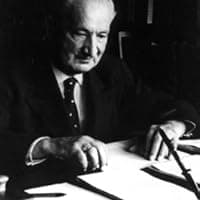
Martin Heidegger
Martin Heidegger (1889-1976) was a German philosopher whose work is perhaps most readily associated with phenomenology and existentialism, although his thinking should be identified as part of such philosophical movements only with extreme care and qualification. His ideas have exerted a seminal influence on the development of contemporary European philosophy. They have also had an impact far beyond philosophy, for example in architectural theory (see e.g., Sharr 2007), literary criticism (see e.g., Ziarek 1989), theology (see e.g., Caputo 1993), psychotherapy (see e.g., Binswanger 1943/1964, Guignon 1993) and cognitive science (see e.g., Dreyfus 1992, 2008; Wheeler 2005; Kiverstein and Wheeler forthcoming).
26 Books Written

The text of Martin Heidegger's 1930-1931 lecture course on Hegel's Phenomenology of Spirit contains some of Heidegger's most crucial statements about temporality, ontological difference and dialectic, and being and time in Hegel. Within the context of Heidegger's project of reinterpreting Western thought through its central figures, Heidegger takes up a fundamental concern of Being and Time, "a di
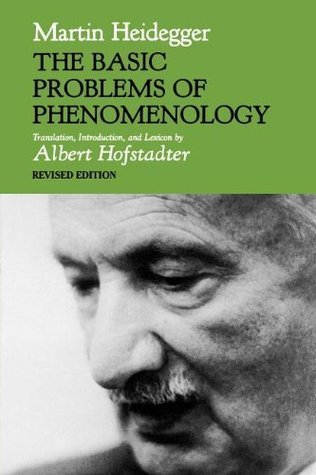
A Choice Outstanding Academic Book of 1982“In Albert Hofstadter’s excellent translation, we can listen in as Heidegger clearly and patiently explains . . . the ontological difference.” —Hubert L. Dreyfus, Times Literary Supplement

Nietzsche, Volumes 3&4: The Will to Power as Knowledge and as Metaphysics & Nihilism
by Martin Heidegger
Rating: 4.3 ⭐
A landmark discussion between two great thinkers--the second (combining volumes III and IV) of two volumes inquiring into the central issues of Friedrich Nietzsche's philosophy.
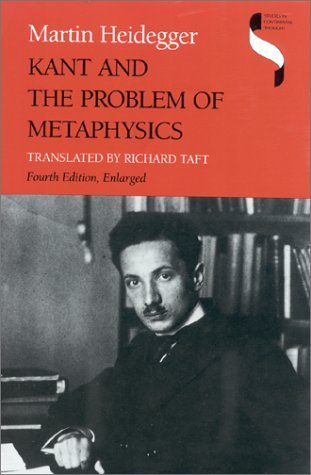
Offers an assessment of Kant's thought. This title talks about the problem of how the author proposed to enact his destruction of the metaphysical tradition and the role that his reading of Kant would play therein.
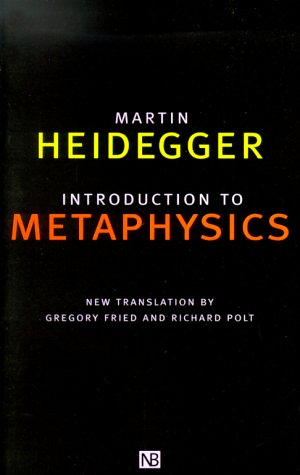
Contains a series of lectures delivered by Heidegger in 1935 at the University of Freiburg. In this work Heidegger presents the broadest and most intelligible account of the problem of being, as he sees this problem. First, he discusses the relevance of it by pointing out how this problem lies at the root not only of the most basic metaphysical questions but also of our human existence in its pres
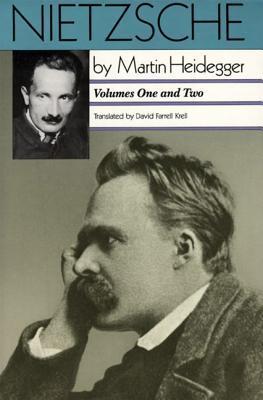
A landmark discussion between two great thinkers, vital to an understanding of twentieth-century philosophy and intellectual history.

Few philosophers have had more influence on the shape of western philosophy after 1900 than Martin Heidegger. Basic Writings offers a full range of this profound and controversial thinker's writings in one volume, including:The Origin of the Work of ArtThe introduction to Being and TimeWhat Is Metaphysics?Letter on Humanism
"To read Heidegger is to set out on an adventure. The essays in this volume—intriguing, challenging, and often baffling to the reader—call him always to abandon all superficial scanning and to enter wholeheartedly into the serious pursuit of thinking.... "Heidegger is not a 'primitive' or a 'romanitic.' He is not one who seeks escape from the burdens and responsibilities of contemporar

"For an acquaintance with the thought of Heidegger, What Is Called Thinking? is as important as Being and Time. It is the only systematic presentation of the thinker's late philosophy and ... it is perhaps the most exciting of his books. The translation is admirable. Without ever neglecting the severe terminological demands of the German text, Glenn Gray and Fred Wieck have transpose

"... an excellent translation of an extremely important book." The Modern SchoolmanThis early version of Being and Time (1927) offers a unique glimpse into the motivations that prompted the writing of this great philosopher's master work and the presuppositions that gave shape to it. Theodore Kisiel's outstanding translation permits English readers to appreciate the centr

The Concept of Time presents the reconstructed text of a lecture delivered by Martin Heidegger to the Marburg Theological Society in 1924. It offers a fascinating insight into the developmental years leading up to the publication, in 1927, of his magnum opus Being and Time, itself one of the most influential philosophical works this century. In The Concept of Time Heidegger introduces many of the

Parmenides, a lecture course delivered by Martin Heidegger at the University of Freiburg in 1942-1943, presents a highly original interpretation of ancient Greek philosophy. A major contribution to Heidegger's provocative dialogue with the pre-Socratics, the book attacks some of the most firmly established conceptions of Greek thinking and of the Greek world. The central theme is the question of t
Originally published in German under the title Holzwege, this collection of texts is Heidegger's first post-war work and contains some of the major expositions of his later philosophy. Although translations of the essays have appeared individually in a variety of places, this is the first English translation to bring them together as Heidegger intended. It is an invaluable resource for all student

One of Heidegger's most important works, this text gives a thorough explanation of what is arguably the most fundamental and abiding theme of his philosophy, namely the difference between truth as the "unhiddenness of beings" and truth as the "correctness of propositions". For Heidegger, it was by neglecting the former primordial concept of truth in favour of the latter derivative concept that Wes
In this volume Martin Heidegger confronts the philosophical problems of language and begins to unfold the meaning begind his famous and little understood phrase "Language is the House of Being." The "Dialogue on Language," between Heidegger and a Japanese friend, together with the four lectures that follow, present Heidegger's central ideas on the origin, nature, and significance of language. Thes

"[Heidegger's] greatest work... essential for all collections." --Choice..". students of Heidegger will surely find this book indispensable." --Library JournalContributions to Philosophy (From Enowning), written in 1936-38 and first published in 1989 as Beitrage zur Philosophie (Vom Ereignis), is Heidegger's most ground-breaking work after the publication of Being and Time
This is the first time that a seminal collection of fourteen essays by Martin Heidegger (originally published in German under the title Wegmarken) has appeared in English in its complete form. The volume includes new or first-time translations of seven essays, and thoroughly revised, updated versions of the other seven. They will prove an essential resource for all students of Heidegger, whether t

»Wenn wir fragen: Was ist das - die Philosophie?, dann sprechen wir über die Philosophie. Indem wir auf diese Weise fragen, bleiben wir offenbar auf einem Standpunkt oberhalb und d. h. außerhalb der Philosophie. Aber das Ziel unserer Frage ist, in die Philosophie hineinzukommen, in ihr uns aufzuhalten, nach ihrer Weise uns zu verhalten, d. h. zu "philosophieren".«

The Principle of Reason, the text of an important and influential lecture course that Martin Heidegger gave in 1955–56, takes as its focal point Leibniz's nothing is without reason. Heidegger shows here that the principle of reason is in fact a principle of being. Much of his discussion is aimed at bringing his readers to the "leap of thinking," which enables them to grasp the principle of reason

One of the most important philosophical works of our time, a work that has had tremendous influence on philosophy, literature, and psychology, and has literally changed the intellectual map of the modern world.

Discourse on Thinking questions that must occur to us the moment we manage to see a familiar situation in unfamiliar light.
Poetry, Language, Thought collects Martin Heidegger's pivotal writings on art, its role in human life and culture, and its relationship to thinking and truth. Essential reading for students and anyone interested in the great philosophers, this book opens up appreciation of Heidegger beyond the study of philosophy to the reaches of poetry and our fundamental relationship to the world. Feat
Identity and Difference consists of English translations and the original German versions of two little-known lectures given in 1957 by Martin Heidegger, "The Principle of Identity" and "The Onto-theo-logical Constitution of Metaphysics." Both lectures discuss the difficult problem of the nature of identity in the history of metaphysics. A helpful introduction and a list of references are a

The influence of Heidegger on Sartre's Being and Nothingness is marked, but Heidegger felt that Sartre had misread his work, as he argued in later texts such as the "Letter on 'Humanism'.""Letter on 'Humanism'" is often seen as a direct response to Sartre's 1945 lecture "Existentialism is a Humanism."

A crucial work for understanding a major turning point in Heidegger's thought. "...an important addition to the translations of Heidegger's lecture-courses."--International Philosophical Quarterly"The translators of these lectures have succeeded splendidly in giving readers an intimation of the tensely insistent tone of the original German. Heidegger's concern with a linguistic preconsciousn

On Time and Being charts the so-called "turn" in Martin Heidegger's philosophy away from his earlier metaphysics in Being and Time to his later thoughts after "the end of philosophy." The title lecture, "Time and Being," shows how Heidegger reconceived both "Being" and "time," introducing the new concept of "the event of Appropriation" to help give his metaphysical ideas nonmetaphysi