
Mark Epstein
Mark Epstein, M.D. is a psychiatrist in private practice in New York City and the author of a number of books about the interface of Buddhism and psychotherapy. He received his undergraduate and medical degrees from Harvard University and is currently Clinical Assistant Professor in the Postdoctoral Program in Psychotherapy and Psychoanalysis at New York University.
30 Books Written

The Zen of Therapy: Uncovering a Hidden Kindness in Life
by Mark Epstein
Rating: 3.9 ⭐
• 2 recommendations ❤️
A remarkable exploration of the therapeutic relationship, Dr. Mark Epstein reflects on one year's worth of therapy sessions with his patients to observe how his training in Western psychotherapy and his equally long investigation into Buddhism, in tandem, led to greater awareness - for his patients, and for himself. For years, Dr. Mark Epstein kept his beliefs as a Buddhist separate from his work as a psychiatrist. Content to use his training in mindfulness as a private resource, he trusted that the Buddhist influence could, and should, remain invisible. But as he became more forthcoming with his patients about his personal spiritual leanings, he was surprised to learn how many were eager to learn more. The divisions between the psychological, emotional, and the spiritual, he soon realized, were not as distinct as one might think.In The Zen of Therapy, Dr. Epstein reflects on a year's worth of selected sessions with his patients and observes how, in the incidental details of a given hour, his Buddhist background influences the way he works. Meditation and psychotherapy each encourage a willingness to face life's difficulties with courage that can be hard to otherwise muster, and in this cross-section of life in his office, he emphasizes how therapy, an element of Western medicine, can in fact be considered a two-person meditation. Mindfulness, too, much like a good therapist, can "hold" our awareness for us--and allow us to come to our senses and find inner peace.Throughout this deeply personal inquiry, one which weaves together the wisdom of two worlds, Dr. Epstein illuminates the therapy relationship as spiritual friendship, and reveals how a therapist can help patients cultivate the sense that there is something magical, something wonderful, and something to trust running through our lives, no matter how fraught they have been or might become. For when we realize how readily we have misinterpreted our selves, when we stop clinging to our falsely conceived constructs, when we touch the ground of being, we come home.

Going to Pieces without Falling Apart: A Buddhist Perspective on Wholeness
by Mark Epstein
Rating: 3.9 ⭐
• 1 recommendation ❤️
For decades, Western psychology has promised fulfillment through building and strengthening the ego. We are taught that the ideal is a strong, individuated self, constructed and reinforced over a lifetime. But Buddhist psychiatrist Mark Epstein has found a different way. Going to Pieces Without Falling Apart shows us that happiness doesn't come from any kind of acquisitiveness, be it material or psychological. Happiness comes from letting go. Weaving together the accumulated wisdom of his two worlds--Buddhism and Western psychotherapy--Epstein shows how "the happiness that we seek depends on our ability to balance the ego's need to do with our inherent capacity to be." He encourages us to relax the ever-vigilant mind in order to experience the freedom that comes only from relinquishing control. Drawing on events in his own life and stories from his patients, Going to Pieces Without Falling Apart teaches us that only by letting go can we start on the path to a more peaceful and spiritually satisfying life.About The Author: Mark Epstein, M.D., is a psychiatrist in private practice and the author of Thoughts Without a Thinker . He is a contributing editor to Tricycle: The Buddhist Review and clinical assistant professor of psychology at New York University. He lives in New York City.

Traditional distinctions between matters of the mind and matters of the spirit are increasingly being questioned, and people are searching for alternate perspectives on these issues. Thoughts Without a Thinker is a major contribution to today's exploding discussion of how Eastern spirituality can enhance Western psychology. In it, Mark Epstein argues that the contemplative traditions of the East can be extremely beneficial to patients, not just in helping them recognize their problems, but by giving them the strength to heal. Clearly written and very accessible, this enlightening guide explains the unique psychological contributions of the teachings of Buddhism, describes the path of meditation in contemporary psychological language, and lays out the possibility of a meditation-inspired psychotherapy.
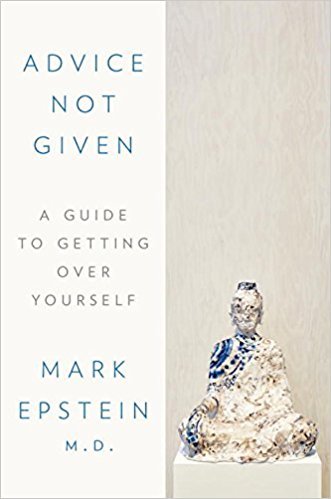
"Most people will never find a great psychiatrist or a great Buddhist teacher, but Mark Epstein is both, and the wisdom he imparts in Advice Not Given is an act of generosity and compassion. The book is a tonic for the ailments of our time."--Ann Patchett, New York Times bestselling author of Commonwealth Our ego, and its accompanying sense of nagging self-doubt as we work to be bigger, better, smarter, and more in control, is one affliction we all share. And while our ego claims to have our best interests at heart, in its never-ending pursuit of attention and power, it sabotages the very goals it sets to achieve. In Advice Not Given, renowned psychiatrist and author Dr. Mark Epstein reveals how Buddhism and Western psychotherapy, two traditions that developed in entirely different times and places and, until recently, had nothing to do with each other, both identify the ego as the limiting factor in our well-being, and both come to the same conclusion: When we give the ego free rein, we suffer; but when it learns to let go, we are free.With great insight, and in a deeply personal style, Epstein offers readers a how-to guide that refuses a quick fix, grounded in two traditions devoted to maximizing the human potential for living a better life. Using the Eightfold Path, eight areas of self-reflection that Buddhists believe necessary for enlightenment, as his scaffolding, Epstein looks back productively on his own experience and that of his patients. While the ideas of the Eightfold Path are as old as Buddhism itself, when informed by the sensibility of Western psychotherapy, they become something more: a road map for spiritual and psychological growth, a way of dealing with the intractable problem of the ego. Breaking down the wall between East and West, Epstein brings a Buddhist sensibility to therapy and a therapist's practicality to Buddhism. Speaking clearly and directly, he offers a rethinking of mindfulness that encourages people to be more watchful of their ego, an idea with a strong foothold in Buddhism but now for the first time applied in the context of psychotherapy.Our ego is at once our biggest obstacle and our greatest hope. We can be at its mercy or we can learn to mold it. Completely unique and practical, Epstein's advice can be used by all--each in his or her own way--and will provide wise counsel in a confusing world. After all, as he says, "Our egos can use all the help they can get."

Trauma does not just happen to a few unlucky people; it is the bedrock of our psychology. Death and illness touch us all, but even the everyday sufferings of loneliness and fear are traumatic. In The Trauma of Everyday Life renowned psychiatrist and author of Thoughts Without a Thinker Mark Epstein uncovers the transformational potential of trauma, revealing how it can be used for the mind’s own development.Western psychology teaches that if we understand the cause of trauma, we might move past it while many drawn to Eastern practices see meditation as a means of rising above, or distancing themselves from, their most difficult emotions. Both, Epstein argues, fail to recognize that trauma is an indivisible part of life and can be used as a lever for growth and an ever deeper understanding of change. When we regard trauma with this perspective, understanding that suffering is universal and without logic, our pain connects us to the world on a more fundamental level. The way out of pain is through it. Epstein’s discovery begins in his analysis of the life of Buddha, looking to how the death of his mother informed his path and teachings. The Buddha’s spiritual journey can be read as an expression of primitive agony grounded in childhood trauma. Yet the Buddha’s story is only one of many in The Trauma of Everyday Life. Here, Epstein looks to his own experience, that of his patients, and of the many fellow sojourners and teachers he encounters as a psychiatrist and Buddhist. They are alike only in that they share in trauma, large and small, as all of us do. Epstein finds throughout that trauma, if it doesn’t destroy us, wakes us up to both our minds’ own capacity and to the suffering of others. It makes us more human, caring, and wise. It can be our greatest teacher, our freedom itself, and it is available to all of us.

Open to Desire: Embracing a Lust for Life - Insights from Buddhism and Psychotherapy
by Mark Epstein
Rating: 4.0 ⭐
Bringing wisdom to a fresh and compelling topic, Mark Epstein shows how desire can be a teacher in its own right, helping us to reconcile our conflicting thoughts about it from both a Buddhist and a psychological point of view. It is common in both Buddhism and Freudian psychoanalysis to treat desire as the root of all suffering and problems, but psychiatrist Mark Epstein believes this to be a grave misunderstanding. In his defense of desire, he makes clear that it is the key to deepening intimacy with ourselves, one another, and our world. An enlightening tapestry of psychotherapeutic practice, contemporary case studies, Buddhist insight, and narratives as diverse as the Ramayana and Sufi parables, "Open to Desire" brings a refreshing new perspective to humanityas most paradoxical emotion.Proposing that spiritual attainment does not have to be detached from intimacy or eroticism, "Open to Desire" begins with an exploration of the dissatisfaction that causes us to both cling to, and fear, desire. Offering a new path for traversing this ambivalence, Dr. Epstein shows us how we can overcome these obstacles, not by indulgence or suppression, but by learning a new way to be with desire. Full of practical advice, this is a lasting guide for finding peace both in ourselves and in our most highly charged interactions.BACKCOVER: Advance Praise for OPEN TO DESIRE "Mark Epstein's "Open to Desire" is a masterpiece in his unique genre of combined Buddhist, psychological, and poetical insight. It teaches us how not just to fear and repress, but to re-channel and harness the most powerful energies of life toward freedom and bliss. I heartily recommend this work."--Robert Thurman, Jey Tsong Khapa Professor of Buddhist studies, Columbia University; President, Tibet House, US; author of "Infinite Life" a"Open to Desire" shines a bright beam of wisdom into an ever-confusing, ever- seductive realm. Mark Epstein, using his rare gifts of insight, brilliantly shows us a way through the confusion of craving to the treasures of intimacy and clarity hidden within our yearnings. The Buddha and Freud meet the Kama Sutra in this essential guidebook for anyone with a healthy lust for life."-- Daniel Goleman, author, "Destructive Emotions: A Scientific Dialogue with the Dalai Lama" aMark Epstein writes with the keen insight of a skilled psychotherapist, the compassion of a long-term meditator, and the gift of a compelling storyteller. He courageously explores the true nature and potential of desire, which we depend on for our very connection to life. This book is an outstanding new view of an emotion at the core of our being..a--Sharon Salzberg, author of "Faith: Trusting Your Own Deepest Experience" aAt last a book that doesnat shy away from the troubled topic of desire. Mark Epstein has written a beautifully crafted, intimate account of the struggle to come to terms with the contradictory yearnings within us. An illuminating, original and provocative work.a -- Stephen Batchelor, author of "Living with the Devil" "A beautiful book. Heals the split between psychotherapy and spirituality by showing positive aspects of desire common to both. Mark Epstein's portrayals of the goodness of desire and its gaps move us in ways that heal and enlighten, always sensitive to who we are and who we can be."--Michael Eigen, author of "The Sensitive Self" and "EmotionalStorm"

The bestselling author of Going to Pieces Without Falling Apart combines a memoir of his own journey as a student of Buddhism and psychology with a powerful message about how cultivating true self-awareness and adopting a Buddhist understanding of change can free the mind.Before Mark Epstein became a medical student at Harvard and began training as a psychiatrist, he immersed himself in Buddhism through experiences with such influential Buddhist teachers as Ram Dass, Joseph Goldstein, and Jack Kornfield. The positive outlook of Buddhism and the meditative principle of living in the moment came to influence his study and practice of psychotherapy profoundly. Going on Being is Epstein’s memoir of his early years as a student of Buddhism and of how Buddhism shaped his approach to therapy, as well as a practical guide to how a Buddhist understanding of psychological problems makes change for the better possible.Going on Being is an intimate chronicle of the evolution of spirit and psyche, and a highly inviting guide for anyone seeking a new path and a new outlook on life.

Insights on the interface between Buddhist teachings and Western psychotherapy by the best-selling author of Thoughts without a Thinker Immersed in Buddhist psychology prior to studying Western psychiatry, Dr. Mark Epstein first viewed Western therapeutic approaches through the lens of the East. This posed something of a challenge. Although both systems promise liberation through self-awareness, the central tenet of Buddha's wisdom is the notion of no-self, while the central focus of Western psychotherapy is the self. This book, which includes writings from the past twenty-five years, wrestles with the complex relationship between Buddhism and psychotherapy and offers nuanced reflections on therapy, meditation, and psychological and spiritual development. A best-selling author and popular speaker, Epstein has long been at the forefront of the effort to introduce Buddhist psychology to the West. His unique background enables him to serve as a bridge between the two traditions, which he has found to be more compatible than at first thought. Engaging with the teachings of the Buddha as well as those of Freud and Winnicott, he offers a compelling look at desire, anger, and insight and helps reinterpret the Buddha's Four Noble Truths and centralconcepts such as egolessness and emptiness in the psychoanalytic language of our time.

Drawing on decades of personal and professional experience, Dr. Mark Epstein considers how his practice of psychotherapy and meditation can be used in tandem to lead his patients, and himself, to greater awareness and fulfillment.For much of his career, Dr. Mark Epstein kept his beliefs as a Buddhist separate from his work as a psychiatrist. But as he became more forthcoming with his patients about his personal spiritual leanings, he was surprised to find how many of them were eager to learn more. The divisions between the psychological, emotional, and the spiritual, he soon realized, were not as distinct as one might think.In The Zen of Therapy , Dr. Epstein reflects on a year’s worth of selected sessions with his patients and observes how, in a given hour, his Buddhist background influences his work. He emphasizes how Western therapy can be considered a two-person meditation, and how mindfulness, much like a good therapist, can “hold” awareness, creating the necessary conditions for inner peace. Throughout this deeply personal and wise inquiry, Dr. Epstein illuminates the therapy relationship as a spiritual friendship, and reveals how a therapist can help us realize that there is something magical running through our fraught lives. For when we understand how readily we have misinterpreted ourselves, when we touch the ground of our own being, we come home.

Jack “the Shot” Foley-A Legend for All Time: With Togo Palazzi and Central Mass. Basketball
by Mark Epstein
Rating: 4.4 ⭐
Mark “Pathfinder” Epstein shares the inside story of college basketball icon Jack “The Shot” Foley and remembers a cherished time in Central Massachusetts sports history.Epstein’s story charts the inspiring life and career of Jack Foley, from Foley’s early years as a budding nature lover to his legendary high school and college basketball days and his later years as an educator. Epstein also celebrates the old-fashioned sports traditions that captivated Foley’s hometown area of Central Massachusetts, and came to represent a golden age of college basketball. As he revisits this iconic era, Epstein shines a light on other basketball luminaries, like Togo Palazzi, as well as the revered institutions, including the College of the Holy Cross, that helped shape these sports heroes.“For anyone who relishes gaining more knowledge and insight into the sport of basketball and the vibrant history of the City of Worcester, this will be a must-read for you.” —Jeff Twiss, vice president of media services, Boston Celtics.Mark "Pathfinder" Epstein grew up in the "golden-era" of playground basketball in the "hot-bed" region known as Central Massachusetts. Mark was the ultimate basketball "junkie". He has had many roles in his favorite sport throughout his lifetime. He is now retired from a career in education and resides with his wife Barbara in Mount Pleasant, South Carolina.This is the author's second book, the first one,“THEY CALL ME PATHFINDER, Education-Basketball-Equality” has received two awards.Pathfinder is also a nationally recognized motivational speaker and can be reached at mepathfinder1@gmail.com.Praise for Jack “the Shot” Foley- A Legend for All With Togo Palazzi and Central Mass. Basketball “Mark Epstein offers us a look at Central Massachusetts during its basketball hotbed days. His observations, research, and interviews were extremely interesting to anyone remotely familiar with basketball. The spotlight could not have shone on a more deserving pair than Holy Cross All-American Jack ‘the Shot’ Foley and former Boston Celtic and Syracuse National Togo Palazzi.” —Tom Sanders, Hall of Famer and Boston Celtics legend“If you want to read a great human-interest story about basketball, this book is a must read. What started off in the late 1950s as a local Worcester story in an area where basketball got its roots soon became a national story for all when Jack ‘the Shot’ Foley became an American phenom.” —Jim Calhoun, Hall of Fame University of Connecticut basketball coach.“The history of Worcester basketball, presented superbly by author Mark Epstein, grabs your immediate attention with the many men and women who proudly comprised the magical history of the sport of basketball in the city and in surrounding communities. Using the brilliant careers of Jack Foley and Togo Palazzi as the spotlight, Epstein paints a clear picture to follow along with and to escape back in time to where traditions ran deep and strong. For anyone who relishes gaining more knowledge and insight into the sport of basketball and the vibrant history of the city of Worcester, this will be a must read.” —Jeff Twiss, vice president of media services, Boston Celtics“This book is long overdue. People should never forget the true greatness of Jack ‘the Shot’ Foley. the Shot should never be forgotten for the many incredible thrills he gave to the legion of basketball fans in Central Massachusetts while playing for Assumption Prep and at Holy Cross.

What the Buddha Felt: A Buddhist Psychiatrist Points the Way to Uncommon Happiness
by Mark Epstein
Rating: 3.5 ⭐
Dr Mark Epstein believes that people need tools to work with difficult emotions, and that the intersection of psychotherapy and Buddhism is the place to look for effective results. Psychotherapy, he says, has often shied away from addressing spiritual issues, while Buddhism is sometimes misperceived as requiring an emotionless approach. When you combine the basic principals that have led to psychotherapy's success in tackling emotonal issues with the Buddhist practice of meditation as a way to integrate emotions rather than repress them, emotional issues no longer act as a stumbling block to spiritual progress. In this program, Epstein adeptly teaches how to merge these two tools, inspiring listeners with practical exercises and stories from both his clinical and Buddhist meditation practices.

Before he began training as a psychiatrist, Mark Epstein immersed himself in Buddhism through influential teachers such as Ram Dass, Joseph Goldstein, and Jack Kornfield. Buddhism's positive outlook and the meditative principle of living in the moment profoundly influenced his study and practice of psychotherapy.Going on Beingis an intimate chronicle of Epstein's formative years as well as a practical guide to how a Buddhist understanding of psychological problems can help anyone change for the better. Epstein gives readers a deeply personal look into his life, thoughts, fears, and hopes, while detailing the influences that have shaped his worldview. Inspiring in its honesty and humility, Going on Beingis a compassionate, brilliant look at how uniting the worlds of psyche and spirit can lead to a new way of seeing reality

CAPE DREAMS-A SEASON WITH THE BREWSTER WHITECAPSMARK “PATHFINDER” EPSTEIN-AUTHORFOREWORD BY PETER GAMMONS-NATIONAL BASEBALL HALL OF FAMECOMING IN APRIL OF 2025Tucked away on the shores of Cape Cod Bay there lies one of the greatest amateur athletic organizations in American sport’s history. Welcome to the 101-year-old tradition of the Cape Cod Baseball League. This great tradition was built on the values that have made our great nation so special.Within the confines of the Cape League there is a quaint and sleepy town that that doesn’t even have a red-light. Every summer this special place produces some of the greatest players in Major League Baseball history. Welcome to Brewster, Massachusetts-home of the Brewster Whitecaps.From all over America every summer the greatest college baseball players come to Brewster and to the other nine towns that have teams on Cape Cod to showcase their great talents. MLB scouts spend their summers looking for the next Sean Casey, Ryan Braun, Chase Utley, Aaron Judge or Billy Wagner, five Major League legends who were all discovered playing in Brewster. These greats are only a few of the more than 1,700 former Major Leaguers who have at one time were scouted playing on the Cape.While reading this once in a generation classic you will learn about the players who were brought together in the summer of 2024 by their manager, the forever lovable Jamie Shevchik. Discover for yourself one of the greatest rosters ever assembled in Cape Baseball history and experience how it became one of the league’s all-time biggest mysteries.Get on top of one of the many up and down tidal waves as this group of lovable characters will take you on one of your most unforgettable journeys that became almost historic. The 2024 Brewster Whitecaps were the consensus favorites to win their third Cape Cod championship in seven seasons.As the story CAPE DREAMS-A SEASON WITH THE BREWSTER WHITECAPS moves along you will be drawn into not just the players and coaches but the supporting cast of more than one hundred volunteers who at the end of this story you will know well enough to call your friends.Now get ready to fall in love with these incredible athletes as they will leave you laughing, crying and asking yourself the same questions everyone else was wondering during the summer of 2024. As the season plays out you will be like the many thousands of fans who came to watch them play. You will find yourself begging for just one more game.Included in this story are interviews and close-up looks at some of the biggest names in the baseball world.WELCOME TO THE UNFORGETTABLE STORY OFCAPE DREAMS-A SEASON WITH THE BREWSTER WHITECAPS

Founded in 1908, Bexley is one of the earliest suburbs of Columbus, but it was settled by Native Americans long before Ohio became a state and Columbus its capital. Bexley packs a wealth of history and culture into less than two and a half square miles. It has been home to governors, award-winning authors, artists, movie stars, business leaders, and a famed aviatrix. Bexley has a long history of diversity and inclusion, welcoming people of all faiths and ethnicities. Hemmed in on all sides by the city of Columbus, Bexley has still been able to maintain a unique economic vitality characterized by businesses of all types for over 100 years. Just as notable is the city's wide array of churches and synagogues, as well as high-quality public and private educational institutions, including Capital University, that educate students from grammar school through graduate studies.

Sixteen contemporary writers reminisce about the teachers who had the most significant effect on their own minds and work, yielding insight into the thought and personality of such incisive thinkers as Yvor Winters, Hannah Arendt, and J. Robert Oppenheimer

Get inspiration for finding your path from one man’s true story of life in the Deep South, a memoir lauded by Coretta Scott King’s cousin, Christine Jackson, as “a book everyone should read!”Growing up, Mark Epstein had dreams of playing basketball, but his lack of motivation sidelined him. Inspired after he read true civil rights stories about Black Americans, Epstein’s secret dream was born. Personal heartbreak drove him to a new life in Charleston, South Carolina, where he found his mission to improve the world through sports.In this inspiring memoir of an educator, Epstein shares the magic of befriending some of the greatest athletes in history as well as students and parents in the public school system. From desperate circumstances to a twenty-seven-year career in education and coaching, They Call Me Pathfinder is the story of how one lost soul from Massachusetts found his way to a life that became an American dream come true.


54

Ambition professionnelle, course aux gratifications, addictions en tout genre, multiplication des relations amoureuses, accumulation de biens, voyages lointains, antidépresseurs... ce sont là les multiples stratégies que nous propose en vain la culture contemporaine pour nous affranchir de la souffrance inhérente à l'existence. Or, tenter de fuir les émotions qui nous perturbent ne fait qu'accroître leur emprise. La souffrance nous rattrape toujours.Il existe une alternative à ce chemin et c'est le propos de Mark Epstein de nous y introduire. Il le fait avec d'autant plus de force qu'il combine les avancées les plus récentes de la psychanalyse en matière de traumatisme avec les enseignements ancestraux du bouddhisme. Car « La vie est souffrance - la vie est dukkha », est le premier enseignement du Bouddha. Christophe Fauré (extrait de la préface) « Mark Epstein a été l'un des très rares écrivains capables de rendre la relation entre psychanalyse et bouddhisme non seulement intéressante, mais aussi captivante et utile. Un livre inspiré et lumineux qui clarifie nombre de nos a priori sur le trauma et, en fait, sur la vie quotidienne . » Adam Phillips, auteur de Winnicott ou le choix de la solitude « Dans cette fascinante méditation sur la condition humaine, Mark Epstein propose une lecture psychanalytique de la vie du Bouddha qui éclaire les joies et peines qui font partie de notre vie . » Stephen Batchelor, auteur de Confession of a Buddhist Atheist


- Mark Epstein recalls his life and major design projects as well as his favorite recipes and gives table-setting and entertaining tips One of New York's top interior designers whose work is known by most of the city's elite, Mark Epstein's designs are about creating timeless interiors for his clients. His work is highly architectural with an emphasis on beautiful backgrounds, favoring serene tailored interiors enlivened with a richly muted palette. Since establishing his firm, Mark Epstein Designs, in 1977, the firm's work has ranged from traditional, to quietly glamorous, and eclectic modern interiors. Mark Epstein Designs includes 13 key design projects that each contain an extra feature - entertaining tips with recipes, table settings, and collecting ideas, bringing together all of Epstein's talents into one harmonious monograph. Content: My Life So Far (Introduction); ME at Work; ME at Home; City/Country - Two Families/Four Homes; Rising to the Occasion - Five Scenarios; Old World/New World; Dedication; Acknowledgments; Sources; Index.

This collection represents a tool to broaden and deepen our geographical, institutional, and historical understanding of the term totalitarianism. Is totalitarianism only found in other societies? How come, then, it emerged historically in ours first? How come it developed in so many countries either in Western Europe (Italy, Germany, Portugal, and Spain) or under implicit Western forms of coercion (Latin America)? How do relations between individual(s), mass and the visual arts relate to totalitarian trends? These are among the questions this book asks about totalitarianism. The volume does not impose a one size fits all interpretation, but opens new spaces for debate on the connection between the visual arts and mass-culture in totalitarian societies. From the Mediterranean to Scandinavia, from Western Europe to Latin America, from the fascism of the early 20th century to contemporary forms of totalitarian control, and from cinema to architecture, the chapters included in TotArt bring expertise, historical sensibility and political awareness to bear on this varied range of phenomena.This collection offers international contributions on visual, performing and plastic arts. The chapters range from examination of comics to study of YouTube videos and American newsreels, from Italian, Spanish, Portuguese, and Uruguayan cinemas to more contemporary American films and TV series, from painters and sculptors to the study of urban spaces.

Cachemire le paradis oublié
by Mark Epstein

Le Japon
by Mark Epstein

Buddha and Freud
by Mark Epstein
Buddha and FreudCan the psychology of the West and the teachings of the Buddha be compatible? Mark Epstein, a graduate of Harvard Medical School and a psychiatrist who teaches psychology at New York University, is a professor of psychiatry and psychotherapy, It is a book looking at the way of mutual fusion....

Trauma User Guide
by Mark Epstein
Trauma User Guideb "No one can go back to the past and start a new one, but from now on, we can start a new ending." - Karl BarthA map of the compass and the teachings of the Buddha bMark Epstein, a prominent psychotherapist, left the trauma to the Buddha, the early death of the Buddhas mother, and the spiritual journey of the Buddha In this book, I show a unique perspective that it was a challenge to solve the primordial suffering that emerged from this trauma. In addition to this bold psychoanalytical pamphlet, the author introduces his experiences and counseling cases and asks, What is your trauma? In addition, I open my eyes to the nature of the mind and introduce the way to sympathize with the suffering of others, leading the reader to live a more humane, loving and wise life. At the moment of covering the book, the reader will realize that I am already my teacher and mother, and will meet myself freely.
![Rare YOUNG MEN'S GOLD Epstein, MarkOverlook Press 1st edit/1st print 1978 [Hardcover] Epstein, Mark [Hardcover] Epstein, Mark](https://m.media-amazon.com/images/S/compressed.photo.goodreads.com/books/1697839992i/137708955.jpg)
Rare YOUNG MEN'S GOLD Epstein, MarkOverlook Press 1st edit/1st print 1978 [Hardcover] Epstein, Mark [Hardcover] Epstein, Mark
by Mark Epstein
This rare and vintage book is a perfect addition to any bibliophile's collection
Going to Pieces Without Falling Apart: A Buddhist Perspective On Wholeness by Mark Epstein
by Mark Epstein

Preparing for the AP United States History Examination will help you prepare for the AP exam quickly, efficiently, and, above all, effectively. Right from the start, you will identify the course topics you most need practice on and be able to focus your studying, while getting a review opportunity for your general knowledge. By the end of the book, you will be primed for taking the exam and on your way to a 5!

Open to the Passions
by Mark Epstein
It is common in both Buddhism and Freudian psychoanalysis to treat desire as if it is the root of all suffering and problems, but psychiatrist Mark Epstein believes this to be a grave misunderstanding. In his controversial defense of desire, he makes clear that it is the key to deepening intimacy with ourselves, each other, and our world.Proposing that spiritual attainment does not have to be detached from intimacy or eroticism, Open to the Passions begins with an exploration of the state of dissatisfaction that causes us to cling to irrational habits.Dr. Epstein helps listeners overcome their own fears of desire so that they can more readily bridge the gap between self and other, cope with feelings of incompletion, and get past the perception of others as objects. Freed from clinging and shame, desire’s spiritual potential can then be opened up.A Better Listen audio production.