
Marcus Tullius Cicero
Born 3 January 106 BC, Arpinum, Italy Died 7 December 43 BC (aged 63), Formia, Italy Marcus Tullius Cicero was a Roman philosopher, statesman, lawyer, political theorist, and Roman constitutionalist. Cicero is widely considered one of Rome's greatest orators and prose stylists. Alternate profiles: Cicéron Marco Tullio Cicerone Cicerone Note: All editions should have Marcus Tullius Cicero as primary author. Editions with another name on the cover should have that name added as secondary author.
30 Books Written

Cicéron, dans ce long extrait de L''Orateur - traité épistolaire composé à la demande du célèbre Brutus en 46 av. J.-C. - met en lumière les différents ressorts de l''éloquence à travers la figure d''un orateur idéal.Destiné à servir de modèle dans une approche pragmatique de la rhétorique, cet archétype permet à Cicéron de définir l''art oratoire dans sa spécificité, de résumer les tâches de l''orateur, de cerner la culture qu''il se doit de posséder.Il y traite de l''argumentation, des figures de style, de la plaisanterie, de la gestuelle, du ton, et d''autres principes encore, toujours valables et presque nécessaires aujourd''hui pour permettre de mieux comprendre et de mieux pratiquer l''art de persuader.

• Introduction by Michael Grant• Against Verres, I• twenty-three letters• The Second Philippic Against Antony• On Duties, III• On Old Age• Appendices inc. maps, genealogy, definitions.First published 1960; reprinted w/revisions 1965; reprinted w/additional revisions 1971.
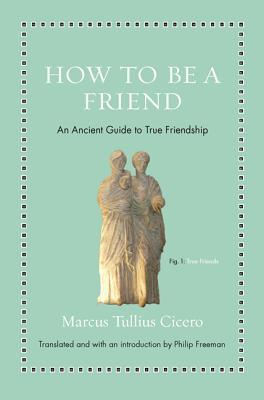
A splendid new translation of one of the greatest books on friendship ever writtenIn a world where social media, online relationships, and relentless self-absorption threaten the very idea of deep and lasting friendships, the search for true friends is more important than ever. In this short book, which is one of the greatest ever written on the subject, the famous Roman politician and philosopher Cicero offers a compelling guide to finding, keeping, and appreciating friends. With wit and wisdom, Cicero shows us not only how to build friendships but also why they must be a key part of our lives. For, as Cicero says, life without friends is not worth living.Filled with timeless advice and insights, Cicero's heartfelt and moving classic--written in 44 BC and originally titled De Amicitia--has inspired readers for more than two thousand years, from St. Augustine and Dante to Thomas Jefferson and John Adams. Presented here in a lively new translation with the original Latin on facing pages and an inviting introduction, How to Be a Friend explores how to choose the right friends, how to avoid the pitfalls of friendship, and how to live with friends in good times and bad. Cicero also praises what he sees as the deepest kind of friendship--one in which two people find in each other "another self" or a kindred soul.An honest and eloquent guide to finding and treasuring true friends, How to Be a Friend speaks as powerfully today as when it was first written.

De Officiis (On Duties) is Cicero's last theoretical work and contains his analysis, in a Greek theoretical framework, of the political and ethical values of the Roman governing class in the late Republic. It has often been treated merely as a key to the Greek philosophical works that Cicero used, but this volume aims to render De Officiis, which had a profound impact upon subsequent political thinkers, more intelligible by explaining its relation to its own time and place. All the standard series features are present, including a wholly new translation, a concise introduction by a leading scholar, select bibliography, chronology, notes on vocabulary and brief biographies of the most prominent individuals mentioned in the text.

Cicero (Marcus Tullius, 106-43 BCE), Roman lawyer, orator, politician and philosopher, of whom we know more than of any other Roman, lived through the stirring era which saw the rise, dictatorship, and death of Julius Caesar in a tottering republic. In his political speeches especially and in his correspondence we see the excitement, tension and intrigue of politics and the part he played in the turmoil of the time. Of about 106 speeches, delivered before the Roman people or the Senate if they were political, before jurors if judicial, 58 survive (a few of them incompletely). In the fourteenth century Petrarch and other Italian humanists discovered manuscripts containing more than 900 letters of which more than 800 were written by Cicero and nearly 100 by others to him. These afford a revelation of the man all the more striking because most were not written for publication. Six rhetorical works survive and another in fragments. Philosophical works include seven extant major compositions and a number of others; and some lost. There is also poetry, some original, some as translations from the Greek. The Loeb Classical Library edition of Cicero is in twenty-nine volumes.

Librarian Note: See Alternate Cover Edition HERE.This volume brings together his tentative and undogmatic reflections on the good life, in which he discusses duty, friendship, the training of a statesman, and the importance of moral integrity in the search for happiness. 1. discussions at Tusculum (V)- 2. on duties (Ii) --3. Laelius: On Friendship --4. on the orator (I) --5. the dream of Scipio--Appendices: --1. the philosophical works of Cicero --2. the rhetorical works of Cicero --3. principal Dates --4. some books about Cicero.

Amid the corruption and power struggles of the collapse of the Roman Republic, Cicero (106-43BC) produced some of the most stirring and eloquent speeches in history. A statesman and lawyer, he was one of the only outsiders to penetrate the aristocratic circles that controlled the Roman state, and became renowned for his speaking to the Assembly, Senate and courtrooms. Whether fighting corruption, quashing the Catiline conspiracy, defending the poet Archias or railing against Mark Antony in the Philippics - the magnificent arguments in defence of liberty which led to his banishment and death - Cicero's speeches are oratory masterpieces, vividly evocative of the cut and thrust of Roman political life.

Worried that old age will inevitably mean losing your libido, your health, and possibly your marbles too? Well, Cicero has some good news for you. In How to Grow Old, the great Roman orator and statesman eloquently describes how you can make the second half of life the best part of all--and why you might discover that reading and gardening are actually far more pleasurable than sex ever was.Filled with timeless wisdom and practical guidance, Cicero's brief, charming classic—written in 44 BC and originally titled On Old Age—has delighted and inspired readers, from Saint Augustine to Thomas Jefferson, for more than two thousand years. Presented here in a lively new translation with an informative new introduction and the original Latin on facing pages, the book directly addresses the greatest fears of growing older and persuasively argues why these worries are greatly exaggerated--or altogether mistaken.Montaigne said Cicero's book "gives one an appetite for growing old." The American founding father John Adams read it repeatedly in his later years. And today its lessons are more relevant than ever in a world obsessed with the futile pursuit of youth.

'My present intention is to clear myself of any suspicion of partially by presenting the views of the generality of philosophers concerning the nature of the gods.'In The Nature of the Gods, Cicero presents a detailed account of the Greek theories of deity, examining the theologies of the Epicureans and the Stoics, together with critical objections to these doctrines raised by the Academic school. Providing vital evidence of the views of the Greek philosophers of the Hellenistic age, Cicero also casts light on the intellectual life of first-century Rome. When these Greek beliefs are translated into the Roman context they result in a fascinating clash of ideologies.This new translation of a work whose importance is becoming increasingly recognized is complemented by an invaluable introduction to the main philosophical issues, as well as substantial and helpful annotation.
Cato maior de senectute est dialogus philosophicus a M. Tullio Cicerone anno 44 a.C.n. scriptus, paulo antequam mortuus est. Qui dialogus in colloquio inter tres personas consistit: Cato Maior disputat de senectute cum P. Scipione Aemiliano et C. Laelio.Laelius de amicitia est dialogus philosophicus M. Tulli Ciceronis, quem scripsit anno 44 a.C.n., post Caesaris mortem, quia Titus Pomponius Atticus Ciceronem aliquid scribere de amicitia oraverat. Liber narrat de amicitia inter Publium Scipionem Aemilianum, nuper mortuum, et Gaium Laelium (cos. 140), qui est persona princeps dialogi.
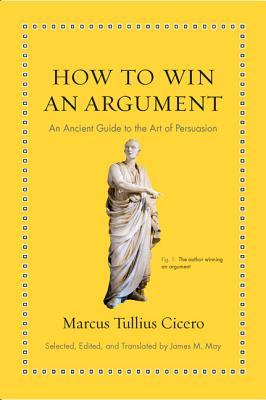
How to Win an Argument: An Ancient Guide to the Art of Persuasion
by Marcus Tullius Cicero
Rating: 3.7 ⭐
All of us are faced countless times with the challenge of persuading others, whether we're trying to win a trivial argument with a friend or convince our coworkers about an important decision. Instead of relying on untrained instinct--and often floundering or failing as a result--we'd win more arguments if we learned the timeless art of verbal persuasion, rhetoric. How to Win an Argument gathers the rhetorical wisdom of Cicero, ancient Rome's greatest orator, from across his works and combines it with passages from his legal and political speeches to show his powerful techniques in action. The result is an enlightening and entertaining practical introduction to the secrets of persuasive speaking and writing--including strategies that are just as effective in today's offices, schools, courts, and political debates as they were in the Roman forum.How to Win an Argument addresses proof based on rational argumentation, character, and emotion; the parts of a speech; the plain, middle, and grand styles; how to persuade no matter what audience or circumstances you face; and more. Cicero's words are presented in lively translations, with illuminating introductions; the book also features a brief biography of Cicero, a glossary, suggestions for further reading, and an appendix of the original Latin texts.Astonishingly relevant, this unique anthology of Cicero's rhetorical and oratorical wisdom will be enjoyed by anyone who ever needs to win arguments and influence people--in other words, all of us.

In 63 b.c., Lucius Sergius Catilina, a Roman aristocrat, formed a conspiracy to overthrow the Roman Republic. Cicero, who was consul that year, exposed the plot and documented his defeat of the conspiracy in his Orations against Catiline. The First Catilinarian Oration is well known and deservedly famous. Scholars are familiar with the other three speeches, but few students know them. This lapse is regrettable. The Third Oration is a fast-paced courtroom drama, and the Second and Fourth Orations provide critical information about this key event in Roman history. Susan O. Shapiro here makes all Cicero’s Catilinarian Orations accessible to the intermediate Latin student.O Tempora! O Mores! is designed to fit a variety of pedagogical approaches. Professors can assign any of the Catilinarian Orations independently or assign excerpts from several of the speeches. Shapiro’s historical essays bring a new dimension to Latin study, explaining the history and politics behind the texts. The essays are divided into short sections that can be assigned individually for class discussion. The volume is further amplified by a vocabulary, maps, a bibliography, and appendices.

On a Life Well Spent: Cicero's De Senectute with preface by Benjamin Franklin
by Marcus Tullius Cicero
Rating: 4.4 ⭐
Does every birthday find you a year older? Cicero’s De Senectute wisdom is for you Let’s face it—even the young aren’t getting any younger. That was true in Cicero’s time as well (107-43 BCE). A Roman orator and statesman, in his older age Cicero wrote about why he welcomed the wisdom we exchange for youth as we gain in years. He also reminds us to keep our eye on the ultimate, meaningful prize as we journey through our lives: “nothing remains to us, but what results from past good and virtuous Actions.”On a Life Well Spent is a book that has bilingualism to thank, twice over. The first thanks go to Cicero, who translated the lofty thoughts of the Greeks into a language more people then spoke: Latin. The second thanks go to Benjamin Franklin, whose published version of Cicero’s De Senectute (On Aging) is reprised here. Franklin tapped the talents of his friend James Logan to translate Cicero’s Latin into a language more people in the American colonies spoke: English.America the Bilingual Press is using this opportunity to also provide readers with a sneak preview of a forthcoming book, The Little Guide to Your Bilingual Life. The author, Steve Leveen, is the founder of the America the Bilingual project.Reading tip: Read the many callouts in the book first—like this one: “Every Part of Life, like the Year, has its peculiar Season.” You’ll feel so much better about that next birthday.

The greatest orator in Roman history, Marcus Tullius Cicero remained one of the republic's chief supporters throughout his life, guided by profound political beliefs that illuminated his correspondence with both close friends and powerful aristocrats. A chronicle of a crumbling civilization during the era when the republic disintegrated and was replaced by despotism, his Letters portray a world dominated by characters who have since acquired almost mythic status - including Pompey, Caesar, Brutus, Cassius, and Mark Antony. Whether describing the vagaries of war, the collapse of Roman society, his beloved republic, or his own personal domestic dramas, all compellingly reflect the complex personality of an honourable and selfless man whose refusal to compromise ultimately cost him his life.

Cicero (Marcus Tullius, 106 - 43 BCE), Roman lawyer, orator, politician and philosopher, of whom we know more than of any other Roman, lived through the stirring era which saw the rise, dictatorship, and death of Julius Caesar in a tottering republic. In his political speeches especially and in his correspondence we see the excitement, tension and intrigue of politics and the part he played in the turmoil of the time. Of about 106 speeches, delivered before the Roman people or the Senate if they were political, before jurors if judicial, 58 survive (a few of them incompletely). In the fourteenth century Petrarch and other Italian humanists discovered manuscripts containing more than 900 letters of which more than 800 were written by Cicero and nearly 100 by others to him. These afford a revelation of the man all the more striking because most were not written for publication. Six rhetorical works survive and another in fragments. Philosophical works include seven extant major compositions and a number of others; and some lost. There is also poetry, some original, some as translations from the Greek.The Loeb Classical Library edition of Cicero is in twenty-nine volumes.

The Rhetorica ad Herrenium was traditionally attributed to Cicero (106 43 BCE), and reflects, as does Cicero s De Inventione, Hellenistic rhetorical teaching. But most recent editors attribute it to an unknown author.The Greek art of rhetoric was first naturalized at Rome in the time of the younger Scipio, and Latin treatises on the subject were in circulation from the time of the Gracchi. But the books by Cato, Antonius, and the other Roman writers have not come down to us, and it is from the second decade of the first century B.C. that we have, in the treatise addressed to Gaius Herennius, the oldest Latin Art preserved entire. Like Cicero's incomplete De Inventione, which belongs close to it in time, this work reflects Hellenistic rhetorical teaching. Our author, however, gives us a Greek art in Latin dress, combining a Roman spirit with Greek doctrine. It is a technical manual, systematic and formal in arrangement; its exposition is bald, but in greatest part clear and precise. Indeed the writer's specific aims are to achieve clarity and conciseness, and to complete the exposition of his subject with reasonable speed. He seeks clarity through the use of Roman terms, and of specially selected examples; he seeks conciseness by keeping practical needs always in view, by scrupulously avoiding irrelevant matter, and by presenting methods and principles, not a host of particular illustrations of a given point.
Cicero (Marcus Tullius, 10643 BCE), Roman lawyer, orator, politician and philosopher, of whom we know more than of any other Roman, lived through the stirring era which saw the rise, dictatorship, and death of Julius Caesar in a tottering republic. In his political speeches especially and in his correspondence we see the excitement, tension and intrigue of politics and the part he played in the turmoil of the time. Of about 106 speeches, delivered before the Roman people or the Senate if they were political, before jurors if judicial, 58 survive (a few of them incompletely). In the fourteenth century Petrarch and other Italian humanists discovered manuscripts containing more than 900 letters of which more than 800 were written by Cicero and nearly 100 by others to him. These afford a revelation of the man all the more striking because most were not written for publication. Six rhetorical works survive and another in fragments. Philosophical works include seven extant major compositions and a number of others; and some lost. There is also poetry, some original, some as translations from the Greek.The Loeb Classical Library edition of Cicero is in twenty-nine volumes.

In the first century BC, Marcus Tullius Cicero, orator, statesman, and defender of republican values, created these philosophical treatises on such diverse topics as friendship, religion, death, fate and scientific inquiry. A pragmatist at heart, Cicero's philosophies were frequently personal and ethical, drawn not from abstract reasoning but through careful observation of the world. The resulting works remind us of the importance of social ties, the questions of free will, and the justification of any creative endeavour.This lively, lucid new translation from Thomas Habinek, editor of Classical Antiquity and the Classics and Contemporary Thought book series, makes Cicero's influential ideas accessible to every reader.

Cicero (106-43BC) was the most brilliant orator in Classical history. Even one of the men who authorized his assassination, the Emperor Octavian, admitted to his grandson that Cicero was: 'an eloquent man, my boy, eloquent and a lover of his country'. This new selection of speeches illustrates Cicero's fierce loyalty to the Roman Republic, giving an overview of his oratory from early victories in the law courts to the height of his political career in the Senate. We see him sway the opinions of the mob and the most powerful men in Rome, in favour of Pompey the Great and against the conspirator Catiline, while The Philippics, considered his finest achievements, contain the thrilling invective delivered against his rival, Mark Antony, which eventually led to Cicero's death.

Cicero (Marcus Tullius, 10643 BCE), Roman lawyer, orator, politician and philosopher, of whom we know more than of any other Roman, lived through the stirring era which saw the rise, dictatorship, and death of Julius Caesar in a tottering republic. In his political speeches especially and in his correspondence we see the excitement, tension and intrigue of politics and the part he played in the turmoil of the time. Of about 106 speeches, delivered before the Roman people or the Senate if they were political, before jurors if judicial, 58 survive (a few of them incompletely). In the fourteenth century Petrarch and other Italian humanists discovered manuscripts containing more than 900 letters of which more than 800 were written by Cicero and nearly 100 by others to him. These afford a revelation of the man all the more striking because most were not written for publication. Six rhetorical works survive and another in fragments. Philosophical works include seven extant major compositions and a number of others; and some lost. There is also poetry, some original, some as translations from the Greek.The Loeb Classical Library edition of Cicero is in twenty-nine volumes.

De finibus bonorum et malorum ("On the ends of good and evil") is a philosophical work by the Roman orator, politician and philosopher Marcus Tullius Cicero. It consists of five books, in which Cicero explains the philosophical views of Epicureanism, Stoicism, and the Platonism of Antiochus of Ascalon. The book was developed in the summer of the year 45 BC within about one and a half months. Together with the Tusculanae Quaestiones written shortly afterwards, De finibus is the most extensive philosophical work of Cicero(source: wiki)
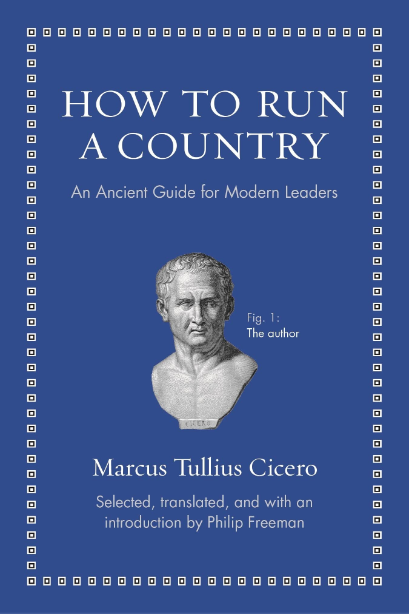
Marcus Cicero, Rome's greatest statesman and orator, was elected to the Roman Republic's highest office at a time when his beloved country was threatened by power-hungry politicians, dire economic troubles, foreign turmoil, and political parties that refused to work together. Sound familiar? Cicero's letters, speeches, and other writings are filled with timeless wisdom and practical insight about how to solve these and other problems of leadership and politics. How to Run a Country collects the best of these writings to provide an entertaining, common sense guide for modern leaders and citizens. This brief book, a sequel to How to Win an Election, gathers Cicero's most perceptive thoughts on topics such as leadership, corruption, the balance of power, taxes, war, immigration, and the importance of compromise. These writings have influenced great leaders--including America's Founding Fathers--for two thousand years, and they are just as instructive today as when they were first written.Organized by topic and featuring lively new translations, the book also includes an introduction, headnotes, a glossary, suggestions for further reading, and an appendix containing the original Latin texts. The result is an enlightening introduction to some of the most enduring political wisdom of all time.

In 56 B.C., M. Caelius Rufus was prosecuted for vis by L. Sempronius Atratinus in a trial with important social and political implications. This third edition of Cicero's speech in defense of Caelius reproduces A.C. Clark's authoritative text along with a new 17th-century conjecture on Caelius' birthplace, and updated notes and appendices on a variety of political, social, and literary concerns, including the connection between Caelius and Catallus.

How to Think about God: An Ancient Guide for Believers and Nonbelievers
by Marcus Tullius Cicero
Rating: 3.6 ⭐
A vivid and accessible new translation of Cicero's influential Stoic writings on the divineMost ancient Romans were deeply religious and their world was overflowing with gods--from Jupiter, Minerva, and Mars to countless local divinities, household gods, and ancestral spirits. One of the most influential Roman perspectives on religion came from a nonreligious belief system that is finding new adherents even today: Stoicism. How did the Stoics think about religion? In How to Think about God, Philip Freeman presents vivid new translations of Cicero's On the Nature of the Gods and The Dream of Scipio. In these brief works, Cicero offers a Stoic view of belief, divinity, and human immortality, giving eloquent expression to the religious ideas of one of the most popular schools of Roman and Greek philosophy.On the Nature of the Gods and The Dream of Scipio are Cicero's best-known and most important writings on religion, and they have profoundly shaped Christian and non-Christian thought for more than two thousand years, influencing such luminaries as Augustine, Thomas Aquinas, Dante, and Thomas Jefferson. These works reveal many of the religious aspects of Stoicism, including an understanding of the universe as a materialistic yet continuous and living whole in which both the gods and a supreme God are essential elements.Featuring an introduction, suggestions for further reading, and the original Latin on facing pages, How to Think about God is a compelling guide to the Stoic view of the divine.

-- Historical introduction-- Running vocabulary on facing pages-- Complete text-- Full apparatus of notes-- Glossary of proper names and places-- Appendix clarifying rhetorical terms and political offices-- Complete lexicon-- Bibliography

Cicero was still in his twenties when he got Sextus Roscius off a charge of murdering his father and nearly sixty when he defended King Deiotarus, accused of trying to murder Caesar. In between (with, among others, his speeches for Cluentius and Rabirius), he built a reputation as the greatest orator of his time.Cicero defended his practice partly on moral or compassionate grounds of 'human decency'--sentiments with which we today would agree. His clients generally went free. And in vindicating men--who sometimes did not deserve it--he left us a mass of detail about Roman life, law and history and, in two of the speeches, graphic pictures of the 'gun-law' of small provincial towns.
Book by Cicero, Sally Davis, Gilbert Lawall

Throughout history, some books have changed the world. They have transformed the way we see ourselves - and each other. They have inspired debate, dissent, war and revolution. They have enlightened, outraged, provoked and comforted. They have enriched lives - and destroyed them. Now Penguin brings you the works of the great thinkers, pioneers, radicals and visionaries whose ideas shook civilization and helped make us who we are.Amongst the most famous and influential of all political polemics, Cicero's scathing speeches against the dictatorial ambitions of Mark Antony are the passionate last testament of the greatest statesman of his age; a final attempt to restore his beloved Republic that was to cost him his life.

Cicero (106-43 BC) was the greatest orator of the ancient world and a leading politician of the closing era of the Roman republic. This book presents with nine of his speeches that reflect the development, variety, and drama of his political career. Among them are two speeches from his prosecution of Verres, a corrupt and cruel governor of Sicily; four speeches against the conspirator Catiline; and the Second Philippic, the famous denunciation of Mark Antony, which cost Cicero his life. Also included are On the Command of Gnaeus Pompeius, in which he praises the military successes of Pompey, and For Marcellus, a panegyric in praise of the dictator Julius Caesar. These new translations preserve Cicero's oratorical brilliance and achieve new standards of accuracy. A general introduction outlines Cicero's public career, and separate introductions explain the political significance of each of the speeches. This edition also provides an up-to-date scholarly bibliography, glossary and two maps. Together with the companion volume of Defense Speeches, this edition provides an unparalleled sampling of Cicero's achievements.

'But I must stop now, I can no longer speak for tears--and my client has ordered that tears are not to be used in his defence.'Cicero (106-43 BC) was the greatest orator of the ancient world: he dominated the Roman courts, usually appearing for the defence. His speeches are masterpieces of persuasion: compellingly written, and sometimes hilariously funny. This book presents five of his most famous defences: of Roscius, falsely accused of murdering his father; of the consul-elect Murena, accused of electoral bribery; of the poet Archias, on a citizenship charge; of Caelius, ex-lover of Clodia Metelli, on charges of violence; and of Milo, for murdering Cicero's hated enemy Clodius. Cicero's clients were rarely whiter-than-white, but so seductive is his oratory that the reader cannot help taking his side. In these speeches we are plunged into some of the most exciting courtroom dramas of all time.These new translations preserve Cicero's literary artistry and emotional force, and achieve new standards of accuracy. Each speech has its own introduction discusses Cicero's public career and the criminal courts. The substantial explanatory notes guide the reader through the speeches, and offer new scholarship presented in a clear way.