
Lennard Bickel
26 Books Written
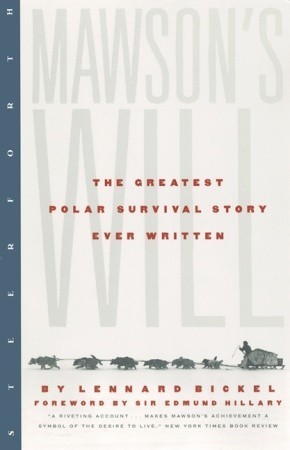
Mawson's Will: The Greatest Polar Survival Story Ever Written
by Lennard Bickel
Rating: 4.3 ⭐
• 4 recommendations ❤️
The dramatic story of explorer Douglas Mawson and "the most outstanding solo journey ever recorded in Antarctic history" (Sir Edmund Hillary, mountaineer and explorer) For weeks in Antarctica, Douglas Mawson faced some of the most daunting conditions ever known to blistering wind, snow, and cold; the loss of his companion, dogs, supplies, and even the skin on his hands and feet. But despite constant thirst, starvation, disease, and snow blindness—he survived.Sir Douglas Mawson is remembered as the young Australian who would not go to the South Pole with Robert Scott in 1911. Instead, he chose to lead his own expedition on the less glamorous mission of charting nearly 1,500 miles of Antarctic coastline and claiming its resources for the British Crown. His party of three set out through the mountains across glaciers in 60-mile-per-hour winds. Six weeks and 320 miles out, one man fell into a crevasse—along with the tent, most of the equipment, the dogs' food, and all except a week's supply of the men's provisions.Mawson's Will is the unforgettable story of one man's ingenious practicality, unbreakable spirit, and how he continued his meticulous scientific observations even in the face of death. When the expedition was over, Mawson had added more territory to the Antarctic map than anyone else of his time. Thanks to Bickel's moving account, Mawson can be remembered for the vision and dedication that make him one of the world's great explorers.

This is a dramatic true story of Antarctic tragedy and survival among the heroic group that was to lay supplies across the Great Ross Ice Shelf in preparation for the Endurance expedition. Launched by Shackleton (and led by Captain Aenaes Mackintosh), this courageous crew completed the longest sledge journey in polar history (199 days) and endured near-unimaginable deprivation. They accomplished most of their mission, laying the way for those who never came. All suffered; some died. Now Australian writer Lennard Bickel honors these forgotten heroes. Largely drawn from the author's interviews with surviving team member Dick Richards, this retelling underscores the capacity of ordinary men for endurance and noble action.

This Accursed Land charts the epic journey of Antarctic survival endured by explorer and geologist Sir Douglas Mawson. On the 10th of November, 1912, Douglas Mawson, Lieutenant Belgrave Ninnis and Xavier Mertz set off from the hut at base camp to undertake geographic research, mapping the coastline and collecting geological samples. Three men with their faithful husky's and very basic equipment faced almost insurmountable odds in the world's most desolate climate. Unearthing hitherto unpublished journals, Lennard Bickels's in depth research creates a devastatingly clear image of the great hardships faced by Mawson and his team. Crevasses opened under their feet, blizzards overwhelmed them and, perhaps most dangerously, malnutrition dogged their heels. After the death of his two companions, Mawson's incredible resilience and determination carried him through what to most would have been certain death. In a period of excitement and heroic exploration, Mawson's story was sadly overshadowed by the tragedy of the Scott expedition, meaning that his great achievements were mostly overlooked by the general public in his lifetime.

This book describes the life of Louis Braille who, blinded accidentally as a young boy, was sent to an institution in Paris where he devoted his life to developing the finger system for reading now used by the blind all over the world. He died at the age of 43, unknown and unhonoured. The author tells of the trials and torments Braille suffered in his attempts to perfect the system and to get it accepted. Lennard Bickel has also written "This Accursed Land", "The Deadly Element", "Shackleton's Forgotten Argonauts", "Rise Up to Life", "Facing Starvation" and "The Southern Universe".

Sir Edmund Hillary described Douglas Mawson’s epic and punishing journey across 600 miles of unknown Antarctic wasteland as ‘the greatest story of lone survival in polar exploration’.This Accursed Land tells that story; how Mawson declined to join Captain Robert Scott’s ill-fated British expedition and instead lead a three-man husky team to explore the far eastern coastline of the Antarctic continent.But the loss of one member and most of the supplies soon turned the hazardous trek into a nightmare. Mawson was trapped 320 miles from base with barely nine days’ food and nothing for the dogs.Eating poisoned meat, watching his body fall apart, crawling over chasms and crevices of deadly ice, his ultimate and lone struggle for survival, starving, poisoned, exhausted and indescribably cold, is an unforgettable story of human endurance. Grippingly told by Lennard Bickel, this is the most extraordinary journey from the brutal golden age of Antarctic exploration. Perfect for fans of Jon Krakauer’s Into Thin Air or Michael Palin’s Erebus.

Book by Bickel, Lennard

Book by Bickel, Lennard

Sir Edmund Hillary described Douglas Mawson’s epic and punishing journey across 600 miles of unknown Antarctic wasteland as ‘the greatest story of lone survival in polar exploration’.This Accursed Land tells that story; how Mawson declined to join Captain Robert Scott’s ill-fated British expedition and instead lead a three-man husky team to explore the far eastern coastline of the Antarctic continent.But the loss of one member and most of the supplies soon turned the hazardous trek into a nightmare. Mawson was trapped 320 miles from base with barely nine days’ food and nothing for the dogs.Eating poisoned meat, watching his body fall apart, crawling over chasms and crevices of deadly ice, his ultimate and lone struggle for survival, starving, poisoned, exhausted and indescribably cold, is an unforgettable story of human endurance.Grippingly told by Lennard Bickel, this is the most extraordinary journey from the brutal golden age of Antarctic exploration. Perfect for fans of Jon Krakauer’s Into Thin Air or Michael Palin’s Erebus.

Howard Florey was the brilliant, ambitious and sometimes ruthless Australian who developed penicillin, the first antibiotic, enabling a mastery of disease and death never before imagined in human history. This many-sided man was the first Australian to be President of the Royal Society and when he died in 1968, Sir Robert Menzies said 'in terms of world well-being, Florey was the most important man ever born in Australia'.

It wouldn't be for years after that fateful day when Alexander Fleming sneezed on a petri dish and stumbled upon Penicillin, that the almost miraculous power of this mould would transform the lives of every person on the planet. In Florey, The Man Who Made Penicillin we follow the life of Howard Walter Florey, who worked tirelessly for years with his dedicated team at Oxford to realise the potential of not only penicillin, but also the huge breadth of 'tailor made' antibiotics. Born in Australia, Florey left Adelaide for Oxford on a Rhodes scholarship after graduating in medicine, seeking a career in medical science. In a time when an infection from a thorn scratch could lead to a long and painful death, and meningitis, rheumatic fever, venereal disease and other bacterial infections had meant certain doom, the idea of an antibiotic that could treat all of these afflictions was almost unimaginable. In the aftermath of WW1, when septicaemia and gas gangrene had claimed the lives of so many young men, the need for antibiotics had never been keener. First published in 1972, Florey, the Man Who Made Penicillin tracks Florey's battle with funding, the many set-backs and limitations of his equipment and public opinion, and the fascinating journey that led humankind to Penicillin. Whist Fleming got the lion's share of the credit, it was Florey who truly gave the world Penicillin.

Born in France in 1809, Louis Braille was the fourth child of a village saddler. At the age of three, he stabbed himself in the eye with a pointed tool taken from his father's work bench.Some thirteen years later he again took a sharp tool from the same bench and used it to create a code of raised dots punched through sheets of paper. With the patience of genius, he perfected his code – still unsurpassed – and fashioned an alphabet that opened the world of learning to the blind.Louis Braille died at the age of forty-three, unknown and unhonoured. His superiors at the Royal Institute for the Young Blind in Paris would not recognise a system that was not based on the shapes of the alphabet.Lennard Bickel researched this story in Paris and in the small village where Louis Braille was born. He tells of the trials and torments of young blind man struggling amid the harshest conditions to perfect something he believed in.Triumph Over Darkness, first published in 1988, is a stirring story of determination and tenacity in the face of adversity.


Sống Sót Giữa Miền Cực Giá đưa ta đến với miền nam Cực khắc nghiệp - vùng đất băng giá vĩnh cửu và những trận bão tuyết, những khe băng nguy hiểm chết người, và cái đói, cái rét có khả năng hủy hoại tinh thần và sức khỏe của con người. Thế nhưng Nam Cực còn là một thế giới khác với phong cảnh đẹp nao lòng, những động vật kỳ lạ, nhưng hiện tượng thiên nhiên kỳ thú, và trên tất cả là hình ảnh hùng tráng của con người dám mạ hiểm để khám phá. Sách gồm có bốn câu chuyện xuất sắc trích từ hồi ký viết về bốn nhà thám hiểm nổi tiếng đầy chân thực và hấp dẫn.

In Search of Frank Hurley
by Lennard Bickel
Deadly Element: The Story of Uranium
by Lennard Bickel
Shakleton's Forgotten Argonauts
by Lennard Bickel
Shackleton's Forgotten Men: The Untold Tragedy of the Endurance Epic
by Lennard Bickel
First edition. Brand new, pristine dust jacket. Unread. No ownership marks, folds, stains, dogears or other issues. With photographs, maps, and map endpapers.

Howard Florey
by Lennard Bickel
Howard Florey was the brilliant, ambitious and sometimes ruthless Australian who developed penicillin, the first antibiotic, enabling a mastery of disease and death never before imagined in human history. This many-sided man was the first Australian to be President of the Royal Society and when he died in 1968, Sir Robert Menzies said 'in terms of world well-being, Florey was the most important man ever born in Australia'.

Triumph over Darkness
by Lennard Bickel
First published in 1988, Triumph over Darkness is a stirring story of determination and tenacity in the face of adversity. Born in France in 1809, Louis Braille was the 4th child of a village saddler. At the age of three he stabbed himself in the eye with a pointed tool taken from his father’s work bench. Some 13 years later he again took a sharp tool from the same bench and used it to create a code of raised dots punched through sheets of paper. With the patience of genius, he perfected his code- still unsurpassed-and fashioned an alphabet that opened the world of learning to the blind.Louis Braille died at the age of 43 unknown and unhonoured. He superiors at the Royal Institute for the Young Blind in Paris would not recognise the system that was not based on the shapes of the alphabet. Lennard Bickel researched this story in Paris and in the small village where Louis Braille was born. He tells of the trials and torments of a young blind man struggling amid the harshest conditions to perfect something he believed in. This book will be of interest to general readers interested in the life of Louis Braille.
THE ACCURSED LAND
by Lennard Bickel

The Greatest Polar Survival Story Ever Written Publisher: Steerforth
by Lennard Bickel

The Last Antarctic Heroes
by Lennard Bickel
In search of Frank Hurley
by Lennard Bickel

The southern universe
by Lennard Bickel