
Lee Kuan Yew
Lee Kuan Yew was born in Singapore in 1923. He was educated at Raffles College, Singapore and Fitzwilliam College, Cambridge, England. He was called to the Bar, Middle Temple, London, in 1950 and practised law in Singapore. He became advisor to several trade unions. In 1954, he was a founder of the People's Action Party and was Secretary General up to 1992. Mr Lee became Singapore's Prime Minister in 1959, serving successive terms until he resigned in November 1990, when he was appointed Senior Minister by Prime Minister Goh Chok Tong. He was re-appointed again after the 1991, 1997 and 2001 general elections. In August 2004, Mr Lee was appointed Minister Mentor by Prime Minister Lee Hsien Loong, and was reappointed again after the 2006 general elections. He stepped down as Minister Mentor in May 2011, and was appointed Senior Advisor to the Government of Singapore Investment Corporation.
29 Books Written
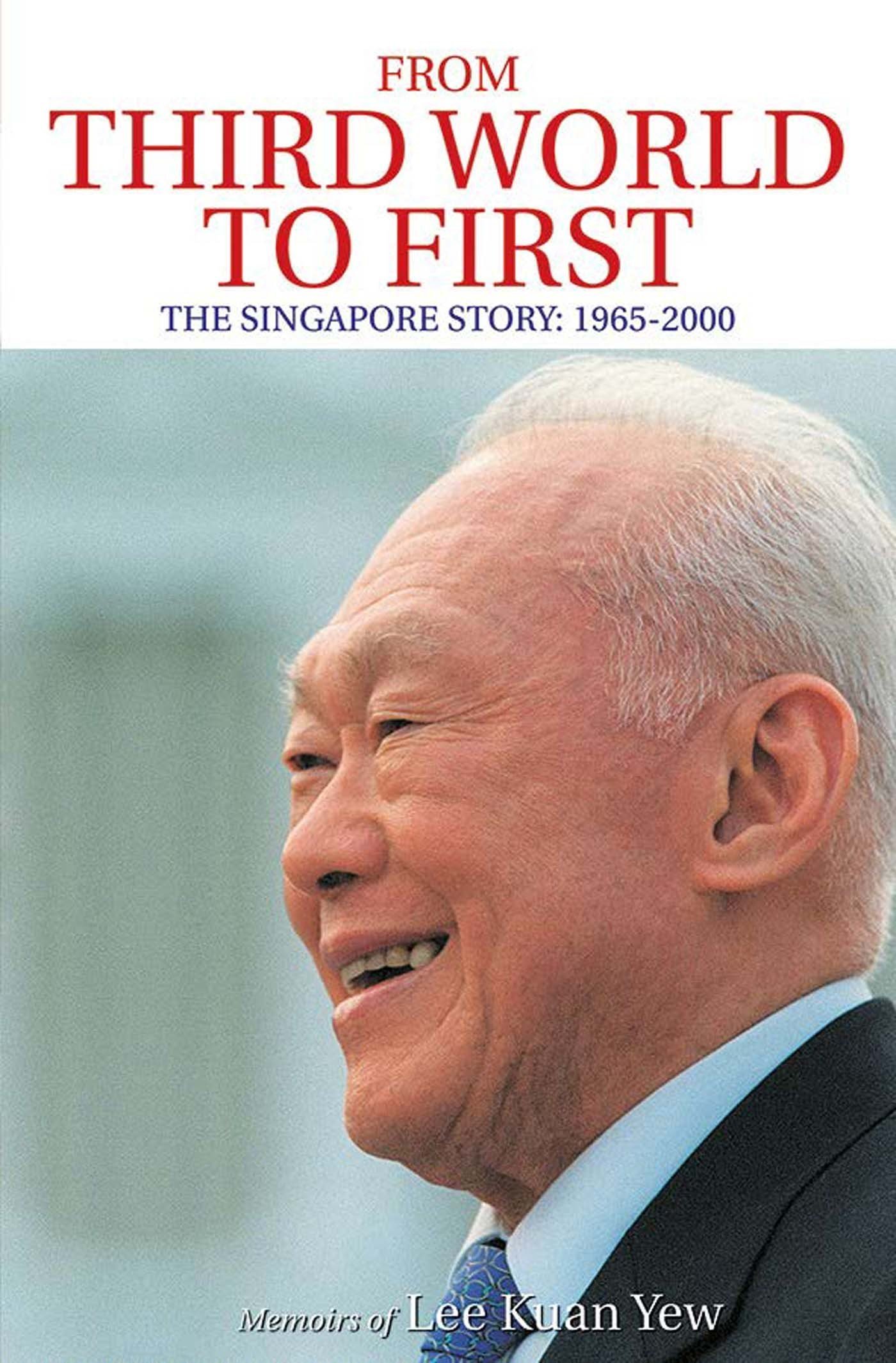
From Third World to First: The Singapore Story: 1965-2000
by Lee Kuan Yew
Rating: 4.5 ⭐
• 3 recommendations ❤️
Few gave tiny Singapore much chance of survival when it was granted independence in 1965. How is it, then, that today the former British colonial trading post is a thriving Asian metropolis with not only the world's number one airline, best airport, and busiest port of trade, but also the world's fourth–highest per capita real income?The story of that transformation is told here by Singapore's charismatic, controversial founding father, Lee Kuan Yew. Rising from a legacy of divisive colonialism, the devastation of the Second World War, and general poverty and disorder following the withdrawal of foreign forces, Singapore now is hailed as a city of the future. This miraculous history is dramatically recounted by the man who not only lived through it all but who fearlessly forged ahead and brought about most of these changes.Delving deep into his own meticulous notes, as well as previously unpublished government papers and official records, Lee details the extraordinary efforts it took for an island city–state in Southeast Asia to survive at that time.Lee explains how he and his cabinet colleagues finished off the communist threat to the fledgling state's security and began the arduous process of nation building: forging basic infrastructural roads through a land that still consisted primarily of swamps, creating an army from a hitherto racially and ideologically divided population, stamping out the last vestiges of colonial–era corruption, providing mass public housing, and establishing a national airline and airport.In this illuminating account, Lee writes frankly about his trenchant approach to political opponents and his often unorthodox views on human rights, democracy, and inherited intelligence, aiming always "to be correct, not politically correct." Nothing in Singapore escaped his watchful eye: whether choosing shrubs for the greening of the country, restoring the romance of the historic Raffles Hotel, or openly, unabashedly persuading young men to marry women as well educated as themselves. Today's safe, tidy Singapore bears Lee's unmistakable stamp, for which he is unapologetic: "If this is a nanny state, I am proud to have fostered one."Though Lee's domestic canvas in Singapore was small, his vigor and talent assured him a larger place in world affairs. With inimitable style, he brings history to life with cogent analyses of some of the greatest strategic issues of recent times and reveals how, over the years, he navigated the shifting tides of relations among America, China, and Taiwan, acting as confidant, sounding board, and messenger for them. He also includes candid, sometimes acerbic pen portraits of his political peers, including the indomitable Margaret Thatcher and Ronald Reagan, the poetry–spouting Jiang Zemin, and ideologues George Bush and Deng Xiaoping.Lee also lifts the veil on his family life and writes tenderly of his wife and stalwart partner, Kwa Geok Choo, and of their pride in their three children –– particularly the eldest son, Hsien Loong, who is now Singapore's deputy prime minister.For more than three decades, Lee Kuan Yew has been praised and vilified in equal measure, and he has established himself as a force impossible to ignore in Asian and international politics. From Third World to First offers readers a compelling glimpse into this visionary's heart, soul, and mind.

Visionary? Authoritarian? Model for the West? Lee Kuan Yew, the long-time leader of Singapore, has been called all these things, and more. In these vivid memoirs, Lee takes a profoundly personal look back at the events that led to Singapore's independence and shaped its struggle for success. And, as always, he lets the chips fall where they may.In intimate detail, Lee recounts Singapore's unforgettable history. You'll be with Lee as he leads striking unionists against the colonial government; shares tea and rounds of golf with key players in Britain and Malaya; and drinks warm Anchor beer with leaders of the communist underground at secret midnight meetings. From British colonial rule through Japanese occupation in World War II, Communist insurrection, riots, independence -- and the struggles that followed -- few political memoirs anywhere have been this blunt, or this fascinating.Anyone interested in the political history of Singapore, Asia, and the modern world.

In this book, Lee draws on that wealth of experience and depth of insight to offer his views on today's world and what it might look like in 20 years. This is no dry geopolitical treatise. Nor is it a thematic account of the twists and turns in global affairs. Instead, in this broad-sweep narrative that takes in America, China, Asia and Europe, he parses their society, probes the psyche of the people and draws his conclusions about their chances for survival and just where they might land in the hierarchy of tomorrow's balance of power. What makes a society tick? What do its people really believe? Can it adapt? In spare, unflinching prose that eschews political correctness, he describes a China that remains obsessed with control from the centre on its way to an unstoppable rise; an America that will have to share its pre-eminence despite its never-say-die dynamism; and a Europe that struggles with the challenges of keeping its union intact. His candid and often startling views on why Japan is closed to foreigners, why the Arab Spring won't bring one man, one vote to the Middle East, and why preventing global warming is not going to be as fruitful as preparing for it; make this a fresh and gripping read. Lee completes the book by looking into the future of Singapore, his enduring concern and by offering the reader a glimpse into his personal life and his view of death. The book is interspersed with a Q&A section in each chapter, gleaned from conversations he had with journalists from The Straits Times.

Lee Kuan Yew played the pivotal role in Singapore's transition from British Crown Colony to independent developing nation, and on to the economically powerful and diplomatically influential city-state it is today. Throughout this surprising and at times painful journey, he has proved a charismatic and occasionally controversial leader. Lee is a conviction politician whose speeches are unambiguous, characterful and eminently quotable; this collection of almost 600 short quotations provides a compelling summary of his views on a wide range of topics from Singapore's past, present and future. In Lee's own words: "I have been accused of many things in my lfe, but not even my worst enemy has ever accused me of being afraid to speak my mind."

In My Lifelong Challenge, we learn of the many policy adjustments and the challenges Lee Kuan Yew encountered – from Chinese language chauvinists who wanted Chinese to be the preeminent language in Singapore, from Malay and Tamil community groups fearing that Chinese was being given too much emphasis, from parents of all races wanting an easier time for their school-going children, from his own Cabinet colleagues questioning his assumptions about language. We learn of the pain of teachers forced to switch from teaching in Chinese to teaching in English almost overnight, and of students who were caught in the transition from a Chinese medium of instruction to an English one. My Lifelong Challenge is also the story of Lee’s own struggle to learn the Chinese language. This book describes vividly his steely determination to improve his Chinese and reclaim his Chinese heritage, right up to the present when he is well into his 80s. Lee distils his experiences of 50 years into eight precepts that he spells out at the end of his narrative.

The Battle for Merger charts the crucial years of 1961–1962, when the PAP government was in a precarious position and the future of Singapore was hanging in the balance. This commemorative book retains the authenticity of the transcripts of Lee Kuan Yew’s twelve radio talks and appendices, which are exact reproductions of the original 1962 edition. Complete with nostalgic photographs of historical events as well as painstaking reproductions of secret letters and codes, this book also includes new material to give a comprehensive coverage on the intriguing subject of merger between Singapore and Malaysia. This publication contains the following: 1. A new message from Lee Kuan Yew that reveals the former prime minister’s hindsight on merger 2. A comprehensive essay by Associate Professor Albert Lau that provides the historical background to merger 3. Concise notes to key players, places and events 4. MP3 audio recordings of the twelve radio talks in English, Mandarin and Malay The battle for merger is a story worth retelling. This book is for all who want to understand what was at stake during those tumultuous times. Reading this would be akin to reliving the sensational moments created by Lee Kuan Yew’s timely revelations during the twelve radio broadcasts. It tells of how the Old Guards stood up and fought back against the communists and later the communalists, of how they refused to be cowed and thus won the confidence of that generation, which went on to help build modern Singapore.


Li Guangyao tan Xinjiapo di Hua ren she hui =: Lee Kuan Yew on the Chinese community in Singapore
by Lee Kuan Yew
Rating: 4.5 ⭐
Chinese, English


Book Synopsis:Mr Lee Kuan Yew turns 90 this September. To commemorate his birthday, The Straits Times and Lianhe Zaobao - flag ship newspapers of the Singapore Press Holdings – have put together a unique collection of photographs in a pictorial book capturing his public and private life. Organised in six chapters, this pictorial is a snapshot of Mr Lee’s life from his early childhood to his entry into the rough and tumble of politics in the 1950s, through the battle for the hearts and mind of Singaporeans and the nation building years that transformed this country into what it is today. In January 2013, a team began work to put the book together. The project was led by The Straits Times’ picture editor Stephanie Yeow, and included Straits Times correspondent Cassandra Chew, senior writer Leong Weng Kam, Lianhe Zaobao’s news editor Han Yong May and executive photographer Spencer Chung. The book was designed by Straits Times senior executive artist Sally Lam. English/Malay Newspapers Division’s managing editor Han Fook Kwang oversaw the project. It took the team months to source for images from Mr Lee’s family, old friends, colleagues, grassroots leaders, government agencies and even collectors of Lee Kuan Yew paraphernalia. The result is a pictorial that not only covers the breadth of Mr Lee’s great achievements, but also reveals the intimate moments of his personal life. Hardback, 268pp + 480 photographs Publisher: Straits Times Press Pub Date: Sep 2013 ISBN: 9789814342582 Size: 261 x 323 mm Language: Bilingual

National Day Rally Speeches: 50 Years of Nationhood in Singapore, 1966-2015
by Lee Kuan Yew
Rating: 4.3 ⭐
The annual National Day Rally speeches in Singapore provide a valuable summation of all the major issues encountered each year, the challenges faced, as well as the policies and strategies that have shaped Singapore from Independence in 1965 to the present time.This book presents a collection of 50 National Day Rally speeches made between 1966 and 2015 by Singapore's Prime Ministers Mr Lee Kuan Yew, Mr Goh Chok Tong and Mr Lee Hsien Loong. This is the first time that these speeches have been published in one book. It is an excellent resource for researchers and academics as well as anyone who seeks a better understanding of Singapore's nation-building journey and insights into how the country has evolved into what it is today.KEY FEATURES- Presents, for the first time and in a single volume, a complete collection of 50 National Day Rally speeches delivered between 1966 and 2015 by Singapore's Prime Ministers Mr Lee Kuan Yew, Mr Goh Chok Tong and Mr Lee Hsien Loong.- Chronicles the key political, social and economic changes that Singapore has experienced, as well as the policies and strategies that have shaped the country over the past five decades since Independence.- Contains detailed annotations of key terms and phrases mentioned in the speeches.- Features 38 photos of three prime ministers of Singapore delivering the National Day Rally speech.

The Commonwealth: A Continuity of Association after Empire. Smuts Memorial Lecture
by Lee Kuan Yew
Rating: 3.0 ⭐

Book by Lee, Kuan Yew


On 31 Aug. 1964, the Prime Minister, Mr. Lee Kuan Yew left Singapore for Brussels to attend the centenary of the Socialist International. This publication attempts to present, in words and pictures, the story of the Prime Minister's successful trip. Included are his speeches delivered on Sept. 3 and Sept. 5, 1964 at Brussels, as well as his speech to Malaysian students in London on Sept. 10, 1964.
[Malaysia will succeed
by Lee Kuan Yew

Fracture and Strength, 90
by Lee Kuan Yew
Coverage composites; ceramics; fatigue crack growth; weldments; and stress corrosion cracking.
East-West: The Twain Have Met
by Lee Kuan Yew
Social revolution in Singapore
by Lee Kuan Yew
THE SINGAPORE ACCOUNT~MEMOIRS OF LEE KUAN YEW
by Lee Kuan Yew
The battle for a Malaysian Malaysia
by Lee Kuan Yew
The essentials of economic growth
by Lee Kuan Yew
Are there enough Malaysians to save Malaysia?
by Lee Kuan Yew
Asia-Pacific region in the new geopolitical context
by Lee Kuan Yew


シンガポールの政治哲学―リー・クアンユー首相演説集〈上〉
by Lee Kuan Yew