
Kazuo Ishiguro
Sir Kazuo Ishiguro (カズオ・イシグロ or 石黒 一雄), OBE, FRSA, FRSL is a British novelist of Japanese origin and Nobel Laureate in Literature (2017). His family moved to England in 1960. Ishiguro obtained his Bachelor's degree from the University of Kent in 1978 and his Master's from the University of East Anglia's creative writing course in 1980. He became a British citizen in 1982. He now lives in London. His first novel, A Pale View of Hills, won the 1982 Winifred Holtby Memorial Prize. His second novel, An Artist of the Floating World, won the 1986 Whitbread Prize. Ishiguro received the 1989 Man Booker prize for his third novel The Remains of the Day. His fourth novel, The Unconsoled, won the 1995 Cheltenham Prize. His latest novel is The Buried Giant, a New York Times bestseller. He was awarded the Nobel Prize in Literature 2017. His novels An Artist of the Floating World (1986), When We Were Orphans (2000), and Never Let Me Go (2005) were all shortlisted for the Man Booker Prize. In 2008, The Times ranked Ishiguro 32nd on their list of "The 50 Greatest British Writers Since 1945". In 2017, the Swedish Academy awarded him the Nobel Prize in Literature, describing him in its citation as a writer "who, in novels of great emotional force, has uncovered the abyss beneath our illusory sense of connection with the world".
29 Books Written

Klara and the Sun is a magnificent new novel from the Nobel laureate Kazuo Ishiguro--author of Never Let Me Go and the Booker Prize-winning The Remains of the Day.Klara and the Sun, the first novel by Kazuo Ishiguro since he was awarded the Nobel Prize in Literature, tells the story of Klara, an Artificial Friend with outstanding observational qualities, who, from her place in the store, watches carefully the behavior of those who come in to browse, and of those who pass on the street outside. She remains hopeful a customer will soon choose her.Klara and the Sun is a thrilling book that offers a look at our changing world through the eyes of an unforgettable narrator, and one that explores the fundamental question: what does it mean to love?In its award citation in 2017, the Nobel committee described Ishiguro's books as novels of great emotional force and said he has uncovered the abyss beneath our illusory sense of connection with the world.

As a child, Kathy – now thirty-one years old – lived at Hailsham, a private school in the scenic English countryside where the children were sheltered from the outside world, brought up to believe that they were special and that their well-being was crucial not only for themselves but for the society they would eventually enter. Kathy had long ago put this idyllic past behind her, but when two of her Hailsham friends come back into her life, she stops resisting the pull of memory.And so, as her friendship with Ruth is rekindled, and as the feelings that long ago fueled her adolescent crush on Tommy begin to deepen into love, Kathy recalls their years at Hailsham. She describes happy scenes of boys and girls growing up together, unperturbed – even comforted – by their isolation. But she describes other scenes as well: of discord and misunderstanding that hint at a dark secret behind Hailsham's nurturing facade. With the dawning clarity of hindsight, the three friends are compelled to face the truth about their childhood – and about their lives now.
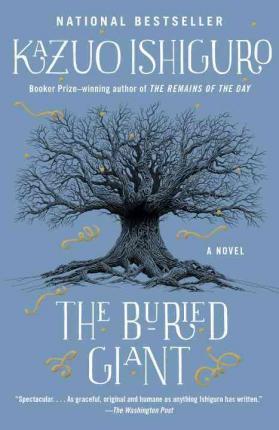
In post-Arthurian Britain, the wars that once raged between the Saxons and the Britons have finally ceased. Axl and Beatrice, an elderly British couple, set off to visit their son, whom they haven’t seen in years. And, because a strange mist has caused mass amnesia throughout the land, they can scarcely remember anything about him. As they are joined on their journey by a Saxon warrior, his orphan charge, and an illustrious knight, Axl and Beatrice slowly begin to remember the dark and troubled past they all share. By turns savage, suspenseful, and intensely moving, The Buried Giant is a luminous meditation on the act of forgetting and the power of memory, an extraordinary tale of love, vengeance, and war.

Librarian's note: See alternate cover edition of ISBN 0571225381 here.In the summer of 1956, Stevens, a long-serving butler at Darlington Hall, decides to take a motoring trip through the West Country. The six-day excursion becomes a journey into the past of Stevens and England, a past that takes in fascism, two world wars, and an unrealised love between the butler and his housekeeper.

In the face of the misery in his homeland, the artist Masuji Ono was unwilling to devote his art solely to the celebration of physical beauty. Instead, he put his work in the service of the imperialist movement that led Japan into World War II. Now, as the mature Ono struggles through the aftermath of that war, his memories of his youth and of the “floating world”—the nocturnal world of pleasure, entertainment, and drink—offer him both escape and redemption, even as they punish him for betraying his early promise. Indicted by society for its defeat and reviled for his past aesthetics, he relives the passage through his personal history that makes him both a hero and a coward but, above all, a human being.

The maze of human memory--the ways in which we accommodate and alter it, deceive and deliver ourselves with it--is territory that Kazuo Ishiguro has made his own. In his previous novels, he has explored this inner world and its manifestations in the lives of his characters with rare inventiveness and subtlety, shrewd humor and insight. In When We Were Orphans, his first novel in five years, he returns to this terrain in a brilliantly realized story that illuminates the power of one's past to determine the present.Christopher Banks, an English boy born in early-twentieth-century Shanghai, is orphaned at age nine when his mother and father both vanish under suspicious circumstances. Sent to live in England, he grows up to become a renowned detective and, more than twenty years later, returns to Shanghai, where the Sino-Japanese War is raging, to solve the mystery of the disappearances.The story is straightforward. Its telling is remarkable. Christopher's voice is controlled, detailed, and detached, its precision unsurprising in someone who has devoted his life to the examination of details and the rigors of objective thought. But within the layers of his narrative is slowly revealed what he can't, or won't, see: that his memory, despite what he wants to believe, is not unaffected by his childhood tragedies; that his powers of perception, the heralded clarity of his vision, can be blinding as well as enlightening; and that the simplest desires--a child's for his parents, a man's for understanding--may give rise to the most complicated truths.A masterful combination of narrative control and soaring imagination, When We Were Orphans is Kazuo Ishiguro at his best.

Librarian note: This a previously-published edition of ISBN 9780571225378.In his highly acclaimed debut, A Pale View of Hills, Kazuo Ishiguro tells the story of Etsuko, a Japanese woman now living alone in England, dwelling on the recent suicide of her daughter. Retreating into the past, she finds herself reliving one particular hot summer in Nagasaki, when she and her friends struggled to rebuild their lives after the war. But then as she recalls her strange friendship with Sachiko - a wealthy woman reduced to vagrancy - the memories take on a disturbing cast.

One of the most celebrated writers of our time gives us his first cycle of short fiction: five brilliantly etched, interconnected stories in which music is a vivid and essential character. A once-popular singer, desperate to make a comeback, turning from the one certainty in his life . . . A man whose unerring taste in music is the only thing his closest friends value in him . . . A struggling singer-songwriter unwittingly involved in the failing marriage of a couple he’s only just met . . . A gifted, underappreciated jazz musician who lets himself believe that plastic surgery will help his career . . . A young cellist whose tutor promises to “unwrap” his talent . . . Passion or necessity—or the often uneasy combination of the two—determines the place of music in each of these lives. And, in one way or another, music delivers each of them to a moment of reckoning: sometimes comic, sometimes tragic, sometimes just eluding their grasp. An exploration of love, need, and the ineluctable force of the past, Nocturnes reveals these individuals to us with extraordinary precision and subtlety, and with the arresting psychological and emotional detail that has marked all of Kazuo Ishiguro’s acclaimed works of fiction.

Ryder, a renowned pianist, arrives in a Central European city he cannot identify for a concert he cannot remember agreeing to give. But then as he traverses a landscape by turns eerie and comical – and always strangely malleable, as a dream might be - he comes steadily to realise he is facing the most crucial performance of his life.Ishiguro's extraordinary and original study of a man whose life has accelerated beyond his control was met on publication by consternation, vilification – and the highest praise.

Faber Stories, a landmark series of individual volumes, presents masters of the short story form at work in a range of genres and styles.When Ray turns up to visit his old university friends Charlie and Emily, he's given a special task: to be so much his useless self that he makes Charlie look good by comparison.But Ray has his own buried feelings to contend with. Decades earlier, he and Emily would listen to jazz when they were alone, and now, as Sarah Vaughan sings through the speakers, he struggles to control everything the sound brings with it.In Kazuo Ishiguro's hands, a snapshot of domestic realism becomes a miniature masterpiece of memory and forgetting.Bringing together past, present and future in our ninetieth year, Faber Stories is a celebratory compendium of collectable work.

My Twentieth Century Evening and Other Small Breakthroughs: The Nobel Lecture
by Kazuo Ishiguro
Rating: 4.2 ⭐
Delivered in Stockholm on 7 December 2017, My Twentieth Century Evening and Other Small Breakthroughs is the lecture of the Nobel Laureate in Literature, Kazuo Ishiguro. A generous and hugely insightful biographical sketch, it explores his relationship with Japan, reflections on his own novels and an insight into some of his inspirations, from the worlds of writing, music and film. Ending with a rallying call for the ongoing importance of literature in the world, it is a characteristically thoughtful and moving piece.

From the Nobel Prize–winning author of Klara and the Sun and Never Let Me Go comes a gorgeously illustrated volume of lyrics written for the platinum-selling, Grammy-nominated jazz singer Stacey Kent.Memorably introduced by Ishiguro himself, The Summer We Crossed Europe in the Rain collects the lyrics of sixteen songs he wrote for world-renowned American singer Stacey Kent, which were set to music by her partner, Jim Tomlinson. An exquisite coming together of the literary and musical worlds, the lyrics are infused with a sense of yearning, melancholy, love, and the romance of travel and liminal spaces.Further exploring the notion of collaboration and interpretation, the collection is illustrated by the acclaimed Italian artist Bianca Bagnarelli, whose work perfectly captures the atmosphere and sensibility of the songs.

First published in Firebird 2, ed. T J Binding (Penguin, 1983).

Short Story: "A Village After Dark" (The New Yorker, 2001)

An Artist of the Floating World & The Remains of the Day (Omnibus) [Paperback] kazuo ishiguro

Klara and the Sun ‘The Sun always has ways to reach us.'From her place in the store, Klara, an Artificial Friend with outstanding observational qualities, watches carefully the behaviour of those who come in to browse, and of those who pass in the street outside. She remains hopeful a customer will soon choose her, but when the possibility emerges that her circumstances may change for ever, Klara is warned not to invest too much in the promises of humans.In Klara and the Sun, his first novel since winning the Nobel Prize in Literature, Kazuo Ishiguro looks at our rapidly-changing modern world through the eyes of an unforgettable narrator to explore a fundamental question: what does it mean to love? Never Let Me Go Kazuo Ishiguro imagines the lives of a group of students growing up in a darkly skewed version of contemporary England. Narrated by Kathy, now thirty-one, Never Let Me Go dramatises her attempts to come to terms with her childhood at the seemingly idyllic Hailsham School and with the fate that has always awaited her and her closest friends in the wider world. A story of love, friendship and memory, Never Let Me Go is charged throughout with a sense of the fragility of life.

Venezia, una gondola al chiaro di luna, la voce calda del vecchio crooner Tony Gardner, che un tempo ammaliava le folle. Esiste scenario più romantico per una serenata all'amore che fu? Esiste scenario più crudele?

«Mon manager, Bradley Stevenson, qui au cours des années a été un ami précieux à sa manière, soutient que j’ai en moi l’étoffe d’un vrai pro. Pas seulement comme musicien de studio, mais comme vedette de première division. Il est faux que les saxophonistes ne deviennent plus des vedettes, affirme-t-il, et il répète sa liste de noms. Marcus Lightfoot. Silvio Tarrentini. Ce sont tous des musiciens de jazz, fais-je remarquer. C’est bien ce que tu es, non? réplique-t-il. Mais je ne le suis encore que dans mes rêves les plus secrets. Dans le monde réel – quand je n’ai pas le visage entièrement enveloppé de pansements comme en ce moment – je suis juste un ténor payé à la journée, raisonnablement sollicité pour l’enregistrement en studio, ou lorsqu’un groupe a perdu son saxo habituel. S’ils veulent de la pop, je joue de la pop. R&B? Parfait. Publicités pour des voitures, thème musical d’un talk show, j’accepte. Ces temps-ci je suis un musicien de jazz seulement quand je suis enfermé dans mon réduit.»Dans ces deux nouvelles construites en écho, se croisent et se répondent, de Venise à Beverly Hills, quelques magnifiques figures de musiciens désenchantés.


Please Note That The Following Individual Books As Per Original ISBN and Cover Image In this Listing shall be Dispatched Kazuo Ishiguro 3 Books Collection Never Let Me As children, Kathy, Ruth, and Tommy were students at Hailsham, an exclusive boarding school secluded in the English countryside. It was a place of mercurial cliques and mysterious rules where teachers were constantly reminding their charges of how special they were.The Remains of the This is Kazuo Ishiguro's profoundly compelling portrait of a butler named Stevens. Stevens, at the end of three decades of service at Darlington Hall, spending a day on a country drive, embarks as well on a journey through the past in an effort to reassure himself that he has served humanity.A Pale View of Here is the story of Etsuko, a Japanese woman now living alone in England, dwelling on the recent suicide of her daughter. In a novel where past and present confuse, she relives scenes of Japan's devastation in the wake of World War II.

Short story published in 7 New Writers

This set of three books by Kazuo Ishiguro includes: "An Artist Of The Floating World"; "The Remains Of The Day"; and "The Unconsoled". It forms part of Faber's "Threebies" series, which offers different sets of three titles, each set written by a best-selling author.

Nouvelle extraite du n°5 Automne 1989 de la revue Le Serpent à Plumes.Publiée par le groupement de libraires L’œil de la lettre en 1990.


Short story published in Granta 17: While Waiting for a War (Granta 17: While Waiting for a War) - in form of an extract from the novel An Artist of the Floating World

Rare collection of previously unpublished stories, collected with watercolor paintings by Eileen Hogan
