
Kate Murphy
Journalist Kate Murphy’s eclectic essays and articles for The New York Times, The Wall Street Journal, The Economist, Agence France-Presse, and Texas Monthly have been shared and commented on by millions. She is known for her fresh and accessible style and ability to distill complex subjects, particularly the science behind human interactions. Her first book, You’re Not Listening: What You’re Missing and Why It Matters, was published in thirty-two languages and has become required reading in interpersonal communication courses at high schools, colleges, and universities worldwide. Kate lives in Houston, Texas, and holds a commercial pilot’s license.
2 Books Written

You're Not Listening: What You're Missing and Why It Matters
by Kate Murphy
Rating: 4.1 ⭐
• 4 recommendations ❤️
Who listens to you?New York Times contributor Kate Murphy asked people on five continents this question, and the response was typically a long, awkward pause. People struggled to come up with someone, anyone, who truly listened to them without glazing over, glancing down at a phone, or jumping in to offer an opinion. Many admitted that they, themselves, weren’t very good listeners, and most couldn’t even describe what it meant to be a good listener.Despite living in a world where technology allows constant digital communication and opportunities to connect, it seems no one is really listening or even knows how. And it’s making us lonelier, more isolated, and less tolerant than ever before. A listener by trade, Murphy wanted to know how we got here.In this illuminating and often humorous deep dive, Murphy explains why we’re not listening, what it’s doing to us, and how we can reverse the trend. She makes accessible the psychology, neuroscience, and sociology of listening while also introducing us to some of the best listeners out there (including a CIA agent, focus-group moderator, bartender, radio producer, and top furniture salesman).While listening is often regarded as talking’s meek counterpart, Murphy discovered it’s actually the more powerful position in communication. We learn when we listen. It’s how we connect, cooperate, empathize, and fall in love. Listening is something we do or don’t do every day. While we might take listening for granted, how well we listen, to whom, and under what circumstances determines who we are and the paths we take in life.Equal parts cultural observation, scientific exploration, and rousing call to action that’s full of practical advice, You’re Not Listening is to listening what Susan Cain’s Quiet was to introversion. It’s time to stop talking and start listening.
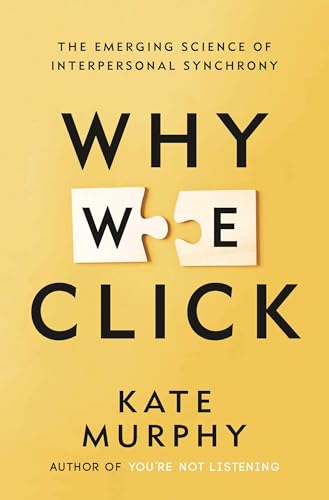
Why do you immediately click with some people while others just as inexplicably turn you off? Do people emit vibes? Is it possible to read a room? Are bad habits contagious?Kate Murphy, author of the international bestseller You’re Not Listening, answers these and other fascinating questions in Why We Click, the first book that explores the emerging science and outsize impact of interpersonal synchrony, the most consequential social dynamic most people have never heard of. Interpersonal synchrony is the seemingly magical, yet now scientifically documented, tendency of human beings to fall into rhythm and find resonance with one another.Not only do we subconsciously match one another’s movements, postures, facial expressions, and gestures; recent breakthroughs in technology have revealed we also sync up our heart rates, blood pressure, brainwaves, pupil dilation, and hormonal activity. The result is that emotions, moods, attitudes, and subsequent behaviors can be as infectious as any disease, and can have just as profound an impact on our health and well-being.Interweaving science, philosophy, literature, history, business management theory, pop-culture, and plenty of relatable, real world examples, Why We Click explains why being “in sync,” “in tune,” “in step,” and “on the same wavelength” are more than just turns of phrase. From the bedroom to the boardroom and beyond, Murphy reveals with characteristic curiosity, concision, and wit how our instinct to sync with others drives much of our behavior and how our deepest desires—to be known, admired, loved, and connected—are so often thwarted in modern life.