
Karl Marlantes
A graduate of Yale University and a Rhodes Scholar at Oxford University, Karl Marlantes served as a Marine in Vietnam, where he was awarded the Navy Cross, the Bronze Star, two Navy Commendation medals for valor, two Purple Hearts, and ten air medals. He is the author of Matterhorn, which won the William E. Colby Award given by the Pritzker Military Library, the Center For Fiction's Flaherty-Dunnan First Novel Prize, the 2011 Indies’ Choice Award for Adult Debut Book of the Year and the Marine Corps Heritage Foundation’s James Webb Award for Distinguished Fiction. He lives in rural Washington.
4 Books Written

A big, powerful saga of men in combat, written over the course of thirty-five years by a highly decorated Vietnam veteran.Intense, powerful, and compelling, Matterhorn is an epic war novel in the tradition of Norman Mailer's The Naked and the Dead and James Jones's The Thin Red Line. It is the timeless story of a young Marine lieutenant, Waino Mellas, and his comrades in Bravo Company, who are dropped into the mountain jungle of Vietnam as boys and forced to fight their way into manhood. Standing in their way are not merely the North Vietnamese but also monsoon rain and mud, leeches and tigers, disease and malnutrition. Almost as daunting, it turns out, are the obstacles they discover between each other: racial tension, competing ambitions, and duplicitous superior officers. But when the company finds itself surrounded and outnumbered by a massive enemy regiment, the Marines are thrust into the raw and all-consuming terror of combat. The experience will change them forever.Written over the course of thirty years by a highly decorated Vietnam veteran, Matterhorn is a visceral and spellbinding novel about what it is like to be a young man at war. It is an unforgettable novel that transforms the tragedy of Vietnam into a powerful and universal story of courage, camaraderie, and sacrifice: a parable not only of the war in Vietnam but of all war, and a testament to the redemptive power of literature.A graduate of Yale University and a Rhodes Scholar at Oxford University, Karl Marlantes served as a Marine in Vietnam, where he was awarded the Navy Cross, the Bronze Star, two Navy Commendation Medals for valor, two Purple Hearts, and ten air medals. This is his first novel. He lives in rural Washington State.
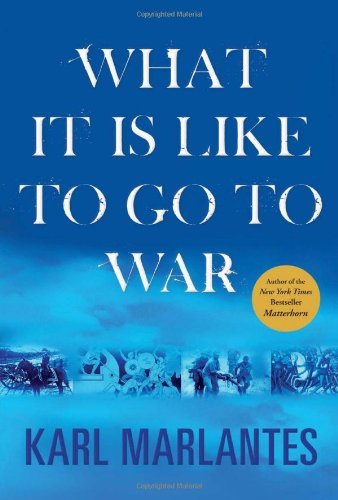
From the author of the New York Times bestseller Matterhorn, this is a powerful nonfiction book about the experience of combat and how inadequately we prepare our young men and women for war.War is as old as humankind, but in the past, warriors were prepared for battle by ritual, religion and literature -- which also helped bring them home. In a compelling narrative, Marlantes weaves riveting accounts of his combat experiences with thoughtful analysis, self-examination and his readings -- from Homer to the Mahabharata to Jung. He talks frankly about how he is haunted by the face of the young North Vietnamese soldier he killed at close quarters and how he finally finds a way to make peace with his past. Marlantes discusses the daily contradictions that warriors face in the grind of war, where each battle requires them to take life or spare life, and where they enter a state he likens to the fervor of religious ecstasy.Just as Matterhorn is already being acclaimed as a classic of war literature, What It Is Like To Go To War is set to become required reading for anyone -- soldier or civilian -- interested in this visceral and all too essential part of the human experience.

Three Finnish siblings head for the logging fields of nineteenth-century America in the New York Times–bestselling author’s “commanding historical epic” (Washington Post).Born into a farm family, the three Koski siblings—Ilmari, Matti, and Aino—are raised to maintain their grit and resiliency in the face of hardship. This lesson in sisu takes on special meaning when their father is arrested by imperial Russian authorities, never to be seen again. Lured by the prospects of the Homestead Act, Ilmari and Matti set sail for America, while young Aino, feeling betrayed and adrift after her Marxist cell is exposed, follows soon after.The brothers establish themselves among a logging community in southern Washington, not far from the Columbia River. In this New World, they each find themselves—Ilmari as the family’s spiritual rock; Matti as a fearless logger and entrepreneur; and Aino as a fiercely independent woman and union activist who is willing to make any sacrifice for the cause that sustains her.Layered with fascinating historical detail, this novel bears witness to the stump-ridden fields that the loggers—and the first waves of modernity—leave behind. At its heart, Deep River explores the place of the individual, and of the immigrant, in an America still in the process of defining its own identity.

From New York Times bestselling author Karl Marlantes comes a propulsive and sweeping novel in which loyalty, friendship, and love are put to the ultimate test.Helsinki, 1947. Finland teeters between the Soviet Union and the West. Everyone is being watched. A wrong look or a wrong word could end in catastrophe. Natalya Bobrova, from Russia, and Louise Koski, from the United States, are young wives of their country’s military attachés. When they meet at an embassy party, their husbands, Arnie and Mikhail, both world-class skiers, drunkenly challenge each other to a friendly—but secret—cross-country wilderness race.This is another masterful novel from the author of the modern classic Matterhorn, whose “breakneck writing style is both passionate and haunting” (W. E. B. Griffin). Layered with fast-paced action, historical detail, and a keen eye for the way totalitarianism and loss of truth and privacy threatens love and friendship, Cold Victory is a triumph.