
Julie Salamon
Julie Salamon has written thirteen books in many genres, including Unlikely Friends, an Audible Original released summer 2021. Her new children's book One More Story, Tata, illustrated by Jill Weber, was published by Astra's Minerva imprint in July 2024. She is working on a nonfiction book for Ann Godoff at The Penguin Press, that involves the crisis of urban homelessness and its intersection with history. Julie's other books include New York Times bestsellers Wendy and the Lost Boys and The Christmas Tree (illustrated by Jill Weber) as well as Hospital, The Devil’s Candy, Facing the Wind , The Net of Dreams , Innocent Bystander and Rambam’s Ladder. She has written two children's books, Mutt's Promise, and Cat in the City, also illustrated by Jill Weber. Julie was a reporter and then the film critic for The Wall Street Journal and then a television critic and reporter on the staff of the New York Times. Julie is a graduate of Tufts University and New York University School of Law. She is chair of the BRC, a social services organization in New York City that provides care for people who are homeless and may suffer from addiction or mental disease.. Born in Cincinnati and raised in Seaman, Ohio, a rural town of 800; in 2008 she was inducted into the Ohio Women’s Hall of Fame. New York City has long been home; she lives in downtown Manhattan with her husband Bill Abrams, executive director of Trickle Up. They have two children, Roxie and Eli, and a dog named Frankie, most recent in a long line of feline and canine friends.
19 Books Written

The Devil's Candy: The Anatomy of a Hollywood Fiasco
by Julie Salamon
Rating: 4.0 ⭐
• 2 recommendations ❤️
"A definitive portrait of the madness of big-time moviemaking" ( Newsweek ), now the basis for the new season of TCM's hit podcast, "The Plot Thickens"When Brian De Palma agreed to allow Julie Salamon unlimited access to the film production of Tom Wolfe's best-selling book The Bonfire of the Vanities , both director and journalist must have felt like they were on to something big. How could it lose? But instead Salamon got a front-row seat at the Hollywood disaster of the decade. She shadowed the film from its early stages through the last of the eviscerating reviews, and met everyone from the actors to the technicians to the studio executives. They'd all signed on for a blockbuster, but there was a sense of impending doom from the start--heart-of-gold characters replaced Wolfe's satiric creations; affable Tom Hanks was cast as the patrician heel; Melanie Griffith appeared mid-shoot with new, bigger breasts. With a keen eye and ear, Salamon shows us how the best of intentions turned into a legendary Hollywood debacle.The Devil's Candy joins John Gregory Dunne's The Studio, Steven Bach's Final Cut, and William Goldman's Adventures in the Screen Trade as a classic for anyone interested in the workings of Hollywood. With a new afterword profiling De Palma ten years after the movie's devastating flop (and this book's best-selling publication), Julie Salamon has created a riveting insider's portrait of an industry where art, talent, ego, and money combine and clash on a monumental scale.

The Christmas Tree is the tale of a little girl named Anna, who is orphaned and sent to live in a convent. The lonely girl befriends, as only a child can, a tiny fir tree. Anna and Tree, as she calls him, grow up together, unlocking the secrets of friendship and sharing the wonders of nature. It is this same profound appreciation and love of nature that the grown-up Anna, now Sister Anthony, passes on to her students.When Tree is threatened by a winter storm, Sister Anthony, by now an old woman, decides to give up her dearest friend, allowing him to become the most enjoyed and famous tree of all: the tree at Rockefeller Center in New York City.A perennial holiday favorite, The Christmas Tree is about learning to love and, ultimately, being able to share that love with others.

The authorized biography of Pulitzer Prize-winning playwright Wendy Wasserstein.In Wendy and the Lost Boys bestselling author Julie Salamon explores the life of playwright Wendy Wasserstein's most expertly crafted herself. The first woman playwright to win a Tony Award, Wendy Wasserstein was a Broadway titan. But with her high- pitched giggle and unkempt curls, she projected an image of warmth and familiarity. Everyone knew Wendy Wasserstein. Or thought they did.Born on October 18, 1950, in Brooklyn, New York, to Polish Jewish immigrant parents, Wendy was the youngest of Lola and Morris Wasserstein's five children. Lola had big dreams for her children. They didn't Sandra, Wendy's glamorous sister, became a high- ranking corporate executive at a time when Fortune 500 companies were an impenetrable boys club. Their brother Bruce became a billionaire superstar of the investment banking world. Yet behind the family's remarkable success was a fiercely guarded world of private tragedies.Wendy perfected the family art of secrecy while cultivating a densely populated inner circle. Her friends included theater elite such as playwright Christopher Durang, Lincoln Center Artistic Director André Bishop, former New York Times theater critic Frank Rich, and countless others.And still almost no one knew that Wendy was pregnant when, at age forty-eight, she was rushed to Mount Sinai Hospital to deliver Lucy Jane three months premature. The paternity of her daughter remains a mystery. At the time of Wendy's tragically early death less than six years later, very few were aware that she was gravely ill. The cherished confidante to so many, Wendy privately endured her greatest heartbreaks alone.In Wendy and the Lost Boys , Salamon assembles the fractured pieces, revealing Wendy in full. Though she lived an uncommon life, she spoke to a generation of women during an era of vast change. Revisiting Wendy's works- The Heidi Chronicles and others-we see Wendy in the free space of the theater, where her many selves all found voice. Here Wendy spoke in the most intimate of terms about everything that matters family and love, dreams and devastation. And that is the Wendy of Neverland, the Wendy who will never grow old.

Hospital: Man, Woman, Birth, Death, Infinity, Plus Red Tape, Bad Behavior, Money, God and Diversity on Steroids
by Julie Salamon
Rating: 3.4 ⭐
A bestselling author and award winning journalist follows a year in the life of a big urban hospital, painting a revealing portrait of how medical care is delivered in America today.Most people agree that there are complicated issues at play in the delivery of health care today, but those issues may not always be what we think they are. In 2005, Maimonides Hospital in Brooklyn, New York, unveiled a new state-of-theart, multimillion-dollar cancer center. Determined to understand the whole spectrum of factors that determine what kind of medical care people receive in this country, bestselling author Julie Salamon spent one year tracking the progress of the center and getting to know the characters who make the hospital run. Located in a community where sixty-seven different languages are spoken, Maimonides is a case study for the particular kinds of concerns that arise in institutions that serve an increasingly multicultural American demographic. Granted an astonishing “warts and all” level of access by the hospital higher-ups, Salamon followed the doctors, patients, administrators, nurses, ambulance drivers, cooks, and cleaning staff. She explored not just the action on the ground—what happens between doctors and patients—but also the financial, ethical, technological, sociological, and cultural matters that the hospital community encounters every day. Drawing on her skills as interviewer, observer, and social critic, Salamon presents the story of modern medicine, uniquely viewed from the vantage point of those who make it run. She draws out the internal and external political machinations that exist between doctors and staff as well as between hospital and community. And she grounds the science and emotion of medical drama in the financial realities of operating a huge, private institution that must contend with issues like adapting to the specific needs of immigrant groups that make up a large and growing portion of our society. Salamon exposes struggles of both the profound and humdrum variety. There are bitter internal feuds, warm personal connections, comedy, egoism, greed, love, and loss. There are rabbinic edicts to contend with as well as imams and herbalists and local politicians. There are system foul-ups that keep blood test results from being delivered on time, careless record keepers, shortages of everything except forms to fill, recalcitrant and greedy insurance reimbursement systems, and the surprising difficulty of getting doctors to wash their hands. This is the dynamic universe of small and large concerns and personalities that, taken together, determine the nature of our care and assume the utmost importance. As Martin Payson—chairman of the board at Maimonides and ex-Time-Warner vice chairman—puts it: “Hospitals have a lot in common with the movie business. You’ve got your talent, entrepreneurs, ambition, ego stroking, the business versus the creative part. The big difference is that in the hospital you don’t get second takes. Movies are make-believe. This is real life.”
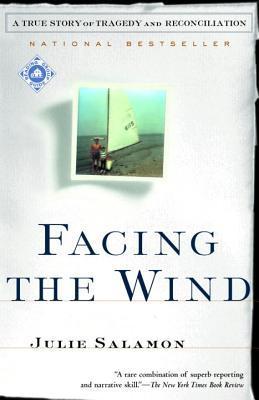
Robert and Mary Rowe’s second child, Christopher, was born with severe neurological and visual impairments. For many years, the Rowes’ courageous response to adversity set an example for other parents of children with birth defects. Then the pressures on Bob Rowe—personal and professional—took their toll, and he fell into depression and, ultimately, delusion. And one day he took a baseball bat and killed his wife and three children. Julie Salamon deftly avoids sensationalism as she tells the Rowes’ tragic story with intelligence, sympathy, and insight. Like all great literary journalism, Facing the Wind asks us to join its issues and examine our own lives and problems in the new, bright light that good writing always sheds.

The definitive story of one American family at the center of a single, shocking act of international terrorism that "manages to capture the essence of the Israeli-Palestinian conflict" (Dan Ephron).On October 3, 1985, Leon Klinghoffer, a disabled Jewish New Yorker, and his wife boarded the Achille Lauro to celebrate their 36th wedding anniversary with a Mediterranean cruise. Four days later, four Palestinian fedayeen hijacked the Italian luxury liner and took the passengers and crew hostage. Leon Klinghoffer was shot in the head, his body and wheelchair thrown overboard. His murder became a flashpoint in the intractable struggle between Israelis and Arabs and gave Americans a horrifying preview of what it means when terrorism hits home.In this richly reported book, drawing on multiple perspectives, Julie Salamon dispels the mythology that has grown around that shattering moment. What transpired on the Achille Lauro left the Klinghoffer family in the grip of irredeemable sorrow, while precipitating tragic reverberations for the wives and sons of Abu al-Abbas, the Palestinian mastermind behind the hijacking, and the family of Alex Odeh, a Palestinian-American murdered in Los Angeles in a brutal act of retaliation.Through intimate interviews with almost all living participants, including one of the hijackers, Julie Salamon brings alive the moment-by-moment saga of the hijacking and the ensuing U.S.-led international manhunt; the diplomatic wrangling between the United States, Egypt, Italy, and Israel; the long agonizing search for justice; and the inside story of the controversial opera about the Klinghoffer tragedy that provoked a culture war.An Innocent Bystander is a masterful work of journalism that moves between the personal and the global with the pace of a geopolitical thriller and the depth of a psychological drama. Throughout lies the tension wrought by terrorism and its repercussions today.

A tender and beautifully illustrated debut children’s book from a New York Times bestselling teamA city savvy stray cat named Pretty Boy has always managed to make it on his own. He’s as vain as they come, and he won’t admit to being dependent on anyone. But as he discovers the pleasures of friendship, he learns that home really is where the heart is. Or, at the very least, home is where his friends are. And with friends all around New York City, Pretty Boy will always have a place to call home.The author and illustrator team who brought us the New York Times bestseller The Christmas Tree introduce an unforgettable animal adventure in the tradition of A Cricket in Times Square and The One and Only Ivan. The result is a story that will captivate readers of all ages with its warmth and wit.

Who am I? Who were these people who made me who I am? And, what was this place? Was it ever what I thought it was?For celebrated journalist and author Julie Salamon, these recently became central questions. Salamon spent the first 18 years of her life Seaman, Ohio, a town that is part of the American heartland, a repository of mythology and misunderstanding. Seaman, Ohio, remains central to her identity, despite having lived in New York City for more than four decades, the place where her husband and she raised their children, three cats, and two dogs, and built her career and community. And yet, she could never shake the attachment to her childhood town. In fact, in almost every official author bio, it’s put it right up front: "raised in a rural town in Appalachian Ohio." In between projects, she kept going back. Her office is filled with files of interviews conducted with people there over the years. She always was wondering if the home of her memories was truly the way she remembered it.Seaman is located in Adams County, which is routinely ranked one of the two poorest of Ohio’s 88 counties. In both 2016 and 2020, the county voted for Donald Trump. That reality made Salamon’s examination of her childhood feel urgent, particularly because Salamon and her family were anomalies. They were immigrants from a foreign country. They were Democrats. They were Jewish. In looking back, what Salamon remembers most about this place—despite her otherness—was the overwhelming feeling of acceptance and love. Love for her family, love for the land, and, in particular, love for best friends, Candee and June.In Unlikely Friends, Salamon tells the intimate story about a conservative backwater that brought together three girls from different backgrounds—Julie, June, and Candee—respectively, Jewish, Black, and Appalachian. Girls who, in all likelihood, wouldn’t have become friends if they had lived anywhere else. While it might appear to be a small tale, as the country’s political divide widens, this personal history of unlikely connection is more pressing, more universal than ever. This is a story about race and religion, about country and community, about the legends people create to make sense of their lives. What Salamon discovers along the way is that memories are indeed complicated. While her fondness for the place and her happy childhood memories aren’t figments of her imagination, the rosy depiction of the past has been incomplete all along. That, like life, memory is a work in progress.
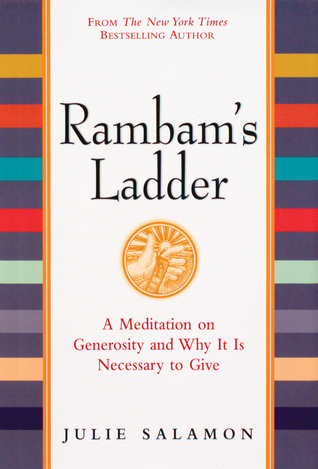
Rambam's Ladder: A Meditation on Generosity and Why It Is Necessary to Give
by Julie Salamon
Rating: 3.4 ⭐
The Eight Steps of GivingNearly a thousand years ago the great philosopher and physician Maimonides, known to Hebrew scholars as Rambam, pondered the question of righteousness Out of it came the Ladder of Charity.Rambam's Ladder, written by Julie Salamon, the bestselling author and New York Times culture writer, is a book that will inspire every reader to get a toehold on the ladder and start climbing. In eight chapters, one for each rung, the book helps us navigate the world of giving. How much to give? How do we know if our gifts are being used wisely? Is it bettter to give anonymously? Along the way, Rambam's Ladder will help all of us make our lives, and the lives of those around us, better.

Fans of The Incredible Journey and Old Yeller will love this endearing, page-turning dog adventure story Luna is a farm puppy who loves to dance, and has only known a happy, serene life surrounded by her mother, Mutt, and her siblings, and cared for by Gilberto, the son of farm workers. But now Gilberto and his parents have moved on, and Mr. Thomas the farmer doesn't feel he can take care of a whole family of dogs. He finds new homes for the puppies, not realizing that the man who took Luna and her brother does not have their best interests at heart. Luna and Chief, hungry and scared, are trapped in the smelly barn of a puppy mill—until they take matters into their own paws and find a way to escape. But can Luna and Chief find their way home? With a lovable cast of animal characters and endearing illustrations, this charming story is a perfect read-aloud for fans of classic children’s novels like Gentle Ben, A Cricket in Times Square, and Shiloh.

This is the heartwarming story of four generations of Jewish women that come together on Shabbat, and the magical bond little Ruby and her great-grandma Tata share through storytelling.Every Friday, for Shabbat, little Ruby gets to visit great-grandma Tata. Together, they go for leisurely strolls with grandma Yaya, take naps while Mommy and Daddy cook dinner, and—best of all—share fantastical stories between the two of them. As Tata tells Ruby her dreamlike stories, Ruby’s imagination takes flight . . . From soaring on giant blueberry birds to scaling ladders to the skies, Ruby and Tata take on the world together. In this intergenerational tale that spans four generations of Jewish women, acclaimed author-illustrator duo Julie Salamon and Jill Weber celebrate family traditions, the power of storytelling, and the enduring love between a little girl and her great-grandma.

The author of The Devil's Candy and White Lies--herself the daughter of Holocaust survivors--shares her family's her mother's memory of Josef Mengele; her father's relocation to Ohio after the war; and her own Jewish upbringing in the heartland of America.

Jamaica Just, a journalist for a New York daily, tries to reconcile her life with the experiences of her parents who survived the Nazi death camps

Klinghoffer's Daughters
by Julie Salamon
NYT bestselling author Julie Salamon's KLINGHOFFER'S DAUGHTERS, a story of the American family at the center of a single, shocking act of international terrorism, to Vanessa Mobley at Little, Brown, by Kathy Robbins at The Robbins Office (NA).
[Wendy and the Lost Boys: The Uncommon Life of Wendy Wasserstein] [By: Salamon, Julie] [July, 2012]
by Julie Salamon
The Net of Dreams
by Julie Salamon
The Christmas Tree
by Julie Salamon