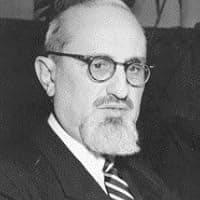
Joseph B. Soloveitchik
Rabbi Joseph Ber Soloveitchik (1903-1993) Rabbi Joseph B. Soloveitchik was born into a family already known for its great Torah learning. His grandfather and father, emphasized a thorough analysis of Talmud, and it is in this way that Rav Soloveitchik studied and taught his own students. He was awarded a Ph.D. from the University of Berlin, and then settled in Boston in the early 1930’s. He became Rosh HaYeshiva of Yeshiva University, and gave weekly shiurim to senior students, while delivering philosophy lectures to graduate students. His accomplishments in both Halachic study and secular study made him a unique Torah personality to Torah scholars all over. His limitless expertise in and appreciation of secular disciplines never lessened his total devotion to Torah study. Indeed Torah study was the central focus of his life and his teachings. His public historic shiurim in memory of his great father, Rav Moshe Soloveitchik, and his public shiurim between Rosh Hashana and Yom Kippur organized by the Rabbinical Council of America known as Kinus T’Shuva, were attended by thousands of Torah students from all groupings in the Torah community. Thus he was one of the leaders of the generation. He never engaged in pejorative or invectives when speaking of non-orthodox Jews. He was polite and respectful to others. Yet he was firm and inflexible in protecting and advocating the Mesorah of Torah tradition. His ruling, written by him, that one is not allowed to pray in a house of worship that violates Halachic standards even if it would result in not fulfilling the Mitzvah of Tekiath Shofar is an illustration of his strong stand on Torah and Mesorah. This can also be seen from his opinion that while dialogue with non-Jewish faiths may be necessary, it may not deal with theological topics. This was a historic principle which guided his disciples in all their dealings with non-Jewish clergy, and continues to this very day. His teachings and shiurim are responsible for literally thousands of men and women in the educational and academic community today. F.S.
28 Books Written

Some twenty years ago, the editors of Hamevaser, Yeshiva University's Torah student monthly, recognized the growing thirst for the late Rabbi Joseph B. Soloveitchik's teachings. In response, they published the original version of this conspectus, containing the first English version of the Rav's Hebrew and Yiddish discourses, with summaries of his shiurim and lectures. This volume substantially bu

Joseph B. Soloveitchik, the rabbi known as “The Rav” by his followers worldwide, was a leading authority on the meaning of Jewish law and prominent force in building bridges between traditional Orthodox Judaism and the modern world. In The Lonely Man of Faith , a soaring, eloquent essay first published in Tradition magazine in 1965, Soloveitchik investigates the essential loneliness of the person

The Halakhic Mind: An Essay on Jewish Tradition and Modern Thought
by Joseph B. Soloveitchik
Rating: 4.4 ⭐
From Simon & Schuster, The Halakchic Mind is an essay on Jewish tradition and modern thought from Rabbi Joseph B. Soloveitchik.Discusses the conflict between philosophy and science, examines the growth of religious knowledge, and shows how the Halakha, Jewish religious law, can be used to formulate a new religious outlook.

Rabbi Soloveitchik's unique and widely influential approach to theodicy is that in the face of catastrophe and misfortune, we cannot ask why, since that question is unanswerable. Instead we must ask how we can grow and individuals and as a community. It is not the why? that is important, but the what?Rav Soloveitchik grapples with the enormity of the Shoah and the miracle of the foundi

The best single introduction to Jewish religious thought in print. — Theology Today National Jewish Book Award Winner Halakhic Man is the classic work of modern Jewish and religious thought by the twentieth century’s preeminent Orthodox Jewish theologian and talmudic scholar. It is a profound excursion into religious psychology and phenomenology, a pioneering attempt at a philosophy of halakhah, a

One of the classics of modern Jewish thought, Kol Dodi Dofek is now translated in English and titled Fate and From the Holocaust to the State of Israel. Rabbi Soloveitchik presents an extended theological meditation on the Holocaust and the rise of the State of Israel, a profound examination of the Jewish covenant of faith and the covenant of fate and destiny which links all Jews, religious, irrel

Out of the Whirlwind: Essays on Mourning, Suffering and the Human Condition
by Joseph B. Soloveitchik
Rating: 4.4 ⭐
The topics of mourning and suffering are among the most salient in the writings of Rabbi Soloveitchik, both when he describes personal experiences and when he articulates his philosophy.The essays in this volume powerfully illustrate the Rav's peerless ability to derive a Jewish understanding of both God and the human condition from Biblical and Halakhic sources. The Rav explores such

"Prayer, indeed, is the symbolic portrayal of a range of experiences that form the ecstatic state of mind. Is such an exalted experience something in which every human being may share; or is it confined to the religious genius - a curious and unique type of personality who is capable of attaining this ecstatic state of mind, of rapture and unification, a personality who rejects what seems clearly,

"The Megillah contains two the story of human happiness and fulfillment, as well as the story of human misery and distress. The reading of the Megillah is a dialectical performance. We pray to te Almighty while we read the Megillah, because we are in distress; we thank God and relate His wonders while we read the Megillah, for we have found refuge in Him; He has saved us." ~ Excerpted from "The Du

Before Hashem You Shall Be Purified : Rabbi Joseph B. Soloveitchik on the Days of Awe
by Joseph B. Soloveitchik
Rating: 4.2 ⭐
Rabbi Soloveitchik, one of the greatest Halakhic minds of the twentieth century, has left a remarkable legacy of public lectures. Among the most popular of venues for these lectures was the Kinus Teshuvah, where the Rav would weave halakhah and homiletics so compellingly that the line between them blurred and often disappeared entirely. Presented in Yiddish, these discourses (teshuvah derashot) co

Festival of Freedom, the sixth volume in the series MeOtzar HoRav, consists of ten essays on Passover and the Haggadah drawn from the treasure trove left by the late Rabbi Joseph B. Soloveitchik, widely known as the Rav. For Rabbi Soloveitchik, the Passover Seder is not simply a formal ritual or ceremonial catechism. Rather, the Seder night is endowed with a unique and fascinating quality, exalted

Rabbi Joseph B. Soloveitchik was a towering twentieth-century intellectual and rabbinic figure. Scion of several generations of world-famous talmudic luminaries, he was the acknowledged leader of Modern Orthodoxy and religious Zionism, giving intellectual and religious integrity to these important movements. Rabbi Soloveitchik's position in the Jewish community is best epitomized by the fact that

Reflections of the Rav: Lessons in Jewish Thought Adapted from the Lectures of Rabbi Joseph B. Soloveitchik, Vol. 1
by Joseph B. Soloveitchik
Rating: 3.8 ⭐
Besdin, Abraham R.

Community, Covenant And Commitment: Selected Letters And Communications
by Joseph B. Soloveitchik
Rating: 4.0 ⭐
Community, Covenant and Commitment includes more than seventy private and public letters written by the Rav, where he reveals his private opinions on contemporary issues such as religious Zionism, women studying Torah, interfaith issues, and topics close to his heart in areas of communal, theological, philosophical and personal concerns, as well as a number of detailed interviews conducted with hi

For thousands of years, philosophers have pondered the question what it means to be human. Rabbi Joseph B. Soloveitchik, known universally as "the Rav"--the rabbi par excellence--answers the question in "The Emergence of Ethical Man, edited by Michael Berger. Relying on both scientific research and classical Jewish sources, Soloveitchik explains how a thoroughly naturalistic setting could give bir

Man of Faith in the Modern World: Reflections of The Rav Volume Two, Adapted from the lectures of Rabbi Joseph B. Soloveitchik
by Joseph B. Soloveitchik
Rating: 4.0 ⭐
Rabbi Besdin's second collection dealing with such perennial themes as repentance, faith, reasons for mitzvot, transmitting the Mesorah, and more. There are also a number of chapters dealing with Rosh Hashana, Yom Kippur and Sukkot.

Lord Is Righteous in All His Ways: Reflections on the Tish'ah be-Av Kinnot
by Joseph B. Soloveitchik
Rating: 4.2 ⭐
The Lord is Righteous in All His Ways is Rabbi Soloveitchik's answers to many questions relating to this most important day in the Jewish calendar. What is the role of Tishah be-Av at the beginning of the twenty-first century, close to two thousand years after the destruction of the second Temple? What is the halakhic character of Tishah be-Av? What themes in the Kinot (liturgical poetry) recited

Abraham's Journey: Reflections on the Life of the Founding Patriarch
by Joseph B. Soloveitchik
Rating: 4.5 ⭐
Abraham s Journey, the ninth in the series MeOtzar HoRav: Selected Writings of Rabbi Joseph B. Soloveitchik, focuses on the life of Avraham Avinu, founding patriarch of the Jewish People. Abraham is not only the first Jew, but also a historical prototype, his experiences and actions foreshadowing critical patterns in the history of his people. In addition, Abraham serves as a spiritual and ethical

And From There You Shall Seek is Rabbi Soloveitchik s fullest and most elaborate examination of religious consciousness and the dynamics of religious experience. Its presentation of the challenging interplay between cultural creativity, religious practice, and spiritual quest is sure to enrich the contemporary reader.Drawing its title from Deuteronomy 4:29 And from there you shall seek

Rabbi Joseph B. Soloveitchik, known to all the the Rav, was one of the Torah giants and seminal Jewish thinkers of the twentieth century. For him, the Seder night was a magnificent experience, an exalted evening like no other in the year. Uplifted by the grandeur of the Seder, the Rav filled page after page of his writings and lectures with his extraordinary insights and brilliant analysis of its


"Nearly all the material in this volume is taken from lectures Rabbi Soloveitchik delivered in the mid1970s"--ECIP introduction.


This volume brings together five classic works by Rabbi Joseph B. Soloveitchik, one of the most eminent Jewish thinkers of the twentieth century. These essays some collected here for the first time address both perennial questions of religious existence and dilemmas specific to the modern era. They cover topics such as individual and community; the necessity of personal sacrifice in religious life

In this volume’s opening essay, Rabbi Soloveitchik Nowadays a basic investigation of morality and ethos would be of great importance. There is a crying need for clarification of many practical problems, both in the individual-private and in the social-ethical realms. There are too many uncertainties in which we live today, uncertainties about what we ought to do. We should try to infer from our et

The subject of repentance, or teshuvah, captivated Rabbi Soloveitchik's imagination, and it is easy to understand why. As a transformation of the personality in response to the divinewill, teshuvah uncovers the depths of human nature and of man's relationship with God.In addressing repentance, Rabbi Soloveitchik confronted questions such Can a person change? Is one s personality static

Blessings and Thanksgiving: Reflections on the Siddur and Synagogue
by Joseph B. Soloveitchik
Rating: 4.7 ⭐
This volume collects ten of Rabbi Soloveitchik's studies on prayer, based on edited transcripts of public lectures and previously unpublished manuscripts, as well as essays newly translated from Hebrew and Yiddish. These studies add a new dimension to the Rav's previously published writings on tefilla, focusing not only on its general aspects but on individual prayers and blessings and their parti

The Return to Zion - Addresses on Religious Zionism and American Orthodoxy
by Joseph B. Soloveitchik
Rating: 4.7 ⭐
Rabbi Joseph B. Soloveitchik (known simply as “the Rav”) was the Torah giant of the last century long aliated with Religious Zionism. His addresses delivered at major conferences and conventions of Mizrachi Organization of America and Hapoel Hamizrachi of America were the high point of these gatherings, as the Rav mesmerized his audience with perceptive observations on the state of American and Is