
Jorge Luis Borges
Jorge Francisco Isidoro Luis Borges Acevedo was an Argentine short-story writer, essayist, poet and translator regarded as a key figure in Spanish-language and international literature. His best-known works, Ficciones (transl. Fictions) and El Aleph (transl. The Aleph), published in the 1940s, are collections of short stories exploring motifs such as dreams, labyrinths, chance, infinity, archives, mirrors, fictional writers and mythology. Borges's works have contributed to philosophical literature and the fantasy genre, and have had a major influence on the magic realist movement in 20th century Latin American literature. Born in Buenos Aires, Borges later moved with his family to Switzerland in 1914, where he studied at the Collège de Genève. The family travelled widely in Europe, including Spain. On his return to Argentina in 1921, Borges began publishing his poems and essays in surrealist literary journals. He also worked as a librarian and public lecturer. In 1955, he was appointed director of the National Public Library and professor of English Literature at the University of Buenos Aires. He became completely blind by the age of 55. Scholars have suggested that his progressive blindness helped him to create innovative literary symbols through imagination. By the 1960s, his work was translated and published widely in the United States and Europe. Borges himself was fluent in several languages. In 1961, he came to international attention when he received the first Formentor Prize, which he shared with Samuel Beckett. In 1971, he won the Jerusalem Prize. His international reputation was consolidated in the 1960s, aided by the growing number of English translations, the Latin American Boom, and by the success of Gabriel García Márquez's One Hundred Years of Solitude. He dedicated his final work, The Conspirators, to the city of Geneva, Switzerland. Writer and essayist J.M. Coetzee said of him: "He, more than anyone, renovated the language of fiction and thus opened the way to a remarkable generation of Spanish-American novelists."
30 Books Written

Labyrinths: Selected Stories & Other Writings
by Jorge Luis Borges
Rating: 4.2 ⭐
• 2 recommendations ❤️
This is a collection, in translation, of short stories and essays by Argentina's most avant-garde writer. He was born of mixed Spanish, English, and remotely Portuguese-Jewish ancestry in Buenos Aires in 1899, inheriting as well the flux and inconsistency of a far-flung border area of Western culture. Borges began his literary career as a poet and then turned to these prose-poem stories and fables. They display an intellectual pyrotechnical brilliance, carried to the furthest limit. Borges' nihilism also far outstrips Sartre or Becket, and in comparison with his elegance, invention and universal culture, they are not much more than bourgeois humanists. This Argentinian with a cabalistic turn of mind, takes all literature, philosophy and metaphysics as his domain and they become, as Andre Maurois says in his preface, "a game of the mind". Borges seeks to astonish and does so successfully.

Here is a handsome edition of one of Borges' "ficciones," in a translation first published in Labyrinths in 1962. It's an important story in the Borges' canon, incorporating most of the author's philosophical and esthetic preoccupations in a typically brief compass. With great solemnity and a convincing array of scholarly detail (including annotated references to imaginary books and articles), Borges concocts a fable of an alternate world and its infiltration of our own. The reality of Tlön is idealist: material objects have no existence; language has no nouns; its principal discipline is psychology, since its inhabitants see the universe as nothing but a series of mental processes. A series of 24 illustrations accompanies the text. Their disturbing resemblances to our reality make them appropriate reflections of Borges's imaginative constructs.' —The Kingston Whig-Standard

The seventeen pieces in Ficciones demonstrate the whirlwind of Borges's genius and mirror the precision and potency of his intellect and inventiveness, his piercing irony, his skepticism, and his obsession with fantasy. Borges sends us on a journey into a compelling, bizarre, and profoundly resonant realm; we enter the fearful sphere of Pascal's abyss, the surreal and literal labyrinth of books, and the iconography of eternal return. To enter the worlds in Ficciones is to enter the mind of Jorge Luis Borges, wherein lies Heaven, Hell, and everything else in between. Part One: The Garden of Forking Paths Prologue Tlön, Uqbar, Orbis Tertius (1940) The Approach to Al-Mu'tasim (1936, not included in the 1941 edition) Pierre Menard, Author of the Quixote (1939) The Circular Ruins (1940) The Lottery in Babylon (1941) An Examination of the Work of Herbert Quain (1941) The Library of Babel (1941) The Garden of Forking Paths (1941) Part Two: Artifices Prologue Funes the Memorious (1942) The Form of the Sword (1942) Theme of the Traitor and the Hero (1944) Death and the Compass (1942) The Secret Miracle (1943) Three Versions of Judas (1944) The End (1953, 2nd edition only) The Sect of the Phoenix (1952, 2nd edition only) The South (1953, 2nd edition only)

Full of philosophical puzzles and supernatural surprises, these stories contain some of Borges's most fully realized human characters. With uncanny insight, he takes us inside the minds of an unrepentant Nazi, an imprisoned Mayan priest, fanatical Christian theologians, a woman plotting vengeance on her father’s “killer,” and a man awaiting his assassin in a Buenos Aires guest house. This volume also contains the hauntingly brief vignettes about literary imagination and personal identity collected in The Maker, which Borges wrote as failing eyesight and public fame began to undermine his sense of self.For more than seventy years, Penguin has been the leading publisher of classic literature in the English-speaking world. With more than 1,700 titles, Penguin Classics represents a global bookshelf of the best works throughout history and across genres and disciplines. Readers trust the series to provide authoritative texts enhanced by introductions and notes by distinguished scholars and contemporary authors, as well as up-to-date translations by award-winning translators.

Alternate cover edition of ISBN-13: 978-0140286809, ISBN-10/ASIN: 0140286802For the first time in English, all the fiction by the writer who has been called “the greatest Spanish-language writer of our century” collected in a single volumeA Penguin Classics Deluxe Edition with flaps and deckle-edged paper For some fifty years, in intriguing and ingenious fictions that reimagined the very form of the short story—from his 1935 debut with A Universal History of Iniquity through his immensely influential collections Ficciones and The Aleph, the enigmatic prose poems of The Maker, up to his final work in the 1980s, Shakespeare’s Memory—Jorge Luis Borges returned again and again to his celebrated themes: dreams, duels, labyrinths, mirrors, infinite libraries, the manipulations of chance, gauchos, knife fighters, tigers, and the elusive nature of identity itself. Playfully experimenting with ostensibly subliterary genres, he took the detective story and turned it into metaphysics; he took fantasy writing and made it, with its questioning and reinventing of everyday reality, central to the craft of fiction; he took the literary essay and put it to use reviewing wholly imaginary books.Bringing together for the first time in English all of Borges’s magical stories, and all of them newly rendered into English in brilliant translations by Andrew Hurley, Collected Fictions is the perfect one-volume compendium for all who have long loved Borges, and a superb introduction to the master’s work for all who have yet to discover this singular genius.
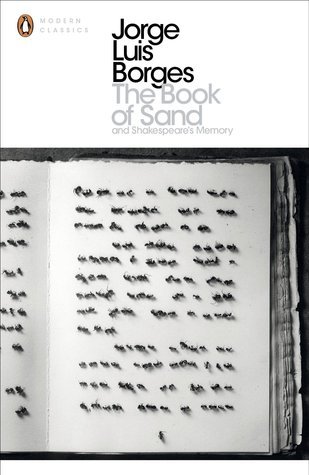
Alternate cover edition — ISBN: 0141183829'One of the most remarkable artists of our age' - Mario Vargas Llosa. The Book of Sand was the last of Borges' major collections to be published. The stories are, in his words, 'variations on favourite themes...combining a plain and at times almost colloquial style with a fantastic plot'. It includes such marvellous tales as "The Congress", "Undr" and "The Mirror and the Mask". Also included are the handful of stories written right at the end of Borges' life - "August 25, 1983", "Blue Tigers", "The Rose of Paracelsus" and "Shakespeare's Memory".

Jorge Luis Borges's famous 1941 meditation on language, alphabets, and the library that contains all knowledge is an allegory of our Universe, and in this edition is complemented and enhanced by the etching of the French artist, Érik Desmazières.

In his writing, Borges always combined high seriousness with a wicked sense of fun. Here he reveals his delight in re-creating (or making up) colorful stories from the Orient, the Islamic world, and the Wild West, as well as his horrified fascination with knife fights, political and personal betrayal, and bloodthirsty revenge. Sparkling with the sheer exuberant pleasure of story-telling, this wonderful collection marked the emergence of an utterly distinctive literary voice.For more than seventy years, Penguin has been the leading publisher of classic literature in the English-speaking world. With more than 1,700 titles, Penguin Classics represents a global bookshelf of the best works throughout history and across genres and disciplines. Readers trust the series to provide authoritative texts enhanced by introductions and notes by distinguished scholars and contemporary authors, as well as up-to-date translations by award-winning translators.

Cuento "El Aleph", de Jorge Luis Borges, originalmente publicado en el libro El Aleph, en 1949.

In a perfect pairing of talent, this volume blends twenty illustrations by Peter S.' with Jorge Luis Borges' 1957 compilation of 116 "strange creatures conceived through time and space by the human imagination," from dragons and centaurs to Lewis Carroll's Cheshire Cat and the Morlocks of H. G. Wells' The Time Machine. A lavish feast of exotica brought vividly to life with art commissioned specifically for this volume, The Book of Imaginary Beings will delight readers of classic fantasy as well as Borges' many admirers.

The largest collection of poetry ever assembled in English by “the most important Spanish-language writer since Cervantes” (Mario Vargas Llosa)A Penguin Classics Deluxe Edition with flaps and deckle-edged paperThough universally acclaimed for his dazzling fictions, Jorge Luis Borges always considered himself first and foremost a poet. This new bilingual selection brings together some two hundred poems, including scores of poems never previously translated. Edited by Alexander Coleman, it draws from a lifetime's work--from Borges's first published volume of verse, Fervor de Buenos Aires (1923), to his final work, Los conjurados, published just a year before his death in 1986. Throughout this unique collection the brilliance of the Spanish originals is matched by luminous English versions by a remarkable cast of translators, including Robert Fitzgerald, Stephen Kessler, W. S. Merwin, Alastair Reid, Mark Strand, Charles Tomlinson, and John Updike.

"The Garden of Forking Paths" (original Spanish title: "El jardín de senderos que se bifurcan") is the title story in the collection El jardín de senderos que se bifurcan (1941), which was republished in its entirety in Ficciones (Fictions) in 1944. It was the first of Borges's works to be translated into English by Anthony Boucher when it appeared in Ellery Queen's Mystery Magazine in August 1948.

At the age of seventy, after a gap of twenty years, Jorge Luis Borges returned to writing short stories. In Brodie's Report, he also returned to the style of his earlier work with its brutal realism, nightmares, and bloodshed. Many of these stories, including Unworthy and The Other Duel, are set in the macho Argentinean underworld, and even the rivalries between artists are suffused with suppressed violence. Throughout, opposing themes of fate and free will, loyalty and betrayal, time and memory flicker in the recesses of these compelling stories, among the best Borges ever wrote.

Dreamtigers has been heralded as one of the literary masterpieces of the twentieth century by Mortimer J. Adler, editor of Great Books of the Western World. It has been acknowledged by its author as his most personal work. Composed of poems, parables, and stories, sketches and apocryphal quotations, Dreamtigers at first glance appears to be a sampleralbeit a dazzling oneof the master's work. Upon closer examination, however, the reader discovers the book to be a subtly and organically unified self-revelation. Dreamtigers explores the mysterious territory that lies between the dreams of the creative artist and the "real" world. The central vision of the work is that of a recluse in the "enveloping serenity " of a library, looking ahead to the time when he will have disappeared but in the timeless world of his books will continue his dialogue with the immortals of the past Homer, Don Quixote, Shakespeare. Like Homer, the maker of these dreams is afflicted with failing sight. Still, he dreams of tigers real and imagined, and reflects upon of a life that, above all, has been intensely introspective, a life of calm self-possession and absorption in the world of the imagination. At the same time he is keenly aware of that other Borges, the public figure about whom he reads with mixed emotions: "It's the other one, it's Borges, that things happen to."

Lectures discuss The Divine Comedy, nightmares, The Thousand and One Nights, Buddhism, poetry, the Kabbalah, and blindness

Winner of the National Book Critics Circle Award in CriticismThe first comprehensive selection in any language of the non-fiction--much of it appearing here in English for the first time--of “one of literature’s most fertile and original minds” (San Francisco Chronicle)A Penguin Classics Deluxe Edition with flaps and deckle-edged paperIt will come as a surprise to many readers that the greater part of Jorge Luis Borges’s extraordinary writing was not in the genres of fiction or poetry, but in various forms of non-fiction prose. His thousands of pages of essays, reviews, prologues, lectures, and notes on politics and culture—though revered in Latin America and Europe as among his finest work—have scarcely been translated into English.Selected Non-Fictions presents a Borges almost entirely unknown to American readers. Here is the dazzling metaphysician speculating on the nature of time and reality and the inventions of heaven and hell, and the almost superhumanly erudite reader of the world’s literatures, from Homer to Ray Bradbury, James Joyce to Lady Murasaki. Here, too, the political Borges, taking courageous stands against fascism, antisemitism, and the Perón dictatorship; Borges the movie critic, on King Kong and Citizen Kane and the Borgesian art of dubbing; and Borges the regular columnist for the Argentine equivalent of the Ladies’ Home Journal, writing hilarious book reviews and capsule biographies of modern writers.Like the Aleph in his famous story—the magical point in a basement in Buenos Aires from which one can view everything in the world—Borges’s non-fictions are a vortex for seemingly the entire universe: Dante and Ellery Queen, Shakespeare and the Kabbalah, the history of angels and the history of tango, the Buddha, Bette Davis, and the Dionne Quints.Selected Non-Fictions presents more than 160 of these astonishing writings, from his youthful manifestos to his last meditations on his favorite books. More than a hundred of these pieces have never before appeared in English, and all have been rendered in brilliant new translations by Esther Allen, Suzanne Jill Levine, and Eliot Weinberger. This unique selection presents Borges as at once a deceptively self-effacing guide to the universe and the inventor of a universe that is an indispensable guide to Borges.

The Marvelous Borges Has another writer written to greater effect with fewer words? Whether in the form of the short story, essay, or poem, Jorge Luis Borges routinely performed astonishing turns of imagination in the length of a spare handful of pages. Borges's writings are models of succinct power; by temperament and by artistic ambition, he was a minimalist, given to working his wonders on the smallest scale possible. A master of fiction, Borges never published a novel -- or even, it seems, felt the lure of attempting one. He professed a heartfelt conservative piety for the older literary forms, for the saga and epic, the lyric and tale, but he made radically inventive uses of the traditional forms in his own literary labors.Borges possessed an uncommon complement of gifts. He was capable of launching startling, even unnerving flights of cerebral fantasy or metaphor but owned a first-rate mind and a critical intelligence entirely at ease with the metaphysical abstractions of the philosophers and theologians. All the same, in his intellectual bearing Borges was a skeptic, critical of but not disparaging or cynical toward the truth claims of systematic philosophical or religious thought. He was at once a genuine artist and a judicious, sympathetic critic.The posthumous publication of This Craft of Verse, Borges's 1967 Norton Lectures, reacquaints us with his splendid critical faculties. The volume is a welcome gift, too, reminding us of Borges's generous insistence on identifying with his fellow readers, who are ever ready to be transported by their love for literature. (Harvard University Press scheduled release of the remastered recordings for the fall of 2000.) Enough cause, then, to celebrate the recent discovery of these long-stored and forgotten tape recordings of lectures delivered at Cambridge more than three decades ago. By the late 1960s, Borges was quite blind and incapable of consulting notes when delivering an address. The lectures transcribed and collected here -- with their frequent quotations from the European languages, both ancient and modern -- were delivered extemporaneously, performances made possible by Borges's own powers of recollection (which were, it need hardly be said, formidable).In life and in literary manner Borges was a cosmopolitan, his range of reference almost inexhaustibly wide. His reading embraced Homer and Virgil, the Icelandic sagas and Beowulf, Chaucer and Milton, Rabelais and Cervantes, Kafka and Joyce. This Craft of Verse addresses issues central to the art of essential metaphors, epic poetry, the origins of verse, and poetic meaning. The lectures conclude with a statement of Borges's own "poetic creed." This slim but profound volume, however, ranges much farther afield. Borges serves up intriguing asides on the novel, on literary criticism and history, and on theories of translation. Ultimately, his comments touch on the largest questions raised by literature and language and the thornier puzzles of human communication.The lectures convey Borges's evident delight in English and his eloquence and ease in the language, even when facing a distinguished audience of native English speakers. But perhaps that is not so surprising, after all, for Borges carried on a lifelong love affair with the English language and the literatures of the British Isles and North America. His parents, who were fluent in English, introduced Borges to the language when he was a young boy, and Borges was allowed the run of his father's extensive library of English classics. Among the bookshelves of his father's study he first encountered authors he would admiringly cite over a long literary Wells and Kipling and Chesterton and Shaw, to name only a few. And the study of Old English became a hobby to which Borges remained passionately devoted until his death. The English language he counted as his second (and perhaps even preferred) home.Since the 1960s, when the then relatively obscure Buenos Aires writer was first introduced to English-speaking readers in translations of the classic Ficciones and the anthology Labyrinths, it has been apparent that Borges survives the ordeal of translation without obvious loss. His power remains intact on the page. This he owes to the virtues of his prose style, to the elegant simplicity and naturalness that, as the transcribed Norton Lectures demonstrate, were indistinguishable from the man. Borges's style is concise, understated, cleanly cadenced, strict in its devotion to the old-fashioned values of clarity and logical order. Whether in his native Spanish or in his adopted English, Borges is a writer and lecturer who impresses us with his singular intellectual wit, charm, and refinement.This Craft of Verse makes an exquisite addition to a distinguished series and offers, moreover, invaluable insights into the mind and work of a true modern maste...

El trabajo que da título a Historia de la eternidad se ocupa del tiempo y de su negación, y examina dos concepciones contrapuestas de eternidad: la alejandrina, de raíz platónica, y la cristiana, nacida con la doctrina trinitaria de Ireneo y formalizada por San Agustín. Otras dos penetrantes digresiones estudian la doctrina de Nietzsche sobre el eterno retorno y las concepciones basadas en el carácter recurrente del movimiento histórico. El examen de las versiones clásicas de "Las 1001 noches" ilustra los condicionamientos culturales e históricos de la labor de traducción.

This remarkable book by one of the great writers of our time includes essays on a proposed universal language, a justification of suicide, a refutation of time, the nature of dreams, and the intricacies of linguistic forms. Borges comments on such literary figures such as Pascal, Coleridge, Cervantes, Hawthorne, Whitman, Valery, Wilde, Shaw, and Kafka. With extraordinary grace and erudition, he ranges in time, place, and subject from Omar Khayyam to Joseph Conrad, from ancient China to modern England, from world revolution to contemporary slang.

"The Circular Ruins"/"Las ruinas circulares") first published in the literary journal Sur in December 1940, it was included in the 1941 collection The Garden of Forking Paths (Spanish: El jardín de senderos que se bifurcan) and the 1944 collection Ficciones. It was first published in English in View (Series V, No. 6 1946), translated by Paul Bowles.

Poems and prose presented in both English and Spanish evoke Borges' impressions of blindness and death.

"Funes the Memorious" is the tale of one Ireneo Funes, who, after falling off his horse and receiving a bad head injury, acquired the amazing talent—or curse—of remembering absolutely everything.Included in the collection of short stories "Ficciones."

Publicado por primera vez en edición de bolsillo, La memoria de Shakespeare reúne los cuatro últimos relatos dados a la imprenta en diversas publicaciones por Jorge Luis Borges. Además del cuento que da título al volumen -un apunte sobre la disociación entre el recuerdo y la existencia-, éste incluye los titulados «25 de agosto, 1983» -una nueva incidencia sobre el tema del doble, tan querido al maestro argentino-, «Tigres azules» -una enigmática incursión en la zona de sombra que separa locura y cordura- y, finalmente, «La rosa de Paracelso», narración que ilustra la vieja disputa entre fe e incredulidad.

Escrito con algún resabio ultraísta y bajo el influjo de su regreso a Argentina tras los años vividos en Europa, este libro anticipa con nitidez la obra futura de Borges. En sus páginas ya están las metáforas clásicas, la adjetivación asombrosa, el incipiente planteo metafísico, la precisión verbal, la peculiar inflexión vacilante que esconde un remate perfecto.El tema central son los suburbios de la ciudad, el linde misterioso donde el barrio se desdibuja en el campo. Esa tensión entre lo particular y lo universal funda en nuestras letras un nuevo modo de observar la realidad cotidiana, una exquisita poética de lo inestable.


Libro usado en buenas condiciones, por su antiguedad podria contener señales normales de uso

Compilation of short stories and vignettes by Borges.

豪尔赫·路易斯·博尔赫斯是一个世界级的作家 ,他熟悉写作的条条框框,知道如何打破、什么时候打破这些条条框框。他是语言的魔术师,如同所有最优秀的变戏法的人、诗人一样,一旦戏法揭穿,诗文出口,他会让我们感到,这原来一直存在,在我们心中的某个地方,只是没能表达出来而已。1971年春,博尔赫斯应邀赴哥伦比亚大学为写作班进行讲学,他解析自己的作品,并通过例子帮助其他人改进他们的作品。每次讲课围绕一个主题:谈写小说,谈写诗歌,谈翻译。在座的人,每人分发到博尔赫斯的短篇小说《决斗(另篇)》和他的六首诗,以及博尔赫斯作品的不同译本范例,博尔赫斯逐行评论,详细讲解创作的过程。《博尔赫斯,写作课》以讲课的录音稿为底稿,为保留原汁原味,未作任何编辑。另附课堂中所举范例的西班牙文原文与英文译文,供对比阅读。

Cuento "La casa de Asterión", de Jorge Luis Borges, originalmente publicado en el libro El Aleph, en 1949.

This is the first installment of the semi-annual anthology from Flatmancrooked Publishing. This edition features a Jorge Luis Borges story not currently in print in English, and new fiction from Ha Jin you have not read, because we published it first. This book also introduces the work of James Bartels, Bessie Nadine Sweet, James Kaelan, Emma Straub, Thomas McCafferty, Crystal Anne Cheney, Chris Robinson, David Dumitru, and Jim O'Loughlin. flat man crooked, flatman crooked, flat mancrooked, Sacramento publishing, Northern California.