
Jonathan Edwards
Librarian Note: There is more than one author in the Goodreads database named Jonathan Edwards. Jonathan Edwards was the most eminent American philosopher-theologian of his time, and a key figure in what has come to be called the First Great Awakening of the 1730s and 1740s. The only son in a family of eleven children, he entered Yale in September, 1716 when he was not yet thirteen and graduated four years later (1720) as valedictorian. He received his Masters three years later. As a youth, Edwards was unable to accept the Calvinist sovereignty of God. However, in 1721 he came to what he called a "delightful conviction" though meditation on 1 Timothy 1:17. From that point on, Edwards delighted in the sovereignty of God. Edwards later recognized this as his conversion to Christ. In 1727 he was ordained minister at Northampton and assistant to his maternal grandfather, Solomon Stoddard. He was a student minister, not a visiting pastor, his rule being thirteen hours of study a day. In the same year, he married Sarah Pierpont, then age seventeen, daughter of Yale founder James Pierpont (1659–1714). In total, Jonathan and Sarah had eleven children. Stoddard died on February 11th, 1729, leaving to his grandson the difficult task of the sole ministerial charge of one of the largest and wealthiest congregations in the colony. Throughout his time in Northampton his preaching brought remarkable religious revivals. Yet, tensions flamed as Edwards would not continue his grandfather's practice of open communion. Stoddard believed that communion was a "converting ordinance." Surrounding congregations had been convinced of this, and as Edwards became more convinced that this was harmful, his public disagreement with the idea caused his dismissal in 1750. Edwards then moved to Stockbridge, Massachusetts, then a frontier settlement, where he ministered to a small congregation and served as missionary to the Housatonic Indians. There, having more time for study and writing, he completed his celebrated work, The Freedom of the Will (1754). Edwards was elected president of the College of New Jersey (later Princeton University) in early 1758. He was a popular choice, for he had been a friend of the College since its inception. He died of fever at the age of fifty-four following experimental inoculation for smallpox and was buried in the President's Lot in the Princeton cemetery beside his son-in-law, Aaron Burr.
31 Books Written

The End for Which God Created the World: Updated to Modern English
by Jonathan Edwards
Rating: 4.5 ⭐
• 2 recommendations ❤️
Why did God make the world? Though rarely asked today, the question of why God created the world captured the thought and imagination of Jonathan Edwards, one of history's most profound thinkers. Using both reason and Scripture, Edwards determined that God created the world primarily as an arena for his eternal and innate glory to flow outward like a fountain, and for his emanating glory to be received, praised, and enjoyed by the creatures he made. How he arrives at this answer is an amazing, worship-inducing journey. This version of Edwards' classic treatise is a modern English paraphrase, designed to allow readers to meditate on the ideas and truths Edwards illuminates, rather than unravelling his long and dense sentences. Pastor Jared Wilson: "Dollar has both polished the diamonds and given us the lenses to better behold them. Read, study, enjoy, and worship Christ through this book." Edwards scholar Kyle Strobel: "Jonathan Edwards is, without question, one of the great minds of the Christian tradition. Unfortunately, Edwards is often lauded but rarely read, because he is such a difficult read, both in the depth of his thoughts and in archaic writing style. Jason does us a great service, making the first more accessible by updating the second. Reading these classic works allow your affections to be stoked by the Spirit!"

Jonathan Edwards is best known as the theologian of revival. In this, his major study on the theme, he analyses the nature of a genuine work of the Holy Spirit.

This is a reprint of Jonathan Edward's famous sermon. Many have said it is the most famous sermon ever preached. The sermon was first delivered in Enfield, MA on July 8, 1741. The sermon had an amazing impact on the audience.

"Considered by many to be the greatest book by enormously influential American preacher and theologian Jonathan Edwards (1703-1758), this provocative 1754 work explores the necessity of God's grace for the salvaging of the damaged will of humanity and argues that free will is an extension of and connected to the grace of God. What is the nature of morality? Can God be evil? What constitutes sin? How does God's foreknowledge of all events impact concepts of morality? How does intent inform our acts of vice and virtue? Still controversial and hotly debated in the 21st century, this demanding evangelistic work, which some call it the best argument for the sovereignty of God, is among the essential reading of the thinker whose philosophies inspired the 18th-century religious of the Great Awakening, which continues to hugely influence American Protestantism to this day. Freedom of the Will will enthrall and challenge serious readers of the Bible as well as students of theology's impact on American history. "

Of the many good gifts the Lord has given his church on earth, none exceeds that of his love. The things of this earth are temporary, but “love never ends” (1 Cor. 13:8)—it is a present taste of future glory, made available through communion with the Holy Spirit. In this classic work, Heaven Is a World of Love , New England pastor Jonathan Edwards encourages Christians struggling through the imperfect life here on earth to experience the perfect love of God through an exposition of the biblical foundations for the cause of God’s love, the objects of God’s love, the enjoyment of God’s love, and the fruits of God’s love. Each page of pastoral insight will leave readers hungry to experience more of God.

Charity and Its Fruits: Christian Love as Manifested in the Heart and Life
by Jonathan Edwards
Rating: 4.6 ⭐
Few Christian leaders since the Reformation have been as gifted as Jonathan Edwards. A man of intense personal devotion to Christ, he was a leader of revival, and a creative Reformed theologian as well as being a missionary and a philosopher fully meriting Hugh Martin's description of him as 'that greatest of metaphysical divines'. Yet it is likely that he would have preferred to be remembered simply as 'pastor of the Church of Northampton'. Preached in 1738 (the same year that Edwards published A Narrative of Surprising Conversions), Charity and Its Fruits gives us an insight into his regular pulpit ministry in the years between the Northampton revival of 1735 and 'the Great Awakening' of 1740. Entirely free from sentimentality this moving exposition of 1 Corinthians 13, like the better known Religious Affections, reveals Edwards' insistence both that true Christian experience is 'supernatural'- Spirit produced and Christ centered- and that 'all true Christian grace tends to practice'. These sermons show how it is possible to steer between Arminianism on the one hand and Antinomianism on the other. The concluding chapteron heaven as a world of love is perhaps the most beautiful in all Edwards's writings.
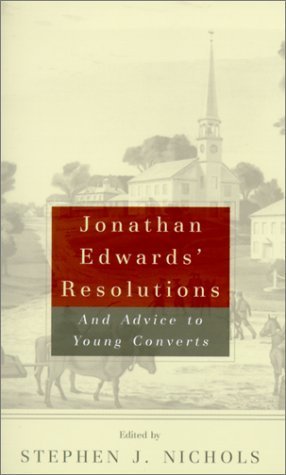
While completing his preparation for the ministry, Jonathan Edwards (1703–1758) wrote seventy resolutions that guided him throughout his life. About twenty years later, he wrote a letter to young Deborah Hatheway, a new convert in a nearby town, advising her concerning the Christian life. These two writings, often reprinted during the eighteenth and nineteenth centuries, overflow with straightforward and biblically sound advice. This advice is as current today as it was in the 1700s, and it far surpasses the how-to books now overrunning bookstores.

This book was converted from its physical edition to the digital format by a community of volunteers. You may find it for free on the web. Purchase of the Kindle edition includes wireless delivery.

Widely recognized as a great theologian, an influential preacher and a prolific writer, Jonathan Edwards played a prominent role in helping to spark the spirit of revivalism known as the Great Awakening in the eighteenth-century America. Edwards' sermons, while intellectually engaging, were also accessible to the common people and often generated highly emotional responses. His foremost desire was to help people transform from mere believers in Christian doctrine to converted Christians who were moved to action by the principles of their belief.This two-volume collection of Edwards' works features important sermons of the Great Awakening as well as Edwards' memoirs and other essays. First published in 1834, here is what makes this new edition of "The Works of Jonathan Edwards" the best available:"More readable." This edition has larger, more readable type than previous editions."More complete." This edition contains all matter included in the first collected American edition, various original extracts from the diary and papers of Edwards, several smaller pieces printed originally in a separate form, and a memoir by descendant Sereno E. Dwight.For anyone interested in the roots of Christianity and revival in colonial America, "The Works of Jonathan Edwards" is a fundamental resource."Jonathan Edwards . . . was among the noblest and ablest Christians of his age, and can now be seen, two centuries after, as one of the greatest theologians ever given by God to his church. As a saint and scholar, evangelist and educationalist, pastor and teacher, missionary and metaphysician, he showed a grasp of the grandeur of God's sovereignty and the glory of divine grace equaled only by men of the caliber of John Owen and John Calvin."--J. I. Packer"Edwards is widely recognized as being probably the greatest American theologian. His writings, though sometimes difficult, are often inspiring. Full doctrinal agreement is not a prerequisite to profiting from this great man of God."--Christianity Today

This volume contains one of Edwards' most analytical treatises on revival, Distinguishing Marks of a Work of the Spirit of God, and his famous Narrative of Surprising Conversions, a detailed account of the famous revival of religion at Northampton, Massachusetts, in 1735.
Prepared by editors of the distinguished series The Works of Jonathan Edwards , this authoritative anthology includes selected treatises, sermons, and autobiographical material by early America’s greatest theologian and philosopher."Jonathan Edwards remains unequaled among North American theologians. These selections exemplify his special eloquence, knowledge of the human heart, and metaphysical passion for complex beauty in nature, God, and Being-in-general."―Richard R. Niebuhr, Hollis Professor of Divinity Emeritus, The Divinity School, Harvard UniversityPraise for the earlier "Selections . . . representative of both the public and the private Edwards . . . give readers a nuanced introduction to Edwards and his time as well as an accessible entrée to the whole body of his work."― Booklist"The most comprehensive one-volume Edwards anthology ever assembled."―Gerald R. McDermott, Religious Studies Review

Edwards (1703-1758) is by far the best known American theologian. After graduating from and teaching at Yale University, he began a very fruitful ministry at Northampton, MA. The church was the scene of the explosive revival of 1734, 35, and burned fiercely for God under Edwards for several years. Edwards then went to pastor the lowly Indians. But at last he was called to be the first president of Princeton University, where he served only 5 weeks, dying of smallpox.

Jonathan Edwards, widely considered America’s most important Christian thinker, was first and foremost a preacher and pastor who guided souls and interpreted religious experiences. His primary tool in achieving these goals was the sermon, out of which grew many of his famous treatises. This selection of Edwards’ sermons recognizes their crucial role in his life and art.The fifteen sermons, four of which have never been published before, reflect a life dedicated to experiencing and understanding spiritual truth. Chosen to represent a typical cycle of Edwards’ preaching, the sermons address a wide range of occasions, situations, and states, corporate as well as personal. The book also contains an introduction that discusses Edwards’ contribution to the sermon as a literary form, places his sermons within their social and cultural contexts, and considers his theological aims as a way of familiarizing the reader with the "order of salvation" as Edwards conceived of it. Together, the sermons and the editors’ introduction offer a rounded picture of Edwards the preacher, the sermon writer, and the pastoral theologian.

The scope of Jonathan Edwards’ book, A History of the Work of Redemption , is vast. From a deep extensive knowledge of Scripture, Jonathan Edwards sets out to survey the whole of the redemptive work of God in history, from the Fall of man to the consummation of all things.A thrilling conclusion Everything in human history from start to finish is subservient to Christ’s work of redemption. Not only can nothing thwart that work, but, in the wisdom of God, all that comes to pass actually serves to advance it.In a series of thirty sermons preached in Northampton, New England, in 1739, Edwards sought to establish his congregation in this mighty truth. Later in his ministry he hoped to write a book expounding the same theme, and was even reluctant to accept the presidency of Princeton College for fear this project would be hindered.Although he did not live to carry out his intention, we can see the substance of what the intended book would have contained in this new edition of the sermons of 1739. Here readers can catch Edward’s vision of the mighty advance of the cause of Christ in the world, and gain encouragement for all gospel labours from the certainty of its triumph.

A major work in moral philosophy by the Puritan who was the most modern man of his age. Edwards at his very greatest . . . he speaks with an insight into science and psychology so much ahead of his time that our own can hardly be said to have caught up with him. Perry Miller, 'Jonathan Edwards' Like the great speculators Augustine, Aquinas, and Pascal, Jonathan Edwards treated religious ideas as problems not of dogma, but of life. His exploration of self-love disguised as true virtue is grounded in the hard facts of human behavior. More than a hellfire preacher, more than a theologian, Edwards was a bold and independent philosopher. Nowhere is his force of mind more evident than in this book. He speaks as powerfully to us today as he did to the keenest minds of the eighteenth century.

The 18th century was a wealth of knowledge, exploration and rapidly growing technology and expanding record-keeping made possible by advances in the printing press. In its determination to preserve the century of revolution, Gale initiated a revolution of its own: digitization of epic proportions to preserve these invaluable works in the largest archive of its kind. Now for the first time these high-quality digital copies of original 18th century manuscripts are available in print, making them highly accessible to libraries, undergraduate students, and independent scholars.The Age of Enlightenment profoundly enriched religious and philosophical understanding and continues to influence present-day thinking. Works collected here include masterpieces by David Hume, Immanuel Kant, and Jean-Jacques Rousseau, as well as religious sermons and moral debates on the issues of the day, such as the slave trade. The Age of Reason saw conflict between Protestantism and Catholicism transformed into one between faith and logic -- a debate that continues in the twenty-first century.++++The below data was compiled from various identification fields in the bibliographic record of this title. This data is provided as an additional tool in helping to insure edition identification: ++++British LibraryT034703London: printed by Henry Cock; and sold at the Foundery, near Upper Moor-fields, by T. Trye; and by R. Akenhead, Newcastle, 1755. 48p.; 12

A SERMON Preach’d at Northampton, [Mass.], And Published at the Desire of some of the Hearers. Boston: S. Kneeland & T. Green. 1734The early stirrings of the Great Awakening were intensified by Edwards' famous sermon A Divine and Supernatural Light, Immediately Imparted to the Soul by the Spirit of God (1734). Through a fascinating process of canceling out his opponents' positions, Edwards clearly defines the workings of God's grace in the human soul. He distinguishes between "Common Grace" (intrinsic to virtually all unregenerate), which acts upon the mind of natural man and assists the faculties of the soul in their natural course; and "Special Grace" (intrinsic to true saints only), which acts in the human heart and unites with the mind of the saint as a new supernatural principle of life and action that restores human faculties to their proper place. God's spiritual light therefore does not consist of making impressions on the Imagination nor does it teach any new dogmas; it only gives a due apprehension of God's beauty. Hence a saint with indwelling grace does not merely believe rationally that God is glorious, but has a due sense of God's glory in his own heart. Whereas the head can merely sustain a speculative or notional knowledge of beauty, the heart delights in the idea of it, and the will prompted by the affections for the highest good embraces the virtuous act. In Edwards' illustration, the unregenerate can rationally attain a sense of God’s beauty, but only the sanctified can attain full conviction and immediate evidence of God’s grace: one can have a rational sense of the sweetness of honey, but the true sense of its taste can only be attained through experience. Edwards' distinction is echoed in what Samuel Taylor Coleridge would call primary and secondary beauty.

A sermon preached by Jonathan Edwards to his Enfield, Connecticut, congregation in July 1741, "Sinners in the Hands of an Angry God" is particularly noted for its vivid descriptions of the torments of Hell and mankind's natural depravity. At the same time, it was also an appeal to man's need for salvation and a reminder of the agonies that awaited the unreformed. Coming during the height of the Great Awakening--a period of religious fervor in the first half of the eighteenth century--the homily was at once regarded by many as the greatest ever given on American soil and vehemently attacked by others as puritanical "fire and brimstone." One thing seems certain: it made a lasting impact on American Christianity.Accompanying this landmark document are sermons by nine other influential Puritans of the sixteenth to eighteenth centuries, among them Thomas Shepard's "The Parable of the Ten Virgins," Cotton Mather's "An Hortatory and Necessary Address," John Cotton's "The Way of Life," as well as sermons by John Winthrop, Increase Mather, Jonathan Mayhew, Thomas Hooker, Peter Bulkeley, and Samuel Willard.Enlightening and thought-provoking, the volume will serve as primary source material in many American history and literature courses.

A Faithful Narrative of the Surprising Work of God is Jonathan Edwards' own account of the mighty way in which God moved among the people of Northampton, Massachusetts and other nearby communities in the early stages of what has become known as The Great Awakening. There is much to be learned from Edwards regarding the nature of true conversion and how God's Spirit works in awakening and converting sinners. A Faithful Narrative is reproduced here in its entirety with the hopes that many will profit greatly from the observations of the greatest evangelist ever to grace the American continent.

The Personal Narrative of Jonathan Edwards and His Seventy Resolutions
by Jonathan Edwards
Rating: 3.3 ⭐
Jonathan Edward's short spiritual autobiography.

This book begins the publication of Jonathan Edwards' personal theological notebooks, called collectively the "Miscellanies." The entries in Volume 13 span the early years of Edwards' ministry (1722-31) and range widely in subject matter. They record Edwards' initial thoughts on some of his most characteristic ideas, for example, original sin, free will, the Trinity, and God's end in creation. Many entries, however, relate to doctrinal and polemical subjects not included in the corpus of Edwards' published writings. The volume also contains Edwards' alphabetical index to the entire "Miscellanies"; this "Table" is a theological document in its own right and reveals the interrelationship among the various components of Edwards' theological system.

In this book, America’s greatest theologian explains one of Christianity’s most important subjects―the believer’s standing in grace. Edwards gives his usual thorough treatment as he examines the difference between common and saving grace, demonstrates the nature and qualities of saving grace, and emphasizes how a principle of grace is from the Spirit of God. Edwards also deals extensively and insightfully with the issue of the Holy Spirit as it relates to standing in grace.This work was first published in 1865 by Alexander Grosart under the title A Treatise on Grace and was included as part of Selections from the Unpublished Writings of Jonathan Edwards. This new edition is typeset and edited for easier reading.Table of 1. Common and Saving Grace Differ, Not Only in Degree, but in Nature and Kind2. Wherein All Saving Grace Does Summarily Consist3. How a Principle of Grace Is from the Spirit of God

Famoso sermon de Jonathan Edwards donde se nos habla de la realidad de la verdadera conversion cristiana. Abordar las principales senales de la gracia de Dios en la vida de un ser humano.

A treatment on the Trinity of the Godhead by one of America's greatest philosopher-theologians.

Un sermón donde el renombrado predicador y teólogo estadounidense Jonathan Edwards nos advierte y exhorta acerca del deber de la oración privada.

The only full edition of Edwards' Works currently available. Dr. D. M. Lloyd-Jones said 'In my early days in the ministry there were no books which helped me more, both personally and in respect of my preaching, than this two-volume edition of The Works of Jonathan Edwards...I devoured these volumes and literally just read and read them. It is certainly true that they helped me more than anything else. If I had the power I would make these two volumes compulsory reading for all ministers! Edwards seems to satisfy all round; he really was an amazing man."According to Wikipedia: "Jonathan Edwards (October 5, 1703 – March 22, 1758) was a colonial American Congregational preacher, theologian, and missionary to Native Americans. Edwards "is widely acknowledged to be America's most important and original philosophical theologian". His work is very broad in scope, but he is often associated with his defense of Calvinist theology, the metaphysics of theological determinism, and the Puritan heritage. His famous sermon "Sinners in the Hands of an Angry God," emphasized the just wrath of God against sin and contrasted it with the provision of God for salvation; the intensity of his preaching sometimes resulted in members of the audience fainting, swooning, and other more obtrusive reactions. The swooning and other behaviors in his audience caught him up in a controversy over "bodily effects" of the Holy Spirit's presence."

Jonathan Edwards is widely recognized today as perhaps the greatest of all North American thinkers and philosophers. Such was the depth and power of his intellect that annually new books and articles on his work come into print. But Edwards was supremely a Christian thinker. His great goal in life was to know and glorify God through Jesus Christ and to encourage others to do the same. Consequently it is in his sermons that we find the real heart of the man. Here he is thinker, herald, pastor and theologian all in one. This selection of ten of Edwards' sermons provides a fine sample of the God-centredness of his ministry. In them he shows the seriousness of man's sinful condition, the riches of Christ's grace, and the marvels of the Christian life. To read Edwards is, almost invariably, to be led into the presence of God. That was the great aim of his preaching, and echoes of it will be heard in reading these pages.

A Dissertation Concerning the End for Which God Created the World is a work by Christian theologian, reformer, author, and pastor Jonathan Edwards that was started in the mid-1750s but not finally published until after his death in 1765. This dissertation was published concurrently with The Nature of True Virtue. The two works have much in common, specifically the assertion that God's aim in creating the world was not human happiness but his own glory.

The Jonathan Edwards trilogy includes three of the most important sermons ever preached on American soil. Sinners in the Hands of an Angry God is maybe the most important and well-known sermon of his, but also included is A Divine and Supernatural Light describing and illuminating what Edwards describes as a supernatural light imparted by God. His farewell sermon was given in June of 1750 and is a commendation to those who are in the Lord's service, a plea to maintain unity, avoid dissension and false doctrine, and a call to devote themselves to prayer.

Book by Edwards, Jonathan

The Works of Jonathan Edwards, Vol. 22: Sermons and Discourses, 1739-1742
by Jonathan Edwards
Rating: 4.3 ⭐
The sermons and discourses in this volume chart the rise and decline of the Great Awakening in Jonathan Edwards's parish in Northampton, Massachusetts, and beyond. A leading figure of the revival period, Edwards delivered potent and wide-ranging sermons during the years 1739-42. In this volume the transcript of the original manuscript of Sinners in the Hands of an Angry God is reproduced, along with the text of its first printed edition.