
Jonathan Baron
Jonathan Baron is professor of psychology at the University of Pennsylvania. He studies intuitions and judgment biases that impede maximization of utility (good) by democratic government. These include parochialism, the act-omission distinction, moralistic values, and the isolation effect. Relevant rubrics are Behavioral Public Finance, Behavioral Public Economics, and Behavioral Law and Economics. He is also interested in experimentation and data analysis.
10 Books Written
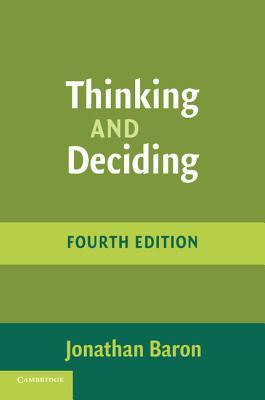
Beginning with its first edition and through subsequent editions, Thinking and Deciding has established itself as the required text and important reference work for students and scholars of human cognition and rationality. In this, the fourth edition, Jonathan Baron retains the comprehensive attention to the key questions addressed in the previous editions - How should we think? What, if anything, keeps us from thinking that way? How can we improve our thinking and decision making? - and his expanded treatment of topics such as risk, utilitarianism, Baye's theorem, and moral thinking. With the student in mind, the fourth edition emphasizes the development of an understanding of the fundamental concepts in judgment and decision making. This book is essential reading for students and scholars in judgment and decision making and related fields, including psychology, economics, law, medicine, and business.

People often follow intuitive principles of decision making, ranging from group loyalty to the belief that nature is benign. But instead of using these principles as rules of thumb, we often treat them as absolutes and ignore the consequences of following them blindly.In Judgment Misguided , Jonathan Baron explores our well-meant and deeply felt personal intuitions about what is right and wrong, and how they affect the public domain. Baron argues that when these intuitions are valued in their own right, rather than as a means to another end, they often prevent us from achieving the results we want. Focusing on cases where our intuitive principles take over public decision making, the book examines some of our most common intuitions and the ways they can be misused. According to Baron, we can avoid these problems by paying more attention to the effects of our decisions. Written in a accessible style, the book is filled with compelling case studies, such as abortion, nuclear power, immigration, and the decline of the Atlantic fishery, among others, which illustrate a range of intuitions and how they impede the public's best interests. Judgment Misguided will be important reading for those involved in public decision making, and researchers and studentsin psychology and the social sciences, as well as everyone looking for insight into the decisions that affect us all.

Governments, health professionals, patients, research institutions, and researchsubjects look to bioethicists for guidance in making important decisions about medical treatment andresearch. And yet, argues Jonathan Baron in Against Bioethics, applied bioethics lacks the authorityof a coherent guiding theory and is based largely on intuitive judgments. Baron proposes analternative, arguing that bioethics could have a coherent theory based on utilitarianism anddecision analysis. Utilitarianism holds that the best option is the one that does the most expectedgood. Decision analysis provides a way of thinking about the risks and trade-offs of specificoptions. Like economics, utilitarian decision analysis makes predictions of expected good in complexsituations, using data when possible, and focusing human judgment on the issues relevant toconsequences. With such a guiding theory, bioethics would never yield decisions that clearly goagainst the expected good of those involved, as some do now.Baron discusses issues in bioethics thatcan be illuminated by such analysis, including "enhancements" to nature in the form of genetics,drugs, and mind control; reproduction; death and end-of-life issues, including advance directives,euthanasia, and organ donation; coercion and consent; conflict of interest and the reform ofinternal review boards; and drug research. Although Baron opposes current practice in bioethics, heargues that by combining utilitarianism and decision analysis, bioethics can achieve its aims ofproviding authoritative guidance in resolving thorny medical and ethical issues.

This book describes a variety of programs -- firmly based in psychological theory and modern decision analysis -- that are suitable for teaching adolescents how to improve both their own decision making skills and their understanding of the decision making of others. Providing practical advice as well as theoretical analysis, this volume addresses general questions such as the nature and rationale of the enterprise, its implementation, and its evaluation. Relevant to several current adolescent problems including drug abuse, this is an excellent source, either as research, new curriculum, or enrichment of old curriculum.

What is intelligence? Can it be increased by teaching? If so, how, and what difference would an increase make? Before we can answer these questions, we need to clarify them. Jonathan Baron argues that when we do so we find that intelligence has much to do with rational thinking, and that the skills involved in rational thinking are in fact teachable, at least to some extent. Rationality and Intelligence develops and justifies a prescriptive theory of rational thinking in terms of utility theory and the theory of rational life plans. The prescriptive theory, buttressed by other assumptions, suggests that people generally think too little and in a way that is insufficiently critical of the initial possibilities that occur to them. However these biases can be - and sometimes are - corrected by education.

Public controversies - such as those about the distribution of goods between rich and poor, trade and population policies, allocation of medical resources, and the tradeoff between environment al protection and economic efficiency - often hinge on fundamental views about how we ought to make decisions tImt affect each other, that is, what principles we ought to follow. Efforts to find an acceptable public philosophy, a set of such principles on which people might agree, have foundered because of dis agreement among philosophers and others who are concerned with such issues. One view, which I shall develop and defend here, holds that decisions that affect others should be made according to an overall evaluation of the consequences of each option. This consequentialist view is opposed by a variety of alternatives, but many of the alternatives have in COlllmon a basis in moral intuition. To take a simple example, consequentialism holds that, other things equal, if we have decided that it is better to let a terminally ill patient die than to prolong her agony by keeping her alive, then we ought to kill her.


Iron Horse
by Jonathan Baron
Jonathan Baron is a teacher, actor, athlete in Houston, Texas. Follow his adventures and life story from New York to Cincinnati, back to New York, Taipei and Taiwan. This is a no-bull story of a young Cincinnati cowboy to adulthood iron horse.

Celebrity Branding im Sportmarketing: Erfolgsfaktoren und Risiken
by Jonathan Baron
Bachelorarbeit aus dem Jahr 2018 im Fachbereich BWL - Offline-Marketing und Online-Marketing, 1,3, Gottfried Wilhelm Leibniz Universität Hannover (Marketing & Management), Deutsch, Der weltweit, über einzelne Kulturkreise hinausgehende, für Faszination in allen Altersklassen sorgende Sport ist heutzutage eine der beliebtesten Freizeitbeschäftigungen vieler Menschen. Dabei wird mit Sport nicht nur eine gesunde Lebensweise oder die Leistung im Wettkampf verbunden, sondern auch die Werbung von verschiedenen Unternehmen, ob auf Zuschauertribünen, Einlauftunneln, Werbebanden, im Pressebereich von Stadien oder über zahlreiche weitere Instrumente. Gerade durch die zunehmende Professionalisierung und Kommerzialisierung des Sports in den vergangenen Jahrzehnten gibt es in der modernen Zeit unzählige Werbeformen, die Unternehmen verwenden, um die Konsumenten von ihren Produkten oder Dienstleistungen zu überzeugen (vgl. Hermanns und Riedmüller 2008, S.5ff.). Hauptziele sind dabei die Gewinnmaximierung, Absatzsteigerung, Konsumentenbeeinflussung sowie das wichtigste Ziel, das Erreichen von Aufmerksamkeit für die beworbenen Produkte. Eine weitverbreitete Art der Werbeform ist der Einsatz von Celebrities (Prominenten) für eine Marke. Celebrity Branding ist im Sport allgegenwärtig, sei es ein David Beckham für Adidas, ein Lebron James für Nike oder ein Usain Bolt für Puma.
Thinking and Deciding, Edition: 3
by Jonathan Baron