
John Yoo
12 Books Written

Defender in Chief: Donald Trump's Fight for the Constitution
by John Yoo
Rating: 3.8 ⭐
• 2 recommendations ❤️
In Defender in Chief, celebrated constitutional scholar John Yoo makes an airtight case against Donald Trump's supposed disdain for constitutional rules and norms.Donald Trump isn't shredding the Constitution--he's its greatest protector.Ask any liberal--and many moderate conservatives--and they'll tell you that Donald Trump is a threat to the rule of law as delineated by the U.S. Constitution. Mainstream media outlets have reported fresh examples of alleged executive overreach or authoritarian rhetoric nearly every day of his presidency. In the 2020 primaries, the candidates seem to be competing to paint the most frightening picture of how the president is destroying our democracy and jeopardizing our nation's very existence.Far from considering Trump an inherent threat to our nation's founding principles, Yoo convincingly argues that Jefferson, Madison, Hamilton, Adams, and Franklin would have seen the president as more in line with their vision of the executive branch than his recent predecessors, even at his most controversial.This authoritative and engaging work is a compelling, intellectually-sound defense of an embattled president's ideas and actions.
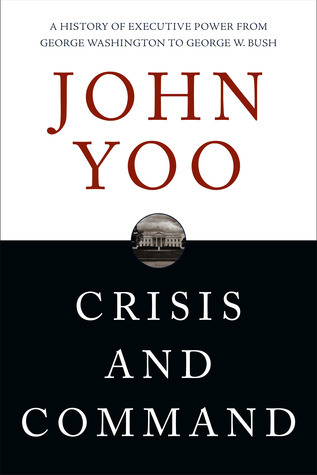
Crisis and Command: A History of Executive Power from George Washington to George W. Bush
by John Yoo
Rating: 3.6 ⭐
An American President faces war and finds himself hamstrung by a Congress that will not act. To protect national security, he invokes his powers as Commander-in-Chief and orders actions that seem to violate laws enacted by Congress. He is excoriated for usurping dictatorial powers, placing himself above the law, and threatening to “breakdown constitutional safeguards.” One could be forgiven for thinking that the above describes former President George W. Bush. Yet these particular attacks on presidential power were leveled against Franklin D. Roosevelt. They could just as well describe similar attacks leveled against George Washington, Thomas Jefferson, Andrew Jackson, Abraham Lincoln and a number of other presidents challenged with leading the nation through times of national crisis. However bitter, complex, and urgent today’s controversies over executive power may be, John Yoo reminds us they are nothing new. In Crisis and Command , he explores a factor too little consulted in current the past. Through shrewd and lucid analysis, he shows how the bold decisions made by Washington, Jefferson, Jackson, Lincoln, and FDR changed more than just history; they also transformed the role of the American president. The link between the vigorous exercise of executive power and presidential greatness, Yoo argues, is both significant and misunderstood. He makes the case that the founding fathers deliberately left the Constitution vague on the limits of presidential authority, drawing on history to demonstrate the benefi ts to the nation of a strong executive office.

John Yoo, the key legal architect of the Bush administration’s response to 9/11, delivers a fascinating insider account of the War on Terror. While America reeled from the cataclysmic events of September 11, 2001, Yoo and a skeletal staff of the Office of Legal Counsel found themselves on the phone with the White House. In a series of memos, Yoo offered his legal opinions on the president’s authority to respond, and in the process had an almost unmatched impact on America's fight against terrorism. His analysis led to many of the Bush administration’s most controversial policies, including detention at Guantanamo Bay, coercive interrogation, military trials for terrorists, preemptive attacks, and the National Security Agency’s wiretapping program. In fascinating detail, Yoo takes us inside the corridors of power and examines specific cases, from John Walker Lindh and Jose Padilla to an American al-Qaeda leader assassinated by a CIA pilotless drone in the deserts of Yemen. In a midterm election year, when the controversies over the president’s handling of the War on Terror are sure to wage more forcefully than ever before, John Yoo’s War by Other Means is set to become one of the fall’s most talked about books.

The Powers of War and Peace: The Constitution and Foreign Affairs after 9/11
by John Yoo
Rating: 3.1 ⭐
Since the September 11 attacks on the United States, the Bush administration has come under fire for its methods of combating terrorism. Waging war against al Qaeda has proven to be a legal quagmire, with critics claiming that the administration's response in Afghanistan and Iraq is unconstitutional. The war on terror—and, in a larger sense, the administration's decision to withdraw from the ABM Treaty and the Kyoto accords—has many wondering whether the constitutional framework for making foreign affairs decisions has been discarded by the present administration.John Yoo, formerly a lawyer in the Department of Justice, here makes the case for a completely new approach to understanding what the Constitution says about foreign affairs, particularly the powers of war and peace. Looking to American history, Yoo points out that from Truman and Korea to Clinton's intervention in Kosovo, American presidents have had to act decisively on the world stage without a declaration of war. They are able to do so, Yoo argues, because the Constitution grants the president, Congress, and the courts very different powers, requiring them to negotiate the country's foreign policy. Yoo roots his controversial analysis in a brilliant reconstruction of the original understanding of the foreign affairs power and supplements it with arguments based on constitutional text, structure, and history.Accessibly blending historical arguments with current policy debates, The Powers of War and Peace will no doubt be hotly debated. And while the questions it addresses are as old and fundamental as the Constitution itself, America's response to the September 11 attacks has renewed them with even greater force and urgency.“Can the president of the United States do whatever he likes in wartime without oversight from Congress or the courts? This year, the issue came to a head as the Bush administration struggled to maintain its aggressive approach to the detention and interrogation of suspected enemy combatants in the war on terrorism. But this was also the year that the administration’s claims about presidential supremacy received their most sustained intellectual defense [in] The Powers of War and Peace .”—Jeffrey Rosen, New York Times“Yoo’s theory promotes frank discussion of the national interest and makes it harder for politicians to parade policy conflicts as constitutional crises. Most important, Yoo’s approach offers a way to renew our political system’s democratic vigor.”—David B. Rivkin Jr. and Carlos Ramos-Mrosovsky, National Review

Justice in the BalanceAlexander Hamilton famously predicted that the judiciary would be "the least dangerous" branch of government. How's that working out?The Supreme Court stands as arbiter over a country increasingly unable to govern itself. Americans can't agree on the meaning of the Constitution or even the rule of law. Are the nine high priests enthroned in their marble temple the saviors of the Republic or the pallbearers of democracy? Are they defenders of the Constitution as written or super-legislators who make law from the bench? What did the Founders envision when they vested the "judicial Power" in "one supreme Court"?John Yoo, a professor of law at UC Berkeley, and Robert J. Delahunty, a fellow at the Claremont Institute Center for the American Way of Life, provide the answers with an incisive reading of the law and constitutional history. The Politically Incorrect Guide to the Supreme Court The Politically Incorrect Guide to the Supreme Court offers a penetrating and irreverent account of the justices—ideologues and cowards, geniuses and mediocrities, all of them thoroughly human—and a fascinating analysis of a Court that has swung like a pendulum from preserving the Republic to undermining government by the people and back to defending the Constitution. Sprightly, informative, and powerfully argued, this book is guaranteed to give the reader a deeper understanding of America's most powerful judicial body.

The world today is overwhelmed by wars between nations and within nations, wars that have dominated American politics for quite some time. Point of Attack calls for a new understanding of the grounds for war. In this book John Yoo argues that the new threats to international security come not from war between the great powers, but from the internal collapse of states, terrorist groups, the spread of weapons of mass destruction, and destabilizing regional powers. In Point of Attack he rejects the widely-accepted framework built on the U.N. Charter and replaces it with a new system consisting of defensive, pre-emptive, or preventive measures to encourage wars that advance global welfare. Yoo concludes with an analysis of the Afghanistan and Iraq wars, failed states, and the current challenges posed by Libya, Syria, North Korea, and Iran.

When a young pig loses his family and home, he ventures out into the world to find the place where he belongs. His journey takes him to a trillionaire’s house, to the moon, and back to Earth. Follow Rocket Pig as he finds a new family and writes the story of his life.

President Lincoln, Civil Liberties, and the Constitution: Adapted from Crisis and Command
by John Yoo
Rating: 3.0 ⭐
An American President faces war and finds himself hamstrung by a Congress that will not act. To protect national security, he invokes his powers as Commander-in-Chief and orders actions that seem to violate laws enacted by Congress. He is excoriated for usurping dictatorial powers, placing himself above the law, and threatening to "breakdown constitutional safeguards."One could be forgiven for thinking that the above describes the former President George W. Bush. Yet these particular attacks on presidential power were leveled against Abraham Lincoln. They could just well describe attacks leveled against Washington, Jefferson (over the Louisiana Purchase) Jackson, Lincoln (over the Emancipation Proclamation) and a number of other presidents challenged with leading the nation through a time of national crisis.However bitter, complex, and urgent today's controversies over executive power may be, author John Yoo reminds us that they are nothing new. In "President Lincoln, Civil Liberties, and the Constitution," he explores how the bold decisions made by Lincoln changed more than just history: they also transformed the role of the American president. Adapted from "Crisis and Command," in which Yoo delves into the crises of Constitution, conscience, and public opinion faced by some of our most prominent presidents, this eBook takes an incisive look at the controversial executive decisions made by one of our most popular presidents.


In Defender in Chief, celebrated constitutional scholar John Yoo makes a provocative case against Donald Trump's alleged disruption of constitutional rules and norms.Donald Trump isn't shredding the Constitution—he's its greatest defender.Ask any liberal—and many moderate conservatives—and they'll tell you that Donald Trump is a threat to the rule of law and the U.S. Constitution. Mainstream media outlets have reported fresh examples of alleged executive overreach or authoritarian White House decisions nearly every day of his presidency. In the 2020 primaries, the candidates have rushed to accuse Trump of destroying our democracy and jeopardizing our nation's very existence.Yoo argues that this charge has things exactly backwards. Far from considering Trump an inherent threat to our nation's founding principles, Yoo convincingly argues that Washington, Jefferson, Madison and Hamilton would have seen Trump as returning to their vision of presidential power, even at his most controversial. It is instead liberal opponents who would overthrow existing constitutional understanding in order to unseat Trump, but in getting their man would inflict permanent damage on the office of the presidency, the most important office in our constitutional system and the world.This provocative and engaging work is a compelling defense of an embattled president's ideas and actions. A Macmillan Audio production from All Points Books"An engaging, completely original, and superbly researched and argued analysis from one of America’s top legal minds that elevates the debate through Yoo’s mastery of history, jurisprudence, and dispassionate scholarship."--Victor Davis Hanson, author of The Case for Trump