
John Vaillant
John Vaillant is an author and freelance writer whose work has appeared in The New Yorker, The Atlantic, National Geographic, and the Guardian, among others. His first book, The Golden Spruce (Norton, 2005), was a bestseller and won several awards, including the Governor General's and Rogers Trust awards for non-fiction (Canada). His second nonfiction book, The Tiger (Knopf, 2010), was an international bestseller, and has been published in 16 languages. Film rights were optioned by Brad Pitt’s film company, Plan B. In 2014 Vaillant won the Windham-Campbell Prize, a global award for non-fiction. In 2015, he published his first work of fiction, The Jaguar's Children (Houghton Mifflin), which was long-listed for the Dublin IMPAC and Kirkus Fiction Prizes, and was a finalist for the Writers’ Trust Fiction Prize (Canada).
12 Books Written

The Tiger: A True Story of Vengeance and Survival
by John Vaillant
Rating: 4.1 ⭐
• 4 recommendations ❤️
NATIONAL BESTSELLER • A gripping story of man pitted against nature’s most fearsome and efficient predator. This "travelogue about tiger poaching in Russia’s far east opens up a new genre ... [the] conservation thriller" ( Nature ).Outside a remote village in Russia’s Far East a man-eating tiger is on the prowl. The tiger isn’t just killing people, it’s murdering them, almost as if it has a vendetta. A team of trackers is dispatched to hunt down the tiger before it strikes again. They know the creature is cunning, injured, and starving, making it even more dangerous. As John Vaillant re-creates these extraordinary events, he gives us an unforgettable and masterful work of narrative nonfiction that combines a riveting portrait of a stark and mysterious region of the world and its people, with the natural history of nature’s most deadly predator.

When a shattered kayak and camping gear are found on an uninhabited island in the Pacific Northwest, they reignite a mystery surrounding a shocking act of protest. Five months earlier, logger-turned-activist Grant Hadwin had plunged naked into a river in British Columbia's Queen Charlotte Islands, towing a chainsaw. When his night's work was done, a unique Sitka spruce, 165 feet tall and covered with luminous golden needles, teetered on its stump. Two days later it fell.As vividly as John Krakauer puts readers on Everest, John Vaillant takes us into the heart of North America's last great forest.
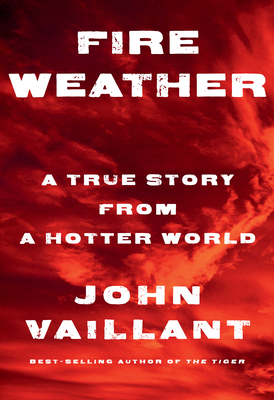
A stunning account of a colossal wildfire that collided with a city and a panoramic exploration of the rapidly changing relationship between fire and humankindIn May 2016, Fort McMurray, the hub of Canada’s oil industry and America’s biggest foreign supplier, was overrun by wildfire. The multi-billion-dollar disaster melted vehicles, turned entire neighborhoods into firebombs, and drove 88,000 people from their homes in a single afternoon. Through the lens of this apocalyptic conflagration—the wildfire equivalent of Hurricane Katrina—John Vaillant warns that this was not a unique event but a shocking preview of what we must prepare for in a hotter, more flammable world.Fire has been a partner in our evolution for millennia, shaping culture, civilization, and, very likely, our brains. Fire has enabled us to cook our food, defend and heat our homes, and power the machines that drive our titanic economy. Yet this volatile energy source has always threatened to elude our control, and in our new age of intensifying climate change, we are seeing its destructive power unleashed in previously unimaginable ways.With masterly prose and a cinematic eye, Vaillant takes us on a riveting journey through the intertwined histories of North America’s oil industry and the birth of climate science, to the unprecedented devastation that modern forest fires wreak, and into lives forever changed by these disasters. His urgent work is a book for—and from—our new century of fire, which has only just begun.

From the best-selling author of The Tiger and The Golden Spruce, this debut novel is a gripping survival story of a young man trapped, perhaps fatally, during a border crossing. Héctor is trapped. The water truck, sealed to hide its human cargo, has broken down. The coyotes have taken all the passengers’ money for a mechanic and have not returned. Those left behind have no choice but to wait.Héctor finds a name in his friend César’s phone. AnniMac. A name with an American number. He must reach her, both for rescue and to pass along the message César has come so far to deliver. But are his messages going through?Over four days, as water and food run low, Héctor tells how he came to this desperate place. His story takes us from Oaxaca — its rich culture, its rapid change — to the dangers of the border. It exposes the tangled ties between Mexico and El Norte — land of promise and opportunity, homewrecker and unreliable friend. And it reminds us of the power of storytelling and the power of hope, as Héctor fights to ensure his message makes it out of the truck and into the world.Both an outstanding suspense novel and an arresting window into the relationship between two great cultures, The Jaguar’s Children shows how deeply interconnected all of us, always, are.



ROCKY MOUNTAIN WILDERNESS AREA, T HE MUSKWA-KECHIKA MANAGMENT AREA IN BRITISH COLUMBIA
by John Vaillant

L'âge du feu: Chronique d'une planète en flammes
by John Vaillant
En mai 2016, le centre de l'industrie pétrolière au Canada, Fort Mc Murray (Alberta), est détruit par un gigantesque incendie. Cette catastrophe a causé des dégâts de plusieurs milliards de dollars, transformant des quartiers entiers en bombes incendiaires, faisant fondre des véhicules et fuir 90 000 personnes de leurs domiciles en un après-midi. En partant de ce récit apocalyptique, John Vaillant explore le passé et l'avenir d'un monde de plus en plus chaud, et de plus en plus inflammable. Pendant des centaines de milliers d'années, le feu a contribué à l'évolution de l'humanité, participant au développement de la culture et de la civilisation. Mais aujourd'hui, avec les changements climatiques, le pouvoir destructeur du feu se déchaîne dans des proportions encore jamais vues. Par sa prose vigoureuse et cinématographique, John Vaillant plonge dans les histoires croisées de l'industrie du pétrole et de la climatologie, documente les destructions causées par les feux de forêt modernes et témoigne des existences bouleversées suite à ces catastrophes. Un ouvrage à lire d'urgence dans notre nouvel âge du feu.

El tiempo del fuego (Ensayo nº 1)
by John Vaillant
En mayo de 2016, Fort McMurray, el centro neurálgico de la industria petrolera canadiense y el mayor proveedor extranjero de Estados Unidos, fue arrasado por un colosal incendio forestal. La catástrofe, valorada en miles de millones de dólares, derritió vehículos, convirtió barrios enteros en bombas incendiarias y expulsó a 88.000 personas de sus hogares en una sola tarde. A través de esta conflagración apocalíptica —equivalente al huracán Katrina—, Vaillant advierte que no se trató de un acontecimiento único, sino de un aviso de que debemos prepararnos para un mundo cada vez más caliente e inflamable. El fuego ha participado en nuestra evolución durante cientos de milenios, moldeando la cultura y la civilización. Nos ha permitido cocinar los alimentos, defender y calentar nuestros hogares y alimentar las máquinas que mueven nuestra titánica economía. Sin embargo, esta volátil fuente de energía siempre ha amenazado con eludir nuestro control, y en esta era de intensificación del cambio climático, estamos viendo cómo se desata su poder destructivo de formas antes inimaginables. El tiempo del fuego es un fascinante viaje a través de las historias entrelazadas de la industria petrolera norteamericana y el nacimiento de la ciencia climática, hasta la devastación sin precedentes provocada por los incendios forestales modernos.
Scripture Compared with Itself, in Proof of the Catholic Doctrine of the Holy Trinity [&C.]. 1819 [Leather Bound]
by John Vaillant
Leather Binding on Spine and Corners with Golden leaf printing on spine. This book is printed in black & white, Sewing binding for longer life, where the book block is actually sewn (smythe sewn/section sewn) with thread before binding which results in a more durable type of binding. Reprinted in 2022 with the help of original edition published long back 1819. As this book is reprinted from a very old book, there could be some missing or flawed pages. If it is multi vo Resized as per current standards. We expect that you will understand our compulsion with such books. 67 Scripture compared with itself, in proof of the Catholic doctrine of the Holy Trinity [&c.]. 1819 John Vaillant