
John Keegan
Sir John Desmond Patrick Keegan, OBE, FRSL was a British military historian, lecturer and journalist. He published many works on the nature of combat between the 14th and 21st centuries concerning land, air, maritime and intelligence warfare as well as the psychology of battle.
27 Books Written

Praised as “the best military historian of our generation” by Tom Clancy, John Keegan reconsiders his masterful study of World War II, The Second World War , with a new forewordKeegan examines each theater of the war, focusing on five crucial battles and offering new insights into the distinctive methods and motivations of modern warfare. In eloquent, perceptive analyses of the airborne battle of Crete, the carrier battle of Midway, the tank battle of Falaise, the city battle of Berlin, and the amphibious battle of Okinawa, Keegan illuminates the strategic dilemmas faced by the leaders and the consequences of their decisions on the fighting men and the course of the war as a whole. An extraordinary, definitive history, The Second World War will be required reading for generations to come." The Second World War merits the acceptance as the standard work that it will surely recieve." - The Washington Post"If you want to know how it happened, read Keegan's thoughtful and elegant prose." - Los Angeles Times

The First World War created the modern world. A conflict of unprecedented ferocity, it abruptly ended the relative peace and prosperity of the Victorian era, unleashing such demons of the twentieth century as mechanized warfare and mass death. It also helped to usher in the ideas that have shaped our times--modernism in the arts, new approaches to psychology and medicine, radical thoughts about economics and society--and in so doing shattered the faith in rationalism and liberalism that had prevailed in Europe since the Enlightenment. With The First World War, John Keegan, one of our most eminent military historians, fulfills a lifelong ambition to write the definitive account of the Great War for our generation.Probing the mystery of how a civilization at the height of its achievement could have propelled itself into such a ruinous conflict, Keegan takes us behind the scenes of the negotiations among Europe's crowned heads (all of them related to one another by blood) and ministers, and their doomed efforts to defuse the crisis. He reveals how, by an astonishing failure of diplomacy and communication, a bilateral dispute grew to engulf an entire continent.But the heart of Keegan's superb narrative is, of course, his analysis of the military conflict. With unequalled authority and insight, he recreates the nightmarish engagements whose names have become legend--Verdun, the Somme and Gallipoli among them--and sheds new light on the strategies and tactics employed, particularly the contributions of geography and technology. No less central to Keegan's account is the human aspect. He acquaints us with the thoughts of the intriguing personalities who oversaw the tragically unnecessary catastrophe--from heads of state like Russia's hapless tsar, Nicholas II, to renowned warmakers such as Haig, Hindenburg and Joffre. But Keegan reserves his most affecting personal sympathy for those whose individual efforts history has not recorded--"the anonymous millions, indistinguishably drab, undifferentially deprived of any scrap of the glories that by tradition made the life of the man-at-arms tolerable."By the end of the war, three great empires--the Austro-Hungarian, the Russian and the Ottoman--had collapsed. But as Keegan shows, the devastation ex-tended over the entirety of Europe, and still profoundly informs the politics and culture of the continent today. His brilliant, panoramic account of this vast and terrible conflict is destined to take its place among the classics of world history.With 24 pages of photographs, 2 endpaper maps, and 15 maps in text
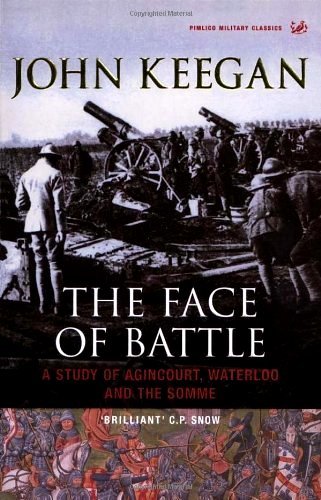
The Face of Battle is military history from the battlefield: a look at the direct experience of individuals at 'the point of maximum danger'. It examines the physical conditions of fighting, the particular emotions and behaviour generated by battle, as well as the motives that impel soldiers to stand and fight rather than run away.In his scrupulous reassessment of three battles, John Keegan vividly conveys their reality for the participants, whether facing the arrow cloud of Agincourt, the levelled muskets of Waterloo or the steel rain of the Somme.

The acclaimed author of The Face of Battle examines centures of conflict in a variety of diverse societies and cultures. "Keegan is at once the most readable and the most original of living military historians . . . A History of Warfare is perhaps the most remarkable study of warfare that has yet been written."--The New York Times Book Review.

Six Armies in Normandy: From D-Day to the Liberation of Paris; June 6 - Aug. 5, 1944
by John Keegan
Rating: 4.1 ⭐
Acclaimed military historian John Keegan’s investigation into World War II and the Normandy InvasionThe armies of six nations met on the battlefields of Normandy in what was to be the greatest Allied achievement of World War II. With dramatic, driving power, John Keegan describes the massed armies—American, Canadian, English, French, German, and Polish—at successive stages of the invasion. As he details the strategies of the military engagements, Keegan brilliantly shows how each of the armies reflected its own nation's values and traditions. In a new introduction written especially to commemorate the 50th anniversary of D-Day, he contemplates the ways the events at the battle of Normandy still reverberate today.“The best military historian of our generation.” –Tom Clancy “John Keegan writes about war better than almost anyone in our century.” –The Washington Post Book World “Very dramatic… Very well done… a book which conjures romance from some very hard fighting.” –A. J. P. Taylor, The New York Review of Books “The story of this vast, complex, and risky amphibious assault, and the campaign which followed, has been told many times, but never better than by John Keegan.” –The Wall Street Journal

John Keegan’s brilliant look at the meaning of leadership In The Mask of Command, John Keegan asks us to consider questions that are seldom asked: What is the definition of leadership? What makes a great military leader? Why is it that men, indeed sometimes entire nations, follow a single leader, often to victory, but with equal dedication also to defeat?Dozens of names come to mind...Napoleon, Lee, Charlemagne, Hannibal, Castro, Hussein. From a wide array, Keegan chooses four commanders who profoundly influenced the course of history: Alexander the Great, the Duke of Wellington, Ulysses S. Grant and Adolph Hitler. All powerful leaders, each cast in a different mold, each with diverse results.The Mask of Command is a companion volume to John Keegan's classic study of the individual soldier, The Face of Battle : together they form a masterpiece of military and human history.

In this magesterial history and national bestseller, John Keegan shares his original and perceptive insights into the psychology, ideology, demographics, and economics of the American Civil War. Illuminated by Keegan’s knowledge of military history he provides a fascinating look at how command and the slow evolution of its strategic logic influenced the course of the war. Above all, The American Civil War gives an intriguing account of how the scope of the conflict combined with American geography to present a uniquely complex and challenging battle space. Irresistibly written and incisive in its analysis, this is an indispensable account of America’s greatest conflict.

In fiction, the spy is a glamorous figure whose secrets make or break peace, but, historically, has intelligence really been a vital step to military victories? In this breakthrough study, the preeminent war historian John Keegan goes to the heart of a series of important conflicts to develop a powerful argument about military intelligence.In his characteristically wry and perceptive prose, Keegan offers us nothing short of a new history of war through the prism of intelligence. He brings to life the split-second decisions that went into waging war before the benefit of aerial surveillance and electronic communications. The English admiral Horatio Nelson was hot on the heels of Napoleon’s fleet in the Mediterranean and never knew it, while Stonewall Jackson was able to compensate for the Confederacy’s disadvantage in firearms and manpower with detailed maps of the Appalachians. In the past century, espionage and decryption have changed the face of the Japanese surprise attack at the Battle of the Midway was thwarted by an early warning. Timely information, however, is only the beginning of the surprising and disturbing aspects of decisions that are made in war, where brute force is often more critical.Intelligence in War is a thought-provoking work that ranks among John Keegan’s finest achievements.

When today's world leaders need inspiration and strength in times of crisis, they often turn to Winston Churchill, quoting him and citing his heroic example. The son of a member of Parliament, Churchill, a poor academic student, wanted to be a soldier early in life. But after he escaped from a South African prison camp, his national fame catapulted him into a life of politics.In this Penguin Life, the eminent historian John Keegan charts Churchill's career, following his steadfast leadership during the catastrophic events of World War II while England was dangerously poised on the brink of collapse. With wonderful eloquence, Keegan illuminates Churchill's incredible strength during this crucial moment in history and his unshakable belief that democracy would always prevail. Keegan looks at Churchill's speeches, which are some of the greatest examples of English oratory, and identifies his ability to communicate his own idea of an English past as the source of Churchill's greatness. He also sheds light on the political climate of Churchill's time. The result is an insightful, sensitive portrait of Churchill the war leader and Churchill the man.

The Price of Admiralty: The Evolution of Naval Warfare from Trafalgar to Midway
by John Keegan
Rating: 4.1 ⭐
Military historian John Keegan’s gripping history of naval warfare’s evolution.In The Price of Admirality , leading military historian John Keegan illuminates the history of naval combat by expertly dissecting four landmark sea battles, each featuring a different type of the Battle of Trafalgar, the Battle of Jutland in World War I, the Battle of Midway in World War II, and the long and arduous Battle of the Atlantic.“The best military historian of our generation.”—Tom Clancy “ The Price of Admirality stands alongside Mr. Keegan’s earlier works in its power to impart both the big and little pictures of war.”—The New York Times

The Iraq War: The Military Offensive, from Victory in 21 Days to the Insurgent Aftermath
by John Keegan
Rating: 3.4 ⭐
The 2003 Iraq war remains among the most mysterious armed conflicts of modernity. In The Iraq War , John Keegan offers a sharp and lucid appraisal of the military campaign, explaining just how the coalition forces defeated an Iraqi army twice its size and addressing such questions as whether Saddam Hussein ever possessed weapons of mass destruction and how it is possible to fight a war that is not, by any conventional measure, a war at all.Drawing on exclusive interviews with Donald Rumsfeld and General Tommy Franks, Keegan retraces the steps that led to the showdown in Iraq, from the highlights of Hussein’s murderous rule to the diplomatic crossfire that preceded the invasion. His account of the combat in the desert is unparalleled in its grasp of strategy and tactics. The result is an urgently needed and up-to-date book that adds immeasurably to our understanding of those twenty-one days of war and their long, uncertain aftermath.

At once a grand tour of the battlefields of North America and an unabashedly personal tribute to the military prowess of an essentially unwarlike people. • "[A] magisterial narrative history, enriched by an authorial voice."-- The Washington PostFields of Battle spans more than two centuries and the expanse of a continent to show how the immense spaces of North America shaped the wars that were fought on its soil.

Acclaimed military historian John Keegan’s anthology of war writing from 25 centuries of battle In The Book of War, John Keegan marshals a formidable host of war writings to chronicle the evolution of Western warfare through the voice of the most eloquent participants—from Thucydides’ classic account of ancient Greek phalanx warfare to a blow-by-blow description of ground fighting against the Iraqi troops in Kuwait during the Gulf War. Keegan gathers more than eighty selections, including Caesar’s Commentaries on the Roman invasion of Britain; the French Knight Jehan de Wavrin at the battle of Agincourt; Davy Crockett in the war against the Creek; Wellington’s dispatch on Waterloo; Hemingway after Caporetto; and Ernie Pyle at Normandy.“The best military historian of our generation.” –Tom Clancy “A monumental piece of literary military history.” –Chicago TribuneA brilliantly edited and comprehensive anthology."— The New York Times Book Review .

Although 50 years have passed since the end of World War II, there has as yet been no definitive history of that conflict. Existing histories have raised as many questions as they Did Roosevelt have foreknowledge of the attack on Pearl Harbour? Could the Allies have invaded France before 1944? Might bombing the Auschwitz railway have impeded the course of the Holocaust? John Keegan here assesses the literature that has emerged from World War II - and the controversies it has generated - in a book that combines stunning erudition with crisp prose and highly personal discernment.

This is an illustrated version World War of Keegan's "The First World War" The text is an abridgment of that work

John Keegan, widely considered the greatest military historian of our time and the author of acclaimed volumes on ancient and modern warfare--including, most recently, The First World War , a national bestseller--distills what he knows about the why’s and how’s of armed conflict into a series of brilliantly concise essays.Is war a natural condition of humankind? What are the origins of war? Is the modern state dependent on warfare? How does war affect the individual, combatant or noncombatant? Can there be an end to war? Keegan addresses these questions with a breathtaking knowledge of history and the many other disciplines that have attempted to explain the phenomenon. The themes Keegan concentrates on in this short volume are essential to our understanding of why war remains the single greatest affliction of humanity in the twenty-first century, surpassing famine and disease, its traditional companions.

One of the Ballentine Illustrated history of WWII Series, this is the Weapons Book No. 16. Paperback, with many photos and illustrations, about the Waffen SS.

Focusing on the experience of battle as it is known by soldiers from infantryman to commander, this history traces the development of warfare from its beginnings as a clash between warriors to the high technology of today

A stunning visual account of the greatest conflict in world history. The Second World War is the largest event in the history of mankind. No populated continent was untouched by its operations, and the political structure of the postwar world has been largely determined by its outcome. The global nature of the war, and the ambitions of the belligerents, meant that it was fought on a scale that, even today, confounds the imagination. It was a stimulus to unparalleled economic activity and provoked the most important clash of ideologies experienced by the world since the Crusades. The Collins Atlas of World War II furthers our understanding of the war that forever changed our world. The scale and scope of the war is examined here in graphic form, with maps that trace the military campaigns as well as the social and political developments. Authoritative text addresses the issues and events leading to war and all of the clashes and challenges during wartime. For anyone with an interest in the history, society, politics, warfare, and culture of the world, the Collins Atlas of World War II is a perfect companion.

John Keegan concentrates on four key conflicts - Trafalgar, Jutland, Midway and the Battle of the Atlantic. Not only are we taken into the very heart of the fighting, we are also given a panoramic view of naval warfare through the centuries. 'A masterly study' DAILY MAIL 'Rich in unexpected facts and insights. . . Keegan's historical command is dazzling. ' JAN MORRIS INDEPENDENT


From one of the world's preeminent and bestselling military historians comes a vivid history of war on our own continent. John Keegan has visited battlefields throughout the world, but finds himself constantly returning to North America which he loves. Here, geography and climate have shaped the course of military history as they have nowhere else in the world. Guided by his central wisdom, Keegan takes us on a tour of every major fortification and scene of battle on the continent, from the arrival of the Europeans in the sixteenth century to the establishment of New France on the shores of the St. Lawrence River, and from the French conflicts with the British of the Atlantic colonies to the battles with the Native populations in the nineteenth century.Part military history, part travelogue, Warpaths allows us to see how war in Canada and America shaped and was shaped by the land. John Keegan's matchless insight allows us to discover how strife and battle crated our heritage.

Rear cover "The German panzer force was one of the military Wonders of the World. Between September 1939 and December 1941 it swept across Europe from the Atlantic to the Black Sea, leaving in its wake a trail of broken armies and defeated nations. The creator of this extraordinary military machine was Heinz Guderian.


VIETNAM. Here is the true story, full of heroism and endurance against impossible odds, a chilling tale of French forces hopelessly maneuvering tanks in the age of Guerilla Warfare.

Who's Who in Military History looks at those people who have shaped the course of war. Broad in geographical and chronological scope, it concentrates on all the major periods and conflicts in history, from 1453 up to and including the Persian Gulf War. It provides:* detailed biographies of the most interesting and important figures in military history* a series of maps showing the main theatres of war* a glossary of common words and phrases* a unique and valuable source of information for both the student and the general reader.

Three hundred masterpieces by some of the world's finest artists enhance a detailed study of various facets of the history and nature of war