
John Kay
I was born in Edinburgh, Scotland in 1948, and completed my schooling and undergraduate education in that city: I am fortunate to have lived most of my life in beautiful places. I went to the University of Edinburgh to study mathematics. But, after taking a subsidiary course in economics, I decided that I wanted to be an economist. The notion that one might understand society better through the application of rigorous and logical analysis excited me – and it still does. After graduating from Edinburgh, I went to Nuffield College, Oxford. I worked there under James Mirrlees, who was in due course to win the Nobel Prize for his contributions to economic theory. On Mirrlees’s advice, I applied for and to my astonishment got a permanent teaching post in the University of Oxford at the embarrassingly early age of 21. Oxford is a collegiate university – members of the faculty generally have both University and College appointments. This post carried with it a fellowship at St John’s College, an association which I have maintained and enjoyed ever since. Through the 1970s I developed a conventional academic career, publishing in academic journals, and writing my first book Concentration in Modern Industry (with Leslie Hannah, an economic historian colleague). My particular interests were in public finance and industrial organisation. But my rationale for studying economics had, from the beginning, been concerned for application. My career began to change direction when I was asked to join a group to review the structure of the British tax system. This group was established under the auspices of a newly established think tank, the Institute for Fiscal Studies, and was headed by James Meade, another economist who had achieved the ultimate distinction of a Nobel prize. Meade’s rigour was as demanding as that of Mirrlees, (both delivered it with extraordinary personal charm). But the most important effect of my experience with the Meade Committee was that I began to develop a taste for the popular exposition of economic concepts. In this vein, I wrote (with Mervyn King, now Governor of the Bank of England) a more personal account of issues in taxation, The British Tax System which ran through five editions. Pursuing these interests, I moved from Oxford and joined the Institute for Fiscal Studies as its first research director. Soon after I became Director of the Institute. IFS developed into (and remains) one of Britain’s leading think tanks, respected and feared by policymakers and journalists for its fiercely independent analysis of fiscal issues. After seven years, I decided it was time to move on. The success of IFS had been built on serious economics accompanied by a commitment to popularisation and application. If this could be done for public policy issues, could the same be done in the area of business policy? This was the thinking that led me to accept a chair at the London Business School in 1986 and, at the same time, to establish a consulting company, London Economics. Over the next few years, the application of economics to business issues became my intellectual focus. During this period, London Economics grew rapidly, largely on the back of the wave of privatisation and regulatory change in Britain in the 1980s. By 1991, managing the company had become a major responsibility. I revised my arrangements with London Business School. My new contract was as Visiting Professor but my job as executive chairman of London Economics took the larger part of my time. London Economics grew until, by its tenth anniversary, its annual turnover exceeded £10m with offices in three continents and assignments in over sixty countries. London Economics gave me insights into the business world. These came both through consultancy work with major corporations and first hand observation of the growth and development of a small business. Other activities have enriched my more scholarly work by broadening the experi
29 Books Written

Radical Uncertainty: Decision-Making Beyond the Numbers
by John Kay
Rating: 4.1 ⭐
• 2 recommendations ❤️
Some uncertainties are resolvable. The insurance industry’s actuarial tables and the gambler’s roulette wheel both yield to the tools of probability theory. Most situations in life, however, involve a deeper kind of uncertainty, a radical uncertainty for which historical data provide no useful guidance to future outcomes. Radical uncertainty concerns events whose determinants are insufficiently understood for probabilities to be known or forecasting possible. Before President Barack Obama made the fateful decision to send in the Navy Seals, his advisers offered him wildly divergent estimates of the odds that Osama bin Laden would be in the Abbottabad compound. In 2000, no one—not least Steve Jobs—knew what a smartphone was; how could anyone have predicted how many would be sold in 2020? And financial advisers who confidently provide the information required in the standard retirement planning package—what will interest rates, the cost of living, and your state of health be in 2050?—demonstrate only that their advice is worthless.The limits of certainty demonstrate the power of human judgment over artificial intelligence. In most critical decisions there can be no forecasts or probability distributions on which we might sensibly rely. Instead of inventing numbers to fill the gaps in our knowledge, we should adopt business, political, and personal strategies that will be robust to alternative futures and resilient to unpredictable events. Within the security of such a robust and resilient reference narrative, uncertainty can be embraced, because it is the source of creativity, excitement, and profit.

"John Kay tells a fast-paced detective story as he searches for the surprising secret to success...Brilliant."-Tim Harford, author of The Logic of Life In this revolutionary book, economist John Kay proves a notion that feels at once paradoxical and deeply the best way to achieve any complex or broadly defined goal, from happiness to preventing forest fires, is the indirect way. We can learn how to achieve our objectives only through a gradual process of risk taking and discovery-what Kay calls obliquity. The author traces this seemingly counterintuitive path to success as it manifests itself in nearly every aspect of life, including business, politics, sports, and more.

A Financial Times Book of the Year, 2015An Economist Best Book of the Year, 2015A Bloomberg Best Book of the Year, 2015 The finance sector of Western economies is too large and attracts too many of the smartest college graduates. Financialization over the past three decades has created a structure that lacks resilience and supports absurd volumes of trading. The finance sector devotes too little attention to the search for new investment opportunities and the stewardship of existing ones, and far too much to secondary-market dealing in existing assets. Regulation has contributed more to the problems than the solutions.Why? What is finance for? John Kay, with wide practical and academic experience in the world of finance, understands the operation of the financial sector better than most. He believes in good banks and effective asset managers, but good banks and effective asset managers are not what he sees.In a dazzling and revelatory tour of the financial world as it has emerged from the wreckage of the 2008 crisis, Kay does not flinch in his criticism: we do need some of the things that Citigroup and Goldman Sachs do, but we do not need Citigroup and Goldman to do them. And many of the things done by Citigroup and Goldman do not need to be done at all. The finance sector needs to be reminded of its primary purpose: to manage other people's money for the benefit of businesses and households. It is an aberration when the some of the finest mathematical and scientific minds are tasked with devising algorithms for the sole purpose of exploiting the weakness of other algorithms for computerized trading in securities. To travel further down that road leads to ruin.

The Long and the Short of It - Finance and Investment for Normally Intelligent People Who Are Not in
by John Kay
Rating: 4.0 ⭐
Discusses the complexities of modern finance, both the basics of investment and the sophisticated innovations of the modern financial system. This book explains how the fresh economy bubble and the credit crunch - the follies of finance have threatened the stability of the world economy.

Capitalism faltered at the end of the 1990s as corporations were rocked by fraud, the stock-market bubble burst and the American business model – unfettered self-interest, privatization and low tax – faced a storm of protest. But what are the alternatives to the mantras of market fundamentalism? Leading economist John Kay unravels the truth about markets, from Wall Street to Switzerland, from Russia to Mumbai, examining why some nations are rich and some poor, why ‘one-size-fits-all’ globalization hurts developing countries and why markets can work – but only in a humane social and cultural context. His answers offer a radical new blueprint for the future.

The Corporation in the 21st Century: Why (almost) everything we are told about business is wrong
by John Kay
Rating: 3.6 ⭐
In the world of Adam Smith and Karl Marx, capitalists built and controlled mills and factories. That relationship between capital and labour continued in the automobile assembly lines and petrochemical plants of the twentieth century.But no products and production have dematerialised. The goods and services provided by the leading companies of the twenty-first century appear on your screen, fit in your pocket, or occupy your head. Ownership of the means of production is a redundant concept. Workers are the means of production; increasingly, they take the plant home. Capital is a service bought from a specialist supplier with little influence over customer businesses. The professional managers who run modern corporations do not exert authority because they are wealthy; they are wealthy because they exert authority.The pharmaceutical industry (or Big Pharma) creates life-saving vaccines and ramps drug prices up to near-unaffordable levels. Amazon gives us next-day delivery on almost everything and has its workers urinate in bottles rather than take breaks. John Kay's incisive overhaul of our ideas about business redefines our understanding of successful commercial activity and the corporation - and describes how we have come to 'love the product' as we 'hate the producer.' This is a brilliant and original work from one of the greatest economists.

Can economics be fun? Is it relevant to everyday life? John Kay believes passionately that the answer to both questions is yes and in this collection of essays, based on his widely acclaimed "Financial Times" columns, he sets out to prove it. In this book, you will learn why modern advertisements frequently convey no information, understand that tailgating drivers and hedge fund managers are victims of the same illusions, appreciate the inefficiency of Christmas giving, and benefit from the economic lessons of a romantic evening at the Elizabeth restaurant thirty years ago. You will find here acerbic commentary on the boom and bust in financial markets, a wide ranging guide to the latest economic ideas, and a demonstration that complex analysis can be made accessible through lucid exposition and dry humour.
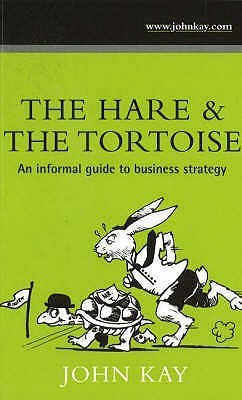
Most business books are bland or dull, or both. This volume is John Kay combines insightful analysis with and verve. In this book, we meet heroes as diverse as Sun Tzu, Jacques Derrida, and Jack we study businesses as diverse as Honda Motors, the grandes marques of Champagne, the Jenners department store in Princes Street, Edinburgh; we learn why size doesn’t matter, why brakes are different from signals, how to value businesses, and why the author was wrong to tell students that Boeing’s position in the civil aircraft market was unassailable. In less than two hundred pages, John Kay provides a lively introduction to business strategy and a guide to many of the key issues in business today.

How did BMW recover from the verge of bankruptcy to become one of the Europe's strongest companies? Why did Saatchi and Saatchi's global strategy bring the company to its knees? Why has Philips outstanding record in innovation not been translated into success in the market? What can be learned from the marriage contract about the conduct of commercial negotiations? These are some of the questions addressed as John Kay asks What makes a business successful?

When John Kay's Foundations of Corporate Success first appeared in the U.K., it commanded the attention of the corporate world--and drew widespread praise. The Financial Times hailed it as "a powerfully argued book, which casts a fresh light on a range of practical business challenges." And Business Age wrote, "You must read John Kay's new book Foundations of Corporate Success . Kay is currently the best management theorist in Britain, bar none.... He is a rare find."Now John Kay has produced an American edition of this landmark book. In this freshly revised volume, Kay applies his groundbreaking theories to the U.S. experience, illustrating them with examples of success and failure in the American market. For too long, he writes, managers have chased after the latest fad in business planning and strategy, beguiled by military analogies and the demand for overarching vision. Success, he believes, should not be measured by organizational size or market share, but by the added value--the amount that output exceeds the input of raw materials, payroll, and capital. Corporate strategy should be aimed at this basic goal, beginning with the question, "How can we be different?" Kay identifies four key innovation, reputation (especially in the form of brands), strategic assets (government mandated monopolies or other measures which restrict market access by competitors), and architecture (the relationships between a company and its employees,suppliers, and customers). Success comes not when managers drive through a towering vision of the company's destiny, but when they act on their organization's specific capabilities and advantages--especially in the key area of architecture. Honda, he notes, captured a third of the American motorcycle market within five years. No vision was required for this success, he Honda simply did what it did best (making a simple, inexpensive product), followed by careful attention to the architecture of its business ties to distributors, customers, etc. He ranges through industries from airlines to retail clothing, pointing out the reasons for successes and failures. Kay also draws on game theory to underscore the importance of stable, long-term relationships.Other writers have hit upon some of these points, the Financial Times "But none has explored them as thoroughly as Kay, who succeeds in marrying an authoritative grasp of economic, legal, and sociological theory with an impressively detailed knowledge of contemporary business practice." This volume transforms Kay's theoretical and practical knowledge into a powerful tool for today's American business manager.

This is the most extensively revised edition of the best discussion of the main problems of the current British tax system. The revisions reflect substantial changes in the tax system and the ways people think about the tax issues that have occurred since the book's first publication in1978.

The Corporation in the Twenty-First Century: Why (almost) everything we are told about business is wrong
by John Kay
Rating: 4.0 ⭐

This book focuses on the timely topic of private enterprises and regulation in the United Kingdom from both theoretcial and appled viewpoints. Papers cover such far-ranging topics privatizing public enterprises, new industrial policies, private versus public enterprise performance, assetsales and liberalization, franchising and competitive tendering, and financial implications and labor relations.

British Tax System by J.A. Kay
by John Kay
PAPER, ITS HISTORY
by John Kay
The story of the origin and manufacture of paper. Starts with parchment, goes on to papyrus and then to the paper of the day. Text is followed by a list of important facts and definitions. With a lengthy presentation from the author on the free endpaper. Front cover soiled. ii , 100, 2 . original pictorial cloth.. tall 12mo..
Please Note That The Following Individual Books As Per Original ISBN and Cover Image In this Listing shall be Dispatched Titles In This The Corporation in the Twenty-First Century [Hardcover] Data Means Business [Paperback] Managing Business Start-Ups [Paperback] The Corporation in the Twenty-First Century, Data Means Business, Managing Business Start-Ups 3 Books Collection The Corporation in the Twenty-First Century [Hardcover]: For generations, we have defined a corporation as a business that uses its accumulated wealth to own the means of production and exercise economic power. That is no longer the reality. Corporations no longer control their own industries, and our most desired goods and services aren't stacked in container they appear on your screen, fit in your pocket or occupy your head. Data Means Embedding a pragmatic, data-guided culture in any organisation can be a challenge. This comprehensive guide for leaders sets out a proven framework for developing the mindset and strategies required to generate value from data and to scale quickly. Jargon-free and packed with practical advice, Data Means Business can help you activate your data to generate growth. Managing Business This incredible book is packed with expert strategies and insights to help you navigate every stage of your entrepreneurial journey. Whether you're just starting out or already established, this book is an essential tool for achieving success. So, why wait? Dive in and get ready to transform your dreams into reality!9781805221722/9781781335215/9789359772318
Tax Reform - Problems and Possibilities
by John Kay
Effects of Sunday Trading
by John Kay
Community Values and the Market Economy
by John Kay
Ownership and Maximisation
by John Kay
Inflation Accounting
by John Kay