
John Irving
JOHN IRVING was born in Exeter, New Hampshire, in 1942. His first novel, Setting Free the Bears, was published in 1968, when he was twenty-six. He competed as a wrestler for twenty years, and coached wrestling until he was forty-seven. Mr. Irving has been nominated for a National Book Award three times—winning once, in 1980, for his novel The World According to Garp. He received an O. Henry Award in 1981 for his short story “Interior Space.” In 2000, Mr. Irving won the Oscar for Best Adapted Screenplay for The Cider House Rules. In 2013, he won a Lambda Literary Award for his novel In One Person. An international writer—his novels have been translated into more than thirty-five languages—John Irving lives in Toronto. His all-time best-selling novel, in every language, is A Prayer for Owen Meany. Avenue of Mysteries is his fourteenth novel.
30 Books Written

The bestselling coming-of-age classic novel by John Irving--now in a limited 40th anniversary edition with a new introduction by the author. He is more than popular. He is a Populist, determined to keep alive the Dickensian tradition that revels in colorful set pieces...and teaches moral lessons.--The New York Times The opening sentence of John Irving's breakout novel, The World According to Garp, signals the start of sexual violence, which becomes increasingly political. Garp's mother, Jenny Fields, was arrested in Boston in 1942 for wounding a man in a movie theater. Jenny is an unmarried nurse; she becomes a single mom and a feminist leader, beloved but polarizing. Her son, Garp, is less beloved, but no less polarizing.From the tragicomic tone of its first sentence to its mordantly funny last line--we are all terminal cases--The World According to Garp maintains a breakneck pace. The subject of sexual hatred--of intolerance of sexual minorities and differences--runs the gamut of lunacy and sorrow. Winner of the National Book Award, Garp is a comedy with forebodings of doom. In more than thirty languages, in more than forty countries--with more than ten million copies in print--Garp is the precursor of John Irving's later protest novels.

Eleven-year-old Owen Meany, playing in a Little League baseball game in Gravesend, New Hampshire, hits a foul ball and kills his best friend's mother. Owen doesn't believe in accidents; he believes he is God's instrument. What happens to Owen after that 1953 foul is both extraordinary and terrifying. At moments a comic, self-deluded victim, but in the end the principal, tragic actor in a divine plan, Owen Meany is the most heartbreaking hero John Irving has yet created.

Raised from birth in the orphanage at St. Cloud's, Maine, Homer Wells has become the protege of Dr. Wilbur Larch, its physician and director. There Dr. Larch cares for the troubled mothers who seek his help, either by delivering and taking in their unwanted babies or by performing illegal abortions. Meticulously trained by Dr. Larch, Homer assists in the former, but draws the line at the latter. Then a young man brings his beautiful fiancee to Dr. Larch for an abortion, and everything about the couple beckons Homer to the wide world outside the orphanage ...
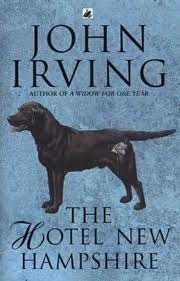
“The first of my father’s illusions was that bears could survive the life lived by human beings, and the second was that human beings could survive a life led in hotels.” So says John Berry, son of a hapless dreamer, brother to a cadre of eccentric siblings, and chronicler of the lives lived, the loves experienced, the deaths met, and the myriad strange and wonderful times encountered by the family Berry. Hoteliers, pet-bear owners, friends of Freud (the animal trainer and vaudevillian, that is), and playthings of mad fate, they “dream on” in a funny, sad, outrageous, and moving novel by the remarkable author of A Prayer for Owen Meany and Last Night in Twisted River.

“One night when she was four and sleeping in the bottom bunk of her bunk bed, Ruth Cole woke to the sound of lovemaking—it was coming from her parents’ bedroom.”This sentence opens John Irving’s ninth novel, A Widow for One Year, a story of a family marked by tragedy. Ruth Cole is a complex, often self-contradictory character—a “difficult” woman. By no means is she conventionally “nice,” but she will never be forgotten.Ruth’s story is told in three parts, each focusing on a critical time in her life. When we first meet her—on Long Island, in the summer of 1958—Ruth is only four.The second window into Ruth’s life opens on the fall of 1990, when she is an unmarried woman whose personal life is not nearly as successful as her literary career. She distrusts her judgment in men, for good reason.A Widow for One Year closes in the autumn of 1995, when Ruth Cole is a forty-one-year-old widow and mother. She’s about to fall in love for the first time.Richly comic, as well as deeply disturbing, A Widow for One Year is a multilayered love story of astonishing emotional force. Both ribald and erotic, it is also a brilliant novel about the passage of time and the relentlessness of grief.Source: john-irving.com

In 1954, in the cookhouse of a logging and sawmill settlement in northern New Hampshire, an anxious twelve-year-old boy mistakes the local constable’s girlfriend for a bear. Both the twelve-year-old and his father become fugitives, forced to run from Coos County–to Boston, to southern Vermont, to Toronto–pursued by the implacable constable. Their lone protector is a fiercely libertarian logger, once a river driver, who befriends them.In a story spanning five decades, Last Night in Twisted River–John Irving’s twelfth novel–depicts the recent half-century in the United States as “a living replica of Coos County, where lethal hatreds were generally permitted to run their course.” From the novel’s taut opening sentence–“The young Canadian, who could not have been more than fifteen, had hesitated too long”–to its elegiac final chapter, Last Night in Twisted River is written with the historical authenticity and emotional authority of The Cider House Rules and A Prayer for Owen Meany. It is also as violent and disturbing a story as John Irving’s breakthrough bestseller, The World According to Garp.What further distinguishes Last Night in Twisted River is the author’s unmistakable voice–the inimitable voice of an accomplished storyteller. Near the end of this moving novel, John Irving writes: “We don’t always have a choice how we get to know one another. Sometimes, people fall into our lives cleanly–as if out of the sky, or as if there were a direct flight from Heaven to Earth–the same sudden way we lose people, who once seemed they would always be part of our lives.”

While reporting a story from India, a New York television journalist has his left hand eaten by a lion; millions of TV viewers witness the accident. In Boston, a renowned hand surgeon awaits the opportunity to perform the nation’s first hand transplant; meanwhile, in the distracting aftermath of an acrimonious divorce, the surgeon is seduced by his housekeeper. A married woman in Wisconsin wants to give the one-handed reporter her husband’s left hand – that is, after her husband dies. But the husband is alive, relatively young, and healthy.

A New York Times bestselling novel of desire, secrecy, and sexual identity, In One Person is a story of unfulfilled love—tormented, funny, and affecting—and an impassioned embrace of our sexual differences. Billy, the bisexual narrator and main character of In One Person, tells the tragicomic story (lasting more than half a century) of his life as a "sexual suspect," a phrase first used by John Irving in 1978 in his landmark novel of "terminal cases," The World According to Garp.In One Person is a poignant tribute to Billy’s friends and lovers—a theatrical cast of characters who defy category and convention. Not least, In One Person is an intimate and unforgettable portrait of the solitariness of a bisexual man who is dedicated to making himself "worthwhile.

Every major character in Until I Find You has been marked for life – not only William Burns, a church organist who is addicted to being tattooed, but also William's son, Jack, an actor who is shaped as a child by his relationships with older women. And Jack's mother, Alice – a Toronto tattoo artist – has been permanently damaged by William's rejection of her. This is a novel about the loss of innocence, on many levels.

A Hindi film star . . . an American missionary . . . twins separated at birth . . . a dwarf chauffeur . . . a serial killer . . . all are on a collision course. In the tradition of A Prayer for Owen Meany, Irving's characters transcend nationality. They are misfits—coming from everywhere, belonging nowhere. Set almost entirely in India, this is John Irving's most ambitious novel and a major publishing event.

“Irving looks cunningly beyond the eye-catching gyrations of the mating dance to the morning-after implications.”— The Washington PostThe darker vision and sexual ambiguities of this sensual, ironic tale about a ménage a quatre in a New England university town foreshadow those of The World According to Garp ; but this very trim and precise novel is a marked departure from the author's generally robust, boisterous style. Though Mr. Irving's cool eye spares none of his foursome, he writes with genuine compassion for the sexual tests and illusions they perpetrate on each other; but the sexual intrigue between them demonstrates how even the kind can be ungenerous, and even the well-intentioned, destructive.“One of the most remarkable things about John Irving's first three novels, viewed from the vantage of The World According to Garp, is that they can be read as one extended fictional enterprise. . . . The 158-Pound Marriage is as lean and concentrated as a mine shaft.”—Terrence Des Pres“Deft, hard-hitting . . . What Irving demonstrates beautifully is that a one-to-one relationship is more demanding than a free-for-all.”— The New York Times Book Review

John Irving returns to the themes that established him as one of our most admired and beloved authors in this absorbing novel of fate and memory.As we grow older—most of all, in what we remember and what we dream—we live in the past. Sometimes, we live more vividly in the past than in the present.As an older man, Juan Diego will take a trip to the Philippines, but what travels with him are his dreams and memories; he is most alive in his childhood and early adolescence in Mexico. “An aura of fate had marked him,” John Irving writes, of Juan Diego. “The chain of events, the links in our lives—what leads us where we’re going, the courses we follow to our ends, what we don’t see coming, and what we do—all this can be mysterious, or simply unseen, or even obvious.”Avenue of Mysteries is the story of what happens to Juan Diego in the Philippines, where what happened to him in the past—in Mexico—collides with his future.

“John Irving, it is abundantly clear, is a true artist.”— Los Angeles TimesFred "Bogus" Trumper has troubles. A divorced, broke graduate student of Old Norse in 1970s New York, Trumper is a wayward knight-errant in the battle of the sexes and the pursuit of His ex-wife has moved in with his childhood best friend, his life is the subject of a tell-all movie, and his chronic urinary tract infection requires surgery. Trumper is determined to change. There's only one it seems the harder he tries to alter his adolescent ways, the more he is drawn to repeating the mistakes of the past. . . .Written when Irving was twenty-nine, Trumper's tale of woe is told with all the wit and humor that would become Irving's trademark.“Three or four times as funny as most novels.” — The New YorkerPraise for The Water-Method Man“Friendship, marriage, and family are his primary themes, but at that blundering level of life where mishap and folly—something close to joyful malice—perpetually intrude and distrupt, often fatally. Life, in [John] Irving's fiction, is always under siege. Harm and disarray are daily fare, as if the course of love could not run true. . . . Irving's multiple manner . . . his will to come at the world from different directions, is one of the outstandint traits of The World According to Garp, but this remarkable flair for . . . stories inside stories . . . isalready handled with mastery . . . and with a freedom almost wanton in The Water-Method Man [which is Garp's predecessor by six years].” —Terrence Des Pres“Brutal reality and hallucination, comedy and pathos. A rich, unified tapestry.” — Time

It is 1967 and two Viennese university students want to liberate the Vienna Zoo, as was done after World War II. But their good intentions have both comic and gruesome consequences, in this first novel written by a twenty-five year old John Irving, already a master storyteller.

John Irving, one of the world’s greatest novelists, returns with his first novel in seven years—a ghost story, a love story, and a lifetime of sexual politics.In Aspen, Colorado, in 1941, Rachel Brewster is a slalom skier at the National Downhill and Slalom Championships. Little Ray, as she is called, finishes nowhere near the podium, but she manages to get pregnant. Back home, in New England, Little Ray becomes a ski instructor. Her son, Adam, grows up in a family that defies conventions and evades questions concerning the eventful past. Years later, looking for answers, Adam will go to Aspen. In the Hotel Jerome, where he was conceived, Adam will meet some ghosts; in The Last Chairlift, they aren’t the first or the last ghosts he sees.
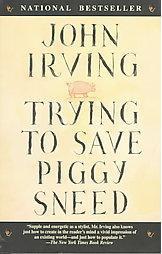
A collection of one dozen short works includes the title piece, a loving portrait of the author's grandmother, and additional stories, including "The Pension Grillparzer" and "Dinner at the White House"Here is a treat for John Irving addicts and a perfect introduction to his work for the uninitiated. To open this spirited collection, Irving explains how he became a writer. There follow six scintillating stories written over the last twenty years ending with a homage to Charles Dickens. This irresistible collection cannot fail to delight and charm.The first collection of short pieces--two of them previously unpublished--by the author of The World According to Garp includes memoirs, six short stories, and essays on Charles Dickens and Gu+a5nter Grass. Reprint. Tour.This gem, a delightful collection of shorter works, both fiction and nonfiction, written by one of the country's finest--and funniest--writers, includes a living portrait of Irving's grandmother, a new, never-before-published essay, six scintillating short stories--including the O. Henry Award-winning "Interior Space"--and two essays on Irving's favorite 19th-century novelist, Charles Dickens. Trying to Save Piggy Sneed is John Irving at the top of his form.

Dedicated to the memory of two wrestling coaches and two writer friends, The Imaginary Girlfriend is John Irving's candid memoir of his twin careers in writing and wrestling. The award-winning author of best-selling novels from The World According to Garp to In One Person, Irving began writing when he was fourteen, the same age at which he began to wrestle at Exeter. He competed as a wrestler for twenty years, was certified as a referee at twenty-four, and coached the sport until he was forty-seven. Irving coached his sons Colin and Brendan to New England championship titles, a championship that he himself was denied.In an autobiography filled with the humor and compassion one finds in his fiction, Irving explores the interrelationship between the two disciplines of writing and wrestling, from the days when he was a beginner at both until his fourth wresting related surgery at the age of fifty-three. Writing as a father and mentor, he offers a lucid portrait of those—writers and wrestlers from Kurt Vonnegut to Ted Seabrooke—who played a mentor role in his development as a novelist, wrestler, and wrestling coach. He reveals lessons he learned about the pursuit for which he is best known, writing. “And,” as the Denver Post observed, in filling “his narrative with anecdotes that are every bit as hilarious as the antics in his novels, Irving combines the lessons of both obsessions (wrestling and writing) . . . into a somber reflection on the importance of living well.”

John Irving's memoir begins with his account of the distinguished career and medical writings of the novelist's grandfather Dr. Frederick C. Irving, a renowned obstetrician and gynecologist, and includes Mr. Irving's incisive history of abortion politics in the United States. But My Movie Business focuses primarily on the thirteen years John Irving spent adapting his novel The Cider House Rules for the screen--for four different directors. Mr. Irving also writes about the failed effort to make his first novel, Setting Free the Bears, into a movie; about two of the films that were made from his novels (but not from his screenplays), The World According to Garp and The Hotel New Hampshire; about his slow progress at shepherding his screenplay of A Son of the Circus into production. Not least, and in addition to its qualities as a memoir--anecdotal, comic, affectionate, and candid--My Movie Business is an insightful essay on the essential differences between writing a novel and writing a screenplay.The photographs in My Movie Business were taken by Stephen Vaughan, the still photographer on the set of The Cider House Rules--a Miramax production directed by Lasse Hallström, with Michael Caine in the role of Dr. Larch. Concurrently with the November 1999 release of the film, Talk Miramax Books will publish John Irving's screenplay.
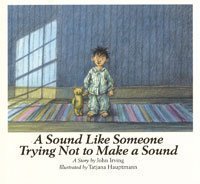
In John Irving's ninth novel A Widow for One Year, a creepy children's book author named Ted Cole writes a bedtime story about things that go bump in the night. That odd, gently comical tale is brought to life here with Tatjana Hauptmann's shadowy, moonlit pencil illustrations. Young Tom wakes up in the middle of the night to an unusual sound, but his two-year-old brother Tim does not. When his fathers asks what it sounded like, Tom reveals a number of silly and scary options: "like a monster with no arms and no legs," or "a dog trying to open a door," or "a ghost dropping stolen peanuts"--"a sound like someone trying not to make a sound," in fact. The illustrations--with a smattering of wordless spreads--show the pajama-clad Tom wandering alone through a big empty house as bulges in the wall and long shadows hint at unseen horrors. In the end, the father tells his boys that the sound is just a mouse in the wall. Tom is immensely relieved, but baby Tim screams because he doesn't know what a mouse is, and stays up all night to ward off the furry, mysterious thing. Not too scary, nor too comforting, Irving's picture-book debut imaginatively captures that late-night world where everything looks and sounds a little like a monster. (Preschool to age 6) --Karin Snelson
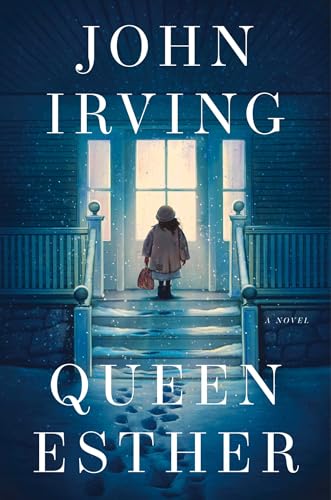
After forty years, John Irving returns to the world of his bestselling classic novel and Academy Award–winning film, The Cider House Rules, revisiting the orphanage in St. Cloud’s, Maine, where Dr. Wilbur Larch takes in Esther—a Viennese-born Jew whose life is shaped by anti-Semitism.Esther Nacht is born in Vienna in 1905. Her father dies on board the ship to Portland, Maine; her mother is murdered by anti-Semites in Portland. Dr. Larch knows it won’t be easy to find a Jewish family to adopt Esther; in fact, he won’t find any family who’ll adopt her. When Esther is fourteen, soon to be a ward of the state, Dr. Larch meets the Winslows, a philanthropic New England family with a history of providing foster care for unadopted orphans. The Winslows aren’t Jewish, but they despise anti-Semitism. Esther’s gratitude for the Winslows is unending; even as she retraces her roots back to Vienna, she never stops loving and protecting the Winslows. In the final chapter, set in Jerusalem in 1981, Esther Nacht is seventy-six. John Irving’s sixteenth novel is a testament to his enduring ability to weave complex characters and intricate narratives that challenge and captivate. Queen Esther is not just a story of survival but a profound exploration of identity, belonging, and the enduring impact of history on our personal lives showcasing why Irving remains one of the world’s most beloved, provocative, and entertaining authors—a storyteller of our time and for all time.

Die Leser von Garp werden sich erinnern: Die Pension Grillparzer ist die erste Erzählung aus der Feder des 19-jährigen Garp mit ihr erobert er Helen, seine spätere Frau. Eine Geschichte voller Verrücktheit und Trauer, mit wiederkehrenden Träumen, verzweifelten Akrobaten, Bären und Wien.

The practices of Dr. Wilbur Larch--obstetrician, orphanage director, ether addict, and abortionist--are hindered, abetted, and continued, in turn, by his favorite orphan, Homer Wells

Three Complete Novels: Setting Free the Bears, The Water-Method Man, The 158-Pound Marriage
by John Irving
Rating: 3.9 ⭐
This collection features the first three novels of this highly acclaimed New York Times bestselling author. Compassionate, satirical, deeply insightful and humorous, these compelling novels have gained him millions of fans. Setting Free the Bears : Siggy and Hannes were disenchanted students and fellow conspirators. Astride a 700cc royal Enfield motorcycle, they roamed the Austrian countryside. When Gallen, a lovely hitchhiker, joined them, they zeroed in on the Vienna Zoo--and Siggy's setting free the bears! The Water-Method Man : The acclaimed second novel by the author of the #1 international bestseller, A Prayer for Owen Meany. Fred "Bogus" Trumper is a wayward knight-errant in the battle of the sexes, and the pursuit of happiness. Yet, he stubbornly clings to the notion he'll make something of his life. The 158 Pound Marriage : Sometimes they looked at each other, aroused half out of their minds by the thought that each had just been making love with another, and it would be enough to make them want to do it--together--all over again. Well, almost enough.

John Irving box set: The Cider House Rules / A Widow for One Year / A Prayer for Owen Meany
by John Irving
Rating: 4.4 ⭐
A boxed set containing three beloved, New York Times bestselling novels by John The Cider House Rules , A Widow for One Year , and A Prayer for Owen Meany .The Cider House RulesSet in rural Maine in the first half of this century, it tells the story of Dr. Wilbur Larch--saint and obstetrician, founder and director of the orphanage in the town of St. Cloud's, ether addict and abortionist. It is also the story of Dr. Larch's favorite orphan, Homer Wells, who is never adopted.A Widow for One YearRichly comic, as well as deeply disturbing, A Widow for One Year is a multilayered love story of astonishing emotional force. Both ribald and erotic, it is also a brilliant novel about the passage of time and the relentlessness of grief.A Prayer for Owen MeanyIn the summer of 1953, two eleven-year-old boys–best friends–are playing in a Little League baseball game in Gravesend, New Hampshire. One of the boys hits a foul ball that kills the other boy’s mother. The boy who hits the ball doesn’t believe in accidents; Owen Meany believes he is God’s instrument. What happens to Owen, after that 1953 foul ball, is extraordinary and terrifying.

The Door in the Floor is limited to 5,000 copies--printed in Korea--pictures and drawings copyright 2004 by Jeff Bridges.

A Teacher's Guide for a Prayer for Owen Meany: Common-Core Aligned Teacher Materials and a Sample Chapter
by John Irving
Rating: 4.3 ⭐
For teachersWe know that the Common Core State Standards are encouraging you to reevaluate the books that you assign to your students. To help you decide which books are right for your classroom, each free ebook in this series contains a Common Core–aligned teaching guide and a sample chapter.This free teaching guide for A Prayer for Owen Meany by John Irving is designed to help you put the new Common Core State Standards into practice."Among the very best American novels of our time."—Charlotte ObserverIn the summer of 1953, two eleven-year-old boys—best friends—are playing in a Little League baseball game in Gravesend, New Hampshire. One of the boys hits a foul ball that kills the other boy's mother. The boy who hits the ball doesn't believe in accidents; Owen Meany believes he is God's instrument. What happens to Owen after that 1953 foul ball is extraordinary.


John Irving über Günter Grass und Elisabeth Mann Borgese, über Marcel Reich-Ranicki und Hunde, die Klavier spielen können. Ein Stimmungsbericht über das Deutschland der neunziger Jahre.


This is one of the stories that is also published in Trying to Save Piggy Sneed, called Interior Space.Speciale uitgave in opdracht an ECI.