
John G. Neihardt
John Gneisenau Neihardt
29 Books Written

Black Elk Speaks, the story of the Oglala Lakota visionary and healer Nicholas Black Elk (1863–1950) and his people during momentous twilight years of the nineteenth century, offers readers much more than a precious glimpse of a vanished time. Black Elk’s searing visions of the unity of humanity and Earth, conveyed by John G. Neihardt, have made this book a classic that crosses multiple genres. Whether appreciated as the poignant tale of a Lakota life, as a history of a Native nation, or as an enduring spiritual testament, Black Elk Speaks is unforgettable. Black Elk met the distinguished poet, writer, and critic John G. Neihardt in 1930 on the Pine Ridge Reservation in South Dakota and asked Neihardt to share his story with the world. Neihardt understood and conveyed Black Elk’s experiences in this powerful and inspirational message for all humankind. This complete edition features a new introduction by esteemed scholar Philip J. Deloria and annotations of Black Elk’s story by renowned Lakota scholar Raymond J. DeMallie. Three essays by John G. Neihardt provide background on this landmark work along with pieces by Vine Deloria Jr., Raymond J. DeMallie, Alexis Petri, and Lori Utecht. Maps, original illustrations by Standing Bear, and a set of appendixes rounds out the edition.

"When the Tree Flowered is John Neihardt's mature and reflective inter-pretation of the old Sioux way of life. He served as a translator of the Sioux past whose audience has proved not to be limited by space or time. Through his writings, Black Elk, Eagle Elk, and other old men who were of that last generation of Sioux to have participated in the old buffalo-hunting life and disorienting period of strife with the U.S. army found a literary voice. What they said chronicles a dramatic transition in the life of the Plains Indians; the record of their thoughts, interpreted by Neihardt, is a legacy preserved for the future. It transcends the specifics of this one tragic case of cultural misunderstanding and conflict and speaks to universal human concerns. It is a story worth contemplating both for itself and for the lessons it teaches all humanity."-Raymond J. DeMallie, editor of The Sixth Grandfather: Black Elk's Teachings Given to John G. Neihardt. "A warm and often moving piece of literature which can be appreciated for its literary value and for its insights into Sioux culture."-Richard N. Ellis, Rocky Mountain Social Science Journal. For more information on John G. Neihardt, visit www.neihardt.com

In 1908 John Neihardt (1881–1973) and two companions traveled the Missouri River—about two thousand miles—in a twenty-foot canoe. Originally published in Outing Magazine as a series of articles, The River and I describes their adventures on that wild waterway before it was dammed by the Army Corps of Engineers and points out storied sites along the shore. The result transcends journalism; Neihardt does for the Missouri what Twain did for the Mississippi. This Landmark edition makes available once more the book that was issued in 1910, two years before Neihardt began work on A Cycle of the West and twenty-two years before the publication of Black Elk Speaks .

The Splendid Wayfaring: Jedediah Smith and the Ashley-Henry Men, 1822-1831
by John G. Neihardt
Rating: 4.0 ⭐
With the publication of The Splendid Wayfaring in 1920, John G. Neihardt sought to restore the reputation of a mountain man who went far in opening up the American West. The exciting narrative begins in 1822, when Smith ascended the Missouri River in the first fur-trading expedition of William H. Ashley and Andrew Henry, and ends in 1831, when he was killed by Comanche Indians on the Cimarron River. In the intervening years Smith became the first explorer to recognize South Pass as the gateway to the Far West, the first overlander to reach California and travel up the coast to the Columbia River, and the first white man to cross the Sierra Nevada and the Great Basin from west to east. The Splendid Wayfaring follows in novelistic detail the history-making adventures of Smith and his companions.

The second volume of A Cycle of the West , dealing with the tragic defeat of the Plains Indians, includes The Song of the Indian Wars (1925) and The Song of the Messiah (1935). The former tells of "the period of migration and the last great fight for the bison pastures between the invading white race and the Sioux, the Cheyenne, and the Arapahoe," while the latter concerns "the conquered people and the worldly end of the last great dream." It closes with the battle of Wounded Knee, ending Indian resistance on the Plains.

A Cycle of the West: The Song of Three Friends, The Song of Hugh Glass, The Song of Jed Smith, The Song of the Indian Wars, The Song of the Messiah
by John G. Neihardt
Rating: 3.8 ⭐
A Cycle of the West rewards its readers with a sweeping saga of the American West and John G. Neihardt's exhilarating vision of frontier history. It is infused with wonder, nostalgia, and a keen appreciation of epic history. Unquestionably the masterpiece of the poet who has been called the "American Homer," A Cycle of the West celebrates the land and legends of the Old West in five narrative The Song of Three Friends (1919), The Song of Hugh Glass (1915), The Song of Jed Smith (1941), The Song of the Indian Wars (1925), and The Song of the Messiah (1935). This unforgettable epic of discovery, conquest, courage, and tragedy speaks movingly and resoundingly of a unique American experience.

This is a pre-1923 historical reproduction that was curated for quality. Quality assurance was conducted on each of these books in an attempt to remove books with imperfections introduced by the digitization process. Though we have made best efforts - the books may have occasional errors that do not impede the reading experience. We believe this work is culturally important and have elected to bring the book back into print as part of our continuing commitment to the preservation of printed works worldwide.

Before Black Elk Speaks , before his epic poem A Cycle of the West , John G. Neihardt wrote many short stories that found favor with readers and critics. Among his best were the seventeen collected in Indian Tales and Others in 1926 and now available for the first time in paperback. "The Singer of the Ache," considered Neihardt's highest achievement in short fiction, portrays young Moon-Walker's quest for supernatural powers achieved at a price. Other Indian tales include "The Look in the Face," one of many about a social outcast; "The White Wakunda," about a Christ figure; "The Mark of Shame," concerning murder as a violation of the natural order; "Vylin" and "Mignon," moral fables about Indian-white marriages; "The Last Thunder Song"; and "Dreams Are Wiser Than Men."Other stories, set on the frontier, are "The Scars," "The Nemesis of the Deuces," "The Revolt of a Sheep," "The Parable of the Sack," "The Art of Hate," and perhaps Neihardt's most popular tale, "The Alien," in which a fur trapper makes a pet of a she-wolf, with unex-pected consequences. "The Red Roan," a ghost story, and "Beyond the Spectrum," about a man who may have stepped outside his body permanently, bring to a peak the strain of the supernatural that is apparent throughout the collection.

The first volume in this two-volume edition of A Cycle of the West includes The Song of Three Friends (1919), which received the National Prize of the Poetry Society of America, The Song of Jed Smith (1941). The first two songs, in the poet's words, "deal with the ascent of the river and characteristic adventures of Ashley-Henry men in the country of the upper Missouri and the Yellowstone. The Song of Jed Smith follows the first band of Americans through South Pass to the Great Salt Lake, the first band of Americans to reach Spanish California by an overland trail." Regarded by many as Dr. Neihardt's masterwork, the cycle as a whole "celebrates the great mood of courage that was developed west of the Missouri River in the nineteenth-century."
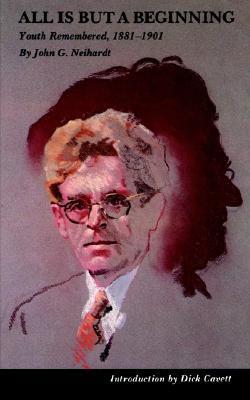
John Neihardt, celebrated for his cycle of epic poems about the American West and for Black Elk Speaks, was in his nineties when he wrote this engaging book about growing up in the Midwest. All Is But a Beginning describes the people and events instrumental in shaping his later distinguished career as a poet; historian, and authority on Indians.

Native American Wisdom: Black Elk Speaks, Shadowcatchers, Wisdomkeepers
by John G. Neihardt
Rating: 4.2 ⭐
New! This boxed set includes "Black Elk Speaks" as told to John G. Neihardt, read by Fred Contreras; "Shadowcatchers" by Steve Wall, read by Apesanahkwat, Michael Toms and Saginaw; and "Wisdomkeepers" by Steve Wall and Harvey Arden, read by Fred Gonyea, Ray Gonyea, Tammy Rahr and Michael Toms. 6 cassettes.

“[ Eagle Voice Remembers ] is John Neihardt’s mature and reflective interpretation of the old Sioux way of life. He served as a translator of the Sioux past, whose audience has proved not to be limited by space or time. Through his writings, Black Elk, Eagle Elk, and other old men who were of that last generation of Sioux to have participated in the old buffalo-hunting life and the disorienting period of strife with the U.S. Army found a literary voice. What they said chronicles a dramatic transition in the life of the Plains Indians; the record of their thoughts, interpreted by Neihardt, is a legacy preserved for the future. It transcends the specifics of this one tragic case of cultural misunderstanding and conflict and speaks to universal human concerns. It is a story worth contemplating both for itself and for the lessons it teaches all humanity.”—Raymond J. DeMallie In her foreword to Eagle Voice Remembers , Coralie Hughes discusses Neihardt’s intention that this book, formerly titled When the Tree Flowered , be understood as a prequel to his classic Black Elk Speaks .

This scarce antiquarian book is a facsimile reprint of the original. Due to its age, it may contain imperfections such as marks, notations, marginalia and flawed pages. Because we believe this work is culturally important, we have made it available as part of our commitment for protecting, preserving, and promoting the world's literature in affordable, high quality, modern editions that are true to the original work.
Epic poem about mountain men explorers in the American West. Excerpt from The Song of Three Friends The following narrative, though complete in itself, is designed to be the first piece in a cycle of poems dealing with the fur trade period of the Trans-Missouri region. "The Song of Hugh Glass," which was published in the fall of 1915, is the second in the series. The four decades during which the fur trade flourished west of the Missouri River may be regarded as a typical heroic period, differing in no essential from the many other great heroic periods that have made glorious the story of the Aryan migration. Jane Harrison says that heroic characters do not arise from any peculiarity of race or even of geographical surroundings; but that, given certain social conditions, they may and do appear anywhere and at any time. The heroic spirit, as seen in heroic poetry, we are told, is the outcome of a society cut loose from its roots, of a time of migrations, of the shifting of populations.

Internationally known for Black Elk Speaks and A Cycle of the West , John G. Neihardt (1881–1973) wrote in almost all major fiction, lyric and epic poetry, biography, autobiography, travelogue, literary criticism, and the familiar essay. The Giving Earth includes nearly forty selections representing every phase of Neihardt’s art, from the passionate poetry of his youth to the masterworks of his maturity to the lapidary reflections of his old age. In her introduction, Hilda Neihardt, who was with her father when he interviewed Black Elk at Pine Ridge, provides many personal details surrounding the publication of his works. She also introduces each section. Included among the early lyrics are "Let Me Live Out My Years." The short stories that brought him his first fame are represented by "Dreams Are Wiser Than Men" and the memorably horrific "Alien." An excerpt from The River and I documents a trip down the Missouri as atmospheric and eventful as any described by Mark Twain. A Cycle of the West , the five-volume masterwork written over nearly thirty years, receives its due with chapters from The Song of Three Friends, The Song of Hugh Glass, The Song of Jed Smith, The Song of the Indian Wars, and The Song of the Messiah . The extent of Neihardt's achievement is apparent long before the reader comes to the selections from the classic Black Elk Speaks and the fine, late novel When the Trees Flowered. Concluding the anthology are selections from the literary criticism that helped form his philosophy of literature and the autobiographical writing of his twilight years. The Giving Earth is the gift of a writer's generous spirit and unlimited imagination.

This volume is a continuation of the autobiography of John G. Neihardt All Is But a Beginning offering a final glimpse into his fascinating life. Covering the years 1901-1908, he weaves a mosaic of personal fulfillment, joy and sorrow, reflecting on the successes and failures he experienced during his "mature" years. As only he could, Neihardt shares a mingling of romantic anecdotes alive with names and faces he sought out or fought for along the way. Writing with warmth and sensitivity, the late Poet Laureate of Nebraska tells of his early newspaper days, his struggle to write poetry, his family, his encounters with nature, his relationships with Indians, and the various people who, whether met once or often, had a profound effect on his life. Using a conversational style, the author does not present episodes in chronological order. Rather he begins to elaborate on one memorable experience, then quickly draws out, without warning, another one that occurred years later, tying them into a pattern or coincidence. The book's Epilogue is written by Neihardt's daughter, Hilda Neihardt Petri. Summarizing her father's visions, daydreams, and philosophy, she movingly concludes that with his death on 3 November 1973 Neihardt's "great adventure had begun." The late John G. Neihardt is best remembered as an authority on the traditions and customs of the Sioux Indians. Neihardt, named Poet Laureate of Nebraska in 1921 and Prairie Poet Laureate of America in 1968, was literary editor of the St. Louis Post-Dispatch from 1926 to 1938 and poet in residence and lecturer in English at the University of Missouri-Columbia from 1949 to 1965. The author of some twenty-five volumes of poetry, fiction, and philosophy, his works include Black Elk Speaks , Lyric and Dramatic Poems , and A Cycle of the West .
The creative energy that would in time produce A Cycle of the West and Black Elk Speaks is apparent in his first book, The Divine Enchantment, published in 1990 when he was nineteen years old. It can be viewed as an early version of the philosophy of spiritual awareness that Neihardt articulated twenty-five years later in Poetic Values. They are reprinted together for the first time in this Landmark Edition.A narrative poem bursting with youthful enthusiasm, The Divine Enchantment reveals Neihardt not as an ordinary poet but as a visionary bard. Inspired by his reading of Eastern philosophy, it is a Hindu myth with Christian parallels. The virgin heroine, Devanaguy, fulfills prophecy in bearing Krishna, the incarnation of Vishnu, in spite of imprisonment by a jealous and fearful king. Neihardt

Coming four years after The Dawn Builder (1910), John G. Neihardt's second novel portrays the lives of Black Hills miners and of those who preyed on them. Life's Lure takes up a theme that runs throughout Neihardt's the consequences of an inordinate desire for wealth. The protagonists come in sets of three. On one hand there are Samuel Drake, a hapless thirty-year-old who has just squandered his inheritance in a Deadwood card game; his fickle wife Joy; and Louis Devlin, a smooth-talking, fast-fingered gentleman gambler. Devlin is not above talking about philosophy; he even paraphrases Nietzsche. On the other hand are Monte Joe, a drunken scoundrel, Punkins, a young man fresh off the farm, guileless and easy pickings; and Nellie, a mining-camp prostitute. Women and gold lure men to go on living, but Fortune is "a capricious jilt." Neihardt puts a lot of colorful characters in motion and then, along with the reader, watches them collide.

Originally published at the beginning of the twentieth century, the short stories of John G. Neihardt deserve to be better known. Their flesh-and-blood Indians were practically unprecedented in an era when the fiends of dime novels and idealizations of Cooper were still the literary norm. Owing much to young Neihardt's intimate association with the Omahas at their reservation in eastern Nebraska, the stories were of an Indian cast that perplexed the critics. They were often overlooked as the years brought laurels to the author of A Cycle of the West and Black Elk Speaks . A closer look at them reveals that Neihardt was a disciplined artist from the very beginning. The nine stories in this volume appeared from 1901 to 1905 in the Overland Monthly ; five were collected in The Lonesome Trail in 1907. All of them are informed by Neihardt's experience among Omaha Indians and shaped by the power of his imagination. Except for "A Prairie Borgia," which clearly touches on the notorious Chief Blackbird's relations with traders, all are set in the time before contact with white men. Love and hate, kindness and cruelty, hope and despair, generosity and envy, honesty and guile, spiritual impulse and sexual desire operate in this wholly Indian world. "The End of the Dream," 'The Triumph of Seha," and "The Smile of God" are patterned on vision quests issuing in profound irony. The social outcast who figured in Neihardt's Indian Tales and Others (1927, a Bison Book), appears again in adventures with a cosmic, and sometimes fantastic, dimension. These stories, as well as "When the Snows Drift," "The Beating of the War Drums," "The Fading of Shadow Flower," "The Singing of the Frogs," and "The Spirit of Crow Butte," have an inwardness reflected by vivid imagery. Their quality led Dr. Susan LaFlesche Picotte, the daughter of Joseph LaFlesche (Iron Eyes), last chief of the Omahas, to exclaim that Neihardt was the only writer in a long line extending from Cooper to Frederic Remington who possessed "a true understanding of Indian character." The stories were compiled by Neihardt's daughter, Hilda Neihardt Petri. In his introduction Jay Fultz discusses their cultural context and artistic integrity.

Death-defying and vulnerable fur-traders and Indians, demi-devils and almost-angels, and other complex personalities come fully to life in The Ancient Memory, which completes the collecting of John G. Neihardt's early short fiction begun with The End of the Dream and Other Stories. Originally published in popular magazines between 1905 and 1908, these stories about the American frontier illustrated Neihardt's artistry in the short form and foreshadow the themes, situations, and characterizations of his later, better-known work. Although two of the Indian stories, the ironic "Feather for Feather" and the satirical "A Political Coup at Little Omaha," were collected in The Lonesome Trail in 1907, none has been reprinted since early in the twentieth century. Other stories included here are "Like a Woman," featuring the plucky Pelagie, and "The Face in the Balcony," which is dedicated to "those who have gone through life misunderstood." "The Epic-Minded Scot," about a stranger who is stubbornly idealistic and scrupulous, is considered one of Neihardt's best tales. "The Brutal Fact" revolves around a William Tell type of contest between trapping partners that anticipates Neihardt's Song of Three Friends. "The Lure of Woman," a study of greed and revenge, was expanded into his novel Life's Lure . The ineffable "Ancient Memory" carries profound philosophical implications while presenting a strange doppelgänger of sorts. Finally, the memorable Waters—an alcoholic, one-legged, one-eyed frontier printer—is introduced in "The Discarded Fetish," which, with minor changes, became the first half of the novel The Dawn-Builder . In her foreword Neihardt's daughter Hilda Neihardt recalls intimate details incidental to the writing of these stories.

The Quest was a landmark publication in modern American poetry, bringing together those lyrical poems most near and dear to their creator, John G. Neihardt. Featured are the poet's favorite selections from his celebrated collections A Bundle of Myrrh, Man-Song, and The Stranger at the Gates. The poems, unfailingly insightful and contemplative, run the gamut of the epic poet's physical and metaphysical experiences, from the delights of the flesh to the joys of parenthood. Also included are a number of previously uncollected poems, illuminating different facets of the complex man that was John G. Neihardt.

This scarce antiquarian book is a facsimile reprint of the original. Due to its age, it may contain imperfections such as marks, notations, marginalia and flawed pages. Because we believe this work is culturally important, we have made it available as part of our commitment for protecting, preserving, and promoting the world's literature in affordable, high quality, modern editions that are true to the original work.
Laureate Address of John G. Neihardt Upon Official Notification of His ... 1921 Leather Bound
by John G. Neihardt
Rating: 4.0 ⭐
Leather Binding on Spine and Corners with Golden leaf printing on spine. This book is printed in black & white, Sewing binding for longer life, where the book block is actually sewn (smythe sewn/section sewn) with thread before binding which results in a more durable type of binding. Reprinted in 2022 with the help of original edition published long back 1921. As this book is reprinted from a very old book, there could be some missing or flawed pages. If it is multi vo Resized as per current standards. We expect that you will understand our compulsion with such books. 59 Laureate Address of John G. Neihardt Upon Official Notification of His ... 1921 John Gneisenau Neihardt

This scarce antiquarian book is a facsimile reprint of the original. Due to its age, it may contain imperfections such as marks, notations, marginalia and flawed pages. Because we believe this work is culturally important, we have made it available as part of our commitment for protecting, preserving, and promoting the world's literature in affordable, high quality, modern editions that are true to the original work.

The Stranger at the Gate
by John G. Neihardt
Unlike some other reproductions of classic texts (1) We have not used OCR(Optical Character Recognition), as this leads to bad quality books with introduced typos. (2) In books where there are images such as portraits, maps, sketches etc We have endeavoured to keep the quality of these images, so they represent accurately the original artefact. Although occasionally there may be certain imperfections with these old texts, we feel they deserve to be made available for future generations to enjoy.

The Dawn Builder , originally published in 1910, was John G. Neihardt’s first novel. At the center of it is a one-eyed, peg-legged man named Waters. He comes to Fort Calhoun, Nebraska Territory, in 1862 and drinks himself into a hole when he isn’t setting type on the town newspaper. Because his thirst is metaphysical as well, he only temporarily loses sight of the possibility of happiness, of building his own dawn. Like all memorable characters, Waters can’t be contained on the page. Isolated by his physical ugliness, marked by loneliness not yet deadened by silence, compromised by his own excessive energy, he reaches out to a young woman farther outside society than he is and to a kindly widow and her son. The Dawn Builder is reminiscent of Twain in its frontier humor, of Poe in its bizarre adventures, and of Dickens in its casting of some busybodies who belong to the Needle Club. Its return to print will be welcomed by John G. Neihardt’s many admirers.

A celebration of love, an ode to virility--Man-Song reveals the passions and longings of the young poet John G. Neihardt. These twenty-seven erotic poems, published just after he had married the sculptor Mona Martinsen, testify to the power of attraction between men and women and the strong bonds forged by male friends and comrades in adversity and triumph. These enduring themes, girding his masterpieces to come, are vividly on display here as the poet seeks balance between the material and spiritual worlds, the caress and meditation, the erotic and the divine. Following the sensual trail of such poems as "A Vision of Women," "Lonesome in Town," and "Unrest," we discover not the vistas of Neihardt's beloved American West, but himself--a rare and fascinating glimpse of the highly personal desires and dreams of arguably America's great epic poet.

Leather Binding on Spine and Corners with Golden Leaf Printing on round Spine (extra customization on request like complete leather, Golden Screen printing in Front, Color Leather, Colored book etc.) Reprinted in 2022 with the help of original edition published long back [1925]. This book is printed in black & white, sewing binding for longer life, Printed on high quality Paper, re-sized as per Current standards, professionally processed without changing its contents. As these are old books, we processed each page manually and make them readable but in some cases some pages which are blur or missing or black spots. If it is multi volume set, then it is only single volume, if you wish to order a specific or all the volumes you may contact us. We expect that you will understand our compulsion in these books. We found this book important for the readers who want to know more about our old treasure so we brought it back to the shelves. Hope you will like it and give your comments and suggestions. - English, Pages 168. EXTRA 10 DAYS APART FROM THE NORMAL SHIPPING PERIOD WILL BE REQUIRED FOR LEATHER BOUND BOOKS. COMPLETE LEATHER WILL COST YOU EXTRA US$ 25 APART FROM THE LEATHER BOUND BOOKS. {FOLIO EDITION IS ALSO AVAILABLE.} Complete Poetic values; their reality and our need of them, by John G. Neihardt. 1925 Neihardt, John G., -.