
John Crowley
Librarian Note: There is more than one author in the Goodreads database with this name. See this thread for more information. John Crowley was born in Presque Isle, Maine, in 1942; his father was then an officer in the US Army Air Corps. He grew up in Vermont, northeastern Kentucky and (for the longest stretch) Indiana, where he went to high school and college. He moved to New York City after college to make movies, and did find work in documentary films, an occupation he still pursues. He published his first novel (The Deep) in 1975, and his 15th volume of fiction (Endless Things) in 2007. Since 1993 he has taught creative writing at Yale University. In 1992 he received the Award in Literature from the American Academy and Institute of Arts and Letters. His first published novels were science fiction: The Deep (1975) and Beasts (1976). Engine Summer (1979) was nominated for the 1980 American Book Award; it appears in David Pringle’s 100 Best Science Fiction Novels. In 1981 came Little, Big, which Ursula Le Guin described as a book that “all by itself calls for a redefinition of fantasy.” In 1980 Crowley embarked on an ambitious four-volume novel, Ægypt, comprising The Solitudes (originally published as Ægypt), Love & Sleep, Dæmonomania, and Endless Things, published in May 2007. This series and Little, Big were cited when Crowley received the prestigious American Academy of Arts and Letters Award for Literature. He is also the recipient of an Ingram Merrill Foundation grant. His recent novels are The Translator, recipient of the Premio Flaianno (Italy), and Lord Byron’s Novel: The Evening Land, which contains an entire imaginary novel by the poet. A novella, The Girlhood of Shakespeare's Heroines, appeared in 2002. A museum-quality 25th anniversary edition of Little, Big, featuring the art of Peter Milton and a critical introduction by Harold Bloom, is in preparation. Note: The John Crowley who wrote Sans épines, la rose: Tony Blair, un modèle pour l'Europe? is a different author with the same name. (website)
31 Books Written

John Crowley's masterful Little, Big is the epic story of Smoky Barnable, an anonymous young man who travels by foot from the City to a place called Edgewood—not found on any map—to marry Daily Alice Drinkwater, as was prophesied. It is the story of four generations of a singular family, living in a house that is many houses on the magical border of an otherworld. It is a story of fantastic love and heartrending loss; of impossible things and unshakable destinies; and of the great Tale that envelops us all. It is a wonder.

From award-winning author John Crowley comes an exquisite fantasy novel about a man who tells the story of a crow named Dar Oakley and his impossible lives and deaths in the land of Ka.A Crow alone is no Crow.Dar Oakley—the first Crow in all of history with a name of his own—was born two thousand years ago. When a man learns his language, Dar finally gets the chance to tell his story. He begins his tale as a young man, and how he went down to the human underworld and got hold of the immortality meant for humans, long before Julius Caesar came into the Celtic lands; how he sailed West to America with the Irish monks searching for the Paradise of the Saints; and how he continuously went down into the land of the dead and returned. Through his adventures in Ka, the realm of Crows, and around the world, he found secrets that could change the humans’ entire way of life—and now may be the time to finally reveal them.

There is more than one history of the world. Before science defined the modern age, other powers, wondrous and magical, once governed the universe, their lore perfected within a lost capital of hieroglyphs, wizard-kings, and fabulous monuments.In the 1970s, a historian named Pierce Moffett moves to the New England countryside to write a book about Ægypt, driven by an idea he dare not believe: that the physical laws of the universe once changed and may change again. Yet the notion is not his alone. Something waits at the locked estate of Fellowes Kraft, author of romances about Will Shakespeare and Giordano Bruno and Dr. John Dee, something for which Pierce and those near him have long sought without knowing it: a key, perhaps, to Ægypt...Shortlisted for the WORLD FANTASY and ARTHUR C. CLARKE AWARDs.

Edited by Rikki Ducornet, Bradford Morrow and Robert Polito.

Born into the community of Truthful Speakers one thousand years after the Storm, he was raised on stories of the old days -- a world filled with saints, a world in which all things were possible, a world which finally destroyed itself. In love with a beautiful woman, Rush journeys far and learns much. Taken into the society of Dr. Boots's List, attached to the old mysteries, Rush grows closer to a sainthood he could never have imagined.

Pierce Moffett stands at a turning point, when the world is changing from what it has been into what it will be. Is it only a moment in the history of his own soul? Or the course of his generation's progress toward maturity?As a child Pierce was no stranger to magic. Transplanted from his native Brooklyn to the Cumberland Mountains of Kentucky, he and his cousins formed a secret club called the Invisible College. Fueled by books, adventures, and the imagination of youth, they scratched the surface of ordinary life and found the hints of something glittering and strange underneath. For most children these revelations fade with the coming of adulthood, but for Pierce the search for the hidden history of the world is just beginning.It is a search that begins with the unfinished manuscript of a writer named Fellowes Kraft and leads to the real-life history of the doomed heretic Giordano Bruno and the Elizabethan metaphysician John Dee. These mysteries reach from past to present, to intertwine themselves with the life of Rosie Rasmussen, who brought Pierce that unfinished manuscript and will be given charge of Pierce's destiny. And as he delves deeper, Pierce begins to apprehend a power beyond reckoning, a knowledge beyond imagining, and a love that can waken sleeping souls.Only rarely does an author emerge with the vision, the voice, and the courage to speculate on the alchemy that transforms the everyday into something transcendent. Crowley opened the gates to this feared and desired land in his magnificent novel AEgypt. Now he leads us far within.

A novel of tremendous scope and beauty, The Translator tells of the relationship between an exiled Russian poet and his American translator during the Cuban missile crisis, a time when a writer's words -- especially forbidden ones -- could be powerful enough to change the course of history.

For the people in this novel, the concerns of everyday life are beginning to transmute into the extraordinary and to reveal the forces, dark and light, that truly govern their lives. So it is for Pierce Moffett, would-be historian and author, who has moved from New York to the Faraway Hills, where he seems to discover -- or rediscover -- a path into magic, past and present.And so it is for Rosie Rasmussen, a single mother grappling with her mysterious uncle's legacy and her young daughter Samantha's inexplicable seizures. For Pierce's lover Rose Ryder, another path she's drawn into a cult that promises to exorcise her demons -- the same cult that Samantha's father has joined.It is the dark of the year, between Halloween and the winter solstice, and the gateway is open between the worlds of the living and the dead. A great cycle of time is ending, and Pierce and Rosie, Samantha and Rose Ryder must take sides in an age-old war that is approaching the final battle.... Or is it?Winner of an American Academy and Institute of Arts and Letters Award for Literature, Crowley in this tale conducts us on a journey into the very mystery of what is, what went before, and what could break through at any moment into our lives.

Berkley Medallion, first paperback edition, 1976. Crowley's well-received 1975 first novel. A visitor arrives from elsewhere on a strange medieval world where the two factions, the "Reds" and the "Blacks", struggle for supremacy through battle, murder and treachery.

Beasts describes a world in which genetically engineered animals are given a variety of human characteristics. Painter is a leo, a combination of man and lion. Reynard, a character derived from medieval European fable, is part fox. Political forces result in the leos being deemed an experimental failure, first resigned to reservations, and later to be hunted down and eliminated. A central element of the story is the relationship between Painter and Reynard, who acts as a kingmaker behind the scenes.

Praise for the Aegypt sequence: "A dizzying experience, achieved with unerring security of technique."-The New York Times Book Review "A master of language, plot, and characterization."-Harold Bloom "The further in you go, the bigger it gets."-James Hynes "The writing here is intricate and thoughtful, allusive and ironic. . . . Aegypt bears many resemblances, incidental and substantive, to Thomas Pynchon's wonderful 1966 novel The Crying of Lot 49."-USA Today "An original moralist of the same giddy heights occupied by Thomas Mann and Robertson Davies."-San Francisco Chronicle This is the fourth novel-and much-anticipated conclusion-of John Crowley's astonishing and lauded Aegypt sequence: a dense, lyrical meditation on history, alchemy, and memory. Spanning three centuries, and weaving together the stories of Renaissance magician John Dee, philosopher Giordano Bruno, and present-day itinerant historian and writer Pierce Moffitt, the Aegypt sequence is as richly significant as Lawrence Durrell's Alexandria Quartet or Anthony Powell's Dance to the Music of Time. Crowley, a master prose stylist, explores transformations physical, magical, alchemical, and personal in this epic, distinctly American novel where the past, present, and future reflect each other. John Crowley was born in the appropriately liminal town of Presque Isle, Maine. His most recent novel is Lord Byron's Novel: The Evening Land. He teaches creative writing at Yale University. In 1992 he received the Award in Literature from the American Academy and Institute of Arts and Letters. He finds it more gratifying that almost all of his work is still in print.

One of our most accomplished literary artists, John Crowley imagines the novel the haunted Romantic poet Lord Byron never penned ...but very well might have. Saved from destruction, read, and annotated by Byron's own abandoned daughter, Ada, the manuscript is rediscovered in our time -- and almost not recognized. Lord Byron's Novel is the story of a dying daughter's attempt to understand the famous father she longed for -- and the young woman who, by learning the secret of Byron's manuscript and Ada's devotion, reconnects with her own father, driven from her life by a crime as terrible as any of which Byron himself was accused.

A master literary stylist, John Crowley has carried readers to diverse and remarkable places in his award-winning, critically acclaimed novels -- from his classic fable, Little, Big, to his New York Times Notable Book, The Translator. Now, for the first time, all of his short fiction has been collected in one volume, demonstrating the scope, the vision, and the wonder of one of America's greatest storytellers. Courage and achievement are celebrated and questioned, paradoxes examined, and human frailty appreciated in fifteen tales, at once lyrical and provocative, ranging fromthe fantastic to the achingly real. Be it a tale of an expulsion from Eden, a journey through time, the dreams of a failed writer, ora dead woman's ambiguous legacy, each story in Novelties & Souvenirs is a glorious reading experience, offering delights to be savored ... and remembered.Contents:Antiquities (1977)Her Bounty to the Dead (1978)The Reason for the Visit (1980)The Green Child (1981)Novelty (1983)Snow (1985)The Nightingale Sings at Night (1989)Great Work of Time (1989)In Blue (1989)Missolonghi 1824 (1990)Exogamy (1993)Lost and Abandoned (1993)Gone (1996)An Earthly Mother Sits and Sings (2000)The War between the Objects and the Subjects (2002)

The Deep In a twilight land, two warring powers -- the Reds and the Blacks -- play out an ancient game of murder and betrayal. Then a Visitor from beyond the sky arrives to play a part in this dark bloody pageant. From the moment he is found by two women who tend to the dead in the wake of battles, it is clear that the great game is to change at last. Beasts It is the day after tomorrow, and society has been altered dramatically by experimentation that enables scientists to combine the genetic material of different species, mixing DNA of humans with animals. Loren Casaubon is an ethologist drawn into the political and social vortex that results with Leo -- a creature both man and lion -- at its center. Engine Summer A young man named Rush That Speaks is growing up in a far distant world -- one that only dimly remembers our own age, the wondrous age of the Angels, when men could fly. Now it is the "engine summer of the world," and Rush goes in search of the Saints who can teach him to speak truthfully, and be immortal in the stories he tells. The immortality that awaits him, though, is one he could not have imagined.

"So rich and so evocative and so authentic." —Tom Brokaw, author of The Greatest Generation "John Crowley is a virtuoso of metaphor, a peerless recreator of living moments, of small daily sublimities.” — New York Times Book Review From the critically acclaimed author of Lord Byron’s Novel and The Translator comes a novel set in World War II America that follows the stories of a group of aircraft factory workers—in particular, the enigmatic figure of draftsman Prosper Olander. Named one of the Best Books of 2009 by the Washington Post, Four Freedoms is a beautifully crafted story of liberation and redemption from an author who has been compared to Robertson Davies, Thomas Mann, and Gabriel Garcia Marquez.

Casper Last, an impoverished genius, uses his time machine in an attempt to preserve the reign of the British Empire for the Otherhood
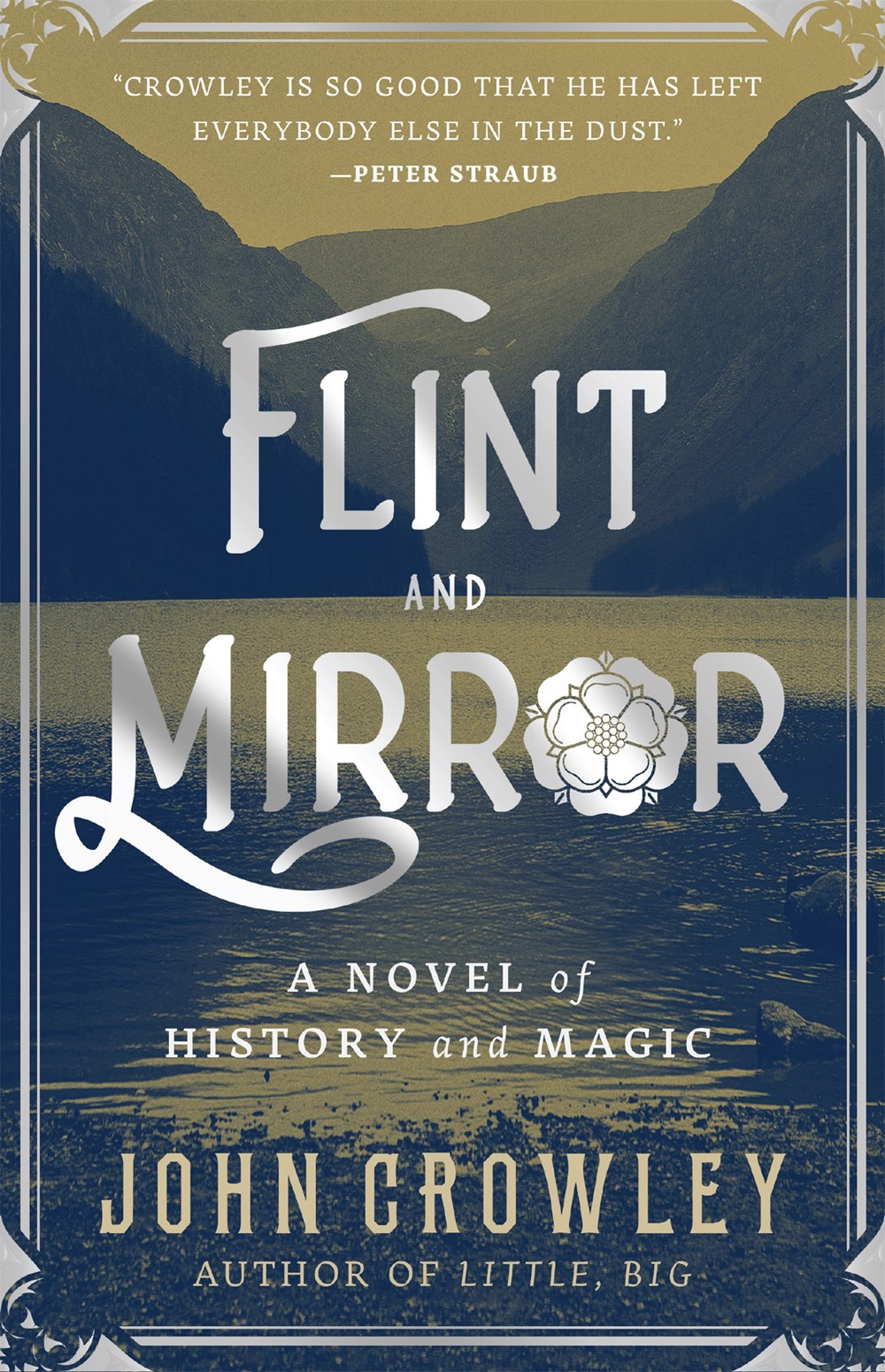
From award-winning author John Crowley comes a novel that masterfully blends history and magic in Flint and Mirror.As ancient Irish clans fought to preserve their lands and their way of life, the Queen and her generals fought to tame the wild land and make it English.Hugh O'Neill, lord of the North, dubbed Earl of Tyrone by the Queen, is a divided man: the Queen gives to Hugh her love, and her commandments, through a little mirror of obsidian which he can never discard; and the ancient peoples of Ireland arise from their underworld to make Hugh their champion, the token of their vow a chip of flint.From the masterful author of Little, Big comes an exquisite fantasy of heartbreaking proportion.

This collection of four never-before-published, superbly crafted novellas, includes: Why the Nightingale Sings at Night, Great Work of Time, In Blue and Novelty.

And Go Like This collects thirteen stories from a master of all trades. Reading John Crowley’s stories is to see almost-familiar lives running parallel to our own, secret histories that never quite happened, memories that might be real or might be invented. In the thirteen stories collected here, Crowley sets his imagination free to roam from a 20th century Shakespeare festival to spring break at a future Yale in his Edgar Award winning story “Spring Break”. And in the previously unpublished “Anosognosia” the world brought about by one John C.’s high-school accident may or may not exist.

"Each story here is a small, well-crafted gem, highly allusive yet not obtrusively so, full of emotion-mostly longing and especially wonder, a response fantasy aims for but rarely achieves with the force Crowley is able to supply." - BarronStories included: "The Green Child""Missolonghi 1824""Antiquities""The Reason for the Visit""Her Bounty to the Dead""Snow""Exogamy"

Book by Crowley, John

John Crowley's all-new essay “Totalitopia” is a wry how-to guide for building utopias out of the leftovers of modern science fiction. “This Is Our Town,” written especially for this volume, is a warm, witty, and wonderfully moving story about angels, cousins, and natural disasters based on a parochial school third-grade reader. One of Crowley’s hard-to-find masterpieces, “Gone” is a Kafkaesque science fiction adventure about an alien invasion that includes door-to-door leafleting and yard work. Perhaps the most entertaining of Crowley's “Easy Chair” columns in Harper's , “Everything That Rises” explores the fractal interface between Russian spiritualism and quantum singularities—with a nod to both Columbus and Flannery O'Connor. “And Go Like This” creeps in from Datlow's Year's Best , the Wild Turkey of horror anthologies. There's a bibliography, an author bio, and of course our Outspoken Interview, the usual cage fight between candor and common sense.

A new novelette by the award-winning author of LITTLE, BIG.

John Crowley's masterful novels (Aegypt, Little, Big, The Translator) are marked by an uncommon combination of imaginative power and intellectual rigor. That same intellectual rigor is on full display in this, Crowley's first, long-overdue collection of non-fiction. In Other Words brings together more than forty pieces on a wide variety of subjects, and offers a fascinating glimpse into the inner workings of a subtle, insatiably curious mind. In Other Words contains, among other delights, long, thoughtful musings on the late Renaissance scholar Ioan Culianu ("A Modern Magic, Imagination, and Power"), on Utopian fiction ("The Labyrinth of the World and the Paradise of the Heart"), and on the nature of narrative itself ("Tips and Tricks for Successful Lying"). In other pieces, Crowley takes an in-depth look at five writers whose work he finds especially significant (T.H. White, Anthony Burgess, Robert Louis Stevenson, Thomas Disch, and Vladimir Nabokov), and offers shorter, equally incisive takes on writers such as John Updike, Italo Calvino, Thomas Berger, Kathryn Davis, and John Banville. In the closing section (entitled, simply, "Comix"), Crowley reveals a (perhaps) surprising affinity for the world of comic strips. His reflections on Walt Kelley, George Herriman, Ben Katchor, and Edward Gorey are informed and affectionate, and contain some of Crowley's most memorable critical writing. In Other Words is one of those all-too-rare volumes that readers will return to again and again, finding new and valuable perceptions on each encounter. Incisive, sympathetic, and unfailingly erudite, it enhances our understanding of a major American writer, and serves as a welcome -- and necessary -- addition to a remarkable body of work.

Reading Backwards is John Crowley’s first collection of non-fiction since In Other Words was published in 2007. Like its predecessor, this new book reflects an astonishing range of interests, both literary and otherwise. Like its predecessor, it is a book that no John Crowley fan can afford to miss.The volume opens with the autobiographical “My Life in the Theater,” a memoir of the younger Crowley’s earliest ambitions, and closes with the moving and memorable “Practicing the Arts of Peace.” In between, the author offers us more than thirty carefully crafted essays, each one notable for its insight, intelligence and typically graceful prose.The opening section, A Voice from the Easy Chair, reflects Crowley’s tenure as Easy Chair columnist for Harper’s Magazine. Subjects include life under the once omni-present threat of the Selective Service Board, the enduring personal importance of the Encyclopedia Britannica, and thoughts on what it means to be truly well read. The second section, Fictional Voices, is filled with acute commentary on a wide range of books and writers, among them SF masters such as Paul Park, Ursula K. le Guin and Thomas Disch; the important, if neglected, historical novelist David Stacton (a model for the fictional Ffellowes Kraft of the Ægypt novels); classic science fiction novels of the 1950s, and much, much more. The final section, Looking Outward, Looking In, ranges freely across a wide variety of subjects and ideas, such as UFO literature, the utopian architecture of Norman Bel Geddes, the life and career of renowned theosophist Helen Blavatsky, and the nature of time.Reading Backwards is a book that can be read from beginning to end with enormous pleasure. It can also be read and enjoyed in whatever order the reader prefers. However it’s read, it’s a multifarious source of entertainment, illumination, and thought, and offers a fascinating glimpse into the intellectual life of one of the finest novelists of our time.Limited: 750 signed numbered hardcover copiesLettered: 26 signed leatherbound copies, housed in a custom traycaseTable of Contents:IntroductionPrologue: My Life in the Theater 1910—1960Section One: A Voice from the Easy ChairEverything that RisesDressed to KillRule, BritannicaA Ring-Formed WorldUniversal UseSpare the DarlingOn Not Being Well-ReadSelective ServiceAn Artist of the Sleeping WorldSection Two: Fictional VoicesA Postcard from UrsulaPaul Park’s Hidden WorldsLife Work: The Fiction of Nicholson BakerLeslie Epstein’s UproarsBen Katchor’s Cardboard SuitcaseRemembering Thomas DischJoan Aiken and the Wolves of Willoughby ChaseDavid Stacton and the Judges of the Secret CourtThe Hero of a Thousand DreamsLittle Criminals: The Fiction of Richard HughesRichard Hughes: In HazardBorn to be PosthumousThe Whole Household of ManBlossom and Fade: Herman Hesse and The Glass Bead GameNine Classic Science Fiction novels of the 1950sSection Three: Looking Outward, Looking InThe Man who Invented the 20th CenturyStranger Things: UFOs and Life on the MoonMetamorphosis: Rosamond Purcell’s Natural HistoryUnrealismMadame and the MastersThe Ones Who Walk Away from MetropolisA Few Moments in EternityWorks of MercyThe Next Future/TotalitopiaA Well Without a BottomNew Ghosts and How to Know ThemTime After TimeSqueak and GibberPracticing the Arts of Peace

Edgewood est un monde à l’intérieur des mondes, le lieu où les arcs-en-ciel rejoignent la terre. La future femme de Smoky, Daily Alice, l’attend, juchée sur le seuil de sa maison délirante aux multiples visages et au jardin foisonnant. Smoky doit délaisser ses habitudes de citadin pour apprivoiser cette contrée et vivre au sein de cette famille au sourcil unique…« Une saga familiale picaresque somptueusement écrite. Sans doute le chef-d’œuvre de Crowley. » Boston Review

"Projeté au milieu de l'étrange famille fondée par John Drinkwater et sa femme Violet, mystérieuse et fragile adepte du spiritisme, l'innocent Smoky Barnable y découvre l'amour et la magie secrète qui anime notre monde.À Edgewood, l'incroyable maison aux multiples visages, Smoky se retrouve pris dans la tourmente : autour de la famille Drinkwater, la dernière bataille entre le monde des légendes et celui de la réalité tangible va se dérouler.""Bientôt, les défenseurs du rêve, comme Lilas, l'enfant chérie des fées, Auberon et Sylvie, les amants prédestinés, Ariel Hawksquill, illustre praticienne des arts magiques, et tous ceux qui les entourent, devront faire face à l'assaut du progrès et de la froide modernité qui menace de balayer leurs rêves.Et, à Edgewood, à l'issue du jugement, le Parlement des Fées décidera du sort des mondes, petits et grands..."

Omnibus collection of three of John Crowley's early Beasts (1976), Engine Summer (1979), and Little, Big (1981). "Little, Big" won the World Fantasy Award for Best Novel and has been called "a neglected masterpiece" by Harold Bloom.


