
John Coates
Librarian Note: There is more than one author with this name on GR. This profile might contain books by multiple authors with this name.
27 Books Written

The Hour Between Dog and Wolf: How Risk Taking Transforms Us, Body and Mind
by John Coates
Rating: 4.0 ⭐
• 4 recommendations ❤️
A successful Wall Street trader turned neuroscientist reveals how risk taking and stress transform our body chemistry Before he became a world-class scientist, John Coates ran a derivatives trading desk in New York City. He used the expression �the hour between dog and wolf” to refer to the moment of Jekyll-and-Hyde transformation traders passed through when under pressure. They became cocky and irrationally risk-seeking when on a winning streak, tentative and risk-averse when cowering from losses. In a series of groundbreaking experiments, Coates identified a feedback loop between testosterone and success—one that can cloud men’s judgment in high-pressure decision-making. Coates demonstrates how our bodies produce the fabled gut feelings we so often rely on, how stress in the workplace can impair our judgment and even damage our health, and how sports science can help us toughen our bodies against the ravages of stress. Revealing the biology behind bubbles and crashes, The Hour Between Dog and Wolf sheds new and surprising light on issues that affect us all.
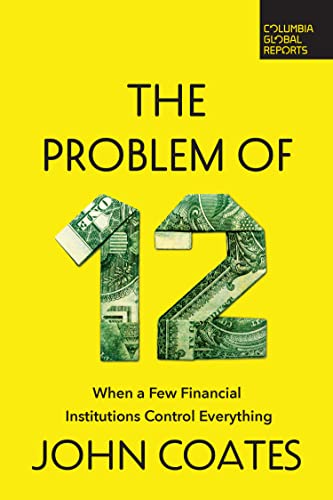
The Problem of Twelve: When a Few Financial Institutions Control Everything
by John Coates
Rating: 3.5 ⭐
The forces behind an economic and political crisis in the makingA “problem of twelve” arises when a small number of institutions acquire the means to exert outsized influence over the politics and economy of a nation.The Big Four index funds of Vanguard, State Street, Fidelity, and BlackRock control more than twenty percent of the votes of S&P 500 companies—a concentration of power that’s unprecedented in America. Then there’s the rise of private equity funds such as the Big Four of Apollo, Blackstone, Carlyle and KKR, which has amassed $2.7 trillion of assets, and are eroding the legitimacy and accountability of American capitalism, not by controlling public companies, but by taking them over entirely, and removing them from public discourse and public scrutiny.This quiet accumulation in the last few decades represents a dramatic transformation in how the American economy operates—a sea change that few of us have noticed and all of us need to consider. Harvard law professor John Coates forcefully calls our attention to what is sure to be one of the major political and economic issues of our time.

Inimese mõtted ja käitumine ning sealhulgas ka riskivalmidus kujunevad aju ja keha koostöös. Riskimine muudab meie keha keemiat. Võitmine suurendab riskihimu sageli niivõrd, et muutume eufooriliseks ja hulljulgeks. Kaotusperioodil võitleme aga hirmuga, elame ikka ja jälle ebaõnnestumisi uuesti läbi, nõnda et stressihormoonid jäävad meie ajju püsima, kutsudes esile haiglaslikku riskipelgust ning isegi depressiooni. Need bioloogilised mehhanismid mõjutavad iga kaupleja tegutsemist ning kumuleerudes võivad esile kutsuda ka börsibuumi ja -krahhi. Sageli eeldatakse, et rahalise riski hindamine seisneb puhtalt ratsionaalses mõttetegevuses. Raamatu autor, Cambridge’i neuroteadlane John Coates on ise olnud pikka aega edukas Wall Streeti maakler ja oma kogemuse põhjal pani ta tähele, et sageli see nii ei ole. Raamatus selgitab ta teaduslikele andmetele toetudes, et kui me riskime, valmistub meie keha võitluseks ja lülitab sisse füsioloogilise hädaabivõrgustiku. Selle tulemusel vallanduvad elektrilised ja keemilised impulsid, mis jõuavad ajju ja mõjutavad selle mõtlemisviisi. Coates jutustab väljamõeldud loo maakleritest, kes satuvad esmalt mulli ja seejärel krahhi lõksu, ning avab selle taustal füsioloogilised protsessid, mis viivad neid kõigepealt irratsionaalse lennuni ja siis pessimismini. Riskimise mõju koguneb mõistusesse ja kehasse, muutes inimese füsioloogiat nii, et see avaldab sügavat ja kestvat mõju. Kuigi Coatesi uuring keskendub börsimaakleritele, heidavad tema järeldused valgust ka kõigile teistele, kel tuleb suure surve all kiireid otsuseid teha, alates spordist ja lõpetades lahingutandriga. Riski haldamiseks ei ole vaja saavutada mõistuse üleolekut kehast, vaid tuleb osata jõuda mõistuse ja keha tõhusa koostööni. Igaüks meist võib muutuda koerast hundiks, küsimus on vaid selles, kas me suudame mõista selle põhjuseid ja tagajärgi. „Kui koerast saab hunt” on Financial Timesi ja Goldman Sachsi aasta äriraamatu 2012. aasta nominent ning Wellcome Trusti raamatuauhinna 2012. aasta nominent.

Nick Cardy has been a cartoonist and illustrator for over 50 years. Spanning the Golden Age to the present, Cardy's career began in 1939 with the Eisner-Iger shop, which produced the "Spirit" newspaper supplement, "Plastic Man" comic books and more. Cardy went on to illustrate newspaper strips, including "Tarzan," and enjoyed a 25 year association with DC Comics before moving on to magazine and movie poster illustration. As well as being one of DC Comics' top Batman and Superman cover artists, fans remember that in the 1960s, Nick helped define comics' Silver Age with sequential artwork on "Aquaman", "Teen Titans", and "Bat Lash." The artist's contributions to the comic book industry earned him the prestigious "Ink Pot Award" for Outstanding achievement. Cardy did occasional non-comics illustration work throughout the decades in which he focused primarily on comic books and strips. But in 1975 the artist decided to focus on non-comics illustration, particularly movie and television work. Some of the properties he worked on include Bad News Bears, Return of the Pink Panther, Meatballs II, California Suite, and even Apocalypse Now. This Eisner Award-nominated volume offers an exploration of Cardy's art career.

Don Heck remains one of the legendary names in comics, considered an "artist's artist," respected by peers, and beloved by fans as the co-creator of Marvel Comics characters Iron Man, Hawkeye, and Black Widow, and for his long stint on Marvel Comics' team book The Avengers. In Don Heck: A Work of Art, author John Coates has meticulously researched and chronicled information on Don's storied 40-year career, including his time at DC, Dell, Gold Key, and as "ghost" artist on Lee Falk's The Phantom newspaper strip. From personal recollections from Don's surviving family, long-time friends, and industry legends, to rare interviews with Heck himself (where he discusses his career, artistic technique, triumphs, frustrations, and love of drawing), this book is full of insight into -- and first-hand anecdotes from -- the early days of Marvel Comics. It also features an unbiased analysis of sales on Don's DC Comics titles, an extensive art gallery (including published, unpublished, and pencil artwork), a Foreword by Stan Lee, and an Afterword by Beau Smith.

Dan Spiegle is one of the most respected -- and hardest working -- comic artists of the last sixty years, with a career spanning the Golden Age of comics through the Modern era. From his beginnings on the Hopalong Cassidy newspaper strip, to his thirty-year tenure on Dell and Gold Key's licensed TV and Movie adaptions (Lost in Space, Korak, Magnus Robot Fighter, Mighty Sampson, Buck Rogers), Dan's work is admired by fans and professionals alike. If you've read comics between the mid-1950s through the 2000s, you've probably enjoyed a comic with Dan's art -- now learn about his life in comic art. Includes a Foreword by longtime collaborator Mark Evanier and an Afterword by Sergio Aragones.

A new direction for policy and action is outlined in this reconsideration of the theoretical framework and application of social work. A holistic, inclusive vision of social work is presented to usher in a change from a self-centered, anticollectivist paradigm to a mutually beneficial, community-focused worldview. Criticized are the assumptions, values, and beliefs that have guided the dominant worldview's support of environmental devastation. Concerns for sustainability, social justice, and global consciousness guide this revision of social work.

The Claims of Common Sense: Moore, Wittgenstein, Keynes and the Social Sciences
by John Coates
Rating: 5.0 ⭐
The Claims of Common Sense investigates the importance of ideas developed by Cambridge philosophers between the World Wars for the social sciences concerning common sense, vague concepts and ordinary language. John Coates examines the thought of Moore, Ramsey, Wittgenstein and Keynes, and traces their common drift away from early beliefs about the need for precise concepts and a canonical notation in analysis. He argues that Keynes borrowed from Wittgenstein and Ramsey their reappraisal of vague concepts, and developed the novel argument that when analysing something as complex as social reality, theory might be simplified by using concepts which lack sharp boundaries. Coates then contrasts this conclusion with the view shared by two contemporary philosophical paradigms - formal semantics and Continental post-structuralism - that the vagueness of ordinary language inevitably leads to interpretive indeterminacy. Developing a link between Cambridge philosophy and work on complexity, vague predicates and fuzzy logic, he argues that Wittgenstein's and Keynes's ideas on the economy of ordinary language present a mediating route for the social sciences between these philosophical paradigms.

Riding on the success of Indigenous Social Work Around the World, this book provides case studies to further scholarship on decolonization, a major analytical and activist paradigm among many of the world's Indigenous Peoples, including educators, tribal leaders, activists, scholars, politicians, and citizens at the grassroots level. Decolonization seeks to weaken the effects of colonialism and create opportunities to promote traditional practices in contemporary settings. Establishing language and cultural programs; honouring land claims, teaching Indigenous history, science, and ways of knowing; self-esteem programs, celebrating ceremonies, restoring traditional parenting approaches, tribal rites of passage, traditional foods, and helping and healing using tribal approaches are central to decolonization. These insights are brought to the arena of international social work still dominated by western-based approaches. Decolonization draws attention to the effects of globalization and the universalization of education, methods of practice, and international 'development' that fail to embrace and recognize local knowledges and methods. In this volume, Indigenous and non-Indigenous social work scholars examine local cultures, beliefs, values, and practices as central to decolonization. Supported by a growing interest in spirituality and ecological awareness in international social work, they interrogate trends, issues, and debates in Indigenous social work theory, practice methods, and education models including a section on Indigenous research approaches. The diversity of perspectives, decolonizing methodologies, and the shared struggle to provide effective professional social work interventions is reflected in the international nature of the subject matter and in the mix of contributors who write from their contexts in different countries and cultures, including Australia, Canada, Cuba, Japan, Jordan, Mexico, New Zealand, South Africa, and the USA.


Boundless Love
by John Coates
The Widow's Tale Or the Indiscretions of Lettice
by John Coates
The Widow's Tale or The Indiscretions of Lettice by Coates John
Here Today
by John Coates
Logic no lady
by John Coates
Time for tea
by John Coates

Faithful in My Fashion
by John Coates
1953. First Printing. 320 pages. No dust jacket. Blue and yellow cloth. Deckled edges. Pages are mildly tanned. Notable cracking to gutters. Notable water staining to pages throughout. Pencil to rear pastedown. Notable staining to upper text block edge. Boards have mild edgewear with corner crushing and notable marking to boards. Mild tanning to board edges and spine, which has mild crushing and tearing to ends. Book has forward lean. Boards are notably warped. Moderate water stains to boards.

Lettice
by John Coates

Pleasures on the Periphery
by John Coates
PLEASURES on the PERIPHERY is a collection of authentic, occasionally surreal observations of life and work in the provinces of Sicily and People’s Hungary 1966-1970. The narrator was short of money, trying to survive like everyone else, very much out on his own – but through his work in a position to encounter a wide cross-section of society. Twenty years later he was one of a team assisting in the local transition from communism to democracy (‘Hello What?’) in the distant south of Hungary, supported by an EC grant. The concept of 'socialism with a human face' pervades many of the descriptions included in this book and acts as a recurrent theme in its vignettes. The book includes a number of original photographs, and begins and ends with excursions to two non-peripheral places, London and the cloudy south-west of Poland.

CARMINA ET EPIGRAMMATA AUREAE AETATIS
by John Coates
This collection of Latin poetry in the style of Horace and Virgil was written over a period of sixty years. At first, the poems were exercises set at Eton and Trinity College, Cambridge, or prize entries – mostly more or less literal “versiones” of original English texts. After a gap of a quarter of a century and peripatetic professional appointments in Finland, Hungary, Poland, Spain and Sicily, Coates took up a position as lecturer at Göttingen University, where the local Classics Department encouraged him to seize his poetic pen again. The ensuing poems were more original, sometimes based on ideas picked up from a literary source that the author admired, which were not always English. These poems became more personal, more ‘silver’ and ‘more English’ in feeling over time as well as sometimes more cynical – an easy attitude to take, and one well represented in Latin poetry. Thematically the 20 odes and 6 epigrams cover such diverse subjects as existentialist thoughts, ideas on everlasting and less lasting love, the effects of war and old age and bee-keeping. The Latin “versiones” are accompanied by English translations for easier access to the Latin verses and to the intertextuality with their original sources. The latter are explained in the commentaries at the end of the book. Diese Sammlung lateinischer Gedichte in der Tradition von Horaz und Vergil ist über sechzig Jahre hinweg entstanden. Zu Beginn handelte es sich noch primär um schulische bzw. studentische Exerzitien am College von Eton und am Trinity College, Cambridge; teils waren es Wettbewerbsbeiträge. Die Mehrzahl der Gedichte dieser frühen Phase stellte dabei “versiones” originär englischer Texte dar. Nach einer Pause von ca. 25 Jahren und einem abwechslungsreichen perpipatetischen Akademikerleben in Finnland, Ungarn, Polen, Spanien und Sizilien nahm der Autor eine Stelle in der Anglistik der Universität Göttingen an, wo ihn das dortige Seminar für Klassische Philologie als lateinischen Schriftsteller wiederentdeckte und zum Dichten neu animierte. Die Produkte dieser späteren Phase knüpfen wiederum an z.B. englische, französische und portugiesische Textvorlagen an, zeigen jedoch eine stärkere Emanzipation von diesen. Sie tragen eine persönlichere Note, die man atmosphärisch eher dem silbernen Latein zurechnen könnte. Auch zeigen sie eine zunehmend “englischere” Grundhaltung, die bisweilen in Zynismus umschlägt – was wiederum eine typische klassisch lateinische Färbung einbringt. Thematisch handeln die insgesamt 20 Oden und 6 Epigramme von sehr unterschiedlichen existentialistische Philosophie, Gedanken zur kurz- bzw. immerwährenden Liebe, die Konsequenzen von Krieg auf unser Privatleben, das Älterwerden und die Bienenzucht. Die lateinischen “versiones” sind jeweils auf Englisch übersetzt, und die Textvorlagen sind in einem Kommentarteil am Schluss des Bandes erläutert.

Kipling the Trickster: Knowingness, Practical Jokes and the Use of Superior Knowledge in Kipling's Short Stories
by John Coates
This book is an exploration of the way in which the characters in Rudyard Kipling’s short stories use superior knowledge, which often involves deception and the playing of practical jokes. There was early critical hostility to the stance adopted by Kipling’s characters, that of a superior knowledge acquired by friendship with a small male circle. This book engages with a long-standing critical tradition which treats the jokes as acts of vicarious revenge or symptoms of supposed defects in Kipling’s personality, instead setting his use of the practical joke in the wider social context of his time.In this book Kipling’s writing is examined for what it reveals about a complex, self-conscious but powerful range of values rather than what it is supposed to disguise or conceal. Although he endorsed British colonial rule, Kipling was frank about the slackness, endemic rule-breaking and second-rate nature of British rule in India. He also criticised some of the widespread cultural, religious and moral phenomena of his time, which he thought harmful. Many of his short stories contain an implied but serious criticism of Victorian beliefs, from attitudes to death-beds, and schoolboys to Positivism.

The Encore: Ronny for Prez
by John Coates
The Encore is a Play about two men who's lives find themselves following parallel arcs at different times in history. One is in the past almost 120 years and the other is 60 years in the future. It follows the political rise and fall of both men.

In early July 2005 the International Olympic Committee announced the city that was to host the 2012 Summer Olympics. The following day that same city suffered four terror attacks. The world's attention was on London for conflicting reasons. That same month John Coates' world was turned upside down when he received a simple text message containing news totally unconnected to that being played out on the world's stage. While struggling to come to terms with his Mother's medical diagnosis, old family issues previously thought forgotten and buried once again rise to the surface seeking for a resolution. After they are gently swept under the carpet yet again, the author discovers that a routine medical check-up of his own has greater consequences than at first thought. The subsequent events have an effect on his immediate family long after the 2012 Summer Olympics. John Coates shares his emotional roller-coaster journey of how cancer had a devastating impact on his family and friends, on how attempts to prepare for the worst did not go to plan and describes that when things couldn't go from bad to worse...they did. As if coping with a death in the family after a long illness isn't enough of a stressful situation, John's wife embarks on IVF treatment and they also decide to move house. Are they trying to overcome all challenges in life in one fell swoop? Dealing with life changing events in your own country and in your own language is more than enough for many people. It's therefore surprising that they didn't give up as many of the events take place in their adopted country of residence of Spain. John Coates takes the reader with him on his personal journey through a period of 18 months in his life. But he doesn't let us off lightly as occasional flashbacks and dark scenarios of his childhood puts the current events into context. Told with humour and sadness, out of the doom and gloom there is happiness ... but it doesn't come easy.