
John Calvin
French-Swiss theologian John Calvin broke with the Roman Catholic Church in 1533 and as Protestant set forth his tenets, known today, in Institutes of the Christian Religion (1536). The religious doctrines of John Calvin emphasize the omnipotence of God, whose grace alone saves the elect. * Jehan Cauvin * Iohannes Calvinus (Latin) * Jean Calvin (French) Originally trained as a humanist lawyer around 1530, he went on to serve as a principal figure in the Reformation. He developed the system later called Calvinism. After tensions provoked a violent uprising, Calvin fled to Basel and published the first edition of his seminal work. In that year of 1536, William Farel invited Calvin to help reform in Geneva. The city council resisted the implementation of ideas of Calvin and Farel and expelled both men. At the invitation of Martin Bucer, Calvin proceeded to Strasbourg as the minister of refugees. He continued to support the reform movement in Geneva, and people eventually invited him back to lead. Following return, he introduced new forms of government and liturgy. Following an influx of supportive refugees, new elections to the city council forced out opponents of Calvin. Calvin spent his final years, promoting the Reformation in Geneva and throughout Europe. Calvin tirelessly wrote polemics and apologia. He also exchanged cordial and supportive letters with many reformers, including Philipp Melanchthon and Heinrich Bullinger. In addition, he wrote commentaries on most books of the Bible as well as treatises and confessional documents and regularly gave sermons throughout the week in Geneva. The Augustinian tradition influenced and led Calvin to expound the doctrine of predestination and the absolute sovereignty of God in salvation. Calvin's writing and preaching provided the seeds for the branch of Protestantism that bears his name. His views live on chiefly in Presbyterian and Reformed denominations, which have spread throughout the world. Calvin's thought exerted considerable influence over major figures and entire movements, such as Puritanism, and some scholars argue that his ideas contributed to the rise of capitalism, individualism, and representative democracy in the west.
30 Books Written

John Calvin's seminal work on Protestant systematic theology, The Institutes of the Christian Religion, was written as an introductory textbook on the Protestant faith and remains influential in the Western world and still widely read by theological students today.

Institutes of the Christian Religion This limited edition of John Calvin's Reformation classic, "Institutes of the Christian Religion," commemorates the 500th anniversary of Calvin's birth in 1509.This beautiful new jacketed cloth volume features: - An eight-page, four-color insert on coated stock, including a frontispiece featuring the title page of the original publication and a timeline of the Reformation and of John Calvin's life... Full description

For centuries, Christians of all ages have turned to John Calvin’s A Little Book on the Christian Life to help them on their journey as they follow Christ. This book is one of the great classics of the Christian faith, calling believers to pursue holiness and endure suffering as they rest in Christ alone.In this new translation from the Latin, Drs. Aaron Denlinger and Burk Parsons capture Calvin’s biblical faithfulness, theological integrity, and pastor’s heart. This is a book for every Christian to pick up, read, and apply.

A classic commentary on the Old and New Testaments, complete and unabridged. Written in a clear, lucid style, it combines a profound reverence for the Bible with a rare objectivity in its exegesis.

The reformation controversy over justification and church authority is presented through primary historic letters between John Calvin and Cardinal Sadoleto.

This book is a little gem!…It would be hard to find a clearer summary of the faith in so short a compass, and perhaps impossible to find one so warm…Well worth the read!' — EVANGELICALS NOW'John Calvin knew that if the biblical truths rediscovered at the Reformation were to spread throughout the world, they would have to be presented in a form which ordinary people could understand. So, during the winter of 1536-1537, the 29 year old Calvin wrote, in French, his Brief Outline of the Christian Faith…This is Calvin’s striking but concise attempt to define the Christian faith for ordinary people!…Here you have the very core of Protestant belief and feel the warmth of its ardent love for God and men.' — From the preface by Stuart Olyott

New Translation of John Calvin’s Classic Work Explores What It Means to Live the Christian LifeFor centuries, believers have poured over John Calvin’s classic work On the Christian Life to answer a fundamental How should I live out my faith? Calvin suggests that understanding theology is trivial if the gospel has yet to “penetrate into the most intimate affection of the heart, take hold of the soul, and have an effect on the whole human being.”Intended to help believers in all seasons of life, this concise book explores themes such as self-denial, taking up one’s cross, submitting to God, enduring suffering for the sake of righteousness, and meditating on the life to come. Readers will reflect on their lives as Christians and be inspired to lean on the grace of Jesus for their salvation alone. Adapted from the 1559 edition of Institutes of the Christian Religion, On the Christian Life provides practical excerpts for readers of John Calvin. Explores the Christian Practical themes include self-denial, taking up one’s cross, submitting to God, suffering for the sake of righteousness Classic Adapted from the 1559 edition of Institutes of the Christian Religion, On the Christian Life provides practical excerpts for readers of John Calvin Valuable Written by John Calvin, foreword by Anthony N. S. Lane, and text translated by Raymond A. Blacketer Part of the Crossway Short Classics Series

Translated by Robert WhiteWhen John Calvin began writing his Institutes of the Christian Religion, he had in mind a short doctrinal work - a handbook or manual -which would set out, in straightforward fashion, the essentials of the Christian faith. Although the sustained persecution of Protestants in France led him in time to accentuate the apologetic nature of the book, the Institutes, as first published in 1536, remained a work of Christian instruction, intended, as Calvin says in his prefatory letter, for those who were 'touched with some zeal for religion', and principally for those among his French compatriots who 'were hungering and thirsting for Christ', and who 'might be shaped to true godliness'.A second edition of the Institues followed in 1539. More elaborate and comprehensive than the first, over twice as long, it was, like the first, written in latin, and thus accessible only to a limited readership. The need for a French version, already apparent to Calvin in 1536, was overwhelming. Accordingly the Reformer, on his return to Geneva in 1541 after a three-year absence in Strasbourg, entrusted his French text to Genevan printer Michel du Bois, who placed it in circulation tht same year. Like the second Latin edition on which it was based, the first French edition comprised seventeen chapters, the last being entitled 'On the Christian Life'.No chapter better corresponds to the author's original intention than this. It offered a clear, balanced set of directions and encouragements to all who desired to live according to the gospel. Strong in its theological affirmation of God's righteousness and providential care, of the reconciliation won for us by Chris and of the Holy Spirit's work of sanctification, it was equally strong in its pastoral concern for believers who were beset by their own weakness and sin, who daily endured trail and tempation and who nevertheless, united to Christ by faith, share in h is life and tasted his power.The Christian life, as Calvin describes it, is lived simultaneously in the shadow of the corss and in the bright light of the resurrection. That the writer himself knew something of the cost of discipleship is clear from a consideration of his own experience. The distress of exile, the burden of poverty, the hurt of slander and misrepresentation, the threat of physical harm, were all things he knew at first hand. Farel, Calvin's colleague, rightly calls him 'my good true brother, who is a partner in the cross of Jesus,...a man active and upright in the work of the gospel'. The author who speaks in the Institues about the pressures of Christian living is no armchair moralist, nor is he an unyielding Stoic for whom overt displays of emotion are a grave weekness. For Calvin tears as well as joy have a valid and necessary to be devoid of feeling is to be no better than a stone or block of wood. The essential thing is that, in good times and in bad, we continue to trust God who through grace has adopted us as his children, who quickens and comforts us by his Spirit, and who bids us persevere in the well-doing until our life's end.The present translation has been newly made from the French of the 1560 Institutes, and follows the text established by Jean-Daniel Benoit in his 5-volume edition of the work. Chapter and section divisions correspond to those of the original publication, but chapter titles have been moditied and section headings are my own. Calvin ususally supplies references for the Scripture passages he cites, and these are given in the body of the text. Some brief endnotes have been added.

Readings from Calvin's Commentary on the Psalms capture the depth of his insight, wisdom, and devotion to God and provide a year's worth of daily meditations.

Calvin’s Commentaries are classics of the first order, essential reading for anyone studying a Bible text. Reading Calvin nearly always leads to new insights on a passage. Philip Schaff said of Calvin that he “was an exegetical genius of the first order. His commentaries are unsurpassed for originality, depth, perspicuity, soundness and permanent value. He combined in a very rare degree all the essential qualities of an exegete—grammatical knowledge, spiritual insight, acute perception, sound judgment, and practical tact.”Based on the Calvin Translation Society edition, this version of the Commentaries is optimized for use on a Kindle. Links to commentary on passages are represented compactly in the Table of Contents so you can find commentary on a passage with minimal paging.This edition features an artistic cover, a new promotional introduction, an index of scripture references, links for scripture references to the appropriate passages, and a hierarchical table of contents which makes it possible to navigate to any part of the book with a minimum of page turns.

This book was converted from its physical edition to the digital format by a community of volunteers. You may find it for free on the web. Purchase of the Kindle edition includes wireless delivery.

Among the many activities which claimed Calvin's attention during his long ministry in Geneva, preaching was the most public and perhaps the most influential. Public because, for many years, twice on Sundays and daily in alternate weeks, the Reformer stodd before a congregation of townsfolk, refugees and visitors to teach, warn, appeal, counsel, admonish, and encourage. influential because, vital as the Institutes, commentarie and treatises were to the defence and propagation of Christian doctrine, it was the Word preached and applied from the pulpit which above all fashioned Geneva's evangelical culture and made it the nerve-centre of Reformed Protestantism. This volume presents readers with a short series of sermons on the Beatitudes, translated for the first time into English by Robert White. They comprise Calvin's exposition of Matthew 5:1-12, Mark 3:13-19 and Luke 6:12-26. Five sermons were preached on the Beatitudes in the course of an extended treatment of the Synoptic Gospels. Begun in July 1559, this series had still not been completed by February 1564, when ill health forced the Reformer's retirement from the pulpit. His absence was to be he died three months later, in May 1564. The late date of these sermons, therefore, marks them out as a definitive example of the Reformer's mature pulpit style. They represent his very last effort to elucidate a New Testament text in the context of regular public worship. Translated into a modern idiom, this book will transport the reader back into sixteenth-century Geneva, where he can hear the Reformer preach on issued of perennial Christian concern.

The Henry Beveridge translation of one of the monumental works of the Christian Church.

In 1558 John Calvin held a prominent position of leadership in the Reform movement. He had written prolifically and his works had been widely circulated-and critiqued. It was at this time that he penned an answer to a critique of his position on divine providence, as articulated in the 1546 edition of the Institutes. His polemical defense of his beliefs, The Secret Providence of God , reflects the boisterous, argumentative tone of the Reformation era and is Calvin's fullest treatment on this most important doctrine. Unfortunately, in recent decades this work has been largely forgotten. With this new English translation of Calvin's work, editor Paul Helm reintroduces The Secret Providence of God to students, pastors, and lay readers of Reformed theology. Translator Keith Goad has modernized the English while preserving a Latinized translation style as far as possible. Helm has provided a full introduction, discussing the work's background, content, style, and relation to Calvin's other writings on providence.

Another quality eBook from Chapel Library. Calvin on Prayer is from Book Three of the Christian classic, Institutes of the Christian Religion. It is both a good introduction to Calvin’s masterpiece and excellent teaching for the Christian’s vital life of prayer. In it John Calvin gives general guidelines for prayer, shows Christ as our great Mediator, practically portrays the different kinds of prayer, and concludes with most useful exposition of the Lord’s Prayer.

Institutes of the Christian Religion is John Calvin's original work of systematic theology. Regarded as one of the most influential works of Protestant theology, it was published in Latin in 1536 (at the same time as Henry VIII of England's Dissolution of the Monasteries) and in his native French language in 1541, with the definitive editions appearing in 1559 (Latin) and in 1560 (French). The book was written as an introductory textbook on the Protestant creed for those with some previous knowledge of theology and covered a broad range of theological topics from the doctrines of church and sacraments to justification by faith alone and Christian liberty. It vigorously attacked the teachings of those Calvin considered unorthodox, particularly Roman Catholicism, to which Calvin says he had been "strongly devoted" before his conversion to Protestantism. The Institutes is a highly regarded secondary reference for the system of doctrine adopted by the Reformed churches, usually called Calvinism.

The wisdom of the ages can still be read in the Crossway Classic Commentaries , which present the very best all-time commentaries on individual books of the Bible. In this newest release, John Calvin explores key passages of Genesis―a book of important beginnings and memorable accounts that lays the foundation of Christianity. Carefully abridged and stylistically adapted for today's reader, Calvin's insights are an excellent guide for every student interested in fathoming the depths of the Bible's first book.

The Bondage and Liberation of the Will: A Defence of the Orthodox Doctrine of Human Choice against Pighius
by John Calvin
Rating: 4.1 ⭐
"This first English translation of an important work of John Calvin is a welcome supplement to his teachings in his Institutes ."--E. Earle Ellis, Southwestern Journal of TheologyThis volume provides Calvin's fullest treatment of the relationship between the grace of God and the free will of humans. It offers insight into Calvin's interpretations of the church fathers, especially Augustine, on the topics of grace and free will and contains Calvin's answer to Pighius's objection that preaching is unnecessary if salvation is by grace alone. This important work, edited by renowned scholar A. N. S. Lane, contains material not found elsewhere in Calvin's writings and will be required reading for students of Calvin and the Protestant Reformation.

Waxkeep Publishing Collections provide history's greatest authors' collected works in a convenient collection complete with a linked table of contents. Waxkeep Publishing's goal is to provide the most complete, and most easy to read collections in the marketplace.The John Calvin Collection includes the following:The Institutes of the Christian ReligionCommentaries on Election and PredestinationCommentaries on The BibleCommentaries on Jesus ChristCommentaries on The ChurchCommentaries on Christian LifeCommentaries on the Knowledge of GodCommentaries on ProvidenceCommentaries on FaithCommentaries on Ethics and the Common LifeThe Necessity of Reforming the ChurchA Treatise on Relics

This abridgement of Ford Lewis Battles' Calvin: Institutes of the Christian Religion will better acquaint readers with the seminal work in Reformed theology. In an easy-to-read, concise format, Donald McKim follows the main development of Calvin's thought, accentuating his contributions without lingering over matters whose importance has become outdated.

***- THIS TITLE IS OUT OF STOCK IN OUR U.S. OFFICE AND WILL SHIP UPON ARRIVAL AS SOON AS POSSIBLE.***Calvin wrote to kings and princes, Reformers and friends, nobility and common people alike. His letters reveal a man of deep pastoral concern, consistent and exemplary evangelistic zeal, with a humble sense of the final authority of God and his Word. This selection, chosen from the 19th century translation, contains a number of letters written in connection with the establishment of the Reformation in England, a cross-section of Calvin's correspondence with his closest friends, especially William Farel, and also Luther and Melanchthon. There are also letters of pastoral counsel and encouragement, and perhaps most moving of all, Calvin's exhortations to five young men imprisoned in Lyons, France, awaiting the day of their certain martyrdom.

Even now, decades or centuries later, the brilliance of men like Calvin, Hodge and Spurgeon still speaks through the Crossway Classic Commentaries, which present the all-time best, written commentaries on individual books of the Bible. Each volume has been abridged and stylistically adapted for today's readers by series editors J.I. Packer and Alister McGrath, while carefully preserving the meaning and message of the original expositors.

The church reached a turning point in the 16th century. Worship had become a spectacle, the gospel was distorted, the sacraments were replaced by superstition, and ministers lived in immorality. To restore the church to the teachings of Christ, the Reformers cried out for a return to God’s authoritative word. In this classic treatise, John Calvin presents four areas of the church’s life and doctrine that must be carefully guarded and guided by scripture. This timeless call for biblical faithfulness beckons us today. How will we respond?This new translation by Dr. Casey Carmichael, with a foreword from Dr. W. Robert Godfrey, also includes A Reply to Cardinal Sadoleto, Calvin’s letter defending the work of reformation as it was applied in the city of Geneva.

The name of John Calvin is frequently associated with the doctrine of predestination. Published in 1552 to counteract the criticisms and contrary views being taught by others, this work shows Calvin rigorously defending his controversial position. Readers will witness Calvin masterfully arguing his points, wrestling with scriptures, and fully engaged in the rough-and-tumble polemical world of sixteenth-century theological debate.

Calvin's expository sermons to the great congregation of St Peter's, Geneva, taken down in shorthand and then published across Europe, were among the most sought-after volumes of the sixteenth century.For the first time in more than 450 years, Calvin's Sermons on Titus have been translated afresh into English. These sermons are not merely an updating of the language of Laurence Thomson's 1579 English translation (which, along with Calvin's Sermons on 1 and 2 Timothy, was previously reprinted in facsimile by the Trust in 1983). Robert White's new translation goes back to Calvin's original French, and the result is a fine modern English translation that will make the reader feel something of the excitement of those Elizabethan Christians who so prized their own contemporary English version of Calvin's sermons on this pastoral epistle.

In 1539, Cardinal Jacopo Sadoleto, Bishop of Carpentras, addressed a letter to the magistrates and citizens of Geneva, asking them to return to the Roman Catholic faith. John Calvin replied to Sadoleto, defending the adoption of the Protestant reforms. Sadoleto's letter and Calvin's reply constitute one of the most interesting exchanges of Roman Catholic/Protestant views during the Reformationand an excellent introduction to the great religious controversy of the sixteenth century.These statements are not in vacuo of a Roman Catholic and Protestant position. They were drafted in the midst of the religious conflict that was then dividing Europe. And they reflect too the temperaments and personal histories of the men who wrote them. Sadoleto's letter has an irenic approach, an emphasis on the unity and peace of the Church, highly characteristic of the Christian Humanism he represented. Calvin's reply is in part a personal defense, an apologia pro vita sua, that records his own religious experience. And its taut, comprehensive argument is characteristic of the disciplined and logical mind of the author of The Institutes of the Christian Religion.

Crucified and Risen: sermons on the death, resurrection, and ascension of Christ
by John Calvin
Rating: 4.8 ⭐
To call the arrest, trial, scourging and crucifixion of Jesus Christ a miscarriage of justice is true as far as it goes, but it does not go far enough. Christ’s death on the cross was not an accident but, as his resurrection attests, was accomplished according to the sovereign, loving will of God, by which sinners can be reconciled to the One who made them, and can pass by grace from death to life.In this memorable set of sermons which date from 1557 to 1558, Calvin, chief pastor of the Genevan church, offers a sensitive reading of Matthew’s account of Christ’s passion, death and resurrection. The preacher’s focus, however, is not so much on the events themselves as on their significance, on what he calls the fruit and efficacy of Christ’s redemptive work. What, in practical terms, is the import of the Easter message for the life of faith? Calvin’s answer has vital implications not only for what we believe but for the way we live, serve, worship and pray.Newly translated from the French of 1558 by Robert White.‘If we seek for salvation, the name of Jesus alone teaches us that it is in him. … If we desire the gifts of the Holy Spirit, we will find them in his anointing. If we are looking for strength, we have it in his lordship…If we ask for redemption, his passion provides it. In his condemnation we have our absolution. If we want pardon for sin’s curse, that gift lies in his cross. Atonement we have in his sacrifice and cleansing in his blood. Our reconciliation was effected by his descent into hell; the mortification of our flesh lies in his burial, and newness of life in his resurrection, through which we also have the hope of immortality.’ — JOHN CALVIN

Calvin's Ephesian Sermons, preached on Sundays at Geneva in 1558-59, when he was 49 years of age, were first printed in French in 1562, then in English in 1577. They have long been one of the rarest of all the Reformer's works and merited the comment of C.H. Spurgeon, a century ago, '...The sermons are priceless.'

Calvin’s Commentaries are classics of the first order, essential reading for anyone studying a Bible text. Reading Calvin nearly always leads to new insights on a passage. Philip Schaff said of Calvin that he “was an exegetical genius of the first order. His commentaries are unsurpassed for originality, depth, perspicuity, soundness and permanent value. He combined in a very rare degree all the essential qualities of an exegete—grammatical knowledge, spiritual insight, acute perception, sound judgment, and practical tact.”Based on the Calvin Translation Society edition, this version of the Commentaries is optimized for use on a Kindle. Links to commentary on passages are represented compactly in the Table of Contents so you can find commentary on a passage with minimal paging.This edition features an artistic cover, a new promotional introduction, an index of scripture references, links for scripture references to the appropriate passages, and a hierarchical table of contents which makes it possible to navigate to any part of the book with a minimum of page turns.
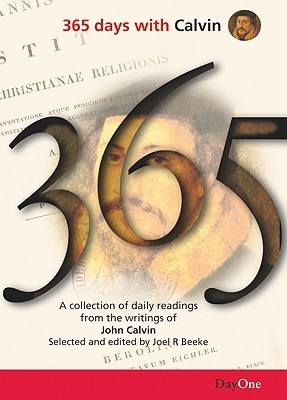
365 Days with Calvin: A Unique Collection of 365 Readings from the Writings of John Calvin
by John Calvin
Rating: 4.3 ⭐
A unique collection of 365 readings from the writings of John Calvin, selected and edited by Joel R Beeke. John Calvin exercised a profound ministry in Europe, and is probably one of the most seminal thinkers ever to have lived. A godly pastor, theologian and preacher, he led his flock by example and worked hard to establish consistent godliness in his city. A prolific writer, his sermons, letters, and, of course, his Christian Institutes have been published again and again. His writings once described as flowing prose are characterized by clarity, simplicity, and yet profoundness, too. In these heart-warming pieces, drawn from his commentaries and sermons, Calvin brings us to Christ, the glorious Savior of all his people.