
John Buchan
Librarian Note: There is more than one author in the GoodReads database with this name. John Buchan was a Scottish novelist, historian, and Unionist politician who served as Governor General of Canada, the 15th since Canadian Confederation. As a youth, Buchan began writing poetry and prose, fiction and non-fiction, publishing his first novel in 1895 and ultimately writing over a hundred books of which the best known is The Thirty-Nine Steps. After attending Glasgow and Oxford universities, he practised as a barrister. In 1901, he served as a private secretary to Lord Milner in southern Africa towards the end of the Boer War. He returned to England in 1903, continued as a barrister and journalist. He left the Bar when he joined Thomas Nelson and Sons publishers in 1907. During the First World War, he was, among other activities, Director of Information in 1917 and later Head of Intelligence at the newly-formed Ministry of Information. He was elected Member of Parliament for the Combined Scottish Universities in 1927. In 1935, King George V, on the advice of Canadian Prime Minister R. B. Bennett, appointed Buchan to succeed the Earl of Bessborough as Governor General of Canada and two months later raised him to the peerage as 1st Baron Tweedsmuir. He occupied the post until his death in 1940. Buchan promoted Canadian unity and helped strengthen the sovereignty of Canada constitutionally and culturally. He received a state funeral in Canada before his ashes were returned to the United Kingdom.
30 Books Written

Major-General Sir Richard Hannay is called in to investigate rumours of an uprising in Constantinople. Once there, he and his friends must thwart the Germans' plans to use religion in winning the war. The book opens in November 1915, with Hannay and his friend Sandy convalescing from wounds received at the Battle of Loos. Sir Walter Bullivant, a senior intelligence officer, summons Hannay to the Foreign Office. Bullivant briefs Hannay on the political situation in the Middle East, suggesting that the Germans and their Turkish allies are plotting to create a Muslim uprising, that will throw the Middle East, India and North Africa into turmoil. Bullivant proposes that Hannay investigate the rumours, following a clue left on a slip of paper with the words ""Kasredin"", ""cancer"" and ""v.I"" written by Bullivant's son a spy, who was recently killed in the region... Richard Hannay is a character created by Scottish novelist John Buchan, based on Edmund Ironside, from Edinburgh, a spy during the Second Boer War. John Buchan (1875-1940) was a Scottish novelist and historian and also served as Canada's Governor General. His 100 works include nearly thirty novels, seven collections of short stories and biographies. But, the most famous of his books were the adventure and spy thrillers and it is for these that he is now best remembered. "

Adventurer Richard Hannay, just returned from South Africa, is thoroughly bored with London life—until he is accosted by a mysterious American, who warns him of an assassination plot that could completely destabalise the fragile political balance of Europe. Initially sceptical, Hannay nonetheless harbours the man—but one day returns home to find him murdered... An obvious suspect, Hannay flees to his native Scotland, pursued by both the police and a cunning, ruthless enemy. His life and the security of Britain are in grave peril, and everything rests on the solution to a baffling enigma: what are the 'thirty nine steps?'

In this nail-biting adventure story, Hannay must outwit a foe far more intelligent than himself; muster the courage to propose to the lovely, clever Mary Lamington; and survive a brutal war. Although Mr. Standfast is a sequel to The Thirty-Nine Steps, it offers far more characterisation and philosophy than the earlier book. For its pace and suspense, its changes of scenery and thrilling descriptions of the last great battles against the Germans, Mr Standfast offers everything that has made its author so enduringly popular.

After the war and newly knighted, Richard Hannay is living peacefully in the Cotswolds with his wife Mary and son Peter John. Unfortunately, a day arrives when three separate visitors tell him of three children being held hostage by a secret kidnapper. All three seem to lead back to a man named Dominick Medina, a popular Member of Parliament. Hannay uncovers a dastardly plot involving hypnotism and the black arts, as well as the more earthly crimes of blackmail and profiteering.

The Island of Sheep (1936) is a novel by John Buchan. It is the last of his novels to revolve around Richard Hannay and Sandy Arbuthnot.The action occurs twelve years later on from the last novel, when Hannay, now in his fifties, is called by an old oath to protect the son of a man he once knew, who is also heir to the secret of a great treasure. He obtains help from Sandy Arbuthnot, now Lord Clanroyden, and Lombard. The action takes place in England, Scotland and on the Island of Sheep.

Nineteen-year-old David Crawfurd travels from Scotland to South Africa to work as a storekeeper. On the voyage he encounters again John Laputa, the celebrated Zulu minister, of whom he has strange memories.In his remote store David finds himself with the key to a massive uprising led by the minister, who has taken the title of the mythical priest-king, Prester John.David's courage and his understanding of this man take him to the heart of the uprising, a secret cave in the Rooirand.

When Richard Hannay is warned of an assassination plot that has potential to take Britain into a war, and then discovers in his flat the murdered body of the American that warned him, he becomes a prime suspect. He flees to the moors of Scotland and a spirited chase begins as he is pursued by the police and the German spies involved with stealing British plans. Buchan's tale unfolds into one of the seminal and most influential 'chase' books, mimicked by many, yet unrivaled in the tension and mystery created by his writing
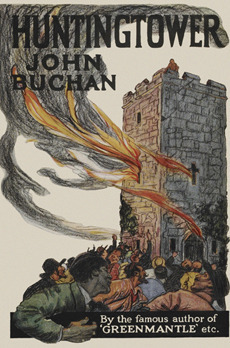
This modern fairy-tale is also the gripping adventure story about Dickson McCunn, a respectable, newly retired grocer who finds himself in the thick of a plot involving the kidnapping of a Russian princess held prisoner in the rambling mansion, Huntingtower. Here, Buchan introduces some of his best-loved characters and paints a remarkable picture of a man rejuvenated by joining much younger comrades in a fight against tyranny and fear.

Who is John Macnab? Three Scottish landowners receive a note which tells them that he intends to poach from their estates without being caught, though if he does he will donate money to a good cause. The reactions of the landowners differs considerably.

When his friend Charles Pitt-Heron vanishes mysteriously, Sir Edward Leithen is at first only mildly concerned. But a series of strange events that follow Pitt-Heron's disappearance convinces Leithen that he is dealing with a sinister secret society. Their codename is ‘The Power-House'. The authorities are unable to act without evidence. As he gets deeper involved with the underworld, Leithen finds himself facing the enemy alone and in terrible danger.

Set against the religious struggles and civil wars of seventeenth century Scotland, John Buchan's Witch Wood is a gripping atmospheric tale in the spirit of Stevenson and Neil Munro.As a moderate presbyterian minister, young David Sempill disputes with the extremists of his faith, as all around, the defeated remnants of Montrose's men are being harried and slaughtered.There are still older conflicts to be faced however, symbolised by the presence of the Melanudrigall Wood, a last remnant of the ancient Caledonian forest. Here there is black magic to be uncovered, but also the more positive pre-Christian intimations of nature worship.In such setting, and faced with the onset of the plague, David Sempill's struggle and eventual disappearance take on a strange and timeless aspect in what was John Buchan's own favourite among his many novels.

This edition consists of five novels :The Thirty-Nine Steps,Greenmantle,Mister Standfast,The Three Hostages, andThe Island of Sheep

Sir Edward Leithen - perhaps the autobiographical of Buchan's characters - is dying of tuberculosis and has been given a year to live. After this prognosis, Leithen undertakes a profoundly heroic quest from London to the Canadian Northwest, tracking down a missing man who is literally 'sick at heart'. In the course of this epic journey, Leithen finds redemption for himself.Sick Heart River is John Buchan's most powerful novel, completed just days before his death. The rich, authentic descriptions of the rugged Canadian landscape were influenced by a voyage down the Mackenzie River in 1937, at which time Buchan was Governor-General of Canda.With an introduction by James Buchan.This edition is authorised by the John Buchan Society.


A tale of kidnapping, politics, suspense—and rugby.

South America is the setting for this adventure from the author of The Thirty-nine Steps. When Archie and Janet Roylance decide to travel to the Gran Seco to see its copper mines they find themselves caught up in dreadful danger; rebels have seized the city. Janet is taken hostage in the middle of the night and it is up to the dashing Don Luis de Marzaniga to aid her rescue.

The Complete Richard Hannay: The Thirty-Nine Steps / Greenmantle / Mr Standfast
by John Buchan
Rating: 4.2 ⭐
Major General Sir Richard Hannay is the fictional secret agent created by writer and diplomat John Buchan, who was himself an Intelligence officer during the First World War. The strong and silent type, combining the dour temperament of the Scot with the stiff upper lip of the Englishman, Hannay is pre-eminent among early spy-thriller heroes. Caught up in the first of these five gripping adventures just before the outbreak of war in 1914, he manages to thwart the enemy's evil plan and solve the mystery of the 'thirty-nine steps'. In Greenmantle, he undertakes a vital mission to prevent jihad in the Islamic Near East. Mr Standfast, set in the decisive months of 1917-18, is the novel in which Hannay, after a life lived 'wholly among men', finally falls in love; later, in The Three Hostages, he finds himself unravelling a kidnapping mystery with his wife's help. In the last adventure, The Island of Sheep, he is called upon to honour an old oath. A shrewd judge of men, he never dehumanises his enemy, and despite sharing some of the racial prejudices of his day, Richard Hannay is a worthy prototype hero of espionage fiction.

Vernon Milbourne, orphaned since childhood and haunted by a recurring dream, is friends with the protective lawyer and MP, Sir Edward Leithen. An Aegean cruise takes them to the mysterious island of Plakos, where Vernon is fascinated by the island's myths. Local superstitions turn to menace as Vernon's encounter with a beautiful woman results in obsession and adventure.

The Thirty-Nine Steps: "A bored, well-to-do Englishman, Richard Hannay, returns home to England after growing up in South Africa. Drifting between his club and the sights of London, he is drawn into the confidences of a secret agent in the thick of espionage. The agent is murdered in Hannay's apartment and Richard finds himself on the run from Scotland Yard and the cult of the 'Black stone.

The House of the Four Winds is a novel of adventure by John Buchan, first published in 1935. It is a Ruritanian romance, and the last of his three Dickson McCunn books.The novel is set in the fictional Central European country of Evallonia in the early 1930s. It concerns the involvement of some Scottish visitors in the overthrow of a corrupt republic and the restoration of the monarchy. It is a sequel to Castle Gay, in which some Evallonians visited Scotland on a secret mission two years before the start of this novel.

Two unforgettable heroes and two classic thrillers, in one volume. Set in Edwardian London, The Power-House features a deadly struggle with a sinister secret society. In The 39 Steps, the archetypal "man who knew too much" is relentlessly pursued by an international network of spies.

John Buchan, 1st Baron Tweedsmuir (1875-1940) completed his autobiography not long before his death. A highly accomplished man, his was a life of note. Although now known by many chiefly as an author, he was also an historian, Unionist politican and Governor General of Canada. Although he stated that it was not strictly an autobiography, Memory Hold-the-Door provides a reflective, personal account of his childhood in Scotland, his literary work from his time at Oxford University to the famous Hannay and Leithen stories and his extensive public service in South Africa, Scotland, France in the Great War, and Canada. Of great interest are his accounts of key contemporary figures, including Lord Grey, Lord Haldane, Earl Balfour, Lord Haig, T.E. Lawrence and King George V. Known in the United States as Pilgrim's Way, Memory Hold-the-Door was reportedly one of the favourite books of John F. Kennedy.

Set in 1745, as Bonnie Prince Charlie's rebel army marches south into England, "Midwinter" tells the story of Alastair Maclean, one of the Prince's most loyal supporters. Sent on ahead to carry out a secret mission of great importance for the Jacobite cause, Maclean is befriended by two extraordinary and very different men--Dr. Samuel Johnson, an impoverished tutor and aspiring man of letters; and the shadowy figure known only as 'Midwinter.' But England in 1745 is a land awash with double-dealing and betrayal, and, as his enemies close in on him, Maclean uncovers evidence that there is a traitor at work, someone so close to the Prince that no one suspects him....

When I was a child in short-coats a spaewife came to the town-end, and for a silver groat paid by my mother she riddled my fate. It came to little, being no more than that I should miss love and fortune in the sunlight and find them in the rain. The woman was a haggard, black-faced gypsy, and when my mother asked for more she turned on her heel and spoke gibberish; for which she was presently driven out of the place by Tarn Roberton, the baillie, and the village dogs. But the thing stuck in my memory, and together with the fact that I was a Thursday's bairn, and so, according to the old rhyme, "had far to go," convinced me long ere I had come to man's estate that wanderings and surprises would be my portion.It is in the rain that this tale begins. I was just turned of eighteen, and in the back-end of a dripping September set out from our moorland house of Auchencairn to complete my course at Edinburgh College. The year was 1685, an ill year for our countryside; for the folk were at odds with the King's Government, about religion, and the land was full of covenants and repressions. Small wonder that I was backward with my colleging. . . .

The Complete Novels of John Buchan: 25+ Spy Classics, Thrillers & Adventure Novels in One Premium Edition (Unabridged): Including Richard Hannay Series, ... of the Dark, The Free Fishers and more
by John Buchan
Rating: 3.9 ⭐
This carefully crafted "The Complete Novels of John 25+ Spy Classics, Thrillers & Adventure Novels in One Premium Edition (Unabridged)" is formatted for your eReader with a functional and detailed table of Richard Hannay Series The Thirty-Nine Steps Greenmantle Mr Standfast The Three Hostages The Island of Sheep, or The Man from the Norlands Dickson McCunn and the 'Gorbals Die-hards' Series Huntingtower Castle Gay The House of the Four Winds Sir Edward Leithen Series The Power-House John Macnab The Dancing Floor, or The Goddess from the Shades The Gap in the Curtain Sick Heart River, or Mountain Meadow Other Novels Sir Quixote of the Moors John Burnet of Barns A Lost Lady of Old Years The Half-Hearted A Lodge in the Wilderness Prester John Salute to Adventurers The Path of the King Midwinter Witch Wood The Blanket of the Dark A Prince of the Captivity The Free Fishers The Magic Walking Stick The Courts of the Morning Autobiography & Biography of John Buchan Memory Hold-the-door (Autobiography) Unforgettable, Unforgotten by Anna M. Buchan John Buchan (1875-1940) was a Scottish novelist and historian and also served as Canada's Governor General. His 100 works include nearly thirty novels, seven collections of short stories and biographies. But, the most famous of his books were the adventure and spy thrillers, most notably The Thirty-Nine Steps, and it is for these that he is now best remembered.

Set in a bleak Yorkshire hamlet, this is a tale of treason and romance. Anthony Lammas, Professor of Logic at St Andrews University, becomes entangled in a web of intrigue that threatens the country. His boyhood allegiance to a brotherhood of deep-sea fishermen involves him and his handsome ex-pupil with a beautiful, but dangerous, woman.

The period is the Pilgrimage of Grace. In the country west of Oxford, nobles, clergy and laity await the success of the risings in Lincolnshire and Yorkshire to overthrow Henry VIII and Cromwell. Peter Pentecost is the man they plan to put on the English throne. Although a monk by training, he is the legitimate child of the Duke of Buckingham and the last of the Bohuns. His bid to be crowned and his duel with Henry VIII make for an exciting adventure.

These twelve stories are told by the old soldiers of the Runagates Club as they reminisce. Richard Hannay, hero of The Thirty-nine Steps, reappears recounting a trek into the bush in The Green Wildebeest. In Dr Lartius, John Palliser-Yeates describes an ingenious Secret Service operation during the First World War. A German code is finally broken in The Loathly Opposite.

What is the true root of royal blood? A band of gold belonging to a young Viking prince is passed from generation to generation. Follow this convoluted, yet heroic, path to the making of one of history's greatest leaders.

This historical adventure romance portrays the lives of the Covenanters in the Scottish Borders. It is the seventeenth century and treachery and revenge feature when a young nobleman sets out to gain an education abroad. In his absence he is betrayed by his cousin.