
Jim Harrison
Jim Harrison was born in Grayling, Michigan, to Winfield Sprague Harrison, a county agricultural agent, and Norma Olivia (Wahlgren) Harrison, both avid readers. He married Linda King in 1959 with whom he has two daughters. Librarian Note: There is more than one author in the GoodReads database with this name. See this thread for more information. His awards include National Academy of Arts grants (1967, 68, 69), a Guggenheim Fellowship (1969-70), the Spirit of the West Award from the Mountain & Plains Booksellers Association, and election to the American Academy of Arts and Sciences (2007). Much of Harrison's writing depicts sparsely populated regions of North America with many stories set in places such as Nebraska's Sand Hills, Michigan's Upper Peninsula, Montana's mountains, and along the Arizona-Mexico border.
30 Books Written

Bordée par les Grands Lacs, la péninsule Nord est un pays aux forêts profondes et au climat rigoureux. Métis chipewa-finnois, Donald y a toujours vécu. Lorsqu'à quarante-cinq ans, il se sait condamné par la maladie, il entreprend de dicter à sa femme son histoire et celle de sa famille, des existences simples et dignes, teintées de spiritualité. Avec son sens incomparable du détail, Jim Harrison poursuit son examen des rapports étroits qu'entretient l'homme avec la Nature. Dans la vie, la mort et au-delà... " Un roman déchirant mais fabuleusement charnel, où se mêlent la sensibilité et la mort, les tourments des cœurs et les jouvences de la vie sauvage. Comme si cet office des ténèbres se transformait peu à peu en un hymne à la joie sous les caresses du vent. " André Clavel, L'Express
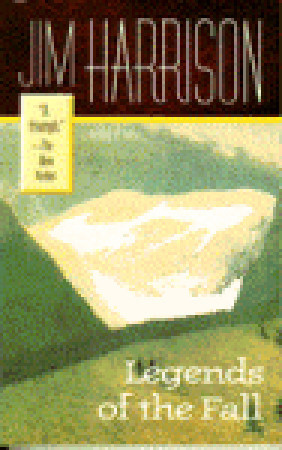
'Legends of the Fall, an epic tale of three brothers and their lives of passion, madness, exploration and danger at the beginning of the Great War, confirms Jim Harrison's reputation as one of the finest American writers of his generation. This magnificent trilogy also contains two other superb short novels. In Revenge, love causes the course of a man's life to be savagely and irrevocably altered. Nordstrom, in The Man Who Gave up his Name, is unable to relinquish his consuming obsessions with women, dancing and food.'

From her home on the California coast, Dalva hears the broad silence of the Nebraska prairie where she was born and longs for the son she gave up for adoption years before. Beautiful, fearless, tormented, at forty-five she has lived a life of lovers and adventures. Now, Dalva begins a journey that will take her back to the bosom of her family, to the half-Sioux lover of her youth, and to a pioneering great-grandfather whose journals recount the bloody annihilation of the Plains Indians. On the way, she discovers a story that stretches from East to West, from the Civil War to Wounded Knee and Vietnam -- and finds the balm to heal her wild and wounded soul.

"It used to be Cliff and Vivian and now it isn't." With these words, Jim Harrison sends his sixty-something protagonist, divorced and robbed of his farm by a late-blooming real estate shark of an ex-wife, on a road trip across America, armed with a childhood puzzle of the United States and a mission to rename all the states and state birds to overcome the banal names men have given them. Cliff's adventures take him through a whirlwind affair with a former student from his high school-teacher days twenty-some years before, to a "snake farm" in Arizona owned by an old classmate; and to the high-octane existence of his son, a big-time movie producer in San Francisco.The English Major is the map of a man's journey into—and out of—himself, and it is vintage Harrison—reflective, big-picture American, and replete with wicked wit.

In a new novel by the author of Off on the Side, the son of a wealthy family of timber barons struggles to reconcile himself with the damage his family has done to Michigan's Upper Peninsula--a scarring that cuts deeply into the fabric of his own family. 85,000 first printing. $85,000 ad/promo.

New York Times best-selling author Jim Harrison is one of America’s most beloved writers, and of all his creations, Brown Dog, a bawdy, reckless, down-on-his-luck Michigan Indian, has earned cult status with readers in the more than two decades since his first appearance. For the first time, Brown Dog gathers all the Brown Dog novellas, including one never-published one, into one volume—the ideal introduction (or reintroduction) to Harrison’s irresistible Everyman.In these novellas, BD rescues the preserved body of an Indian from Lake Superior’s cold waters; overindulges in food, drink, and women while just scraping by in Michigan’s Upper Peninsula; wanders Los Angeles in search of an ersatz Native activist who stole his bearskin; adopts two Native children; and flees the authorities, then returns across the Canadian border aboard an Indian rock band’s tour bus. The collection culminates with He Dog, never before published, which finds BD marginally employed and still looking for love (or sometimes just a few beers and a roll in the hay), as he goes on a road trip from Michigan to Montana and back, arriving home to the prospect of family stability and, perhaps, a chance at redemption.Brown Dog underscores Harrison’s place as one of America’s most irrepressible writers, and one of the finest practitioners of the novella form.

The author of Dalva and Legends of the Fall has created three stunning novellas that echo the best works of Raymond Carver and James Dickey. A superb collection that evokes life lived close to the land--and a brilliant portrayal of the complex relationships of the men and women there.

Author Jim Harrison has won international acclaim for his masterful body of work, including Returning to Earth, Legends of the Fall and over thirty books of fiction, nonfiction, and poetry. In his most original work to date, Harrison delivers an enthralling, witty and expertly-crafted novel following one man’s hunt for an elusive cult leader, dubbed “The Great Leader.”On the verge of retirement, Detective Sunderson begins to investigate a hedonistic cult, which has set up camp near his home in Michigan’s Upper Peninsula. At first, the self-declared Great Leader seems merely a harmless oddball, but as Sunderson and his sixteen-year-old sidekick dig deeper, they find him more intelligent and sinister than they realized. Recently divorced and frequently pickled in alcohol, Sunderson tracks his quarry from the woods of Michigan to a town in Arizona, filled with criminal border-crossers, and on to Nebraska, where the Great Leader’s most recent recruits have gathered to glorify his questionable religion. But Sunderson’s demons are also in pursuit of him.Rich with character and humor, The Great Leader is at once a gripping excursion through America’s landscapes and the poignant story of a man grappling with age, lost love and his own darker nature.

Jim Harrison is one of America’s most beloved and critically-acclaimed authors—on a par with American literary greats like Richard Ford, Anne Tyler, Robert Stone, Russell Banks, and Ann Beattie. His latest collection of novellas, The River Swimmer is Harrison at his most a brilliant rendering of two men striving to find their way in the world, written with freshness, abundant wit, and profound humanity.In The Land of Unlikeness, sixty-year-old art history academic Clive—a failed artist, divorced and grappling with the vagaries of his declining years—reluctantly returns to his family’s Michigan farmhouse to visit his aging mother. The return to familiar territory triggers a jolt of renewal—of ardor for his high school love, of his relationship with his estranged daughter, and of his own lost love of painting. In Water Baby, Harrison ventures into the magical as an Upper Peninsula farm boy is irresistibly drawn to the water as an escape, and sees otherworldly creatures there. Faced with the injustice and pressure of coming of age, he takes to the river and follows its siren song all the way across Lake Michigan.The River Swimmer is a striking portrait of two richly-drawn, profoundly human characters, and an exceptional reminder of why Jim Harrison is one of the most cherished and important writers at work today.

Continuing the story of Dalva and her peculiar and remarkable family, The Road Home encompasses the voices of Dalva's grandfather, John Northridge; Naomi, the widow of his favourite son; Paul, the first Northridge son; and Nelse, Dalva's son.

Their plans were conceived in a drunken excitement and resulted in more horror than any of them could have imagined. There was the poet able to retreat into beatific reveries of superb fishing in cold, fast streams; the Vietnam vet consumed by uppers, downers and violence; and the girl who loved only one of them -- at first. With their ideals ostensibly in order, they set out from Florida to save the Grand Canyon from a dam they believed was being built. Along with the tapedeck for the car, the liquor and the drugs, there was also a case of dynamite.

This rare and vintage book is a perfect addition to any bibliophile's collection

In these three stories Harrison writes about a home-schooled fifteen-year-old girl in rural Montana, in another his beloved recurring character Brown Dog escapes from Canada on the tour bus of an Indian rock band, and finally, he tells about a retired werewolf prone to outbursts of violence under the full moon.

Recovering from a fall down the face of a three-hundred-foot dam in South American, Robert Corvus Strang, a self-educated foreman who works on giant dam projects, recalls his hard but exhilarating life

Jim Harrison is an American master. The Beast God Forgot to Invent offers stories of culture and wildness, of men and beasts and where they overlap. A wealthy man retired to the Michigan woods narrates the tale of a younger man decivilized by brain damage. A Michigan Indian wanders Los Angeles, hobnobbing with starlets and screenwriters while he tracks an ersatz Native-American activist who stole his bearskin. An aging "alpha canine," the author of three dozen throwaway biographies, eats dinner with the ex-wife of his overheated youth, and must confront the man he used to be.

Jim Harrison is one of this country's most beloved writers, a muscular, brilliantly economic stylist with a salty wisdom. For more than twenty years, he has also been writing some of the best essays on food around, now collected in a volume that caused the Santa Fe New Mexican to "To read this book is to come away convinced that Harrison is a flat-out genius — one who devours life with intensity, living it roughly and full-scale, then distills his experiences into passionate, opinionated prose. Food, in this context, is more than It is a metaphor for life." From his legendary Smart and Esquire columns, to present-day pieces including a correspondence with French gourmet Gerard Oberle, fabulous pieces on food in France and America for Men's Journal, and a paean to the humble meatball, The Raw and the Cooked is a nine-course meal that will satisfy every appetite."Our 'poet laureate of appetite' [Harrison] may be, but the collected essays here reflect much more." — John Gamino, The Dallas Morning News"[A] culinary combo plate of Hunter S. Thompson, Ernest Hemingway, Julian Schnabel, and Sam Peckinpah...." — Jane and Michael Stern, The New York Times Book Review"Jim Harrison is the Henry Miller of food writing. His passion is infectious." — Jeffrey Trachtenberg, The Wall Street Journal
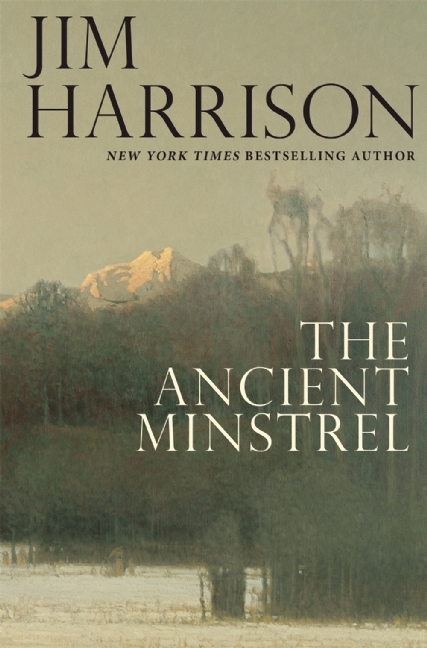
New York Times bestselling author Jim Harrison is one of our most beloved and acclaimed writers, adored by both readers and critics. In The Ancient Minstrel, Harrison delivers three novellas that highlight his phenomenal range as a writer, shot through with his trademark wit and keen insight into the human conditionHarrison has tremendous fun with his own reputation in the title novella, about an aging writer in Montana who spars with his estranged wife, with whom he still shares a home, weathers the slings and arrows of literary success, and tries to cope with the sow he buys on a whim and the unplanned litter of piglets that follow soon after. In Eggs, a Montana woman reminisces about staying in London with her grandparents, and collecting eggs at their country house. Years later, having never had a child, she attempts to do so. And in The Case of the Howling Buddhas, retired Detective Sunderson—a recurring character from Harrison’s New York Times bestseller The Great Leader and The Big Seven—is hired as a private investigator to look into a bizarre cult that achieves satori by howling along with howler monkeys at the zoo.Fresh, incisive, and endlessly entertaining, with moments of both profound wisdom and sublime humor, The Ancient Minstrel is an exceptional reminder of why Jim Harrison is one of the most cherished and important writers at work today.

Jim Harrison is one of our most renowned and popular authors, and his last novel, The Great Leader , was one of the most successful in a decorated it appeared on the New York Times extended bestseller list, and was a national bestseller with rapturous reviews. His darkly comic follow-up, The Big Seven , sends Detective Sunderson to confront his new neighbors, a gun-nut family who live outside the law in rural Michigan.Detective Sunderson has fled troubles on the home front and bought himself a hunting cabin in a remote area of Michigan’s Upper Peninsula. No sooner has he settled in than he realizes his new neighbors are creating even more havoc than the Great Leader did. A family of outlaws, armed to the teeth, the Ameses have local law enforcement too intimidated to take them on. Then Sunderson’s cleaning lady, a comely young Ames woman, is murdered, and black sheep brother Lemuel Ames seeks Sunderson’s advice on a crime novel he’s writing which may not be fiction. Sunderson must struggle with the evil within himself and the far greater, more expansive evil of his neighbor.In a story shot through with wit, bedlam, and Sunderson’s attempts to enumerate and master the seven deadly sins, The Big Seven is a superb reminder of why Jim Harrison is one of America’s most irrepressible writers.

Le roman, pour Harrison, c'est la religion du délire. Il enivre les mots, les soûle à mort ; il écrit à tue-tête et bâtit des phrases où se devinent encore les ahans et les suées. Jim Harrison est unécrivain passionné, donc il nous passionne.Yann Queffélec.Jim Harrison est un auteur culte. Les superlatifs lui sont donc familiers, mais le style de l'écrivain est contagieux et, au-delà des encensements ordinaires, il possède la faculté d'inspirer des commentaires qui se voudraient aussi évocateurs que ses propres figures de style. C'est ainsi que, d'un bord à l'autre de l'Atlantique, on parle volontiers de son écriture au lance-flammes, de ses conflits détaillés au scalpel, de son humour assassin et de cette faculté parfois inquiétante de percevoir les êtres et les sentiments avec l'acuité d'un pic à glace. Le plus étonnant est qu'il obtient cela avec une rare économie de moyens. La prose de Jim Harrison est à la fois simple et précise. La forme même de ses narrations est d'une concision presque magique. Or, en dépit de cette expression dépouillée jusqu'à l'os, il se dégage de ses livres une poésie subtile, parfois brutale et même cruelle. Il évoque aussi bien le charme d'un sous-bois que la fuite éperdue d'un lièvre condamné ou le regard presque humain du chevreuil tourné vers le fusil d'où jaillira la mort à travers les frondaisons rousses de l'été indien.Cela dit, attention : danger ! Les livres de Jim Harrison ne se lisent pas impunément, et si l'on ajoute au génie du romancier la part de création du lecteur, il devient alors impossible d'en sortir tout à fait intact.Serge Lentz.

New York Times bestselling author Jim Harrison was one of this country’s most beloved writers, a muscular, brilliantly economic stylist with a salty wisdom. He also wrote some of the best essays on food around, earning praise as “the poet laureate of appetite” (Dallas Morning News). A Really Big Lunch, to be published on the one-year anniversary of Harrison’s death, collects many of his food pieces for the first time—and taps into his larger-than-life appetite with wit and verve.Jim Harrison’s legendary gourmandise is on full display in A Really Big Lunch.

Julip rassemble trois récits. Avec Chien Brun, d'abord, qui continue à crapahuter vers d'introuvables chimères en nous servant une nouvelle rasade de confessions impudiques, avec Phillip Caulkins, un pro de 50 ans qui a le tort d'aimer Ezra Pound et qui sera chassé de son université. La troisième nouvelle raconte la pitoyable odyssée d'une délurée de 20 ans, Julip, qui trimbale son " joli morceau de cul " des bars en motels, cette Zazie aux semelles de vent ne semble pas avoir d'autres pénates que son vieux break SubaruNé sous le signe du coyote, Jim Harrison ne s'apprivoise pas.Par ces temps de sieste prolongée, il nous remet debout et nous offre bien plus qu'une tranche d'exotisme : une cure de sauvagerie.
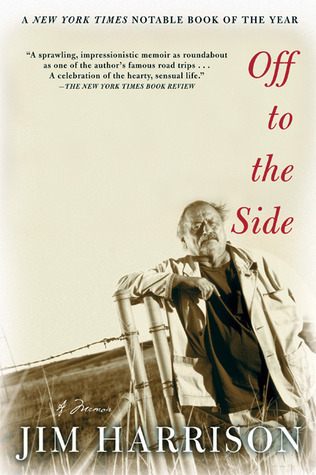
Selected as a New York Times Notable Book of the Year, Off to the Side is the tale of one of America's most beloved writers. Jim Harrison traces his upbringing in Michigan amid the austerities of the Depression and the Second World War, and the seemingly greater austerities of his starchy Swedish forebears. He chronicles his coming-of-age, from a boy drunk with books to a young man making his way among fellow writers he deeply admires — including Peter Matthiessen, Robert Lowell, W.H. Auden, Truman Capote, Tennessee Williams, and Allen Ginsberg. Harrison discusses forthrightly the life-changing experience of becoming a father, and the minor cognitive dissonance that ensued when this boy from the "heartland" somehow ended up a highly paid Hollywood screenwriter. He gives free rein to his "seven obsessions" — alcohol, food, stripping, hunting and fishing (and the dogs who have accompanied him in both), religion, the road, and our place in the natural world — which he elucidates with earthy wisdom and an elegant sense of connectedness. Off to the Side is a work of great beauty and importance, a triumphant achievement that captures the writing life and brings all of us clues for living.

“Jim Harrison has probed the breadth of human appetites—for food and drink, for art, for sex, for violence and, most significantly, for the great twin engines of love and death. Perhaps no American writer better appreciates those myriad drives; since the publication of his first collection of poetry . . . Harrison has become their poet laureate.”—Salon.comIn Jim Harrison’s new book of poems, birds and humans converse, biographies are fluid, and unknown gods flutter just out of sight. In terrains real and imagined—from remote canyons and anonymous thickets in the American West to secret basements in World War II Europe—Harrison calls his readers to live fully in a world where “Death steals everything except our stories.” In Search of Small Gods is an urgent and imaginative book—one filled with “the spore of the gods.”Maybe the problem is that I got involved with the wrong crowd of gods when I was seven. At first they weren’t harmful and only showed themselves as fish, birds, especially herons and loons, turtles, a bobcat and a small bear, but not deer and rabbits who only offered themselves as food. And maybe I spent too much time inside the water of lakes and rivers. Underwater seemed like the safest church I could go to . . .Jim Harrison is the author of thirty books of poetry, fiction, and nonfiction, including Legends of the Fall and Shape of the Journey. A long-time resident of Michigan, he now lives in Montana and Arizona.

After Jim Harrison and Ted Kooser had exchanged letters and poems for years, Kooser was diagnosed with cancer. "Ted's poetry became overwhelmingly vivid," Harrison recalls. "Then we decided to correspond in short poems, because that was the essence of what we wanted to say to each other.""Braided Creek" contains over 300 poems exchanged in this longstanding correspondence. Wise, wry, and penetrating, the poems touch upon numerous subjects, from the natural world to the nature of time. Harrison and Kooser decided to remain silent over who wrote which poem, allowing their voices, ideas, and images to swirl and merge into this remarkable suite of lyrics.Each time I go outside the worldis different. This has happened all my life. * The moon put her handover my mouth and told meto shut up and watch. *A nephew rubs the sore feetof his aunt, and the rope that lifts us all toward gracecreaks on the pulley. *Under the storyteller's hatare many heads, all troubled. Jim Harrison, one of America's best-loved writers, is author of two dozen books of poetry, fiction, essays, food criticism, and memoir. He is best known for a collection of novellas, "Legends of the Fall," and the epic novel "Dalva." He lives in western Montana and southern Arizona.Ted Kooser is the author of eight collections of poetry and a prose memoir. His poetry appears regularly in "The Atlantic Monthly, The New Yorker, Poetry," and "The Nation." He lives in Nebraska.

Jim Harrison's new book, The Summer He Didn't Die, is a collection of novellas showcasing the flair that has made him a contemporary master of the form, and a celebration of love, the senses, and family, no matter how untraditional.The Summer He Didn't Die exults with life and all its magic. In the title novella, Brown Dog, a hapless Michigan Indian loved by Harrison's readers, is trying to parent his two step-children and take care of his family's health on meager resources - it helps a bit that his charms are irresistible to the new dentist in town. Republican Wives is a witty satire on the sexual neuroses of the Right, the mystery of why any person desires another, and the irrational power of love that, when thwarted, can turn so easily into an urge to murder. Tracking is a meditation on Harrison's fascination with place, telling his own familiar mythology through the places he has seen and the intellectual loves he has known in a vivid stream of consciousness that transfigures how we look at our own surroundings.

John Lundgren, a.k.a. Warlock, is an unemployment foundation executive whose life is about to become unhinged. After surviving a midlife crisis, Warlock finally decides to get a job. He soon discovers, however, that his new boss, Dr. Rabun, is no less evil to Professor Moriarty. Hired to troubleshoot for the doctor, Warlock himself battling poachers in the haunted wilderness of northern Michigan while also spying on his employer's wife and son in the seamy underside of Key West. A comedy with one foot in the abyss, Warlock is the singular literary entertainment from an American master.

Jim Harrison's final book of poems, published only a few months before his death “[Jim Harrison] is still close to the source… Dead Man's Float is, as its title would suggest, a flinty and psalmist look at mortality and wonder.”— Los Angeles Times ”Mr. Harrison’s novels and poems over the last two decades have been increasingly preoccupied with mortality, never so much as in Dead Man’s Float, his very good new book of verse. Here he details the shocks of shingles and back surgery, as well as the comprehensive low wheeze of a fraying body… The joys in Mr. Harrison’s world have remained consistent. If sex is less frequently an option, his appetites for food and the outdoors are undiminished. In one poem, he goes out into a rainstorm at night and sits naked at a picnic table. In another, he 'I envied the dog lying in the yard/so I did it.'… The title of this volume, Dead Man’s Float, refers to a way to stay alive in the water when one has grown tired while far from shore. As a poet, however, Mr. Harrison is not passively drifting. He remains committed to language, and to what pleasures he can catch.”—Dwight Garner, The New York Times “Few enough are the books I decide to keep beyond a culling or two. Barring fire or flood, Dead Man's Float will be in my library for the rest of my life. If it's the last poetry collection we get from Harrison—and I hope it isn't—it is as fine an example of his efforts as any."— Missoula Independent "Harrison's poems succeed on the basis of an open heart and a still-ravenous appetite for life."— The Texas Observer "Forthright and unaffected, even brash, Harrison always scoops us straight into the world whether writing fiction or nonfiction [and] goes in deep, acknowledging our frailness even as he seamlessly connects with a world that moves from water to air to the sky beyond."— Library Journal “Harrison pours himself into everything he writes… in poems, you do meet Harrison head-on. As he navigates his seventies, he continues to marvel with succinct awe and earthy lyricism over the wonders of birds, dogs, and stars as he pays haunting homage to his dead and contends with age’s assaults. The sagely mischievous poet of the North Woods and the Arizona desert laughs at himself as he tries to relax by imagining that he’s doing the dead man’s float only to sink into troubling memories…Bracingly candid, gracefully elegiac, tough, and passionate, Harrison travels the deep river of the spirit, from the wailing precincts of a hospital to a “green glade of soft marsh grass near a pool in a creek” to the moon-bright sea.”—Donna Seaman, Booklist “Jim Harrison has been a remarkably productive writer across a multitude of genres… His poetry is earthy, witty, keenly observed and tied closely to the natural world [and] mortality looms large in Dead Man’s Float, his 14th collection of poems… [F]orceful, lucid, fearlessly honest, Harrison knows that the nearness of death intensifies life.”—Arlice Davenport, Wichita Daily Eagle Warbler This year we have two gorgeousyellow warblers nesting in the honeysuckle bush.The other day I stuck my head in the bush.The nestlings weigh one twentieth of an ounce,about the size of a honeybee. We stared ateach other, startled by our existence.In a month or so, when they reach the sizeof bumblebees they'll fly to Costa Rica without a map. Jim Harrison (1937-2016) was one of America's most versatile and celebrated writers.

Jim Harrison's essays and articles have been selected from twenty-five years of work, from venues as diverse as PLAYBOY, THE NATION, OUTSIDE, and the AMERICAN POETRY REVIEW. They explore the passions and concerns of a classic American writer: ice fishing and bar pool, nouvelle cuisine and night walks.

Poetry Foundation Bestseller ListLos Angeles Times Book Prize finalistMichigan Notable BookHigh Plains Book Award finalistBalcones Prize finalist“A beautifully mysterious inquiry... Here Harrison—forthright, testy, funny, and profoundly discerning—a gruff romantic and a sage realist, tells tales about himself, from his dangerous obsession with Federico García Lorca to how he touched a bear’s head, reflects on his dance with the trickster age, and shares magnetizing visions of dogs, horses, birds, and rivers. Oscillating between drenching experience and intellectual musings, Harrison celebrates movement as the pulse of life, and art, which ‘scrubs the soul fresh.’” —Booklist“Harrison has written a nearly pitch-perfect book of poems, shining with the elemental force of Neruda's Odes or Matisse's paper cutouts....In Songs of Unreason,, his finest book of verse, Harrison has stripped his voice to the bare essentials--to what must be said, and only what must be said." —The Wichita Eagle“Songs of Unreason, Harrison’s latest collection of poetry, is a wonderful defense of the possibilities of living.… His are hard won lines, but never bitter, just broken in and thankful for the chance to have seen it all.” —The Industrial Worker Book Review“Unlike many contemporary poets, Harrison is philosophical, but his philosophy is nature-based and idiosyncratic: ‘Much that you see/ isn’t with your eyes./ Throughout the body are eyes.’… As in all good poetry, Harrison’s lines linger to be ruminated upon a third or fourth time, with each new reading revealing more substance and raising more questions.” —Library Journal“It wouldn’t be a Harrison collection without the poet, novelist, and food critic’s reverence for rivers, dogs, and women…his poems stun us simply, with the richness of the clarity, detail, and the immediacy of Harrison’s voice.” —Publishers WeeklyJim Harrison's compelling and provocative Songs of Unreason explores what it means to inhabit the world in atavistic, primitive, and totemistic ways. "This can be disturbing to the learned," Harrison admits. Using interconnected suites, brief lyrics, and rollicking narratives, Harrison's passions and concerns—creeks, thickets, time's effervescence, familial love—emerge by turns painful and celebratory, localized and exiled.

Here is the definitive collection of poetry from one of America's best-loved writers-now available in paperback. With the publication of this book, eight volumes of poetry were brought back into print, including the early nature-based lyrics of Plain Song , the explosive Outlyer & Ghazals , and the startling "correspondence" with a dead Russian poet in Letters to Yesenin . Also included is an introduction by Harrison, several previously uncollected poems, and "Geo-Bestiary," a 34-part paean to earthly passions. The Shape of the Journey confirms Jim Harrison's place among the most brilliant and essential poets writing today. "Behind the words one always feels the presence of a passionate, exuberant man who is at the same time possessed of a quick, subtle intelligence and a deeply questioning attitude toward life. Harrison writes so winningly that one is simply content to be in the presence of a writer this vital, this large-spirited."- The New York Times Book Review "(An) untrammelled renegade genius here's a poet talking to you instead of around himself, while doing absolutely brilliant and outrageous things with language."- Publishers Weekly "Readers can wander the woods of this collection for a lifetime and still be amazed at what they find."- Booklist (starred review.) When the cloth edition of this book was first published, it immediately became one of Copper Canyon Press's all-time bestsellers. It was featured on Garrison Keillor's Writer's Almanac , became a finalist for the Los Angeles Times Book Prize , and was selected as one of the "Top-Ten Books of 1998" by Booklist . Jim Harrison is the author of twenty books, including Legends of the Fall and The Road Home . He has also written numerous screenplays and served as the food columnist for Esquire magazine. He lives in Michigan and Arizona. Dead Deer Amid pale green milkweed, wild clover,a rotted deercurled, shaglike,after a winter so coldthe trees split open.I think she couldn't keep up withthe others (they had no placeto go) and her food,frozen grass and twigs,