
Jill Lepore
Jill Lepore is the David Woods Kemper ’41 Professor of American History, Harvard College Professor, and chair of Harvard's History and Literature Program. She is also a staff writer at The New Yorker. Winner of the Anisfield-Wolf Award for the best non-fiction book on race, and a finalist for the Pulitzer Prize; The Name of War (Knopf, 1998), winner of the Bancroft Prize, the Ralph Waldo Emerson Prize, and the Berkshire Prize and a finalist for the J. Anthony Lukas Award. A co-founder of the magazine Common-place, Lepore’s essays and reviews have also appeared in the New York Times, the Times Literary Supplement, American Scholar, the Los Angeles Times, the Washington Post, The Daily Beast, the Journal of American History and American Quarterly. Her research has been funded by the National Endowment for the Humanities, the Pew Foundation, the Gilder Lehrman Institute, the Charles Warren Center, and the Woodrow Wilson Foundation. She has served as a consultant for the National Park Service and currently serves on the boards of the National Portrait Gallery and the Society of American Historians. Jill lives in Cambridge,Massachusetts.
31 Books Written

Widely hailed for its “sweeping, sobering account of the American past” (New York Times Book Review), Jill Lepore’s one-volume history of America places truth itself—a devotion to facts, proof, and evidence—at the center of the nation’s history. The American experiment rests on three ideas—“these truths,” Jefferson called them—political equality, natural rights, and the sovereignty of the people. But has the nation, and democracy itself, delivered on that promise?These Truths tells this uniquely American story, beginning in 1492, asking whether the course of events over more than five centuries has proven the nation’s truths, or belied them. To answer that question, Lepore wrestles with the state of American politics, the legacy of slavery, the persistence of inequality, and the nature of technological change. “A nation born in contradiction… will fight, forever, over the meaning of its history,” Lepore writes, but engaging in that struggle by studying the past is part of the work of citizenship. With These Truths, Lepore has produced a book that will shape our view of American history for decades to come.

The Contenders: Excerpts from the 2013 National Book Award Nonfiction Finalists
by Jill Lepore
Rating: 3.0 ⭐
The Contenders: Excerpts from the 2013 National Book Award Nonfiction Finalists brings together samples of the five Finalists for the National Book Award in Nonfiction selected by a panel of five experts from over 500 submitted books. The finalists are Book of Ages: The Life and Opinions of Jane Franklin by Jill Lepore, Hitler’s Furies: German Women in the Nazi Killing Fields by Wendy Lower, The Unwinding: An Inner History of the New America by George Packer, The Internal Enemy: Slavery and War in Virginia, 1772-1832 by Alan Taylor, and Going Clear: Scientology, Hollywood, and the Prison of Belief by Lawrence Wright. The winner will be announced at the 64th National Book Awards on November 20, 2013.

A cultural history of Wonder Woman traces the character's creation and enduring popularity, drawing on interviews and archival research to reveal the pivotal role of feminism in shaping her seven-decade story.Examines the life of Wonder Woman creator William Moulton Marston and his polyamorous relationship with wife Elizabeth Holloway and mistress Olive Byrne, both of whom inspired and influenced the comic book character's creation and development.-Abstract from WorldCat

From one of our most accomplished and widely admired historians-a revelatory portrait of Benjamin Franklin's youngest sister, whose obscurity and poverty were matched only by her brother's fame and wealth but who, like him, was a passionate reader, a gifted writer, and an astonishingly shrewd political commentator.It is a life that has never been examined before: that of the sister of one of the most remarkable men of their time, living unknown to the world at large, but a constant presence and influence in her brother's life through their correspondence (he wrote more letters to her than to anyone else). Making use of an astonishing cache of little-studied material, including documents, objects, and portraits only just discovered, Jill Lepore brings Jane Franklin to life in a way that illuminates not only this one extraordinary woman but an entire world. Lepore's life of Jane Franklin, with its strikingly original vantage on Benjamin Franklin, is at once a wholly different account of the founding and one of the great untold stories of American history and letters.
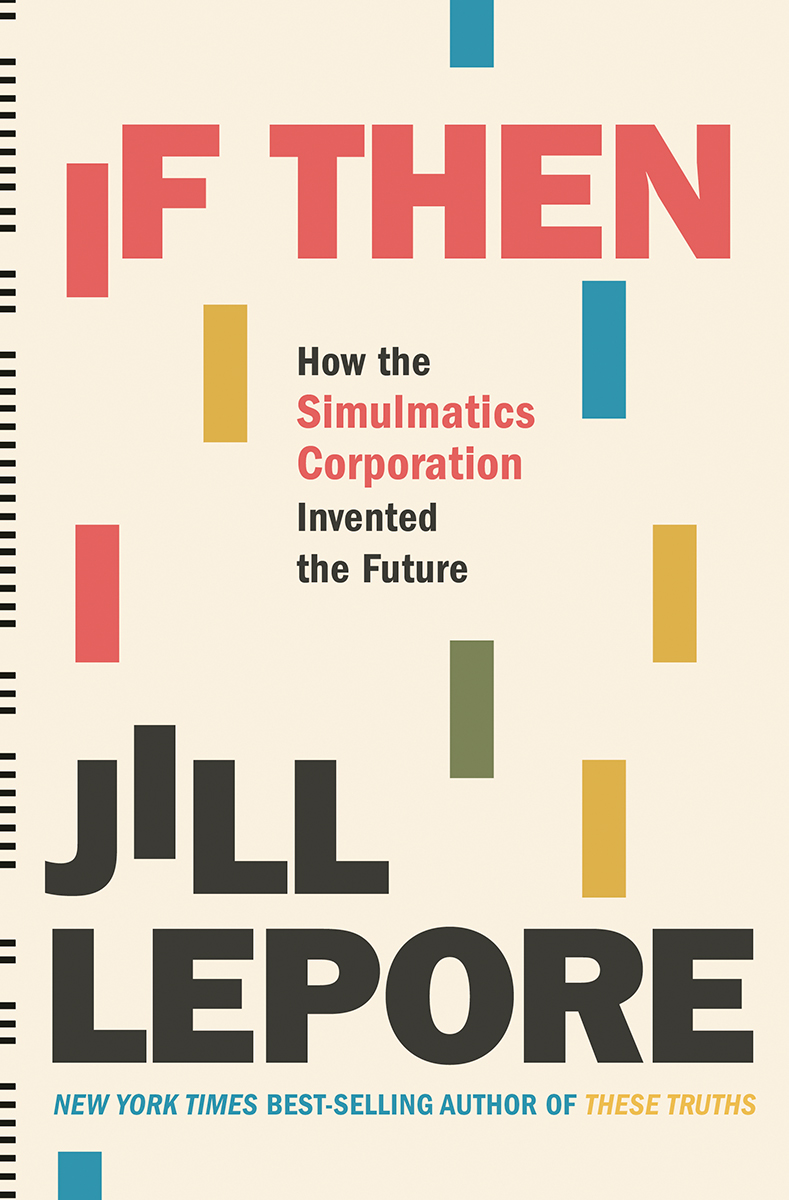
The Simulmatics Corporation, launched during the Cold War, mined data, targeted voters, manipulated consumers, destabilized politics, and disordered knowledge—decades before Facebook, Google, and Cambridge Analytica. Jill Lepore, best-selling author of These Truths, came across the company’s papers in MIT’s archives and set out to tell this forgotten history, the long-lost backstory to the methods, and the arrogance, of Silicon Valley.Founded in 1959 by some of the nation’s leading social scientists—“the best and the brightest, fatally brilliant, Icaruses with wings of feathers and wax, flying to the sun”—Simulmatics proposed to predict and manipulate the future by way of the computer simulation of human behavior. In summers, with their wives and children in tow, the company’s scientists met on the beach in Long Island under a geodesic, honeycombed dome, where they built a “People Machine” that aimed to model everything from buying a dishwasher to counterinsurgency to casting a vote. Deploying their “People Machine” from New York, Washington, Cambridge, and even Saigon, Simulmatics’ clients included the John F. Kennedy presidential campaign, the New York Times, the Department of Defense, and dozens of major manufacturers: Simulmatics had a hand in everything from political races to the Vietnam War to the Johnson administration’s ill-fated attempt to predict race riots. The company’s collapse was almost as rapid as its ascent, a collapse that involved failed marriages, a suspicious death, and bankruptcy. Exposed for false claims, and even accused of war crimes, it closed its doors in 1970 and all but vanished. Until Lepore came across the records of its remains.The scientists of Simulmatics believed they had invented “the A-bomb of the social sciences.” They did not predict that it would take decades to detonate, like a long-buried grenade. But, in the early years of the twenty-first century, that bomb did detonate, creating a world in which corporations collect data and model behavior and target messages about the most ordinary of decisions, leaving people all over the world, long before the global pandemic, crushed by feelings of helplessness. This history has a past; If Then is its cautionary tale.

BANCROFF PRIZE WINNER • King Philip's War, the excruciating racial war—colonists against Indigenous peoples—that erupted in New England in 1675, was, in proportion to population, the bloodiest in American history. Some even argued that the massacres and outrages on both sides were too horrific to "deserve the name of a war."The war's brutality compelled the colonists to defend themselves against accusations that they had become savages. But Jill Lepore makes clear that it was after the war—and because of it—that the boundaries between cultures, hitherto blurred, turned into rigid ones. King Philip's War became one of the most written-about wars in our history, and Lepore argues that the words strengthened and hardened feelings that, in turn, strengthened and hardened the enmity between Indigenous peoples and Anglos. Telling the story of what may have been the bitterest of American conflicts, and its reverberations over the centuries, Lepore has enabled us to see how the ways in which we remember past events are as important in their effect on our history as were the events themselves.

At a time of much despair over the future of liberal democracy, Jill Lepore makes a stirring case for the nation in This America, a follow-up to her much-celebrated history of the United States, These Truths.With dangerous forms of nationalism on the rise, Lepore, a Harvard historian and New Yorker staff writer, repudiates nationalism here by explaining its long history—and the history of the idea of the nation itself—while calling for a “new Americanism”: a generous patriotism that requires an honest reckoning with America’s past.Lepore begins her argument with a primer on the origins of nations, explaining how liberalism, the nation-state, and liberal nationalism, developed together. Illiberal nationalism, however, emerged in the United States after the Civil War—resulting in the failure of Reconstruction, the rise of Jim Crow, and the restriction of immigration. Much of American history, Lepore argues, has been a battle between these two forms of nationalism, liberal and illiberal, all the way down to the nation’s latest, bitter struggles over immigration.Defending liberalism, as This America demonstrates, requires making the case for the nation. But American historians largely abandoned that defense in the 1960s when they stopped writing national history. By the 1980s they’d stopped studying the nation-state altogether and embraced globalism instead. “When serious historians abandon the study of the nation,” Lepore tellingly writes, “nationalism doesn’t die. Instead, it eats liberalism.” But liberalism is still in there, Lepore affirms, and This America is an attempt to pull it out. “In a world made up of nations, there is no more powerful way to fight the forces of prejudice, intolerance, and injustice than by a dedication to equality, citizenship, and equal rights, as guaranteed by a nation of laws.”A manifesto for a better nation, and a call for a “new Americanism,” This America reclaims the nation’s future by reclaiming its past.

From New Yorker staff writer and Harvard historian Jill Lepore, the dark, spellbinding tale of her restless search for the long-lost, longest book ever written, a century-old manuscript called “The Oral History of Our Time.”Joe Gould, a madman, believed he was the most brilliant historian of the twentieth century. So did some of his friends, a group of modernist writers and artists that included E. E. Cummings, Marianne Moore, William Carlos Williams, John Dos Passos, and Ezra Pound. Gould began his life’s work before the First World War, announcing that he intended to write down nearly everything anyone ever said to him. “I am trying to preserve as much detail as I can about the normal life of every day people,” he explained, because “as a rule, history does not deal with such small fry.” By 1942, when The New Yorker published a profile of Gould written by the reporter Joseph Mitchell, Gould’s manuscript had grown to more than nine million words. But when Gould died in 1957, in a mental hospital, the manuscript was nowhere to be found. Then, in 1964, in “Joe Gould’s Secret,” a second profile, Mitchell claimed that “The Oral History of Our Time” had been, all along, merely a figment of Gould’s imagination. Lepore, unpersuaded, decided to find out. Joe Gould’s Teeth is a Poe-like tale of detection, madness, and invention. Digging through archives all over the country, Lepore unearthed evidence that “The Oral History of Our Time” did in fact once exist. Relying on letters, scraps, and Gould’s own diaries and notebooks—including volumes of his lost manuscript—Lepore argues that Joe Gould’s real secret had to do with sex and the color line, with modernists’ relationship to the Harlem Renaissance, and, above all, with Gould’s terrifying obsession with the African American sculptor Augusta Savage. In ways that even Gould himself could not have imagined, what Gould wrote down really is a history of our unsettling and ferocious.

Renowned Harvard scholar and New Yorker staff writer Jill Lepore has composed a strikingly original, ingeniously conceived, and beautifully crafted history of American ideas about life and death from before the cradle to beyond the grave.How does life begin? What does it mean? What happens when we die? “All anyone can do is ask,” Lepore writes. “That's why any history of ideas about life and death has to be, like this book, a history of curiosity.” Lepore starts that history with the story of a seventeenth-century Englishman who had the idea that all life begins with an egg and ends it with an American who, in the 1970s, began freezing the dead. In between, life got longer, the stages of life multiplied, and matters of life and death moved from the library to the laboratory, from the humanities to the sciences. Lately, debates about life and death have determined the course of American politics. Each of these debates has a history. Investigating the surprising origins of the stuff of everyday life—from board games to breast pumps—Lepore argues that the age of discovery, Darwin, and the Space Age turned ideas about life on earth topsy-turvy. “New worlds were found,” she writes, and “old paradises were lost.” As much a meditation on the present as an excavation of the past, The Mansion of Happiness is delightful, learned, and altogether beguiling.

New York Burning: Liberty, Slavery, and Conspiracy in Eighteenth-Century Manhattan
by Jill Lepore
Rating: 3.7 ⭐
Pulitzer Prize Finalist and Anisfield-Wolf Award WinnerIn New York Burning , Bancroft Prize-winning historian Jill Lepore recounts these dramatic events of 1741, when ten fires blazed across Manhattan and panicked whites suspecting it to be the work a slave uprising went on a rampage. In the end, thirteen black men were burned at the stake, seventeen were hanged and more than one hundred black men and women were thrown into a dungeon beneath City Hall. Even back in the seventeenth century, the city was a rich mosaic of cultures, communities and colors, with slaves making up a full one-fifth of the population. Exploring the political and social climate of the times, Lepore dramatically shows how, in a city rife with state intrigue and terror, the threat of black rebellion united the white political pluralities in a frenzy of racial fear and violence.

The Whites of Their Eyes: The Tea Party's Revolution and the Battle over American History
by Jill Lepore
Rating: 3.8 ⭐
Americans have always put the past to political ends. The Union laid claim to the Revolution--so did the Confederacy. Civil rights leaders said they were the true sons of liberty--so did Southern segregationists. This book tells the story of the centuries-long struggle over the meaning of the nation's founding, including the battle waged by the Tea Party, Glenn Beck, Sarah Palin, and evangelical Christians to "take back America." Jill Lepore, Harvard historian and New Yorker staff writer, offers a wry and bemused look at American history according to the far right, from the "rant heard round the world," which launched the Tea Party, to the Texas School Board's adoption of a social-studies curriculum that teaches that the United States was established as a Christian nation. Along the way, she provides rare insight into the eighteenth-century struggle for independence--the real one, that is. Lepore traces the roots of the far right's reactionary history to the bicentennial in the 1970s, when no one could agree on what story a divided nation should tell about its unruly beginnings. Behind the Tea Party's Revolution, she argues, lies a nostalgic and even heartbreaking yearning for an imagined past--a time less troubled by ambiguity, strife, and uncertainty--a yearning for an America that never was. The Whites of Their Eyes reveals that the far right has embraced a narrative about America's founding that is not only a fable but is also, finally, a variety of fundamentalism--anti-intellectual, antihistorical, and dangerously antipluralist.

TIME • 10 Best Books of August 2023A book to be read and kept for posterity, The Deadline is the art of the essay at its best. Few, if any, historians have brought such insight, wisdom, and empathy to public discourse as Jill Lepore. Arriving at The New Yorker in 2005, Lepore, with her panoptical range and razor-sharp style, brought a transporting freshness and a literary vivacity to everything from profiles of long-dead writers to urgent constitutional analysis to an unsparing scrutiny of the woeful affairs of the nation itself. The astonishing essays collected in The Deadline offer a prismatic portrait of Americans’ techno-utopianism, frantic fractiousness, and unprecedented―but armed―aimlessness. From lockdowns and race commissions to Bratz dolls and bicycles, to the losses that haunt Lepore’s life, these essays again and again cross what she calls the deadline , the “river of time that divides the quick from the dead.” Echoing Gore Vidal’s United States in its massive intellectual erudition, The Deadline , with its remarkable juxtaposition of the political and the personal, challenges the very nature of the essay―and of history―itself. 12 images

The U.S. Constitution is among the oldest constitutions in the world--and one of the most difficult to amend. At what cost? In this landmark, lavishly illustrated book, Harvard professor of history and law Jill Lepore argues that the philosophy of amendment is foundational to American constitutionalism. Challenging both originalism and the Supreme Court's monopoly on constitutional interpretation, Lepore argues that the framers never intended for the Constitution to be kept, like a butterfly, under glass, but instead expected that future generations would be forever tinkering with it, improving the machinery of government. In an account as radical as Charles Beard's An Economic Interpretation of the Constitution of the United States, Lepore offers a sweeping, lyrical, and democratic constitutional history, telling the stories of generations of Americans who have attempted everything from abolishing the Electoral College to guaranteeing environmental rights, hoping to mend America by amending its constitution.

In "The Story of America", Harvard historian and "New Yorker" staff writer Jill Lepore investigates American origin stories - from John Smith's account of the founding of Jamestown in 1607 to Barack Obama's 2009 inaugural address - to show how American democracy is bound up with the history of print. Over the centuries, Americans have read and written their way into a political culture of ink and type.Part civics primer, part cultural history, "The Story of America" excavates the origins of everything from the paper ballot and the Constitution to the I.O.U. and the dictionary. Along the way it presents fresh readings of Benjamin Franklin's "Way to Wealth", Thomas Paine's "Common Sense", "The Raven" by Edgar Allan Poe, and "Paul Revere's Ride" by Henry Wadsworth Longfellow, as well as histories of lesser-known genres, including biographies of presidents, novels of immigrants, and accounts of the Depression.From past to present, Lepore argues, Americans have wrestled with the idea of democracy by telling stories. In this thoughtful and provocative book, Lepore offers at once a history of origin stories and a meditation on storytelling itself.Here he lyes --A pilgrim passed I --The way to wealth --The age of Paine --We the parchment --I.O.U. --A Nue Merrykin Dikshunary --His Highness --Man of the people --Pickwick in America --The humbug --President Tom's cabin --Pride of the prairie --Longfellow's ride --Rock, paper, scissors --Objection --Chan the man --The uprooted --Rap sheet --To wit

Many historians and cultural observers argue we live in a post-truth world—but if truth is dead, who killed it? And how did it die? Join celebrated historian Jill Lepore as she cracks the case by examining key moments in the history of truth, doubt, and evidence across the last century.In Who Killed Truth? acclaimed Harvard historian and New Yorker staff writer Jill Lepore traces the origins of our current post-truth crisis. In a series of spellbinding stories, Lepore investigates murders, hoaxes, lies and delusions to reckon with the instability of truth and fiction in the twenty-first century. Listeners will follow Lepore through a fascinating, erudite, and antic journey through the thorny problem of how we know what we know, and why it seems sometimes as if we don’t know anything at all anymore. Revisiting key moments in U.S. history—from the Scopes Monkey Trial in 1925 to the 1977 National Women’s Convention to the first election predicted by computer, and more—Lepore uncovers the secrets of the past the way a detective might, hot on the trail of the killer of truth.Runtime: 13 hours, 40 minutes

A is for American: Letters and Other Characters in the Newly United States
by Jill Lepore
Rating: 3.7 ⭐
What ties Americans to one another? What unifies a nation of citizens with different racial, religious and ethnic backgrounds? These were the dilemmas faced by Americans in the eighteenth and nineteenth centuries as they sought ways to bind the newly United States together. In A is for American, award-winning historian Jill Lepore portrays seven men who turned to language to help shape a new nation’s character and boundaries. From Noah Webster’s attempts to standardize American spelling, to Alexander Graham Bell’s use of “Visible Speech” to help teach the deaf to talk, to Sequoyah’s development of a Cherokee syllabary as a means of preserving his people’s independence, these stories form a compelling portrait of a developing nation’s struggles. Lepore brilliantly explores the personalities, work, and influence of these figures, seven men driven by radically different aims and temperaments. Through these superbly told stories, she chronicles the challenges faced by a young country trying to unify its diverse people.

A panoptical vision of modern America, from the brilliant mind of Jill Lepore.The past decade has marked a shift in America's trajectory. Jill Lepore, the acclaimed writer and New Yorker columnist, has been tracing its contested storylines in real time, beginning with the run-up to Donald Trump's election, through to the chaos and confusion left in its wake. Here we encounter Americans' rising techno-utopianism, frantic fractiousness, and unprecedented - but armed - aimlessness.With the wit and verve that has made her the acclaimed national historian of a generation, these essays reflect on the consuming public fissures of this culture wars and the corrosion of the media; disruptive innovation and the future of technology; constitutional crises surrounding gun rights and the racial history behind the very language of insurrection. Balancing a penetrating personal lens with indispensable history, she makes sense of life in a moment of aberration and extremity that has left our political landscape forever changed.The American Beast offers an arresting portrait of America, capturing the tumultuous relationship between the country's violent past and fractured present.

From Columbus's voyage in 1492 to the publication of the autobiography of Olaudah Equiano, a former slave, in 1789, Jill Lepore, winner of the distinguished Bancroft Prize for history, brings to life in exciting, first-person detail some of the earliest events in American history in Encounters in the New World.Providing fascinating commentary along the way, Lepore seamlessly links together primary sources that illustrate the powerful clash of cultures in the Americas.

The United States was founded on a set of “self-evident” political equality, natural rights, and the sovereignty of the people. But how well has the nation—from its revolutionary birth to our fractious present—lived up to these founding ideals? In an absorbing, character-driven narrative, acclaimed historian Jill Lepore engages this urgent question. Now expanded into a two-volume textbook, the Inquiry Edition is a new kind of history text—one that highlights the importance of analyzing evidence and practicing historical inquiry to help students develop civic skills relevant to their lives far beyond the course.

Show your students the urgency of studying history The United States was founded on a set of “self-evident” political equality, natural rights, and the sovereignty of the people. But how well has the nation―from its revolutionary birth to our fractious present―lived up to these founding ideals? In an absorbing, character-driven narrative, acclaimed historian Jill Lepore engages this urgent question. Now expanded into a two-volume textbook, the Inquiry Edition is a new kind of history text―one that highlights the importance of analyzing evidence and practicing historical inquiry to help students develop civic skills relevant to their lives far beyond the course.


Please Note That The Following Individual Books As Per Original ISBN and Cover Image In this Listing shall be Dispatched Jill Lepore Collection 3 Books If In If Then, distinguished Harvard historian and New Yorker staff writer, Jill Lepore, unearths from the archives the almost unbelievable story of this long-vanished corporation, and of the women hidden behind it. In the 1950s and 1960s, Lepore argues, Simulmatics invented the future by building the machine in which the world now finds itself trapped and tormented, algorithm by algorithm. The Secret History of Wonder Drawing from an astonishing trove of documents, including never-before-seen private papers, Harvard historian and New Yorker staff writer Jill Lepore reveals the fascinating family story that sparked the invention of the most popular female superhero of all time. Delving into the life of Wonder Woman’s eccentric creator, psychologist William Moulton Marston, Lepore uncovers her feminist from the warrior princesses of the Amazon, to suffragists including Emmeline Pankhurst, and the women Marston shared his life with – his wife and his mistress. This With dangerous forms of nationalism on the rise, at a time of much despair over the future of liberal democracy, Harvard historian and New Yorker writer Jill Lepore makes a stirring case for the nation - and repudiates nationalism by explaining its long history.In part a primer on the origins of nations, The Case for the Nation explains how much of American history has been a battle between nationalism, liberal and illiberal, all the way down to the nation's latest, bitter struggles over immigration.


These Truths: A History of The United States
by Jill Lepore

These Truths: A History of the United States
by Jill Lepore
Show your students the urgency of studying history The United States was founded on a set of “self-evident” political equality, natural rights, and the sovereignty of the people. But how well has the nation―from its revolutionary birth to our fractious present―lived up to these founding ideals? In an absorbing, character-driven narrative, acclaimed historian Jill Lepore engages this urgent question. Now expanded into a two-volume textbook, the Inquiry Edition is a new kind of history text―one that highlights the importance of analyzing evidence and practicing historical inquiry to help students develop civic skills relevant to their lives far beyond the course.

The Whites of Their Eyes: The Tea Party's Revolution and the Battle Over American History
by Jill Lepore
Americans have always put the past to political ends. The Union laid claim to the Revolution - so did the Confederacy. Civil rights leaders said they were the true sons of liberty - so did Southern segregationists. This book tells the story of the centuries-long struggle over the meaning of the nation's founding, including the battle waged by the Tea Party, Glenn Beck, Sarah Palin, and evangelical Christians to "take back America".Jill Lepore, Harvard historian and New Yorker staff writer, offers a wry and bemused look at American history according to the far right, from the "rant heard round the world", which launched the Tea Party, to the Texas School Board's adoption of a social-studies curriculum that teaches that the United States was established as a Christian nation. Along the way, she provides rare insight into the 18th-century struggle for independence - the real one, that is. Lepore traces the roots of the far right's reactionary history to the bicentennial in the 1970s, when no one could agree on what story a divided nation should tell about its unruly beginnings.Behind the Tea Party's Revolution, she argues, lies a nostalgic and even heartbreaking yearning for an imagined past - a time less troubled by ambiguity, strife, and uncertainty - a yearning for an America that never was. The Whites of Their Eyes reveals that the far right has embraced a narrative about America's founding that is not only a fable, but is also, finally, a variety of fundamentalism - anti-intellectual, antihistorical, and dangerously antipluralist.

Het beest Amerika
by Jill Lepore
Messcherp portret van een verdeelde en stuurloze natieAmerika is in het afgelopen decennium ingrijpender veranderd dan in de vijftig jaar daarvoor en staat voor een cruciale fase in zijn geschiedenis. In twintig briljante beschouwingen ontrafelt Jill Lepore de tumultueuze troebelingen waaraan Amerika ten prooi is – in de politiek en het presidentschap van Donald Trump en de chaos die erop volgde, maar ook andere ontwikkelingen die de Amerikaanse samenleving ontwrichten. De cultuurstrijd, het verschil tussen arm en rijk, het afbrokkelen van de traditionele media, de macht van de Big Tech, de angst voor technologie en de constitutionele crisis rond gender, abortus, wapenbezit, rassenhaat en geweld.Met een scherp oog en een meesterlijke pen geeft Lepore duiding aan een tijdperk van polarisatie en extremisme dat het Amerikaanse politieke landschap voorgoed heeft veranderd.
Joe Gould's Secret
by Jill Lepore
Mansion of Happiness, The
by Jill Lepore