
Jessica Mitford
Jessica Lucy Freeman-Mitford was an English author, journalist and political campaigner, who was one of the Mitford sisters. She gained American citizenship in later life.
30 Books Written

Jessica Mitford, the great muckraking journalist, was part of a legendary English aristocratic family. Her sisters included Nancy, doyenne of the 1920s London smart set and a noted novelist and biographer; Diana, wife to the English fascist chief Sir Oswald Mosley; Unity, who fell head over in heels in love with Hitler; and Deborah, later the Duchess of Devonshire. Jessica swung left and moved to America, where she took part in the civil rights movement and wrote her classic expose of the undertaking business, The American Way of Death.Hons and Rebels is the hugely entertaining tale of Mitford's upbringing, which was, as she dryly remarks, not exactly conventional. . . Debo spent silent hours in the chicken house learning to do an exact imitation of the look of pained concentration that comes over a hen's face when it is laying an egg. . . . Unity and I made up a complete language called Boudledidge, unintelligible to any but ourselves, in which we translated various dirty songs (for safe singing in front of the grown-ups). But Mitford found her family's world as smothering as it was singular and, determined to escape it, she eloped with Esmond Romilly, Churchill's nephew, to go fight in the Spanish Civil War. The ensuing scandal, in which a British destroyer was dispatched to recover the two truants, inspires some of Mitford's funniest, and most pointed, pages.A family portrait, a tale of youthful folly and high-spirited adventure, a study in social history, a love story, Hons and Rebels is a delightful contribution to the autobiographer's art.

Only the scathing wit and searching intelligence of Jessica Mitford could turn an exposé of the American funeral industry into a book that is at once deadly serious and side-splittingly funny. When first published in 1963 this landmark of investigative journalism became a runaway bestseller and resulted in legislation to protect grieving families from the unscrupulous sales practices of those in "the dismal trade."Just before her death in 1996, Mitford thoroughly revised and updated her classic study. The American Way of Death Revisited confronts new trends, including the success of the profession's lobbyists in Washington, inflated cremation costs, the telemarketing of pay-in-advance graves, and the effects of monopolies in a death-care industry now dominated by multinational corporations. With its hard-nosed consumer activism and a satiric vision out of Evelyn Waugh's novel The Loved One, The American Way of Death Revisited will not fail to inform, delight, and disturb.

Before the turn of the century, the American funeral was simple "to the point of starkness," says Jessica Mitford, the acclaimed muckraking journalist who published this investigation of the country's funeral business in 1963. That the country went on to develop a tendency for gross overspending on funerals Mitford puts down to the greed and ingenuity of undertakers, whom she regards as salesmen guilty of pressuring families into agreeing to their excessive standards for burial. Mitford, who died recently, delivers facts and criticism in a forthright and humorous manner. She would certainly appreciate that her assessment of the American way of death endures after her own passing.

“Decca” Mitford lived a larger-than-life born into the British aristocracy—one of the famous (and sometimes infamous) Mitford sisters—she ran away to Spain during the Spanish Civil War with her cousin Esmond Romilly, Winston Churchill’s nephew, then came to America, became a tireless political activist and a member of the Communist Party, and embarked on a brilliant career as a memoirist and muckraking journalist (her funeral-industry exposé, The American Way of Death, became an instant classic). She was a celebrated wit, a charmer, and throughout her life a prolific and passionate writer of letters—now gathered here.Decca’s correspondence crackles with irreverent humor and mischief, and with acute insight into human behavior (and misbehavior) that attests to her generous experience of the worlds of politics, the arts, journalism, publishing, and high and low society. Here is correspondence with everyone from Katharine Graham and George Jackson, Betty Friedan, Miss Manners, Julie Andrews, Maya Angelou, Harry Truman, and Hillary Rodham Clinton to Decca’s sisters the Duchess of Devonshire and the novelist Nancy Mitford, her parents, her husbands, her children, and her grandchildren.In a profile of J.K. Rowling, The Daily Telegraph (UK), said, “Her favorite drink is gin and tonic, her least favorite food, trip. Her heroine is Jessica Mitford.”

Mitford's brave look at the funeral business, her attack on the Famous Writers School, and her war against a California University that insisted on fingerprinting her are accompanied by her running commentary on the strategies of muckraking journalism
The famous, once-notorious, still-controversial writer and political activist chronicles her girlhood in England, her years with the American Communist Party, and her latter-day adventures as America's premier muckraker

Three decades ago, Jessica Mitford became famous when she introduced us to the idiosyncracies of American funeral rites in The American Way of Death. Now in a book as fresh, provocative, and fearless as anything else she has written, she shows us how and in what circumstances Americans give birth. At the start, she knew no more of the subject, and not less, than any mother does. Recalling her experiences in the 1930s and 1940s of giving birth - in London, in Washington, D.C., and in Oakland, California - she observes, "A curious amnesia takes over in which all memory of the discomforts you have endured is wiped out, and your determination never, ever to do that again fast fades." But then, years later in 1989 - when her own children were adults, and birth a subject of no special interest to her - she meet a young woman, a midwife in Northern California who was being harassed by government agents and the medical establishment. Her sympathies, along with her reportorial instincts, were immediately stirred. There was a story there that needed to be explored and revealed. Far more than she anticipated then, she was at the beginning of an investigation that would lead her over the next three years to the writing of this extraordinary book. This is not a book about the miracle of life. It is about the role of money and politics in a lucrative industry; a saga of champagne birthing suites for the rich and desperate measures for the poor. It is a colorful history - from the torture and burning of midwives in medieval times, through the absurd pretensions of the modest Victorian age, to this century's vast succession of anaesthetic, technological, and "natural" birthing fashions. And it is a comprehensive indictment of the politics of birth and national health. Jessica Mitford explores conventional and alternative methods, and the costs of having a child. She gives flesh-and-blood meaning to the cold statistics. Daring to ask hard questions and skeptical of soft answers

A candid examination of American prison practices is based on the author's extensive research and workshop experiences as an inmate.

“The Making of a Muckraker is worth dropping everything for; it should be read from beginning to end, without missing a glorious word, and never on any account lent to friends.” –Brian Masters, Books and BookmenJessica Mitford, once called ‘Queen of the Muckrakers’ by Time, gives us a collection of her best articles including ‘Let Us Now Appraise Famous Writers,’ her near fatal attack on the Famous Writers school and ‘My Short and Happy Life as a Distinguished Professor,’ her war against fingerprinting by a Californian university. Her comments after each piece give an insight into the after-effects of each investigation. The introduction to the collection also serves as an excellent primer for reporting. Reporting, as she knows, is the best obtainable version of the truth. Then she shows us how to get there with grace, wit, cunning, style, imagination--and above all--a sense of enjoying the journey. “My favorite Mitford blasts...are sharp and witty exercises in counter- malevolence” –Clancy Sigal, Listener “Her best pieces are a delight because...Miss Mitford writes as she talks, with and enthusiasm for her subject.” --Robert Chesshyre, Observer.

Captures the drama of the heroic act performed by Grace Darling and her father when, in 1838, they rescued passengers of a capsized steamboat from the waters off the coast of Northumberland

The Trial of Dr. Spock, The Rev. William Sloane Coffin Jr., Michael Ferber, Mitchell Goodman, and Marcus Raskin
by Jessica Mitford
Rating: 3.8 ⭐
Five exemplary defendants, a cast-iron judge, an anachronistic indictment, a government determined to quell a particular flow of dissent - this is the picture that sharply emerges as Jessica Mitford chronicles at first hand the trial of Dr. the prosecution in Boston, in 1968, of the almost-legendary baby doctor and his four co-defendants on a charge of conspiracy to counsel, aid and abet violations of the Selective Service Act.

Biography of Philip Toynbee. From "Theodore Philip Toynbee (25 June 1916 - 15 June 1981) was a British writer and communist. He wrote experimental novels, and distinctive verse novels, one of which was an epic called Pantaloon, a work in several volumes, only some of which are published. He also wrote memoirs of the 1930s, and reviews and literary criticism, the latter mainly via his employment with The Observer newspaper. He was born in Oxford; his father was the historian Arnold J. Toynbee, and his maternal grandfather was Gilbert Murray. He was educated at Rugby School, where he became rebellious, reacting against the public school system. Inspired by the example of Esmond Romilly, later a friend, he ran away, returned shortly and was expelled. He later wrote a memoir of Romilly, and Jasper Ridley (1913-1944), entitled Friends Apart. Through Romilly, Toynbee met Jessica Mitford, who became a close friend......."

Wenige Familien aus der englischen Aristokratie vereinten die dünkelhaften, hinterweltlichen, aber auch die zuweilen radikal unkonventionellen Züge dieser Gesellschaftsschicht in so burlesker Konzentration auf sich wie die Mitfords in den dreißiger Jahren des 20. Jahrhunderts. Die Töchter aus diesem guten Hause heirateten Brauereierben und Faschisten, waren glühende Bewunderinnen von Adolf Hitler, gingen auf die Fuchsjagd und endlose Cocktailpartys – oder aber sie zogen für die Republik in den Spanischen Bürgerkrieg. Letzteres tat Jessica Mitford, die mit ihren Memoiren eines der vielleicht schönsten, komischsten und boshaftesten Porträts nicht nur ihres exzentrisch reaktionären Elternhauses schrieb. »Eine hinreißende Autobiografie.« Susanne Mayer, Die Zeit

First published in 1974, The American Prison Business studies the lunacies, the delusions, and the bizarre inner workings of the American prison business. From the first demonstration that the penitentiary is an American invention that was initiated by the late eighteenth-century reformers, to the startling revelations, in the chapter called ‘Cheaper than Chimpanzees’ of how pharmaceutical companies lease prisoners as human guinea-pigs, every page stimulates and surprises the reader as Jessica Mitford describes, inter alia the chemical, surgical and psychiatric techniques used to help ‘violent’ prisoners to be ‘reborn’; why businessmen tend to be more enthusiastic than the prisoners they employ in the ‘rent-a-con’ plan; and the Special Isolation Diet which tastes like inferior dog food. Jessica Mitford’s financial analysis of the prison business is a scoop. Her hard-eyed examination of how parole really works is a revelation. As the prison abolition movement continues to gain momentum, this book will provide food for thought for legislators, officials and students of sociology, law, criminology, penology, and history.

xxiii, 284p., boards edgeworn, else very good hardcover in an unclipped, yellowing and lightly edgeworn dust jacket. Italian edition of "The American way of death."
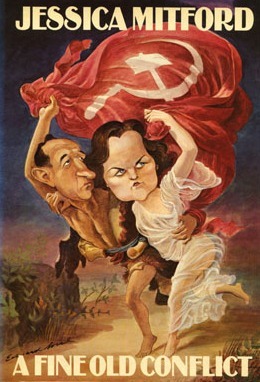
![1977 JESSICA MITFORD COMMUNIST FINE OLD CONFLICT LEFTWING MITFORD SISTER FIRST [Hardcover] JESSICA MITFORD](https://m.media-amazon.com/images/S/compressed.photo.goodreads.com/books/1696986630i/137786440.jpg)
1977 JESSICA MITFORD COMMUNIST FINE OLD CONFLICT LEFTWING MITFORD SISTER FIRST [Hardcover] JESSICA MITFORD
by Jessica Mitford
Jessica Mitford 2 Volumes Set: Poison Penmanship & The American Way of Death Revisited
by Jessica Mitford
Kind & Usual Business,The Prison System
by Jessica Mitford
Americki nacin umiranja
by Jessica Mitford

Kind and usual punishment
by Jessica Mitford
A candid examination of American prison practices is based on the author's extensive research and workshop experiences as an inmate. Bibliogs
Faces of Philip; a memoir of Philip Toynbee
by Jessica Mitford
Hons and Mitford - FIRST EDITION
by Jessica Mitford
The Trial Of Dr. Spock
by Jessica Mitford
The Trial of Dr. Spock: the Rev. William Sloane Coffin, Jr., MichaelFerber, Mitchell Goodman, and Marcus Raskin
by Jessica Mitford
Edward Sorel: Making the World Safe for Hypocrisy
by Jessica Mitford
The Trial of Dr. Spock
by Jessica Mitford
Poison penmanship; the gentle art of muckraking.
by Jessica Mitford
The Americana Way Of Death
by Jessica Mitford
Life Itselfmanship
by Jessica Mitford
The American Way of Birth by Jessica Mitford
by Jessica Mitford