
Jeffrey Eugenides
Jeffrey Kent Eugenides is an American author. He has written numerous short stories and essays, as well as three novels: The Virgin Suicides (1993), Middlesex (2002), and The Marriage Plot (2011). The Virgin Suicides served as the basis of the 1999 film of the same name, while Middlesex received the 2003 Pulitzer Prize for Fiction in addition to being a finalist for the National Book Critics Circle Award, the International Dublin Literary Award, and France's Prix Médicis.
14 Books Written

Are the great love stories of the nineteenth century dead? Or can there be a new story, written for today and alive to the realities of feminism, sexual freedom prenups, and divorce?It's the early 1980s. In American colleges, the wised-up kids are inhaling Derrida and listening to Talking Heads. But Madeleine Hannah, dutiful English major, is writing her senior thesis on Jane Austen and George Eliot, purveyors of the marriage plot that lies at the heart of the greatest English novels. As Madeleine studies the age-old motivations of the human heart, real life, in teh forms of two very different guys, intervenes --the charismatic and intense Leonard Bankhead, and her old friend the mystically inclined Mitchell Grammaticus. As all three of them face life in the real world, they will have to reevaluate everything they have learned. Jeffrey Eugenides creates a new kind of contemporary love story in "his most powerful novel yet" (Newsweek).

The National Bestseller from the Pulitzer Prize-Winning Author of Middlesex and The Marriage Plot With a New IntroductionFirst published in 1993, The Virgin Suicides announced the arrival of a major new American novelist. In a quiet suburb of Detroit, the five Lisbon sisters--beautiful, eccentric, and obsessively watched by the neighborhood boys--commit suicide one by one over the course of a single year. As the boys observe them from afar, transfixed, they piece together the mystery of the family's fatal melancholy, in this hypnotic and unforgettable novel of adolescent love, disquiet, and death. Jeffrey Eugenides evokes the emotions of youth with haunting sensitivity and dark humor and creates a coming-of-age story unlike any of our time. Adapted into a critically acclaimed film by Sofia Coppola, The Virgin Suicides is a modern classic, a lyrical and timeless tale of sex and suicide that transforms and mythologizes suburban middle-American life.

The astonishing tale of a gene that passes down through three generations of a Greek-American family and flowers in the body of a teenage girl.In the spring of 1974, Calliope Stephanides, a student at a girls' school in Grosse Pointe, finds herself drawn to a chain-smoking, strawberry blond classmate with a gift for acting. The passion that furtively develops between them--along with Callie's failure to develop--leads Callie to suspect that she is not like other girls. In fact, she is not really a girl at all.The explanation for this shocking state of affairs takes us out of suburbia- back before the Detroit race riots of 1967, before the rise of the Motor City and Prohibition, to 1922, when the Turks sacked Smyrna and Callie's grandparents fled for their lives. Back to a tiny village in Asia Minor where two lovers, and one rare genetic mutation, set in motion the metamorphosis that will turn Callie into a being both mythical and perfectly a hermaphrodite.Spanning eight decades--and one unusually awkward adolescence- Jeffrey Eugenides's long-awaited second novel is a grand, utterly original fable of crossed bloodlines, the intricacies of gender, and the deep, untidy promptings of desire.

The first collection of short fiction from the Pulitzer Prize-winning author Jeffrey EugenidesJeffrey Eugenides’s bestselling novels have shown him to be an astute observer of the crises of adolescence, self-discovery, family love, and what it means to be American in our times. The stories in Fresh Complaint explore equally rich—and intriguing—territory. Ranging from the bitingly reproductive antics of “Baster” to the dreamy, moving account of a young traveler’s search for enlightenment in “Air Mail” (selected by Annie Proulx for Best American Short Stories), this collection presents characters in the midst of personal and national emergencies. We meet a failed poet who, envious of other people’s wealth during the real-estate bubble, becomes an embezzler; a clavichordist whose dreams of art founder under the obligations of marriage and fatherhood; and, in “Fresh Complaint,” a high school student whose wish to escape the strictures of her immigrant family lead her to a drastic decision that upends the life of a middle-aged British physicist. Narratively compelling, beautifully written, and packed with a density of ideas despite their fluid grace, these stories chart the development and maturation of a major American writer.Complainers --Air mail --Baster --Early music --Timeshare --Find the bad guy --The oracular vulva --Capricious gardens --Great experiment --Fresh complaint

Das Paradies kann einem ganz schön auf den Magen schlagen. Was nützt schon der schönste Palmenstrand der Welt mit feinstem weißen Sand und blauer Lagune, wenn man von einer lästigen Darminfektion gezwungen wird, den lieben langen Tag in einer schäbigen Schilfhütte vor sich hin zu dösen? Kein Wunder, dass der Alternativ-Tourist und Backpacker Mitchell auf der abgelegenen Insel im Golf von Siam auf recht wundersame Gedanken kommt. Die Amöben, die in seinem Gedärm ihr Unwesen treiben, lösen bei dem jungen Amerikaner aus gutem Hause einen Anfall mystischer Sehnsucht aus. So erfüllt Mitchell ein unstillbares Verlangen, die große Harmonie von Leib, Geist und Natur zu erleben, und so die unmittelbaren körperlichen Bedürfnisse ebenso hinter sich zu lassen, wie die unerträgliche Banalität seiner Mitreisenden. Nachdem er sich mit einer rigorosen Fastenkur selbst geheilt hat, geht Mitchell schließlich ins Wasser, um endlich eins zu werden mit dem Paradies, dem Mond und den Amöben. Ganz andere Sorgen hat dagegen Wally Mars. Seine ehemalige Affäre und heimliche Liebe Tomasina Genovese wird getrieben vom unerbittlichen Ticken ihrer inneren Uhr, doch geeignete Männer werden für die erfolgreiche TV-Produzentin immer seltener. Da kommt ihr bei der Suche nach dem idealen Vater ihrer zukünftigen Kinder eine geniale Idee, die Wally jedoch ziemlich affig findet. Eine Schwangerschaftsparty der anderen Art, bei der Tomasina die anwesenden Herren, die ihr besonders geeignet erscheinen, um eine kleine genetische Spende bitten will. Wie Wally aus der Not eine Tugend macht und letztlich zum Hecht im Karpfenteich von Tomasinas geplantem Genpool avançiert, soll hier nicht verraten werden. Dieses Vergnügen sollten sich die Leser von Jeffrey Eugenides' kurzen und höchst einfallsreichen Geschichten nicht entgehen lassen. Jeffrey Eugenides ist ein begnadeter Geschichtenerzähler, was die Leser seiner Romane Die Selbstmord-Schwestern und vor allem dem grandiosen Middlesex in berechtigte Begeisterung versetzt hat. In diesen drei kurzen Erzählungen beweist der amerikanische Autor, der seit Jahren in Berlin lebt und arbeitet, seine Wandlungsfähigkeit und sein feines Gespür für die surrealen Nuancen alltäglicher Schicksale. Bei aller Ironie denunziert Eugenides seine Charaktere nie, sie bleiben trotz ihrer Marotten und mystischen Anwandlungen immer noch vertraut genug, um als Spiegelbild eigener Erfahrungen wirken zu können. So bleibt auch unter all dem vordergründigen Humor ein ernsteres Anliegen spürbar, das über den offensichtlichen Unterhaltungswert von Eugenides' Geschichten hinausweist. --Peter Schneck
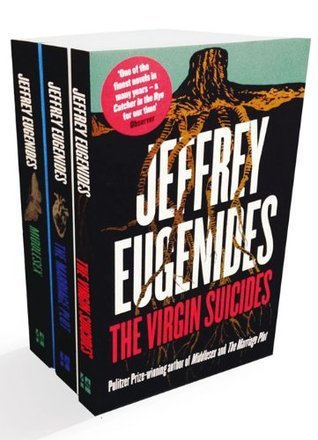
This collection brings together three novels from one of America’s great modern writers. ‘The Virgin Suicides’ – Five doomed sisters and the boys who loved them from afar. A hauntingly evocative tale that became a cult hit film by Sofia Coppola. ‘Middlesex’ – Calliope beloved daughter, son, enigma, and the deeply human narrator of this soaring epic. ‘The Marriage Plot’ – Three flawed individuals searching for different versions of the same ideal; three separate lives drawn irrevocably together. Illuminating and exquisitely written, in these three novels Eugenides explores the imperfections and vagaries of the human heart with unparalleled wit and essential reading for any lover of great fiction.


Free online fiction from the New Yorker. Published in 2018.

From the Pulitzer Prize-winning author of Middlesex and The Virgin Suicides comes an intimate memoir of his father’s spectacular rise–and tragic end.A few days before Thanksgiving 1994, Jeffrey Eugenides’s father, Gus, was piloting a small plane when it crashed in Daytona Beach, Florida. The circumstances surrounding his death added to the mystery of a life that defied expectations, but left many questions unanswered.Now, more than 30 years later, Eugenides tells the story of how his father, a first-generation American, rose from Detroit’s east side to find financial success as a mortgage banker and real estate developer–only to lose it all. Was he the victim of a series of bad breaks, or did his dogged pursuit of the American Dream lead him to overextend and overreach? And, ironically, what role did the U.S. government play in bringing ruin to this most patriotic of citizens?Written in an engaging style more direct than that of his novels, Eugenides appears here unmasked to deliver a moving account of his relationship with his indomitable father, a man for whom he felt admiration, exasperation, gratitude, tenderness, pity and love. Read by the author, this deeply personal audio journey invites listeners to join Eugenides as he finally confronts the truth of his father's last flight.Additional narration provided by Barrett Leddy, Neil Hellegers, and Vikas Adam.

German artist Thomas Demand occupies a singular position in the world of photography. Initially he took up photography to record his ephemeral paper constructions, but in 1993 he turned the tables by making constructions in order to photograph them. Demand begins by translating a preexisting image, usually culled from the media, into a life-size model he makes out of colored paper and cardboard. He recreates a room, a parking lot, a staircase, a landscape--then he photographs the model and destroys it. Demand's photographs appear at once compellingly real and strangely artificial. Since their subjects--handcrafted facsimiles of both architectural spaces and natural environments--are themselves built in the image of other images, the photographs are three times removed from the scenes they seek to depict. Combining craftsmanship and conceptualism in equal parts, Demand pushes the medium of photography toward uncharted frontiers. Given the cinematic quality of many of his photographs, it is not surprising that he has set some of them in motion, producing five 35 mm films. This comprehensive publication presents all of Demand's major works from 1993 to the present. It includes previously unpublished archival documentation, and offers compelling insight into his working process and the stories behind his pictures.


For the last 20 years, James Casebere has constructed increasingly complex small-scale architectural models that are carefully built and then subtly lit and photographed in the studio. These table-sized models are made of simple materials, pared down to essential forms, empty of both extraneous detail and action. Casebere's disconcerting ''sites'' recall prisons, monasteries, tunnels, factories and other such spaces. Casebere has gained increasing international acclaim in recent years as the leading proponent of what has become known as ''constructed photography.'' This is the first publication to comprehensively survey Casebere's career in its entirety, and provides an important contextual and visual framework in which to posit his soaring international reputation. His oeuvre can be seen in the full scope of its development, from his early preoccupation with the genre of the Western and the suburban home, to his concern with institutional buildings, to his recent investigations into the relationships between social control and social structures.