
Jeff Goodell
Jeff Goodell’s latest book is The Heat Will Kill You First: Life and Death on a Scorched Planet. He is the author of six previous books, including The Water Will Come: Rising Seas, Sinking Cities, and the Remaking of the Civilized World, which was a New York Times Critics Top Book of 2017. He has covered climate change for more than two decades at Rolling Stone and discussed climate and energy issues on NPR, MSNBC, CNN, CNBC, ABC, NBC, Fox News and The Oprah Winfrey Show. He is a Senior Fellow at the Adrienne Arsht-Rockefeller Foundation Resilience Center and a 2020 Guggenheim Fellow.
11 Books Written

The Water Will Come: Rising Seas, Sinking Cities, and the Remaking of the Civilized World
by Jeff Goodell
Rating: 4.1 ⭐
• 4 recommendations ❤️
What if Atlantis wasn't a myth but an early precursor to a new age of great flooding? Across the globe, scientists and civilians alike are noticing rapidly rising sea levels and higher and higher tides pushing more water directly into the places we live, from our most vibrant, historic cities to our last remaining traditional coastal villages. With each crack in the great ice sheets of the Arctic and Antarctica, and each tick upwards of Earth's thermometer, we are moving closer to the brink of broad disaster.By century's end, hundreds of millions of people will be retreating from the world's shores as our coasts become inundated and our landscapes transformed. From island nations to the world's major cities, coastal regions will disappear. Engineering projects to hold back the water are bold and may buy some time. Yet despite international efforts and tireless research, there is no permanent solution--no barriers to erect or walls to build--that will protect us in the end from the drowning of the world as we know it.The Water Will Come is the definitive account of the coming water, why and how this will happen, and what it will all mean. As he travels across twelve countries and reports from the front lines, acclaimed journalist Jeff Goodell employs fact, science, and first-person, on-the-ground journalism to show vivid scenes from what already is becoming a water world.

The world is waking up to a new wildfires are now seasonal in California, the Northeast is getting less and less snow each winter, and the ice sheets in the Arctic and Antarctica are melting fast. Heat is the first order threat that drives all other impacts of the climate crisis. And as the temperature rises, it is revealing fault lines in our governments, our politics, our economy, and our values. The basic science is not Stop burning fossil fuels tomorrow, and the global temperature will stop rising tomorrow. Stop burning fossil fuels in 50 years, and the temperature will keep rising for 50 years, making parts of our planet virtually uninhabitable. It’s up to us. The hotter it gets, the deeper and wider our fault lines will open. The Heat Will Kill You First is about the extreme ways in which our planet is already changing. It is about why spring is coming a few weeks earlier and fall is coming a few weeks later and the impact that will have on everything from our food supply to disease outbreaks. It is about what will happen to our lives and our communities when typical summer days in Chicago or Boston go from 90° F to 110°F. A heatwave, Goodell explains, is a predatory event— one that culls out the most vulnerable people. But that is changing. As heatwaves become more intense and more common, they will become more democratic. As an award-winning journalist who has been at the forefront of environmental journalism for decades, Goodell’s new book may be his most provocative yet, explaining how extreme heat will dramatically change the world as we know it. Masterfully reported, mixing the latest scientific insight with on-the-ground storytelling, Jeff Goodell tackles the big questions and uncovers how extreme heat is a force beyond anything we have reckoned with before.
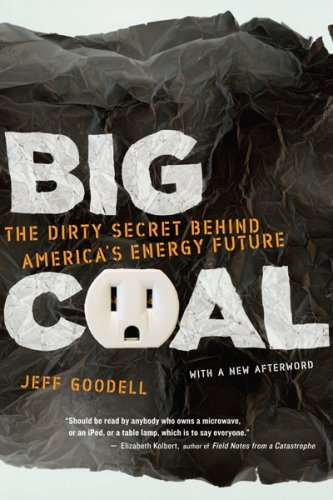
As oil prices increase, Coal has effectively become the default fuel for electricity generation in the twenty-first century. Goodell debunks the faulty assumptions underlying coal's revival and shatters the myth of cheap coal energy.In the tradition of Rachel Carson and Eric Schlosser, the veteran journalist Jeff Goodell examines the danger behind President George W. Bush's recent assertion that coal is America's "economic destiny." Despite a devastating, century-long legacy that has claimed millions of lives and ravaged the environment, coal has become hot again -- and will likely get hotter. In this penetrating analysis, Goodell debunks the faulty assumptions underlying coal's revival and shatters the myth of cheap coal energy. In a compelling blend of hard-hitting investigative reporting, history, and industry assessment, Goodell illuminates the stark economic imperatives America faces and the collusion of business and politics -- what is meant by "big coal" -- that have set us on the dangerous course toward reliance on this energy source.Few of us realize that even today we burn a lump of coal every time we flip on a switch. Coal already supplies more than half the energy needed to power our iPods, laptops, lights -- anything we use that consumes electricity. Our desire to find a homegrown alternative to Mideast oil, the rising cost of oil and natural gas, and the fossil fuel-friendly mood in Washington will soon push our coal consumption through the roof. Because we have failed to develop alternative energy sources, coal has effectively become the default fuel for the twenty-first century.

How to Cool the Planet: Geoengineering and the Audacious Quest to Fix Earth's Climate
by Jeff Goodell
Rating: 3.8 ⭐
Right now, a group of scientists is working on ways to minimize the catastrophic impact of global warming. But they’re not designing hybrids or fuel cells or wind turbines. They’re trying to lower the temperature of the entire planet. And they’re doing it with huge contraptions that suck CO2 from the air, machines that brighten clouds and deflect sunlight away from the earth, even artificial volcanoes that spray heat-reflecting particles into the atmosphere.This is the radical and controversial world of geoengineering, which only five years ago was considered to be "fringe." But as Jeff Goodell points out, the economic crisis, combined with global political realities, is making these ideas look sane, even inspired. Goodell himself started out as a skeptic, concerned about tinkering with the planet’s thermostat. We can’t even predict next week’s weather, so how are we going to change the temperature of whole regions? What if a wealthy entrepreneur shoots particles into the stratosphere on his own? Who gets blamed if something goes terribly wrong? And perhaps most disturbing, what about wars waged with climate control as the primary weapon? There are certainly risks, but Goodell believes the alternatives could be worse. In the end, he persuades us that geoengineering may just be our last best hope—a Plan B for the environment. His compelling tale of scientific hubris and technical daring is sure to jump-start the next big debate about the future of life on earth.

The entire nation stopped and held its collective breath as word spread of the plight of the nine Pennsylvania coal miners who were trapped underground for 77 hours. Now, for the first time, the miners tell their own story--in a dramatic, riveting first-person account of their actions and emotions and of how they managed to make it through the traumatic accident and rescue. The men were below ground when water trapped in an adjacent mine burst through the wall of the new mine they were working. Scrambling to avoid the sluicing tide that rapidly rose in the narrow passageway, the crew knew they were in serious trouble. Moe, who was trapped on the other side of the raging stream, alone and away from the others, thought he would die then and there. However, in a heroic effort, Randly Fogle, crew chief, drove the scoop machinery straight into the flood and Moe managed to leap into it, and thus was carried to relative safety. Now all together, the miners moved to the best location they could find in the freezing-cold, still-rising water. They recount their fears, their prayers, their confessions to one another, and how they kept up their hope that they'd get out alive, while trying to decide how to drown with dignity. Meanwhile, we see the agony their wives, girlfriends, and families were going through, not knowing if they were living or dead. Once a resuce was imminent, the men reveal how they decided who would be the last man up. And they tell of their emotions upon finally touching solid ground and meeting their loved ones, whom they'd thought they would never see again. The successful rescue of the miners lifted the spirits of an entire nation. Now everyone can read the complete story of this harrowing incident--how these men and their families had the strength, courage, and faith to endure their incredible ordeal.

In conjunction with Columbia Journalism Review's Covering Climate Change initiative, Rolling Stone contributing editor and leading environmental journalist Jeff Goodell takes us up close and personal to the world's coldest location - Western Antarctica - and to the foot of the Thwaites Glacier. Hear what it sounds like when ice melts and come to understand how the destabilization of this faraway shelf of ferociously beautiful ice will cause water levels to rise and overflow - much like a bathtub faucet might - across the globe. The consequences of what scientists have nicknamed "the Big Melt" could lead to flooding coastal cities from Africa and Asia to here in the United States in a matter of weeks - and may not stop for years. A team of international scientists are struggling to understand the physics of melting ice and how to potentially slow the drip. This is an environmental thriller with shattering real consequences for all of us.

In Sunnyvale, California, in 1979, Jeff Goodell's family lived quietly on Meadowlark Lane, unaware that their town was soon to become ground zero in the digital revolution. Over the course of the next decade, as Silicon Valley boomed, the Goodell family unraveled.Splintered by their parent's divorce, Jeff and his siblings careen toward self-destruction, while their parents end up on opposite sides of the technological divide: their mother succeeds beyond her wildest dreams at "a small company with a dopey rainbow-colored logo," called Apple, while their father refuses to keep up with the times and loses his landscaping business. Affecting and personal, Sunnyvale is a portrait of one family's fate in a brutally Darwinian world. It is also a thoughtful examination of what has happened to the American family in the face of the technological revolution.

Kevin Mitnick was the most wanted hacker in the world.He was called "The Condor," and "Mr. Cyberpunk." He was a rebel. A loner. A poor kid from California thumbing his nose at society as he hacked into phone companies, international corporations--and possibly even the U.S. Military Command.The FBI couldn't stop him. And they sure as hell couldn't catch him.Then Kevin Mitnick did the "impossible." He got into the personal home computer of the man considered by many a master of cybersecurity, Tsutomu Shimomura. That computer held data for advanced security systems and top secret intrusion and surveillance tools.Shimomura--a modern-day intellectual samurai--decided Mitnick had to be stopped. He had the high-tech gadgets and the brains to do it.Now the leading expert on computer crime made it a matter of honor to bring America's most notorious computer criminal to justice. But the Information Highway is the perfect place to run, hide and get away with dirty tricks...Let the battle begin.


The Water Will Come: Rising Seas, Sinking Cities, and the Remaking of the Civilized World
by Jeff Goodell
What if Atlantis wasn't a myth, but an early precursor to a new age of great flooding? Across the globe, scientists and civilians alike are noticing rapidly rising sea levels, and higher and higher tides pushing more water directly into the places we live, from our most vibrant, historic cities to our last remaining traditional coastal villages. With each crack in the great ice sheets of the Arctic and Antarctica, and each tick upwards of Earth's thermometer, we are moving closer to the brink of broad disaster. By century's end, hundreds of millions of people will be retreating from the world's shores as our coasts become inundated and our landscapes transformed. From island nations to the world's major cities, coastal regions will disappear. Engineering projects to hold back the water are bold and may buy some time. Yet despite international efforts and tireless research, there is no permanent solution-no barriers to erect or walls to build-that will protect us in the end from the drowning of the world as we know it. The Water Will Come is the definitive account of the coming water, why and how this will happen, and what it will all mean. As he travels across twelve countries and reports from the front lines, acclaimed journalist Jeff Goodell employs fact, science, and first-person, on-the-ground journalism to show vivid scenes from what already is becoming a water world. "An immersive, mildly gonzo and depressingly well-timed book about the drenching effects of global warming, and a powerful reminder that we can bury our heads in the sand about climate change for only so long before the sand itself disappears." (Jennifer Senior, New York Times)
![[( How to Cool the Planet: Geoengineering and the Audacious Quest to Fix Earth's Climate By Goodell, Jeff ( Author ) Paperback Apr - 2011)] Paperback](/placeholder.svg?height=400&width=300)