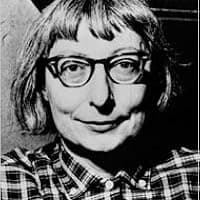
Jane Jacobs
Jane Jacobs, OC, O.Ont (May 4, 1916 – April 25, 2006) was an American-born Canadian writer and activist with primary interest in communities and urban planning and decay. She is best known for The Death and Life of Great American Cities (1961), a powerful critique of the urban renewal policies of the 1950s in the United States. The book has been credited with reaching beyond planning issues to influence the spirit of the times. Along with her well-known printed works, Jacobs is equally well-known for organizing grassroots efforts to block urban-renewal projects that would have destroyed local neighborhoods. She was instrumental in the eventual cancellation of the Lower Manhattan Expressway, and after moving to Canada in 1968, equally influential in canceling the Spadina Expressway and the associated network of highways under construction.
15 Books Written

In this eye-opening work of economic theory, Jane Jacobs argues that it is cities—not nations—that are the drivers of wealth. Challenging centuries of economic orthodoxy, in Cities and the Wealth of Nations the beloved author contends that healthy cities are constantly evolving to replace imported goods with locally-produced alternatives, spurring a cycle of vibrant economic growth. Intelligently

Systems of Survival: A Dialogue on the Moral Foundations of Commerce and Politics
by Jane Jacobs
Rating: 4.1 ⭐
With intelligence and clarity of observation, the author of The Death and Life of Great American Cities addresses the moral values that underpin working life.In Systems of Survival , Jane Jacobs identifies two distinct moral syndromes—one governing commerce, the other, politics—and explores what happens when these two syndromes collide. She looks at business fraud and criminal enterpri

Jane Jacobs, writing from her adoptive country, uses the problems facing an independence-seeking Quebec and Canada as a whole to examine the universal problem of sovereignty and autonomy that nations great and small have struggled with throughout history. Using Norway’s relatively peaceful divorce from Sweden as an example, Jacobs contends that Canada and Canadians—Quebecois and Anglophones alike—

Edge of Empire examines struggles over urban space in three contemporary first world cities in an attempt to map the real geographies of colonialism and postcolonialism as manifest in modern society. From London, the one-time heart of the empire, to Perth and Brisbane, scenes of Aboriginal claims for the sacred in the space of the modern city, Jacobs emphasises the global geography of the local an

A selection of essays exploring the future of Toronto as a citystate. Contributors Jane Jacobs, Joe Berridge, David Crombie, Meric S. Gertler, Richard Gilbert, David Nowlan, Michael Mendelson, John Sewell and Enid Slack,


From the revered author of the classic The Death and Life of Great American Cities comes a new book that will revolutionize the way we think about the economy.Starting from the premise that human beings "exist wholly within nature as part of natural order in every respect," Jane Jacobs has focused her singular eye on the natural world in order to discover the fundamental models for a v

The thesis of this book is that cities are the primary drivers of economic development. Her main argument is that explosive economic growth derives from urban import replacement. Import replacement occurs when a city begins to locally produce goods that it formerly imported, e.g., Tokyo bicycle factories replacing Tokyo bicycle importers in the 1800s. Jacobs claims that import replacement builds u

In this indispensable book, urban visionary Jane Jacobs argues that as agrarianism gives way to a technology-based future, we’re at risk of cultural collapse. Jacobs—renowned author of The Death and Life of Great American Cities and The Economy of Cities —pinpoints five pillars of our culture that are in serious community and family; higher education; the effective practice of science; taxation

A direct and fundamentally optimistic indictment of the short-sightedness and intellectual arrogance that has characterized much of urban planning in this century, The Death and Life of Great American Cities has, since its first publication in 1961, become the standard against which all endeavors in that field are measured. In prose of outstanding immediacy, Jane Jacobs writes about what ma

The collection of lectures and publications from the Schumacher Center for a New Economics represents some of the foremost voices on a new economics.According to Jane Jacobs the healthiest economic regions are those which have strong and innovative import-replacing cities of their own. The economies of such city-regions are shaped and reshaped by complex, economically enlivening, inte

“Jane Jacobs is the kind of writer who produces in her readers such changed ways of looking at the world that she becomes an oracle, or final authority.” —The New York SunHailed by the New York Times Book Review as “perhaps the single most influential work in the history of town planning,” Jane Jacobs’s The Death and Life of Great American Cities was instantly recognized as a masterpie

A career-spanning selection of previously uncollected writings and talks by the legendary author and activistNo one did more to change how we look at cities than Jane Jacobs, the visionary urbanist and economic thinker whose 1961 book The Death and Life of Great American Cities started a global conversation that remains profoundly relevant more than half a century later.<

The Girl on the Hat
by Jane Jacobs

The Select Reader
by Jane Jacobs