
James Ellroy
Lee Earle "James" Ellroy is an American crime fiction writer and essayist. Ellroy has become known for a telegrammatic prose style in his most recent work, wherein he frequently omits connecting words and uses only short, staccato sentences, and in particular for the novels The Black Dahlia (1987) and L.A. Confidential (1990).
29 Books Written

Ellroy's back with the third of his LA Quartet! Christmas 1951, Los Angeles: a city where the police are as crooked as the criminals.Six prisoners are beaten senseless in their cells by cops crazed on alcohol. For the three L.A.P.D. detectives involved, it will expose the guilty secrets on which they have built their corrupt and violent careers...The novel takes these cops on a sprawling epic of brutal violence and the murderous seedy side of Hollywood. One of the best (and longest) crime novels ever written, it is the heart of Ellroy's four-novel masterpiece, the LA Quartet, and an example of crime writing at its most powerful.

We are behind, and below, the scenes of JFK's presidential election, the Bay of Pigs, the assassination—in the underworld that connects Miami, Los Angeles, Chicago, D.C....Where the CIA, the Mob, J. Edgar Hoover, Howard Hughes, Jimmy Hoffa, Cuban political exiles, and various loose cannons conspire in a covert anarchy...Where the right drugs, the right amount of cash, the right murder, buys a moment of a man's loyalty...Where three renegade law-enforcement officers—a former L.A. cop and two FBI agents—are shaping events with the virulence of their greed and hatred, riding full-blast shotgun into history....James Ellroy's trademark nothing-spared rendering of reality, blistering language, and relentless narrative pace are here in electrifying abundance, put to work in a novel as shocking and daring as anything he's written: a secret history that zeroes in on a time still shrouded in secrets and blows it wide open.Chosen by Time magazine as one of the ten best books of the year."Hard-bitten ... ingenious ... Ellroy segues into political intrigue without missing a beat." —The New York Times"Vastly entertaining." —Los Angeles Times"One hellishly exciting ride." —Detroit Free Press"A supremely controlled work of art." —The New York Times Book Review

Two gritty hard-boiled mysteries of the criminal underworld by a New York Times– bestselling author and a CWA Gold Dagger–winning author.A modern master of the noir novel, James Ellroy is “one of the great American writers of our time” ( Los Angeles Times ). And Edward Bunker is a CWA Gold Dagger–winning author, whose classic novel inspired Quentin Tarantino to cast him in Reservoir Dogs . Now two of these California writers’ most famous mysteries are available in one volume.Blood on the Moon by James Lloyd Hopkins is one of Los Angeles’s finest detectives. He’s also a sex addict and an insomniac who breaks the rules to solve his toughest cases. After a psychotic serial killer called “the poet” murders twenty women, he must face his biggest challenge to catch the think like a madman. The first novel in Ellroy’s Lloyd Hopkins trilogy, this noir classic was adapted into the 1988 film Cop , starring James Woods.No Beast So Fierce by Edward After eight years in San Quentin, Max Dembo is free. He has aspirations and even a modicum of faith in the future. But with a history of bad choices, an apathetic parole officer, and no job prospects, Max gives sway to the pervasive temptations of the only life he knows. Based on his own experiences in San Quentin State Prison, Bunker wrote a strikingly authentic story that Quentin Tarantino called “the best first person crime novel I have ever read.”

Pensai che le foto mi avrebbero ferito.Pensai che le foto mi avrebbero rimesso i vecchi incubi.Pensai che avrei toccato con mano l’orrore e in qualche modo ridotto il mio ergastolo.Mi sbagliavo. Quella donna rifiutò di accordarmi la sospensione della pena. Lo faceva su basi molto semplici: La mia morte ti ha dato voce, mi diceva, e ora pretendo che tu la riconosca, la riconosca al di là dello sfruttamento che ne hai fatto.James Ellroy, L’assassino di mia madre***«Nessun autore di romanzo giallo riuscirebbe mai a concepire storie del genere».Corrado Augias***James Ellroy era un ragazzino quando suo padre gli regalò The Badge di Jack Webb: una raccolta di storie tratte dalla cronaca, casi mai risolti, delitti efferati. Tra tutti, uno lo affascinò e lo sconvolse fino a diventare un’ossessione: era il racconto dell’omicidio di Elisabeth Short, la Dalia Nera, una giovane donna su cui l’assassino (mai identificato) si era accanito con una crudeltà inimmaginabile. Anche la madre di Ellroy era stata uccisa; anche l’indagine sul suo assassinio non aveva portato alcun risultato. Due omicidi che mettono in gioco dimensioni opposte – pubblico e privato, partecipazione e voyeurismo – accomunati dall’assenza di ogni spiegazione logica. A leggerne i resoconti, la domanda che si vorrebbe annotare a margine di ogni pagina è sempre la stessa: perché? Si tratta di trovare un colpevole, certo, ma neppure la condanna più spietata cancella l’inquietudine che nasce dall’assenza di movente. Follia, così la chiamiamo, anche quando le perizie psichiatriche assicurano il contrario.Che si sia arrivati a una sentenza o che il caso sia rimasto senza soluzione, le storie che compongono Menti criminali oltrepassano la soglia di un mondo oscuro che ci ripugna ma che insieme ci attrae. Come nei gialli migliori, anche in questo libro ci sono commissari ostinati, indizi, ricostruzioni e intuizioni. Solo che qui, alla fine, niente torna. La coerenza narrativa si dissolve nell’imprevedibilità dell’azione umana, la mente irrazionale – la mente criminale – impedisce ogni trama. Ed è solo a posteriori, solo dopo che la realtà ha scritto le sue storie inimmaginabili, che le possiamo raccontare.Questo libro è una raccolta dei più interessanti e celebrati articoli di true crime degli ultimi trent’anni, scritti da alcune delle firme più note del giornalismo americano, da Alec Wilkinson, John Dunne e David Grann.Ad aprire l’antologia è il testo di James Ellroy, in cui lo scrittore americano ricostruisce l’omicidio della madre. Il testo che lo segue è proprio il resoconto delle indagini sulla morte della Dalia Nera che tanto impressionò Ellroy. Attore, produttore, creatore della serie prima radiofonica poi televisiva di fine anni Quaranta Dragnet, basata su casi autentici della polizia di Los Angeles, Jack Webb raccolse in The Badge i delitti piú scabrosi, quelli che non potevano finire in televisione.Ne Gli omicidi di Humboldt, John Dunne – il giornalista e scrittore, marito di Joan Didion – trascorre alcune settimane in Nebraska per immergersi nella comunità testimone, il 31 dicembre 1993, di un triplice omicidio. Tra le vittime Teena Renae Brandon, una ragazza transgender (da questa storia verrà tratto il film Boys Don’t Cry).In Conversazioni con un killer, Alec Wilkinson accompagna il lettore in un allucinante viaggio nella vita, ma soprattutto nella mente, di John Wayne Gacy, il più efferato serial killer della storia americana: in un reportage che ha fatto la storia del giornalismo di inchiesta, Wilkinson riesce a entrare in confidenza con Gacy e a “dare voce”, una voce tanto autentica quanto disturbante, all’omicida.E ancora: una moderna Medea, l’antropofago della porta accanto, indagini da far sfigurare Csi, lo scrittore che realizza l’omicidio che ha romanzato…«Casi celebri - scrive il curatore Francesco Guglieri nella postfazione - che hanno travalicato i confini della cronaca giornalistica per entrare stabilmente nell’immaginario collettivo, plasmando, spesso in un modo di cui ormai siamo inconsapevoli, i modelli con cui costruiamo i personaggi di romanzi e pellicole». E prosegue: «Come genere letterario il true crime, al pari dei resoconti degli avvistamenti degli ufo, ha qualcosa a che fare con il prodigioso, se non proprio col fantastico: è il racconto dell’irruzione del mostruoso nell’ordinario, dell’inspiegabile apparizione di qualcosa di monstre, di troppo grande per le categorie con cui abitualmente affrontiamo il quotidiano. Non è un caso che James Gordon Bennet, il mitico fondatore dell’Herald, definisca, nel 1842, il true crime (genere in cui lui stesso si cimentò) il “sublime dell’orrore”. Un sublime metropolitano».

On January 15, 1947, the torture-ravished body of a beautiful young woman is found in a vacant lot. The victim makes headlines as the Black Dahlia—and so begins the greatest manhunt in California history. Caught up in the investigation are Bucky Bleichert and Lee Blanchard: Warrants Squad cops, friends, and rivals in love with the same woman. But both are obsessed with the Dahlia—driven by dark needs to know everything about her past, to capture her killer, to possess the woman even in death. Their quest will take them on a hellish journey through the underbelly of postwar Hollywood, to the core of the dead girl's twisted life, past the extremes of their own psyches—into a region of total madness.

This work is set in 1950s, Los Angeles. The City of Angels has become the city of the Angel of Death. Communist witch-hunts and insanely violent killings are terrorising the community. Three men are plunged into a malestrom of violence and deceit when their lives become inextricably linked as each one confronts his own personal darkness.

The internationally acclaimed author of the L.A. Quartet and The Underworld USA Trilogy, James Ellroy, presents another literary noir masterpiece of historical paranoia .Los Angeles, 1958. Killings, beatings, bribes, shakedowns--it's standard procedure for Lieutenant Dave Klein, LAPD. He's a slumlord, a bagman, an enforcer--a power in his own small corner of hell. Then the Feds announce a full-out investigation into local police corruption, and everything goes haywire.Klein's been hung out as bait, "a bad cop to draw the heat," and the heat's coming from all from local politicians, from LAPD brass, from racketeers and drug kingpins--all of them hell-bent on keeping their own secrets hidden. For Klein, "forty-two and going on dead," it's dues time.Klein tells his own story--his voice clipped, sharp, often as brutal as the events he's describing--taking us with him on a journey through a world shaped by monstrous ambition, avarice, and perversion. It's a world he created, but now he'll do anything to get out of it alive.Fierce, riveting, and honed to a razor edge, White Jazz is crime fiction at its most shattering.

The internationally acclaimed author of the L.A. Quartet and The Underworld USA Trilogy, James Ellroy, presents another literary noir masterpiece of historical paranoia .In this savagely audacious novel, James Ellroy plants a pipe bomb under the America in the 1960s, lights the fuse, and watches the shrapnel fly. On November 22, 1963 three men converge in Dallas. Their to clean up the JFK hit’s loose ends and inconvenient witnesses. They are Wayne Tedrow, Jr., a Las Vegas cop with family ties to the lunatic right; Ward J. Littell, a defrocked FBI man turned underworld mouthpiece; and Pete Bondurant, a dope-runner and hit-man who serves as the mob’s emissary to the anti-Castro underground.It goes bad from there. For the next five years these night-riders run a whirlwind of plots and Howard Hughes’s takeover of Vegas, J. Edgar Hoover’s war against the civil rights movement, the heroin trade in Vietnam, and the murders of Martin Luther King, Jr. and Bobby Kennedy. Wilder than L. A. Confidential, more devastating than American Tabloid, The Cold Six Thousand establishes Ellroy as one of our most fearless novelists.

From the author of L.A. Confidential comes My Dark Places, an investigative autobiography by James Ellroy. In 1958, Ellroy's mother, Jean, was raped, killed, and dumped off a road in El Monte, California, a rundown L.A. suburb. The killer was never found, and the case was closed. It was a sordid, back-page homicide that no one remembered. Except her son.James Ellroy was ten years old when his mother died. His bereavement was complex and ambiguous: "I cried. I cranked tears out all the way to L.A. I hated her. I hated El Monte. Some unknown killer just bought me a brand-new beautiful life." He grew up obsessed with murdered women and crime. He ran from his mother's ghost.Ellroy became a writer of radically provocative and bestselling crime novels. "I wear obsession well," he says. "I've turned it into something." He tried to reclaim his mother through fiction. It didn't work. He quit running and wrote this memoir.My Dark Places is Jean and James Ellroy's story—from 1958 to all points past and up to this moment. It is the story of a brilliant homicide detective named Bill Stoner and of the investigation he and Ellroy undertook. It is also an unflinching autobiography with vivid reportage. This is James Ellroy's journey through his most forbidding memories.

America's master of noir delivers his masterpiece, a rip-roaring, devilishly wild ride through the bloody end of the 1960's. It's dark baby, and hot hot hot. Martin Luther King assassinated. Robert Kennedy assassinated. Los Angeles, 1968. Conspiracies theories are taking hold. On the horizon looms the Democratic Convention in Chicago and constant gun fire peppers south L.A. Violence, greed, and grime, are replacing free-love and everybody from Howard Hughes, Richard Nixon and J. Edgar Hoover to the right-wing assassins and left-wing revolutionaries are getting dirty. At the center of it all is a triumvirate: the president’s strong-arm goon, an ex-cop and heroine runner, and a private eye whose quarry is so dangerous she could set off the whole powder keg. With his trademark deadly staccato prose, James Ellroy holds nothing back in this wild, startling and much anticipated conclusion to his Underworld USA trilogy. From the Trade Paperback edition.

The Japanese have bombed Pearl Harbor. The United States teeters on the edge of war. The roundup of allegedly treasonous Japanese Americans is about to begin. And in L.A., a Japanese family is found dead. Murder or ritual suicide? The investigation will draw four people into a totally Ellroy-ian tangle: a brilliant Japanese American forensic chemist; an unsatisfiably adventurous young woman; one police officer based in fact (William H. "Whiskey Bill" Parker, later to become the groundbreaking chief of the LAPD), the other the product of Ellroy's inimitable imagination (Dudley Smith, arch villain of The Big Nowhere, L.A. Confidential, White Jazz). As their lives intertwine, we are given a story of war and of consuming romance, a searing exposé of the Japanese internment, and an astonishingly detailed homicide investigation. In Perfidia, Ellroy delves more deeply than ever before into his characters' intellectual and emotional lives. But it has the full-strength, unbridled story-telling audacity that has marked all the acclaimed work of the Demon Dog of American Crime Fiction.

Fred Underhill is a young cop on the rise in Los Angeles in the early 1950's -- a town blinded to its own grime by Hollywood glitter; a society nourished by newspaper lies that wants its heroes all-American and squeaky clean. A chance to lead on a possible serial killing is all it takes to fuel Underhill's reckless ambition - and it propels him into a dangerous alliance with certain mad and unstable elements of the law enforcement hierarchy. When the case implodes with disastrous consequences, it is Fred Underhill who takes the fall. His life is in ruins, his promising future suddenly a dream of the past. And his good and pure love for a crusading woman lawyer has been corrupted and may not survive. But even without the authority of a badge, Fred Underhill knows that his only hope for redemption lies in following the investigation to its grim conclusion. And the Hell to which he has been consigned for his sins is the perfect place to hunt for a killer who hungers but has no soul.

Fritz Brown's L.A.--and his life--are masses of contradictions, like stirring chorales sung for the dead. A less-than-spotless former cop with a drinking problem--a private eye-cum-repo man with a taste for great music--he has been known to wallow in the grime beneath the Hollywood glitter. But Fritz Brown's life is about to change, thanks to the appearance of a racist psycho who flashes too much cash for a golf caddie and who walked away clean from a multiple murder rap. Reopening this cas could be Fritz's redemption; his welcome back to a moral world and his path to a pure and perfect love. But to get there, he must make it through a grim, lightless place where evil has no national borders; where lies beget lies and death begets death; where there's little tolerance for Bach or Beethoven and deadly arson is a lesser mortal sin; and where a p.i.'s unhealthy interest in the past can turn beautiful music into funeral dirge.

Set in Los Angeles from 1947 to 1959, Hollywood Nocturnes gives us an afterword and six stories set in the same crime-ridden, sex-crazed period of history of James Ellroy's L.A. Quartet novels (which include L.A. Confidential and The Big Nowhere ).Dig the swinging sax man's doing repos and plotting a kidnapping-of himself; a tommy gun is ripping apart windows, curtains, and bodies in High Darktown; a carhop at Scrivner's is keeping two extremely sweet sugar daddies, Howard Hughes and mobster Mickey Cohen, happy-until the scene turns murderous.This is the hip-hop hard-edged world of L.A. 1950s cars with fins, Commies in closets, starmakers with come-ons, ex-cons with guns, and cops with mean streaks as wide as Sunset Strip.James Ellroy's bizarre, stark tales dazzle us with their unexpected humor, raw brutality, and slightly lighter-than-usual noir realism. Hollywood Nocturnes is quintessential bluesy, black, and very, very hot.

Detective Sergeant Lloyd Hopkins can’t stand music, or any loud sounds. He’s got a beautiful wife, but he can’t get enough of other women. And instead of bedtime stories, he regales his daughters with bloody crime stories. He’s a thinking man’s cop with a dark past and an obsessive drive to hunt down monsters who prey on the innocent. Now, there’s something haunting him. He sees a connection in a series of increasingly gruesome murders of women committed over a period of twenty years. To solve the case, Hopkins will dump all the rules and risk his career to make the final link and get the killer.

Martin Michael Plunkett is a product of his times -- the possessor of a genius intellect, a pitiless soul of brushed steel, and a heart of blackest evil. With criminal tendencies forged in the fires of L.A.'s Charles Manson hysteria, he comes to the bay city of San Francisco -- and submits to savage and terrible impulses that reveal to him his true vocation as a pure and perfect murderer. And so begins his decade of discovery and terror, as he cuts a bloody swath across the full length of a land, ingeniously exploiting and feeding upon a society's obsessions. As he maneuvers deftly through a seamy world of drugs, flesh, and perversions, the media will call him many things -- but Martin Plunkett's real name is Death. His brilliant, twisted mind is a horriying place to explore. His madness reflects a nation's own. The killer is on the road. And there's nowhere in America to hide.

From "one of the great American writers of our time" (Los Angeles Times Book Review)--a brilliant historical crime novel, a pulse-pounding, as-it-happens narrative that unfolds in Los Angeles and Mexico in the wake in Pearl Harbor.New Year's Eve 1941, war has been declared and the Japanese internment is in full swing. Los Angeles is gripped by war fever and racial hatred. Sergeant Dudley Smith of the Los Angeles Police Department is now Army Captain Smith and a budding war profiteer. He's shacked up with Claire De Haven in Baja, Mexico, and spends his time sniffing out fifth column elements and hunting down a missing Japanese Naval Attaché. Hideo Ashida is cashing LAPD paychecks and working in the crime lab, but he knows he can't avoid internment forever. Newly arrived Navy Lieutenant Joan Conville winds up in jail accused of vehicular homicide, but Captain William H. Parker squashes the charges and puts her on Ashida's team. Elmer Jackson, who is assigned to the alien squad and to bodyguard Ashida, begins to develop an obsession with Kay Lake, the unconsummated object of Captain Parker's desire. Now, Conville and Ashida become obsessed with finding the identity of a body discovered in a mudslide. It's a murder victim linked to an unsolved gold heist from '31, and they want the gold. And things really heat up when two detectives are found murdered in a notorious dope fiend hang-out.

Los Angeles. In no other city do sex, celebrity, money, and crime exert such an irresistible magnetic field. And no writer has mapped that field with greater savagery and savvy than James Ellroy. With this fever-hot collection of reportage and short fiction, he returns to his native habitat and portrays it as a smog-shrouded netherworld where"every third person is a peeper, prowler, pederast, or pimp."From the scandal sheets of the 1950s to this morning's police blotter, Ellroy reopens true crimes and restores human dimensions to their victims. Sublimely, he resurrects the rag Hush-Hush magazine. And in a baroquely plotted novella of slaughter and corruption he enlists the forgotten luminaries of a lost Hollywood. Shocking, mesmerizing, and written in prose as wounding as an ice pick, Crime Wave is Ellroy at his best.

A hardcover compendium of three detective novels by the author of L.A. Confidential, the basis of the motion picture, includes Blood on the Moon, Because the Night, and Suicide Hill. 50,000 first printing.

A botched liquor store heist leaves three grisly dead. A hero cop is missing. Nobody could see a pattern in these two stray bits of information–no one except Detective Sergeant Lloyd Hopkins, a brilliant and disturbed L.A. cop with an obsessive desire to protect the innocent. To him they lead to one horrifying conclusion--a killer is on the loose and preying on his city. From the master of L.A. noir comes this beautiful and brutal tale of a cop and a criminal squared off in a life and death struggle.

Freddy is an ex-L.A. cop on the skids. He snuffed a cop killer in cold blood - and it got to him bad. Now he's a sleazoid private eye, a shakedown artist, a pimp - and, most notably, the head strongarm goon for Confidential magazine.Welcome to the world of the malevolent monarch of the Hollywood underground - a tale of pervasive paranoia teeming with communist conspiracies, FBI finks, celebrity smut films and strange bedfellows.
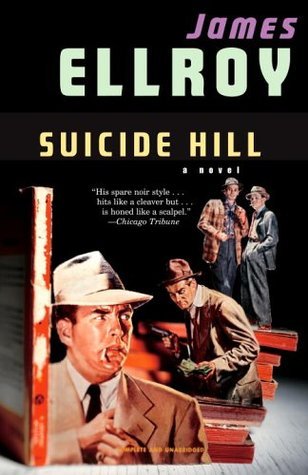
Detective Sergeant Lloyd Hopkins is the most brilliant homicide detective in the Los Angeles Police Department and one of its most troubled. In his obsessive mission to protect the innocent, there is no line he won’t cross. Estranged from his wife and daughters and on the verge of being drummed out of the department for his transgressions, Hopkins is assigned to investigate a series of bloody bank robberies. As the violence escalates and the case becomes ever more vicious, Hopkins will be forced to cross the line once again to stop a maniac on a murder binge.

James Ellroy—Demon Dog of American Letters—goes straight to the tragic heart of 1962 Hollywood with a wild riff on the Marilyn Monroe death myth in an astonishing, behind-the-headlines crime epic.Los Angeles, August 4, 1962. The city broils through a midsummer heat wave. Marilyn Monroe ODs. A B-movie starlet is kidnapped. The overhyped LAPD overreacts. Chief Bill Parker’s looking for some getback. The Monroe deal looks like a moneymaker. He calls in Freddy Otash. The freewheeling Freddy tainted ex-cop, defrocked private eye, dope fiend, and freelance extortionist. A man who lives by the maxim “Opportunity is love.” Freddy gets to work. He dimly perceives Marilyn Monroe’s death and the kidnapped starlet to be a poisonous riddle that only he has the guts and the brains to untangle. We are with him as he tears through all those who block his path to the truth. We are with him as he penetrates the faux -sunshine of Jack and Bobby Kennedy and the shuck of Camelot. We are with him as he falters, and grasps for love beyond opportunity. We are with him as he tracks Marilyn Monroe’s horrific last charade through a nightmare L.A. that he served to create — and as he confronts his complicity and his own raging madness. It’s the Summer of ’62, baby. Freddy O’s got a hot date with history. The savage Sixties are ready to pop. It’s just a shot away.The Enchanters is a transcendent work of American popular fiction. It is James Ellroy at his most crazed, brilliant, provocative, profanely hilarious, and stop-your-heart tender. It is a luminous psychological drama and an unparalleled thrill ride. It is, resoundingly, the great American crime novel.

From “one of the great American writers of our time” (Los Angeles Times Book Review): a raw, explicit memoir as high-intensity and riveting as any of his novels.The year was 1958. James Ellroy was ten years old. His mother, Jean Hilliker, had divorced her fast-buck hustler husband. She gave her son a choice: live with his father or her. He chose his father, and Jean—“half gassed”—attacked him. He wished her dead. Three months later, she was murdered.Ellroy writes, “I owe her for every true thing that I am. I must remove the malediction I have placed on her and on myself,” and in The Hilliker Curse, he narrates his quest for “atonement in women.” He unsparingly describes his shattered childhood, his delinquent teens, his writing life, his love affairs and marriages, a nervous breakdown and the beginning of a relationship with an extraordinary woman who may just be the long-sought Her. It is a layered narrative of time and place, emotion and insight, sexuality and spiritual quest. And all of it is reported with gut-wrenching and heart-rending candor.A brilliant and soul-baring revelation of self—and unlike any memoir you have ever read.

Dig. The Demon Dog gets down with a new book of scenes from America’s capital of Los Angeles. Fourteen pieces, some fiction, some nonfiction, all true enough to be admissible as state’s evidence, and half of it in print for the first time. And every one of them bearing the James Ellroy brand of mayhem, machismo, and hollow-nose prose.Here are Mexican featherweights and unsolved-murder vics, crooked cops and a very clean D.A. Here is a profile of Hollywood’s latest celebrity perp-walker, Robert Blake, and three new novellas featuring a demented detective with an obsession with a Hollywood actress. And, oh yes, just maybe the last appearance of Hush-Hush sleaze-monger Danny Getchell. Here’s Ellroy himself, shining a 500-watt Mag light into all the dark places of his life and imagination. Morgue! puts the reader’s attention in a hammerlock and refuses to let go.

This Dudley Smith omnibus edition consists of: "The Big Nowhere", "L.A. Confidential" and "White Jazz".

James Ellroy is an American original of the most profane order. The bestselling author of the noir classics L.A. Confidential, The Black Dahlia, and The Cold Six Thousand, he has been hailed by the Los Angeles Times as "one of the best writers of our era." A self-proclaimed Luddite, Ellroy is turning to technology for the first time with the publication of Shakedown, a novella released by the digital publisher Byliner. In it, Ellroy is as frenetically depraved as ever, minting an antihero who is a cad for the ages.Meet Freddy Otash: a corrupt cop turned sleaze hustler, extortionist, pimp, and an actual historical figure who made the 1950s magazine Confidential the go-to source for the sins of the rich and famous. In his prime, Freddy raised hell, and in the pages of Shakedown he finds himself stuck in purgatory—-literally—-waiting for a transfer to heaven. Will he make it there, or will fate keep him down below? Promised redemption if he confesses his past sins and transgressions, Freddy writes a tell-all peopled by Hollywood greats like Elizabeth Taylor, Marilyn Monroe, John Wayne, and James Dean (to name a few) who are up to all sorts of wrong. Threesomes, foursomes, you name it—-anything goes in this licentious world.Shakedown explodes the postwar America of June and Ward Cleaver, breathing randy new life into the man who whetted our national appetite for sex and scandal. Freddy's lack of scruples—-and lack of morality—-make today's gossip culture seem almost innocent. What's true and what's fiction? Ellroy's certainly not telling.

James Ellroy, the undisputed master of crime writing, has teamed up with the Los Angeles Police Museum to present a stunning text on 1953 LA. While combing the museum’s photo archives, Ellroy discovered that the year featured a wide array of stark and unusual imagery—and he has written 25,000 words that illuminate the crimes and law enforcement of the era. Ellroy offers context and layers on wild and rich atmosphere—this is the cauldron that was police work in the city of the tarnished angels more than six decades ago. More than 80 duotone photos are spread throughout the book in the manner of hard-edged police evidence.

The L.A. Quartet: The Black Dahlia / The Big Nowhere / L.A. Confidential / White Jazz
by James Ellroy
Rating: 4.5 ⭐
Here in one volume is James Ellroy's first great body of work, an epic re-envisioning of postwar Los Angeles--etched in red and black and film-noir grays.The Black Dahlia depicts the secret infrastructure of L.A.'s most sensational murder case. A young cop morphs into obsessed lover and lust-crazed avenger. The Dahlia claims him. She is the deus ex machina of a boomtown in extremis. The cop's rogue investigation is a one-way ticket to hell.The Big Nowhere blends the crime novel and the political novel. It is winter, 1950--and the L.A. County Grand Jury is out to slam movieland Reds. It's a reverential shuck--and the three cops assigned to the job are out to grab all the glory they can. A series of brutal sex killings intervenes, and the job goes all-the-way bad.L.A. Confidential is the great novel of Los Angeles in the 1950s. Political corruption. Scandal-rag journalism. Bad racial juju and gangland wars. Six local stiffs slaughtered in an all-night hash house. The glorious and overreaching LAPD on an unprecedented scale.White Jazz gives us the tortured confession of a corrupt cop going down for the count. He's a slumlord, a killer, a parasitic exploiter. He's a pawn in a series of police power plays and starting to see that he's being had. He's just met a woman. Thus, he's determined to claw his way out of the horrifying world he's created--and he's determined to tell us everything.The L.A. Quartet is a groundbreaking work of American popular fiction.