
Jakob Schwichtenberg
12 Books Written

Physics from Finance: A gentle introduction to gauge theories, fundamental interactions and fiber bundles
by Jakob Schwichtenberg
Rating: 4.4 ⭐
• 2 recommendations ❤️
Understanding modern physics doesn’t have to be confusing and hard What if there was an intuitive way to understand how nature fundamentally works? What if there was a book that allowed you to see the whole picture and not just tiny parts of it? Thoughts like this are the reason that Physics from Finance now exists. What will you learn from this book? Get to know all fundamental interactions —Grasp how we can describe electromagnetic interactions, weak interactions, strong interactions and gravity using the same key ideas. Learn how to describe modern physics mathematically — Understand the meaning and origin of the Einstein equation, Maxwell’s equations, and the Schrödinger equation. Develop an intuitive understanding of key concepts — Read how we can understand abstract ideas like Gauge Symmetry, Internal Spaces, Gauge Fields, Connections and Curvature using a simple toy model of the financial market. Get an understanding you can be proud of — Learn why fiber bundles and group theory provide a unified framework for all modern theories of physics. Physics from Finance is the most reader-friendly book on the geometry of modern physics ever written. Here’s why. First of all, it's is nothing like a formal university lecture. Instead, it’s like a casual conservation with a more experienced student. This also means that nothing is assumed to be “obvious” or “easy to see”. Each chapter, each section, and each page focusses solely on the goal to help you understand. Nothing is introduced without a thorough motivation and it is always clear where each formula comes from. The book contains no fluff since unnecessary content quickly leads to confusion. Instead, it ruthlessly focusses on the fundamentals and makes sure you’ll understand them in detail. The primary focus on the readers’ needs is also visible in dozens of small features that you won’t find in any other textbook In total, the book contains more than 100 illustrations that help you understand the most important concepts visually. Whenever a concept is used which was already introduced previously, there is a short sidenote that reminds you where it was first introduced and often recites the main points. In addition, helpful diagrams make sure you won’t get lost.
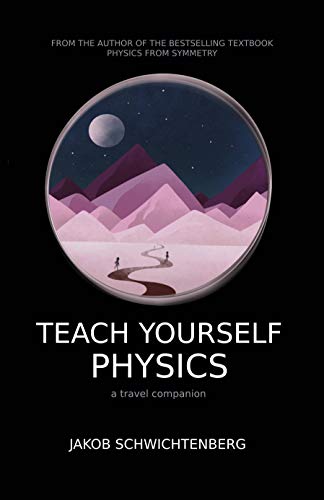
This is a handbook containing all the advice and recommendations about learning physics I wished someone had told me when I was younger. It is neither a career guide nor a comprehensive textbook. What’s inside?Understand why self-learning is an effective strategy. Learn why most university students never develop a deep understanding and what alternatives are possible.Grasp the internal structure of physics. Learn how the fundamental theories of physics are connected and why physics works at all.Develop an understanding of the landscape. Read bird's eye overviews that give a first taste of what the various theories of physics are all about.Everything you need to get started. Read detailed reading and learning recommendations that allow you to carve out a personal learning path.

This is a textbook that derives the fundamental theories of physics from symmetry. It starts by introducing, in a completely self-contained way, all mathematical tools needed to use symmetry ideas in physics. Thereafter, these tools are put into action and by using symmetry constraints, the fundamental equations of Quantum Mechanics, Quantum Field Theory, Electromagnetism, and Classical Mechanics are derived.As a result, the reader is able to understand the basic assumptions behind, and the connections between the modern theories of physics. The book concludes with first applications of the previously derived equations.

No-Nonsense Classical Mechanics: A Student-Friendly Introduction
by Jakob Schwichtenberg
Rating: 4.7 ⭐
Learning classical mechanics doesn’t have to be hard What if there was a way to learn classical mechanics without all the usual fluff? What if there were a book that allowed you to see the whole picture and not just tiny parts of it? Thoughts like this are the reason that No-Nonsense Classical Mechanics now exists. What will you learn from this book? No-Nonsense Classical Mechanics is the most student-friendly book on classical nechanics ever written. Here’s why. The primary focus on the readers’ needs is also visible in dozens of small features that you won’t find in any other textbook

Learning quantum mechanics doesn’t have to be hardWhat if there was a way to learn quantum mechanics without all the usual fluff and mystification? What if there were a book that allowed you to see the whole picture and not just tiny parts of it?Thoughts like this are the reason that No-Nonsense Quantum Mechanics now exists.What will you learn from this book?Get to know the fundamental quantum features — grasp how different nature works at the level of elementary particles.Learn how to describe quantum mechanics mathematically — understand the origin and meaning of the most important quantum the Schrödinger equation + the canonical commutation relations.Master the most important quantum systems — read step-by-step calculations and understand the general algorithm we use to describe them.Get an understanding you can be proud of — learn why there are alternative frameworks to describe quantum mechanics and how they are connected to the standard wave description.No-Nonsense Quantum Mechanics is the most student-friendly book on quantum mechanics ever written.Here’s why.First of all, it's nothing like a formal university lecture. Instead, it’s like a casual conservation with a more experienced student. This also means that nothing is assumed to be “obvious” or “easy to see”.Each chapter, each section, and each page focuses solely on the goal to help you understand. Nothing is introduced without a thorough motivation and it is always clear where each equation comes from.The book contains no fluff since unnecessary content quickly leads to confusion. Instead, it ruthlessly focuses on the fundamentals and makes sure you’ll understand them in detail.The primary focus on the readers’ needs is also visible in dozens of small features that you won’t find in any other textbookIn total, the book contains more than 100 illustrations that help you understand the most important concepts in visually.In each chapter, you’ll find fully annotated equations and calculations are done carefully step-by-step. This makes it much easier to understand what’s going on. Whenever a concept is used that was already introduced previously there is a short sidenote that reminds you where it was first introduced and often recites the main points. In addition, there are summaries at the beginning of each chapter that make sure you won’t get lost.

Learning Electrodynamics doesn’t have to be boring What if there was a way to learn Electrodynamics without all the usual fluff? What if there were a book that allowed you to see the whole picture and not just tiny parts of it? Thoughts like this are the reason that No-Nonsense Electrodynamics now exists. What will you learn from this book? No-Nonsense Electrodynamics is the most student-friendly book on Electrodynamics ever written. Here’s why. The primary focus on the readers’ needs is also visible in dozens of small features that you won’t find in any other textbook

No-Nonsense Quantum Field Theory: A Student-Friendly Introduction
by Jakob Schwichtenberg
Rating: 4.7 ⭐
Learning quantum field theory doesn’t have to be hard What if there were a book that allowed you to see the whole picture and not just tiny parts of it? Thoughts like this are the reason that No-Nonsense Quantum Field Theory now exists. What will you learn from this book? No-Nonsense Quantum Field Theory is one the most student-friendly book on quantum field theory ever written. Here’s why. The primary focus on the readers’ needs is also visible in dozens of small features that you won’t find in any other textbook

No-Nonsense Quantum Mechanics: The Ultimate No Holds Barred Guide To The Quantum World
by Jakob Schwichtenberg
Rating: 4.0 ⭐
Learning Quantum Mechanics doesn’t have to be hardWhat if there was a way to learn Quantum Mechanics without all the usual fluff and mystification? What if there was a book that allowed you to see the whole picture and not just tiny parts of it?Thoughts like this are the reason that No-Nonsense Quantum Mechanics now exists.What will you learn from this book?Get to know the fundamental quantum features — grasp how different nature works at the level of elementary particles.Learn how to describe Quantum Mechanics mathematically — understand the origin and meaning of the most important quantum the Schrödinger equation + the canonical commutation relations.Master the most important quantum systems — read step-by-step calculations and understand the general algorithm we use to describe them.Get an understanding you can be proud of — learn why there are alternative frameworks to describe Quantum Mechanics and how they are connected to the standard wave description.No-Nonsense Quantum Mechanics is the most student-friendly book on Quantum Mechanics ever written.Here’s why.First of all, it's is nothing like a formal university lecture. Instead, it’s like a casual conservation with a more experienced student. This also means that nothing is assumed to be “obvious” or “easy to see”.Each chapter, each section, and each page focusses solely on the goal to help you understand. Nothing is introduced without a thorough motivation and it is always clear where each equation comes from.The book contains no fluff since unnecessary content quickly leads to confusion. Instead, it ruthlessly focusses on the fundamentals and makes sure you’ll understand them in detail.The primary focus on the readers’ needs is also visible in dozens of small features that you won’t find in any other textbookIn total, the book contains more than 100 illustrations that help you understand the most important concepts in visually.In each chapter, you’ll find colorized equations and calculations are done carefully step-by-step. This makes it much easier to understand what’s going on in.- Whenever a concept is used that was already introduced previously there is a short sidenote that reminds you where it was first introduced and often recites the main points.- In addition, there are summaries at the beginning of each chapter that make sure you won’t get lost.

Durch Symmetrie die moderne Physik verstehen: Ein neuer Zugang zu den fundamentalen Theorien
by Jakob Schwichtenberg
Rating: 5.0 ⭐
Auf der Basis von Symmetrie-Überlegungen bietet dieses Buch eine einzigartige Herleitung der fundamentalen Theorien der Physik. Dafür werden zunächst alle mathematische Werkzeuge eingeführt, die der Leser benötigt, um mit Symmetrien in der Physik zu arbeiten. Hierbei wird jedoch nur gewöhnliche Schulmathematik vorausgesetzt. Anschließend werden diese Werkzeuge benutzt, um durch Symmetrie-Überlegungen die fundamentalen Gleichungen der Quantenmechanik, Quantenfeldtheorie, Elektrodynamik und Klassischen Mechanik herzuleiten. So ist der Leser in der Lage, die Basis-Annahmen hinter und die Verbindungen zwischen den modernen Theorien der Physik zu verstehen. Im letzten Teil des Buches werden dann Anwendungen der zuvor hergeleiteten Gleichungen besprochen. Das Buch richtet sich an alle, die sich ein tieferes Verständnis der modernen Physik wünschen. Anfänger und Selbstlerner erhalten durch die "Symmetrie-Perspektive" einen schnellen, aber tiefen Überblick über die moderne Physik. Erfahrene Studierende können durch den unkonventionellen Blickwinkel ihr Verständnis vertiefen und Wissenslücken füllen. Nachdem das Buch "Physics From Symmetry" Leser in aller Welt begeisterte, erscheint nun mit "Physik und Symmetrie" eine verbesserte deutsche Version.

Physics from Symmetry
by Jakob Schwichtenberg
Part Foundations.- Introduction.- Special Relativity.- Part Symmetry Tools.- Lie Group Theory.- The Framework.- Part The Equations of Nature.- Measuring Nature.- Free Theory.- Interaction Theory.- Part Applications.- Quantum Mechanics.- Quantum Field Theory.- Classical Mechanics.- Electrodynamics.- Gravity.- Closing Words.- Part Appendices.- Vector Calculus.- Calculus.- Linear Algebra.- Additional Mathematical Notions.

Physics from Symmetry
by Jakob Schwichtenberg
This is a textbook that derives the fundamental theories of physics from symmetry. It starts by introducing, in a completely self-contained way, all mathematical tools needed to use symmetry ideas in physics. Thereafter, these tools are put into action and by using symmetry constraints, the fundamental equations of Quantum Mechanics, Quantum Field Theory, Electromagnetism, and Classical Mechanics are derived. As a result, the reader is able to understand the basic assumptions behind, and the connections between the modern theories of physics. The book concludes with first applications of the previously derived equations. Thanks to the input of readers from around the world, this second edition has been purged of typographical errors and also contains several revised sections with improved explanations.

Physics from Symmetry
by Jakob Schwichtenberg
This is a textbook that derives the fundamental theories of physics from symmetry.It starts by introducing, in a completely self-contained way, all mathematical tools needed to use symmetry ideas in physics. Thereafter, these tools are put into action and by using symmetry constraints, the fundamental equations of Quantum Mechanics, Quantum Field Theory, Electromagnetism, and Classical Mechanics are derived.As a result, the reader is able to understand the basic assumptions behind, and the connections between the modern theories of physics. The book concludes with first applications of the previously derived equations.