
Jacob S. Hacker
10 Books Written

Let Them Eat Tweets: How the Right Rules in an Age of Extreme Inequality
by Jacob S. Hacker
Rating: 4.0 ⭐
• 2 recommendations ❤️
The Republican Party appears to be divided between a tax-cutting old guard and a white-nationalist vanguard, and with Donald Trump’s ascendance, the upstarts seem to be winning. Yet how are we to explain that, under Trump, the plutocrats have gotten almost everything they want, including a huge tax cut for corporations and the wealthy, regulation-killing executive actions, and a legion of business-friendly federal judges? Does the GOP represent “forgotten” Americans? Or does it represent the superrich?In Let Them Eat Tweets, best-selling political scientists Jacob S. Hacker and Paul Pierson offer a definitive answer: The Republican Party serves its plutocratic masters to a degree without precedent in modern global history. Conservative parties, by their nature, almost always side with the rich, but when faced with popular resistance, they usually make concessions, allowing some policies that benefit the working and middle classes. After all, how can a political party maintain power in a democracy if it serves only the interests of a narrow and wealthy slice of society?Today’s Republicans have shown the way, doubling down on a truly radical, elite-benefiting economic agenda while at the same time making increasingly incendiary racial and cultural appeals to their almost entirely white base. Telling a forty-year story, Hacker and Pierson demonstrate that since the early 1980s, when inequality started spiking, extreme tax cutting, union busting, and deregulation have gone hand in hand with extreme race-baiting, outrage stoking, and disinformation. Instead of responding to the real challenges facing voters, the Republican Party offers division and distraction—most prominently, in the racist, nativist bile of President Trump's Twitter feed.As Hacker and Pierson argue, Trump isn’t a break with the GOP’s recent past. On the contrary, he embodies its tightening embrace of plutocracy and right-wing extremism—a dynamic Hacker and Pierson call “plutocratic populism.” As Trump and his far-right allies spew hatred and lies, Republicans in Congress and in statehouses attack social programs and funnel more and more money to the top 0.1 percent of Americans. Far from being at war with each other, reactionary plutocrats and right-wing populists have become the two faces of a party that now actively undermines democracy to achieve its goals against the will of the majority of Americans.Drawing on decades of research, Hacker and Pierson authoritatively explain the doom loop of tax cutting and fearmongering that characterizes our era—and reveal how we can fight back.

Winner-Take-All Politics: How Washington Made the Rich Richer and Turned Its Back on the Middle Class
by Jacob S. Hacker
Rating: 4.0 ⭐
A groundbreaking work that identifies the real culprit behind one of the great economic crimes of our time— the growing inequality of incomes between the vast majority of Americans and the richest of the rich. We all know that the very rich have gotten a lot richer these past few decades while most Americans haven’t. In fact, the exorbitantly paid have continued to thrive during the current economic crisis, even as the rest of Americans have continued to fall behind. Why do the “haveit- alls” have so much more? And how have they managed to restructure the economy to reap the lion’s share of the gains and shift the costs of their new economic playground downward, tearing new holes in the safety net and saddling all of us with increased debt and risk? Lots of so-called experts claim to have solved this great mystery, but no one has really gotten to the bottom of it—until now. In their lively and provocative Winner-Take-All Politics, renowned political scientists Jacob S. Hacker and Paul Pierson demonstrate convincingly that the usual suspects—foreign trade and financial globalization, technological changes in the workplace, increased education at the top—are largely innocent of the charges against them. Instead, they indict an unlikely suspect and take us on an entertaining tour of the mountain of evidence against the culprit. The guilty party is American politics. Runaway inequality and the present economic crisis reflect what government has done to aid the rich and what it has not done to safeguard the interests of the middle class. The winner-take-all economy is primarily a result of winner-take-all politics. In an innovative historical departure, Hacker and Pierson trace the rise of the winner-take-all economy back to the late 1970s when, under a Democratic president and a Democratic Congress, a major transformation of American politics occurred. With big business and conservative ideologues organizing themselves to undo the regulations and progressive tax policies that had helped ensure a fair distribution of economic rewards, deregulation got under way, taxes were cut for the wealthiest, and business decisively defeated labor in Washington. And this transformation continued under Reagan and the Bushes as well as under Clinton, with both parties catering to the interests of those at the very top. Hacker and Pierson’s gripping narration of the epic battles waged during President Obama’s first two years in office reveals an unpleasant but catalyzing truth: winner-take-all politics, while under challenge, is still very much with us. Winner-Take-All Politics—part revelatory history, part political analysis, part intellectual journey— shows how a political system that traditionally has been responsive to the interests of the middle class has been hijacked by the superrich. In doing so, it not only changes how we think about American politics, but also points the way to rebuilding a democracy that serves the interests of the many rather than just those of the wealthy few.

American Amnesia: How the War on Government Led Us to Forget What Made America Prosper
by Jacob S. Hacker
Rating: 4.1 ⭐
From the groundbreaking author team behind the bestselling Winner-Take-All Politics, a timely and topical work that examines what’s good for American business and what’s good for Americans—and why those interests are misaligned.In Winner-Take-All Politics, Jacob S. Hacker and Paul Pierson explained how political elites have enabled and propelled plutocracy. They trace the economic and political history of the United States over the last century and show how a viable mixed economy has long been the dominant engine of America’s prosperity.Like every other prospering democracy, the United States developed a mixed economy that channeled the spirit of capitalism into strong growth and healthy social development. In this bargain, government and business were as much partners as rivals. Public investments in education, science, transportation, and technology laid the foundation for broadly based prosperity. Programs of economic security and progressive taxation provided a floor of protection and business focused on the pursuit of profit—and government addressed needs business could not.The mixed economy was the most important social innovation of the twentieth century. It spread a previously unimaginable level of broad prosperity. It enabled steep increases in education, health, longevity, and economic security. And yet, extraordinarily, it is anathema to many current economic and political elites. And as the advocates of anti-government free market fundamentalist have gained power, they are hell-bent on scrapping the instrument of nearly a century of unprecedented economic and social progress. In American Amnesia, Hacker and Pierson explain how—and why they must be stopped.

The Great Risk Shift: The Assault on American Jobs, Families, Health Care, and Retirement--And How You Can Fight Back
by Jacob S. Hacker
Rating: 3.8 ⭐
America's leaders say the economy is strong and getting stronger. But ordinary Americans aren't buying it. They see what the rosy statistics We are all struggling under the weight of terrifying economic instability. No matter how well educated and hard working we are, we know that the bottom can fall out at any moment. Meanwhile, the safety net that once protected us is fast unraveling. With retirement plans in growing jeopardy while health coverage erodes, more and more economic risk is shifting from government and business onto the fragile shoulders of the American family.The book documents how two great pillars of economic security--the family and the workplace--guarantee far less financial stability than they once did. The final leg of economic support--the public and private benefits that workers and families get when economic disaster strikes--has dangerously eroded as political leaders and corporations increasingly cut back protections of our health care, our income security, and our retirement pensions. Hacker concludes by advocating an "insurance and opportunity society" that would safeguard economic security and expand economic opportunity, ensuring that all Americans have the basic financial security they need to reach for and achieve the American Dream.

Off Center: The Republican Revolution and the Erosion of American Democracy; With a new Afterword
by Jacob S. Hacker
Rating: 3.7 ⭐
While most Americans remain politically moderate, American politics has careened to the right over the last two decades. Why? What can be done? This book helps make sense of recent political changes and explains how popular will is deliberately being subverted. The authors propose important reforms to strengthen our democracy and return American politics to the center."The most illuminating book on contemporary American politics to be published in over a decade. Every political journalist in America needs to read and heed this brilliant book."—Eric Alterman, author of When Presidents Lie and What Liberal Media?"Closely argued and very readable. . . . This book should become required reading for anyone interested in the triumph of the neocons or worried about where they are leading America."—Publishers Weekly“Hacker and Pierson shrewdly assess the new structures of political power in our country and the success of conservative Republicans in mobilizing resources and framing political choices. This book is innovative, it’s important, and it will open many eyes. It is the book Karl Rove would wish he had written–if he were on the other side.”—E. J. Dionne, Jr., author of Stand Up, Fight Back and Why Americans Hate Politics

The Divided Welfare State: The Battle over Public and Private Social Benefits in the United States
by Jacob S. Hacker
Rating: 3.7 ⭐
The Divided Welfare State is the first comprehensive political analysis of America's distinctive system of public and private social benefits. Everyone knows that the American welfare state is unusual--less expensive and extensive, later to develop and slower to grow, than comparable programs abroad. Yet, U.S. social policy does not stand out solely for its limits. American social spending is actually as high as spending is in many European nations. What is truly distinctive is that so many social welfare duties are handled not by the state, but by the private sector with government support. With sweeping historical reach and a wealth of statistical and cross-national evidence, The Divided Welfare State demonstrates that private social benefits have not merely been shaped by public policy, but have deeply influenced the politics of public social programs--to produce a social policy framework whose political and social effects are strikingly different than often assumed. At a time of fierce new debates about social policy, this book is essential to understanding the roots of America's distinctive model and its future possibilities. Jacob S. Hacker is the Peter Strauss Family Assistant Profesor of Political Science at Yale University. Previously, he was a Junior Fellow of the Harvard Society of Fellows and Fellow at the New America Foundation as well as a Guest Scholar and Research Fellow at the Brookings Institution. He is the author of The Road to Nowhere: The Genesis of President Clinton's Plan for Health Security (Princeton, 1997), which was co-winner of the 1997 Louis Brownlow Book Award of the National Academy of Public Administration. His articles and opinion pieces have appeared in The New Republic, The Nation, the Los Angeles Times, Boston Globe, and Washington Post. A regular media commentator, he has discussed his work widely on C-Span, national public radio and in papers nationwide.

During the 1992 presidential campaign, health care reform became a hot issue, paving the way for one of the most important yet ill-fated social policy initiatives in American Bill Clinton's 1993 proposal for comprehensive coverage under "managed competition." Here Jacob Hacker not only investigates for the first time how managed competition became the president's reform framework, but also illuminates how issues and policies emerge. He follows Clinton's policy ideas from their initial formulation by policy experts through their endorsement by medical industry leaders and politicians to their inclusion--in a new and unexpected form--in the proposal itself. Throughout he explores key Why did health reform become a national issue in the 1990s? Why did Clinton choose managed competition over more familiar options during the 1992 presidential campaign? What effect did this have on the fate of his proposal?Drawing on records of the President's task force, interviews with a wide range of key policy players, and many other sources, Hacker locates his analysis within the context of current political theories on agenda setting. He concludes that Clinton chose managed competition partly because advocates inside and outside the campaign convinced him that it represented a unique middle road to health care reform. This conviction, Hacker maintains, blinded the president and his allies to the political risks of the approach and hindered the development of an effective strategy for enacting it.
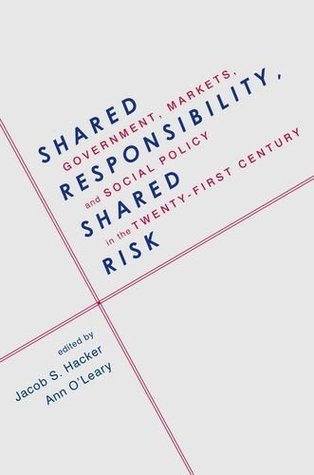
Shared Responsibility, Shared Risk: Government, Markets and Social Policy in the Twenty-First Century
by Jacob S. Hacker
Rating: 4.3 ⭐
The collapse of the financial markets in 2008 and the resulting 'Great Recession' merely accelerated an already worrisome the shift away from an employer-based social welfare system in the United States. Since the end of World War II, a substantial percentage of the costs of social provision--most notably, unemployment insurance and health insurance--has been borne by employers rather than the state. The US has long been unique among advanced economies in this regard, but in recent years, its social contract has become so frayed that is fast becoming unrecognizable. Despite Obama's election, the burdens of social provision are falling increasingly upon individual families, and the situation is worsening because of the unemployment crisis. How can we repair the American social welfare system so that workers and families receive adequate protection and, if necessary, provision from the ravages of the market?In Shared Responsibility, Shared Risk, Jacob Hacker and Ann O'Leary have gathered a distinguished group of scholars on American social policy to address this most fundamental of problems. Collectively, they analyze how the 'privatization of risk' has increased hardships for American families and increased inequality. They also propose a series of solutions that would distribute the burdens of risks more broadly and expand the social safety net. The range of issues covered is health care, homeownership, social security and aging, unemployment, wealth (as opposed to income) creation, education, and family-friendly policies. The book is also comparative, measuring US social policy against the policies of other advanced nations. Given the current crisis in America social policy and the concomitant paralysis within government, the book has the potential to make an important intervention in the current debate.

American Amnesia: How the War on Government Led Us to Forget What Made America Prosper
by Jacob S. Hacker

The Great Risk Shift; The New Economic Insecurity and the Decline of the American Dream, Revised and Expanded Edition
by Jacob S. Hacker