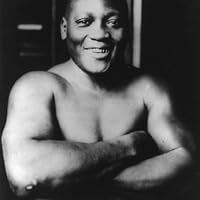
Jack Johnson
As the first African American world heavyweight boxing champion from 1908–to 1915. For more than thirteen years, Jack Johnson was the most famous and the most notorious African-American on Earth. Johnson attests that his success in boxing came from the coaching he received from Joe Choynski, who became his cellmate after the pair were arrested for fighting in Texas, where boxing was illegal at the time.
7 Books Written

African American historian Gerald Early refers to Jack Johnson (1878-1946), the first African American heavyweight champion of the world, as the first African American pop culture icon. Johnson is a seminal and iconic figure in the history of race and sport in America. This manuscript is the translation of a memoir by Johnson that was published in French, has never before been translated, and is virtually unknown. Originally published as a series of articles in 1911 and then in revised form as a book in 1914, it covers Johnson's colorful life and battles, both inside and outside the ring, up until and including his famous defeat of Jim Jeffries in Reno, on July 4, 1910.In addition to the fights themselves, the memoir recounts, among many other things, Johnson's brief and amusing career as a local politician in Galveston, Texas; his experience hunting kangaroos in Australia; and his epic bouts of seasickness. It includes portraits of some of the most famous boxers of the 1900-1915 era―such truly legendary figures as Joe Choynski, Jim Jeffries, Sam McVey, Bob Fitzsimons, Philadelphia Jack O'Brien, and Stanley Ketchel. Johnson comments explicitly on race and the color line in boxing and in American society at large in ways that he probably would not have in a publication destined for an American reading public. The text constitutes genuinely new, previously unavailable material and will be of great interest for the many readers intrigued by Jack Johnson. In addition to providing information about Johnson's life, it is a fascinating exercise in self-mythologizing that provides substantial insights into how Johnson perceived himself and wished to be perceived by others. Johnson's personal voice comes through clearly-brash, clever, theatrical, and invariably charming. The memoir makes it easy to see how and why Johnson served as an important role model for Muhammad Ali and why so many have compared the two.

Autobiography of the first black heavyweight boxing champion of the world

The first African American to win the world heavyweight championship, Jack Johnson (1878–1946) was the preeminent American sports personality of his era. Holder of the title from 1908 to 1915, Johnson continued to box professionally until he was in his 60s. His 1910 victory over the formerly undefeated champion James J. Jeffries in "The Fight of the Century" triggered race riots across the country, and racial bias fueled the clamor for his defeat by a "Great White Hope." Johnson was a cultural lightning rod whose professional success and lavish lifestyle attracted both admiration and envy. In this witty and sophisticated memoir, he recounts without bitterness the prejudice, controversies, and scandals that dogged his public and private lives.Johnson was well known for his exploits beyond the boxing world, and he offers vivid accounts of his international adventures as a bullfighter, race car driver, cabaret entertainer, and spy. His outrageous feats include rescuing a passenger train from murderous bandits in Mexico, chasing a kangaroo across the Australian outback, walking away from five fiery car crashes, and surviving revolutions in Spain, Brazil, Cuba, and elsewhere. The only edition of Johnson's autobiography currently in print, this volume features 16 full-page illustrations and an introductory article by Damon Runyon.

Autobiography of the boxer Jack Johnson

Very Boxe
by Jack Johnson

My Life and Battles
by Jack Johnson
African American historian Gerald Early refers to Jack Johnson (1878–1946), the first African American heavyweight champion of the world, as “the first African-American pop culture icon.” Johnson is a seminal and iconic figure in the history of race and sport in America. My Life and Battles is the translation of a memoir by Johnson that was published in French, has never before been translated, and is virtually unknown. It covers Johnson’s colorful life, both inside and outside the ring, up to and including his famous defeat of Jim Jeffries in Reno, Nevada, on July 4, 1910, in one of the iconic ring battles of the early twentieth century. In addition to the fights themselves the memoir recounts, among many other things, Johnson’s brief and amusing career as a local politician and provides portraits of some of the most famous boxers of the 1900–1915 era.Johnson comments explicitly on race and “the color line” in boxing and in American society at large in ways that he probably would not have in a publication destined for an American reading public. The text constitutes genuinely new, previously unavailable material and will be of great interest for the many readers intrigued by Jack Johnson. In addition to providing information about Johnson’s life, it is a fascinating exercise in self-mythologizing that provides substantial insights into how Johnson perceived himself and wished to be perceived by others. Johnson’s personal voice comes through clearly—brash, clever, theatrical, and invariably charming. The memoir makes it easy to see how and why Johnson served as an important role model for Muhammad Ali and why so many have compared the two. With a foreword by Geoffrey C. Ward.

According to the author Jack Johnson, in 1990 or so, Kevin and I set out on a search for the lost Josephine Mine. I did find it some years later, and it was on a mountain that the Spaniards named Sierra Madre. We learned about the mine from a friend and a book, the book had maps that we followed, and the waybill of Jose Garcia, captain of Mexico City in 1850, gave us clues and directions. On a back trail I did indeed find the Aztec Temple of GOLD.