
Ivan Turgenev
Ivan Sergeyevich Turgenev (Cyrillic: Иван Сергеевич Тургенев) was a novelist, poet, and dramatist, and now ranks as one of the towering figures of Russian literature. His major works include the short-story collection A Sportsman’s Sketches (1852) and the novels Rudin (1856), Home of the Gentry (1859), On the Eve (1860), and Fathers and Sons (1862). These works offer realistic, affectionate portrayals of the Russian peasantry and penetrating studies of the Russian intelligentsia who were attempting to move the country into a new age. His masterpiece, Fathers and Sons, is considered one of the greatest novels of the nineteenth century. Turgenev was a contemporary with Fyodor Dostoevsky and Leo Tolstoy. While these wrote about church and religion, Turgenev was more concerned with the movement toward social reform in Russia.
31 Books Written

The Essential Turgenev will provide American readers with the first comprehensive, portable edition of this great Russian author's works. It offers an extensive introduction to the writings that established Turgenev as one of the preeminent literary figures of his time, and reveals the breadth of insight into changing social conditions that made Turgenev a portal to Russian intellectual life.Readers will find complete, exemplary translations of Turgenev's finest novels, Rudin, A Nest of Gentry, and Fathers and Sons, along with the lapidary novella First Love. The volume also includes selections from Sportsman's Sketches, seven of Turgenev's most compelling short stories, and fifteen prose poems. It also contains samples of the author's nonfiction drawn from autobiographical sketches, memoirs, public speeches, plus the influential essay "Hamlet and Don Quixote" and correspondence with Dostoevsky, Tolstoy, and others.

When a young graduate returns home he is accompanied, much to his father and uncle's discomfort, by a strange friend "who doesn't acknowledge any authorities, who doesn't accept a single principle on faith." Turgenev's masterpiece of generational conflict shocked Russian society when it was published in 1862 and continues today to seem as fresh and outspoken as it did to those who first encountered its nihilistic hero.This new translation, specially commissioned for the Oxford World's Classics, is the first to draw on Turgenev's working manuscript, which only came to light in 1988.About the Series: For over 100 years Oxford World's Classics has made available the broadest spectrum of literature from around the globe. Each affordable volume reflects Oxford's commitment to scholarship, providing the most accurate text plus a wealth of other valuable features, including expert introductions by leading authorities, voluminous notes to clarify the text, up-to-date bibliographies for further study, and much more.

When the down-at-heel Princess Zasyekin moves next door to the country estate of Vladimir Petrovich's parents, he instantly and overwhelmingly falls in love with his new neighbour's daughter, Zinaida. But the capricious young woman already has many admirers and as she plays her suitors against each other, Vladimir's unrequited youthful passion soon turns to torment and despair - although he remains unaware of his true rival for Zinaida's affections. Set in the world of nineteenth-century Russia's fading aristocracy, Turgenev's story depicts a boy's growth of knowledge and mastery over his own heart as he awakens to the complex nature of adult love.

Mumu (Russian: «Муму») is a short story by Ivan Turgenev, a Russian novelist and story writer, written in 1854.The story of Gerasim, a deaf and mute serf whose life of poverty is brought into sharp relief by his connection with Mumu, a dog he rescued, brought greater national attention to the cruelties of serfdom, and received praise for its brutal portrayal of this institution in Russian society.

Turgenev's first major prose work is a series of twenty-five Sketches: the observations and anecdotes of the author during his travels through Russia satisfying his passion for hunting. His album is filled with moving insights into the lives of those he acquaints with, peasants and landowners, doctors and bailiffs, neglected wives and bereft mothers each providing a glimpse of love, tragedy, courage and loss, and anticipating Turgenev's great later works such as First Love and Fathers and Sons. His depiction of the cruelty and arrogance of the ruling classes was considered subversive and led to his arrest and confinement to his estate, but these sketches opened the minds of contemporary readers to the plight of the peasantry and were even said to have led Tsar Alexander II to abolish serfdom.
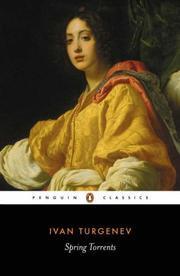
Returning to Russia from a tour in Italy, twenty-three-year-old Dimitry Sanin breaks his journey in Frankfurt, where he encounters the beautiful Gemma Roselli, who works in her parents' patisserie, and falls deeply and deliriously in love for the first time. Convinced that nothing can come in the way of everlasting happiness with his fiancee, Dimitry impetuously decides to begin a new life and sell his Russian estates. But when he meets the potential buyer, the intriguing Madame Polozov, his youthful vulnerability makes him prey for a darker, destructive infatuation. A novel of haunting beauty, "Spring Torrents" (1870-1) is a fascinating, partly autobiographical account of one of Turgenev's favourite themes - a man's inability to love without losing his innocence and becoming enslaved to obsessive passions.

Home of the Gentry is a novel by Ivan Turgenev published in the January 1859 issue of "Sovremennik". I t was enthusiastically received by the Russian society and remained his least controversial and most widely-read novel until the end of the 19th century. It was turned into a movie by Andrey Konchalovsky in 1969.The novel's protagonist is Fyodor Ivanych Lavretsky, a nobleman who shares many traits with Turgenev. The child of a distant, Anglophile father and a serf mother who dies when he is very young, Lavretsky is brought up at his family's country estate home by a severe maiden aunt, often thought to be based on Turgenev's own mother who was known for her cruelty.
RUDIN (1856) by Ivan Sergeevich Turgenev (1818-1883) tells the story of a character typical to Turgenev -- a "superfluous" man, weak of will, brimming with indecisive frustration -- and yet tormented by ideals. Rudin is made impotent by the dissonance of honoring the older generations while at the same time embracing the new bold epoch of pre-revolutionary Russia. The theme of melancholic powerless men coupled with vital idealistic women is prevalent in Turgenev's work, and it would be hard to find a clearer study of the type than RUDIN.

A vivid picture of nineteenth-century Russian society, but above all the poignant story of a man whose mortality becomes the only aspect of life that he shares with his fellow man. When Turgenev published Diary of a Superfluous Man in 1850, he created one of the first literary portraits of the alienated man. Turgenev once said that there was a great deal of himself in the unsuccessful lovers who appear in his fiction. This failure, along with painful self-consciousness, is a central fact for the ailing Chulkaturin in this melancholy tale. As he reflects on his life, he tells the story of Liza, whom he loved, and a prince, whom she loved instead, and the curious turns all their lives took.

This is a pre-1923 historical reproduction that was curated for quality. Quality assurance was conducted on each of these books in an attempt to remove books with imperfections introduced by the digitization process. Though we have made best efforts - the books may have occasional errors that do not impede the reading experience. We believe this work is culturally important and have elected to bring the book back into print as part of our continuing commitment to the preservation of printed works worldwide.

Tolstoy considered Asya, written in 1858, one of Turgenev's two best stories, along with First Love. Asya is a tragic story of two Russians abroad who are in love but conceal it from each other. Constance Garrett and Isabel Hapgood translated Asya in anti

This collection brings together six of Turgenev's best-known `long' short stories, in which he turns his skills of psychological observation and black comedy to subjects as diverse as the tyranny of serfdom, love, and revenge on the Russian steppes. These stories all display the elegance and clarity of Turgenev's finest writing.

Turgenev was the most liberal-spirited and unqualifiedly humane of all the great nineteenth-century Russian novelists, and in Virgin Soil, his biggest and most ambitious work, he sought to balance his deep affection for his country and his people, with his growing apprehensions about what their future held in store. At the heart of the book is the story of a young man and a young woman, torn between love and politics, who struggle to make headway against the complacency of the powerful, the inarticulate misery of the powerless, and the stifling conventions of provincial life. This rich and complex book, at once a love story, a devastating, and bitterly funny social satire, and, perhaps most movingly of all, a heartfelt celebration of the immense beauty of the Russian countryside, is a tragic masterpiece in which one of the world's finest novelists confronts the enduring question of the place of happiness in a political world.

Set in Baden-Baden, Smoke is Ivan Turgenev's most cosmopolitan novel. It is an exquisite study of politics and society and an enduringly poignant love story. Smoke, with its European setting, barbed wit, and visionary call for Russia to look west, became the center of a famous philosophical breach between Turgenev and Dostoevsky.

İvan Sergeyeviç Turgenyev (1818-1883): Avrupa’da ve ülkemizde eserleri ilkönce çevrilen 19. yüzyıl Rus romancıları arasında yer alır. Moskova, Petersburg ve Paris üniversitelerinde öğrenim gören Turgenyev, döneminin Avrupalı bakış açısına sahip tek Rus yazarı olarak anılır. Zayıf iradeli Rus aydınlarını, serflerin yaşantısını, toprak sahibi soyluların aşklarını ve kendisini yakın hissetmediği radikal genç kuşağı tarafsız ve gerçekçi bir dille eserlerine aktarmıştır. 1882 yılında kaleme aldığı ve son eserlerinden olan Klara Miliç’te ise Turgenyev toplumsal meselelerden uzaklaşıp mutluluk, aşk, acı, ölüm ve varoluşun sırları gibi insanlığın sonsuz meselelerine odaklanır. Turgenyev dünyada olduğu gibi ülkemizde de pek çok yazarı etkilemiş, hatta Sabahattin Ali Kürk Mantolu Madonna eserinde Klara Miliç’e atıfta bulunmuştur.Ceren Durukan Akyüz (1983): 2004 yılında Ankara Üniversitesi Dil ve Tarih Coğrafya Fakültesi Rus Dili ve Edebiyatı bölümünden mezun oldu. 2004-2005 yılları arasında Moskova’da Puşkin Rus Dili Enstitüsü’nde eğitim gördü. 2005-2013 yılları arasında Ankara Üniversitesi Türkçe ve Yabancı Dil Uygulama ve Araştırma Merkezi’nde Rusça okutmanlığı yaptı. 2013 yılından beri Ankara Sosyal Bilimler Üniversitesi Rus Dili ve Edebiyatı Bölümü’nde öğretim görevlisi olarak çalışmaktadır.

"No, no, I've got your word for it, I've got to die ... you promised me ... you told me ..." Turgenev's accounts of hunting in rural Russia, and the extraordinary characters he meets there. Introducing Little Black Classics: 80 books for Penguin's 80th birthday. Little Black Classics celebrate the huge range and diversity of Penguin Classics, with books from around the world and across many centuries. They take us from a balloon ride over Victorian London to a garden of blossom in Japan, from Tierra del Fuego to 16th-century California and the Russian steppe. Here are stories lyrical and savage; poems epic and intimate; essays satirical and inspirational; and ideas that have shaped the lives of millions. Ivan Turgenev (1818-1883). Turgenev's works available in Penguin Classics are Fathers and Sons, First Love, Home of the Gentry, On the Eve, Rudin, Sketches from a Hunter's Album, Spring Torrents and Three Sketches from a Hunter's Album.

A play in five acts by Ivan Turgenev, his only well-known work for the theatre.

First Love is a vivid, sensitive tale of adolescent love follows a 16-year-old boy who falls in love with a beautiful, older woman and experiences a whirlwind of changing emotions, from exaltation and jealousy to despair and devotion. First Love is introduced by David Cecil. A Fire at Sea is lesser known work, dictated by Turgenev in French at the end of his life in 1883, recalling an incident while he never forgot. It is introduced by Isaiah Berlin.This beautifully packaged series of classic novellas includes the works of masterful writers. Inexpensive and collectible, they are the first single-volume publications of these classic tales, offering a closer look at this underappreciated literary form and providing a fresh take on the world's most celebrated authors.

A novella in which Turgenev has transformed King Lear's tragedy and taken it to an entirely different level. Harlov, the Lear and his daughter are remarkably portrayed characters. Turgenev has predilection for portraying delicate female characters and his prowess in capturing complete emotional process in love is evident here.

In this rediscovered literary gem, Turgenev explores the elusive nature of love, suggesting that with the loss of love comes a sense of resignation?and the conviction that the essence of life lies in self-denial. It is published here with the short story Yakov Pasynkov. In a series of letters to a friend, the narrator relates how he has managed to convince a married woman?hitherto shielded from the powerful effects of poetry and fiction?of the importance of developing the imagination. By introducing her to Goethe’s masterpiece, he sets in motion a chain of crucial events. In this poetic exploration of spiritual awakening, Turgenev demonstrates his preoccupation with the culture of Western Europe and the nature of human relations. Ivan Turgenev was a Russian novelist and playwright who spent much of his life in Western Europe. His writing profoundly affected the course of European literature.

Un Turguénev inèdit en català, considerat per Flaubert una de les obres mestres de la narrativa russaEn els cercles refinats de Moscou, un jove queda encisat en conèixer l’enigmàtica Susanna Ivànovna, fillastra d’un despòtic professor particular. Captivat pel misteri que l’envolta, vol saber-ne més coses, i entendre les tràgiques circumstàncies per les quals es troba sola i desemparada entre estranys, com «una coloma blanca enmig d’una bandada de corbs negres». L’amor més tràgic i les passions més fosques brillen com mai en l’exquisida prosa de Turguénev.

ONE day, in autumn, on my way home from the distant fields, I caught cold, and was taken ill. Fortunately, the fever overtook me in the county-town, in the hotel. I sent for the doctor. Half an hour later, the district physician made his appearance, a man of short stature, thin and black-haired. He prescribed for me the customary sudorific, ordered the application of mustard-plasters, very deftly tucked my five-ruble bank-note under his cuff,—but emitted a dry cough and glanced aside as he did so,—and was on the very verge of going off about his own affairs, but somehow got to talking and remained. The fever oppressed me; I foresaw a sleepless night, and was glad to chat with the kindly man. Tea was served. My doctor began to talk. He was far from a stupid young fellow, and expressed himself vigorously and quite entertainingly. Strange things happen in the world: you may live a long time, and on friendly terms, with one man, and never once speak frankly from your soul with him; with another you hardly manage to make acquaintance—and behold: either you have blurted out to him your most secret thoughts, as though you were at confession, or he has blurted out his to you. I know not how I won the confidence of my new friend,—only, without rhyme or reason, as the saying is, he “took” and told me about a rather remarkable occurrence; and now I am going to impart his narrative to the indulgent reader. I shall endeavour to express myself in the physician’s words.

Viazovnín, un home de món que de mica en mica ha anat perdent la seva fortuna, decideix tornar a la finca familiar, on es fa molt amic del seu veí Krupitsin, tot i que tenen poc en comú: mentre que l’un és culte i elegant, l’altre és descurat i poc instruït. Els dos amics deixen passar els dies mandrosament, fins que Krupitsin aconsella Viazovnín de posar ordre en la seva vida a través del matrimoni, i s’ofereix a presentar-li unes quantes candidates que bé podrien merèixer la seva consideració. Però com podrà encertar la tria? I sobretot, què suposarà l’entrada d’un element femení en la seva amistat, fins aleshores de pedra picada?


This scarce antiquarian book is a facsimile reprint of the original. Due to its age, it may contain imperfections such as marks, notations, marginalia and flawed pages. Because we believe this work is culturally important, we have made it available as part of our commitment for protecting, preserving, and promoting the world's literature in affordable, high quality, modern editions that are true to the original work.

This vintage book contains Ivan Sergeyevich Turgenev's 1883 collection of poetry, "Poems in Prose," being a translation of what are among the last things written by Turgenev. The poems of this collection are varied: some are like studies for the scenes of a novel; others, again, like a conversation, are purely imaginative sketches, whilst some have an autobiographical interest. The poems include: The Village, The Old Woman, A Dialogue, The Dog, My Opponent, An Axiom, Dost Thou Hearken to the Words of the Fool, The Beggar, A Contented Man, The Destruction of the World, Mescha, The Blockhead, An Oriental Legend, and many more. Ivan Sergeyevich Turgenev (1818 - 1883) was a Russian playwright, novelist, and writer of short stories. "A Sportsman's Sketches" (1852), his first serious publication, constitutes a milestone of Russian Realism. Many antiquarian texts such as this are increasingly hard to come by and expensive, and it is with this in mind that we are republishing this volume now in an affordable, modern, high-quality edition. It comes complete with a specially commissioned new biography of the author."

Ivan Sergeyevich Turgenev (1818-1883) was a great Russian novelist and playwright. His novel Fathers and Sons is regarded as one of major works of 19th-century fiction. After the standard schooling for a child of a gentleman's family, He studied for one year at the University of Moscow and then moved to the University of St Petersburg, focusing on the classics, Russian literature and philology. Turgenev was impressed with German Central-European society, and believed that Russia could best improve itself by imitating the West. Like many of his educated contemporaries, he was particularly opposed to serfdom. He first made his name with A Sportsman's Sketches, also known as Sketches From a Hunter's Album; or, Notes of a Hunter. He wrote several short novels like The Diary of a Superfluous Man, Faust and The Lull. In them Turgenev expressed the anxieties and hopes of Russians of his generation. Amongst his other works are Liza: A Nest of Nobles, The Jew and Other Stories, On the Eve, A Reckless Character and Other Stories, The Torrents of Spring, and The Rendezvous.

Klasik Rus edebiyatının unutulmaz yazarı Turgenyev çağdaşlarından bütünüyle farklı bir yol izledi, yaşadığı dönemde Avrupa kültürüne ve bakış açısına daha yakın bir tavır sergiledi. Dönemin ünlü eleştirmeni Belinski’den büyük destek gören Turgenyev uluslararası üne kavuşan ilk Rus yazar oldu. Daha sonra kaleme alacağı büyük yapıtların habercisi olan öyküleri yazarın edebî kariyerinde çok ayrı bir öneme sahiptir. İki öyküden oluşan bu derlemenin ilk öyküsü Şçigrovsklu Hamlet siyasi haksızlıklar nedeniyle ülkeyi terk etmek zorunda kalan, yaşamları baskı altında geçen Rus soylu aydınlarının yazgısına odaklanır. Yoğun olarak mistisizm ve fantazmagori içeren ikinci öykü Rüya ise Rus edebiyatında bu türdeki ilk örneklerden biridir.

طلب احد الصحفيين الروس مرّة من الشاعر الداغستاني الكبير رسول حمزاتوف أن يعطيه تعريفًا للادب الروسي، فاجاب حمزاتوف قائلاً – إنه أدب (الآباء والبنون) و (الجريمة والعقاب) و (الحرب والسلم).وهكذا تقف رواية تورغينيف (الآباء والبنون) التي أهداها إلى ذكرى بيلنسكي والتي حققت له شهرة عالمية، في طليعة هذا الأدب، إذ أنه في الواقع كتب رواية فكرية بحتة في إطار ممتع وفني جميل. وتعتبر اليوم أقوى آثاره وأرجعها. وقد ترجمت إلى عدة لغات.“الآباء والبنون” تصور الصراع الأبدي والدائم بين الأجيال في المجتمعات الإنسانية كافة، وهي رواية الحب والثروة. وقد قال عنها تشيخوف: «أي رواية عظيمة هذه».روايته في العشية اسمها موسوم في عشية إلغاء نظام القنانة في روسيا، مطورًا فيها إدراك بطلي الرواية بضرورة النضال على الصعيد العملي لتحرير الوطن والشعب

Рассказ и прозаического цикла «Записки охотника». Впервые опубликован в журнале «Современник» в 1851 году. Входит в список обязательной литературы для средних школ.

V etoi knige vy prochitaete trogatelnye, nezhnye i neobyknovenno lirichnye povesti I.S. Turgeneva "Asia", "Pervaia liubov", a takzhe povest "Veshnie vody", posviashchennuiu vsegda volnovavshei Turgeneva teme obreteniia i utraty istinnoi liubvi i ee stolknoveniia s "temnoi", irratcionalnoi strastiu... Ivan Sergeevich Turgenev - odin iz velichaishikh russkikh pisatelei, absoliutnyi master psikhologicheskogo realizma, kotorogo neodnokratno nazyvali "pevtcom russkikh zhenshchin" i "idealnym vyrazitelem chuvstv i nastroenii russkoi intelligentcii". Proizvedeniia Turgeneva iavliaiutsia znakovymi dlia tceloi literaturnoi epokhi, oni neodnokratno stavilis na stcene i ekranizirovalis luchshimi rezhisserami mira - odnako nikomu ne udalos dostich podlinnoi glubiny originalov pisatelia.