
Isak Dinesen
Pseudonym used by the Danish author Karen Blixen. Baroness Karen von Blixen-Finecke (Danish: [kʰɑːɑn ˈb̥leɡ̊sn̩]; 17 April 1885 – 7 September 1962), born Karen Christentze Dinesen, was a Danish author, also known by the pen name Isak Dinesen, who wrote works in Danish, French and English. She also at times used the pen names Tania Blixen, Osceola, and Pierre Andrézel. Blixen is best known for Out of Africa, an account of her life while living in Kenya, and for one of her stories, Babette's Feast, both of which have been adapted into Academy Award-winning motion pictures. She is also noted for her Seven Gothic Tales, particularly in Denmark. (wikipedia)
30 Books Written
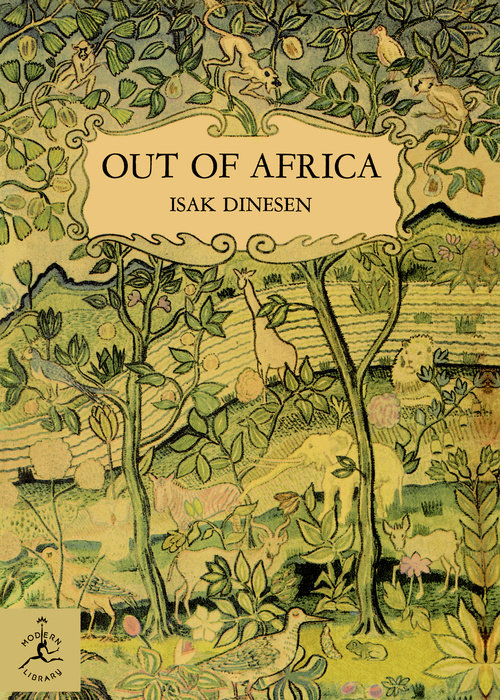
In this book, the author of Seven Gothic Tales gives a true account of her life on her plantation in Kenya. She tells with classic simplicity of the ways of the country and the natives: of the beauty of the Ngong Hills and coffee trees in blossom: of her guests, from the Prince of Wales to Knudsen, the old charcoal burner, who visited her: of primitive festivals: of big game that were her near neighbors--lions, rhinos, elephants, zebras, buffaloes--and of Lulu, the little gazelle who came to live with her, unbelievably ladylike and beautiful.This edition is set from the first American edition of 1937 and commemorates the seventy-fifth anniversary of Random House.

Out of Africa tells the story of a farm that the narrator once had in Africa. The farm is located at the foot of the Ngong hills outside of Nairobi, in what is now Kenya. It sits at an altitude of six thousand feet. The farm grows coffee, although only part of its six thousand acres is used for agriculture. The remaining parts of the land are forest and space for the natives to live on.

With the mysterious arrival of Babette, a refugee from France's civil war, life for two pious sisters and their tiny hamlet begins to change. Before long, Babette has convinced them to try something other than boiled codfish and ale bread: a gourmet French meal. Her feast scandalizes the elders, except for the visiting general. Just who is this strangely talented Babette, who has terrified this pious town with the prospect of losing their souls for enjoying too much earthly pleasure?

Originally published in 1934, Seven Gothic Tales, the first book by "one of the finest and most singular artists of our time" (The Atlantic), is a modern classic. Here are seven exquisite tales combining the keen psychological insight characteristic of the modern short story with the haunting mystery of the nineteenth-century Gothic tale, in the tradition of writers such as Goethe, Hoffmann, and Poe.

In Isak Dinesen's universe, the magical enchantment of the fairy tale and the moral resonance of myth coexist with an unflinching grasp of the most obscure human strengths and weaknesses. A despairing author abandons his wife, but in the course of a long night's wandering, he learns love's true value and returns to her, only to find her a different woman than the one he left. A landowner, seeking to prove a principle, inadvertently exposes the ferocity of mother love. A wealthy young traveler melts the hauteur of a lovely woman by masquerading as her aged and loyal servant.Shimmering and haunting, Dinesen's Winter's Tales transport us, through their author's deft guidance of our desire to imagine, to the mysterious place where all stories are born.

Five tales set in the past explore the experiences of men and women who become the unwilling victims of fate.

Isak Dinesen takes up the absorbing story of her life in Kenya begun in the unforgettable Out of Africa, which she published under the name of Karen Blixen. With warmth and humanity these four stories illuminate her love both for the African people, their dignity and traditions, and for the beauty and wildness of the landscape. The first three were written in the 1950s and the last, 'Echoes from the Hills', was written especially for this volume in the summer of 1960 when the author was in her seventies. In all they provide a moving final chapter to her African reminiscences.

In the classic "Babette's Feast," a mysterious Frenchwoman prepares a sumptuous feast for a gathering of religious ascetics and, in doing so, introduces them to the true essence of grace. In "The Immortal Story," a miserly old tea-trader living in Canton wishes for power and finds redemption as he turns an oft-told sailors' tale into reality for a young man and woman. And in the magnificent novella Ehrengard, Dinesen tells of the powerful yet restrained rapport between a noble Wagnerian beauty and a rakish artist. Hauntingly evoked and sensuously realized, the five stories and novella collected here have the hold of "fairy stories read in childhood . . . of dreams . . . and of our life as dreams" (The New York Times).

A fairy-tale set in the early-19th century in the Grand Duchy of Babenhausen. The story revolves around the desire of the court painter, Herr Cazotte, to seduce Ehrengard, maid of honour to Princess Ludmilla.

Here is a rich new biographical perspective on the brilliant storyteller whose sophisticated romantic fiction...made her an international success and a perpetual candidate for the Nobel Prize for Literature..._these letters+ contain the raw material that was later transformed into her classic memoir Out Of Africa.

Last Tales is a collection of twelve of the last tales that Isak Dinesen wrote before her death in 1962. They include seven tales from Albondocani, a projected novel that was never completed; "The Caryatids," an unfinished Gothic tale of a couple bedeviled by an old letter and a gypsy's spell; and three tales of winter, including "Converse at Night in Copenhagen," a drunken, all-night conversation between a boy-king, a prostitute, and a poor young poet.

Basis for Academy Award-winning film. Tony Award-winning Dewhurst presents a remarkable performance.Read by Colleen Dewhurst.2 audiocassettes (155 min.) : analog.Contents:Babette's feast --Sorrow-acre.

Karen Blixen-Finecke dán bárónő rendkívüli életét és egyéniségét Sydney Pollack Távol Afrikától című, hét Oscar-díjat elnyert filmjéből ismerheti a magyar közönség. A Babette lakomájá-ból Gabriel Axel forgatott ugyancsak Oscar-díjas filmet. A halhatatlan történet egzotikus helyszínre, a XIX. századi Kínába kalauzolja el az olvasót, szereplői különböző okokból hazájuktól távol élő európaiak. A színes cselekmény mögött érdekes gondolatkísérlet rejtőzik: vajon meg lehet-e fordítani a világ menetét, és megtörténtté tenni egy mítoszt? Létezik-e olyan vagyon a világon, amely jogosan kelti tulajdonosában a mindenhatóság érzését? Karen Blixen univerzumában a történet mágikus erővel rendelkezik. Mintha a világ valamiféle rend, előre megírt „történet” szerint működne, melyet az ember ugyan nem változtathat meg, mégis fontos feladata van benne: az, hogy a saját helyét, rendeltetését megtalálja, és azon belül beteljesítse magát.

Carnival is an animated collection of works from every stage of Isak Dinesen's career. Many were written during her most creative years but set aside; others she wrote "just for entertainment." The collection includes "Second Meeting," her last work, and the title story, the first written under her now-famous pen name. None of these stories has previously appeared in book form in English. Three of them were translated especially for this collection by P. M. Mitchell and W. D. Paden."The editors have included only material that will stand easily with her more familiar work and satisfy her large following. . . . The rough drafts and variant treatments have been set aside for scholars."—Joseph McLellan, Washington Post"The wit, the imagination, the elevated philosophical dialogue mark most of the stories in this volume as vintage Dinesen . . . of special interest to Dinesen fans."—Robert Langbaum, New York Times Book Review

'As for me I have one ambition only: to invent stories, very beautiful stories.' So said Karen Blixen who, in creating her spellbinding tales of fantasy and romance, also invented for herself the persona of Isak Dinesen. These three tales of love and loss are taken from Winter's Tales.

Drawing on her own experiences, the author speculates on the meaning of marriage and the relationship between human love and modern marriage

"Isak Dinesen . . . had an original approach to life that permeated all her work. She loved storytelling, with the result that most of her essays are quasi-narratives, which proceed not from major to minor premise but from one anecdote to another as the way of making concrete whatever idea she is considering. Her work is a delight and at times a marvel."— The New Yorker"Through these daguerreotypes we begin to understand other periods, the renunciations of World War I, the purpose of houses and mansions, of ritual ceremonials, such as tatooing. We are given a fresh and vivid view of the women's movement . . . which urges that what our 'small society' needs beyond human beings who have demonstrated what they can do , is people who are . 'Indeed, our own time,' she wrote in 1953, 'can be said to need a revision from doing to being .' She demonstrated it in her own work and craft, with courage and with dignity. This collection is as real as a gallery of old daguerreotypes, moving and unfaded. The work, as Hannah Arendt says, of a wise woman."—Robert Kirsch, Los Angeles Times"These essays . . . have the flavor of good humorous, easy, personal but not oppressive, the distillation of reading, thought, and experience. Their subjects are of surprisingly current interest. We need make no concessions to the past, need not set our watches back to 'historical.' Isak Dinesen was not a faddish thinker. . . . 'In history it is always the human element that has a chance for eternal life,' Dinesen remarks, and she gives these essays their chance."—Penelope Mesic, Chicago


Il pranzo di Babette e La storia immortale, due dei più significativi racconti della raccolta Capricci del destino, ruotano intorno al tema del contrasto tra mondo immaginario e mondo reale, tra le umane fantasie e le convenzioni dell'agire umano. Al centro de Il pranzo di Babette, dal quale è stato tratto l'omonimo film vincitore dell'Oscar, è il personaggio della cuoca comunarda che, crollati gli ideali rivoluzionari, vive esule in un mondo grigio e frugale. Ma il potere visionario di Babette trionfa, paradossalmente e orgogliosamente, sulle miserie della quotidianità. Una notte d'amore tra un marinaio e una donna perduta è al cuore de La storia immortale, dal quale è tratto il film omonimo di Orson Welles con Jeanne Moreau.

In 1937, Karen Blixen published 'Out of Africa', her remarkable chronicle of life on an African Farm, from which this account is taken.


Un giovane scrittore alla ricerca della felicità perduta. Uno studioso di teologia folgorato da una donna poibita. Un assassino salvato da un gesto generoso. Il talento di Karen Blixen, che secondo Hemingway avrebbe meritato il Premio Nobel al suo posto, rivive in tre storie dal fascino senza tempo. Gli opposti universali - amore e morte, onore e viltà, colpa e innocenza - si confrontano in una dimensione sospesa; racconto e realtà non sono mai stati così vicini.

«Me habría quedado más contento si este premio se hubiese otorgado a una magnífica escritora, Isak Dinesen», declaró Ernest Hemingway al recibir el Premio Nobel. Joyas como «El mono», «El festín de Babette» o «La historia inmortal», reunidas en estas páginas junto a todos los relatos publicados en vida de la autora, permiten comprender el alcance de sus palabras. «Para ella contar era encantar», escribió Mario Vargas Llosa. «Sus cuentos son siempre engañosos, impregnadosde elementos secretos e inapresables.» «La embriaguez y lo despiadado son parte de su arte de cuentista». JOHN UPDIKE «Los cuentos de Dinesen se proyectan como los destellos del faro de una costa extraña e infrecuentemente avistada; una costa a la vez bella y peligrosa, ya que promete ser un reducto mágico, pero se asienta sobre las rocas.» EUDORA WELTY

À Copenhague, la saison mondaine commence au Nouvel An. Pendant ces quelques mois, ce ne sont que réceptions et bals où les jeunes gens dansent et rient. Mais pour Ib Angel, éperdument amoureux de sa cousine, la ravissante Adélaïde, ce n'est que souffrance et désespoir...


Contém os contos:- O Dilúvio de Norderney- A história de um galante- A prioresa- Nas estradas de Pisa

Isak Dinesen's Africa: Images of the Wild Continent from the Writer's Life and Words
by Isak Dinesen
Rating: 4.3 ⭐
In her memoir, Out of Africa, and in short stories, Danish-born writer Dinesen evoked a timeless Africa distilled from her 18 years on a Kenya coffee plantation. This lovely-looking but ultimately shallow picture book, a tie-in with the film based on Out of Africa, splices excerpts from Dinesen's autobiographical writings, stories and letters with color photographs of Africa's land, people and wildlife. For readers familiar with her works, the album is pleasant enough, though readers expecting visual signs of today's real, changing, troubled Africa will be disappointed. In an almost apologetic introduction, Judith Thurman, Dinesen's biographer, notes that the writer was not a conservationist, enjoyed big game hunting and had paternalistic, feudal relationships with Africans. Nevertheless, Dinesen upheld the dignity and value of African culture, and her rhythmic prose captured the complex poetry of Africa's landscape.