
Imre Lakatos
Philosopher of mathematics and science, known for his thesis of the fallibility of mathematics and its 'methodology of proofs and refutations' in its pre-axiomatic stages of development, and also for introducing the concept of the 'research programme' in his methodology of scientific research programmes. More at Wikipedia.
21 Books Written

Two books have been particularly influential in contemporary philosophy of Karl R. Popper's Logic of Scientific Discovery, and Thomas S. Kuhn's Structure of Scientific Revolutions. Both agree upon the importance of revolutions in science, but differ about the role of criticism in science's revolutionary growth. This volume arose out of a symposium on Kuhn's work, with Popper in the chair, at an international colloquium held in London in 1965. The book begins with Kuhn's statement of his position followed by seven essays offering criticism and analysis, and finally by Kuhn's reply. The book will interest senior undergraduates and graduate students of the philosophy and history of science, as well as professional philosophers, philosophically inclined scientists, and some psychologists and sociologists.
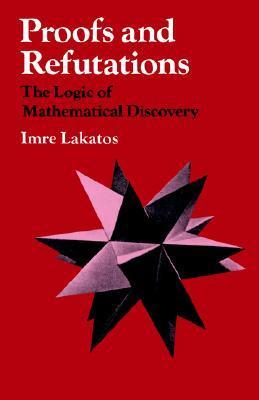
Proofs and Refutations is essential reading for all those interested in the methodology, the philosophy and the history of mathematics. Much of the book takes the form of a discussion between a teacher and his students. They propose various solutions to some mathematical problems and investigate the strengths and weaknesses of these solutions. Their discussion (which mirrors certain real developments in the history of mathematics) raises some philosophical problems and some problems about the nature of mathematical discovery or creativity. Imre Lakatos is concerned throughout to combat the classical picture of mathematical development as a steady accumulation of established truths. He shows that mathematics grows instead through a richer, more dramatic process of the successive improvement of creative hypotheses by attempts to 'prove' them and by criticism of these attempts: the logic of proofs and refutations.

Philosophical Papers, Volume 1: The Methodology of Scientific Research Programmes
by Imre Lakatos
Rating: 4.1 ⭐
Imre Lakatos' philosophical and scientific papers are published here in two volumes. Volume I brings together his very influential but scattered papers on the philosophy of the physical sciences, and includes one important unpublished essay on the effect of Newton's scientific achievement. Volume II presents his work on the philosophy of mathematics (much of it unpublished), together with some critical essays on contemporary philosophers of science and some famous polemical writings on political and educational issues. Imre Lakatos had an influence out of all proportion to the length of his philosophical career. This collection exhibits and confirms the originality, range and the essential unity of his work. It demonstrates too the force and spirit he brought to every issue with which he engaged, from his most abstract mathematical work to his passionate 'Letter to the director of the LSE'. Lakatos' ideas are now the focus of widespread and increasing interest, and these volumes should make possible for the first time their study as a whole and their proper assessment.
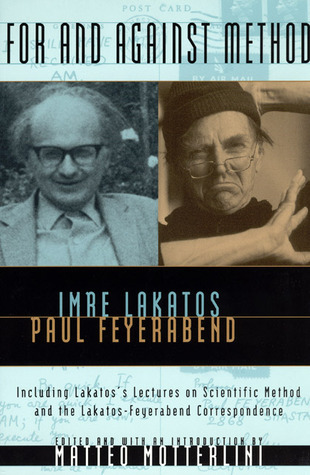
For and Against Method: Including Lakatos's Lectures on Scientific Method and the Lakatos-Feyerabend Correspondence
by Imre Lakatos
Rating: 4.1 ⭐
The work that helped to determine Paul Feyerabend's fame and notoriety, Against Method, stemmed from Imre Lakatos's "In 1970 Imre cornered me at a party. 'Paul,' he said, 'you have such strange ideas. Why don't you write them down? I shall write a reply, we publish the whole thing and I promise you—we shall have a lot of fun.' " Although Lakatos died before he could write his reply, For and Against Method reconstructs his original counter-arguments from lectures and correspondence previously unpublished in English, allowing us to enjoy the "fun" two of this century's most eminent philosophers had, matching their wits and ideas on the subject of the scientific method.For and Against Method opens with an imaginary dialogue between Lakatos and Feyerabend, which Matteo Motterlini has constructed, based on their published works, to synthesize their positions and arguments. Part one presents the transcripts of the last lectures on method that Lakatos delivered. Part two, Feyerabend's response, consists of a previously published essay on anarchism, which began the attack on Lakatos's position that Feyerabend later continued in Against Method. The third and longest section consists of the correspondence Lakatos and Feyerabend exchanged on method and many other issues and ideas, as well as the events of their daily lives, between 1968 and Lakatos's death in 1974.The delight Lakatos and Feyerabend took in philosophical debate, and the relish with which they sparred, come to life again in For and Against Method, making it essential and lively reading for anyone interested in these two fascinating and controversial thinkers and their immense contributions to philosophy of science."The writings in this volume are of considerable intellectual importance, and will be of great interest to anyone concerned with the development of the philosophical views of Lakatos and Feyerabend, or indeed with the development of philosophy of science in general during this crucial period."—Donald Gillies, British Journal for the Philosophy of Science (on the Italian edition)"A stimulating exchange of letters between two philosophical entertainers."—Tariq Ali, The IndependentImre Lakatos (1922-1974) was professor of logic at the London School of Economics. He was the author of Proofs and Refutations and the two-volume Philosophical Papers . Paul Feyerabend (1924-1994) was educated in Europe and held numerous teaching posts throughout his career. Among his books are Against Method ; Science in a Free Society ; Farewell to Reason ; and Killing The Autobiography of Paul Feyerabend , the last published by the University of Chicago Press.

Uno de los rasgos más característicos de la Filosofía de la Ciencia de Lakatos radica en el papel que en ella desempeña la Historia de la Ciencia. A nivel cientiífico y metodológico, Lakatos cambia la unidad de evaluación de la metodología de Popper: teorías aisladas (una unidad abstracta), por la noción histórica de Series de Teorías o Programas de Investigación Científica. A nivel metacientífico o metametodológico, introduce una nueva teoría: los Programas de Investigación Historiográfica para la evaluación de metodologías rivales. Las distintas metodologías pueden compararse criticando las Reconstrucciones Racionales a las que conducen, sin necesidad de hacer referencia directa a ninguna teoría lógica o epistemológica. Según palabras de otro célebre metodológico actual: <> (P.K. Feyerabend)


Falsafah sains Barat klasik seperti falsafah Kant yang diruntuhkan oleh geometri bukan Euklidan dan teori Einstein memang terkenal. Falsafah yang lebih asas lagi yang ditonjolkan pada awal abad ke-20 oleh Bartley ialah justifikasisme, iaitu kepercayaan perlunya teori sains dijustifikasikan dengan ketatnya. Falsafah ini juga roboh kerana penemuan atau pembinaan sains yang dirasionalkan keesahannya menerusi kebarangkalian. Ekorannya, falsafah sains tajaan Popper, Kuhn, Feyerabend dan kalangan Viena menjadi falsafah yang dominan. Falsafah tersebut menjadi perbahasan hangat abad ke-20 hingga kini kerana pertentangannya antara satu dengan lain serta kekuatan dan kelemahan masing-masing. Lakatos mengkritik semua falsafah ini, namun tumpuannya lebih pada falsafah Popper dan Kuhn kerana kedua-dua falsafah ini memusnahkan kekuatan falsafah lain dan wujudnya persaingan hebat antara dua falsafah itu. Mulanya Lakatos memaparkan kelemahan justifikasisme dan bukan maksumisme menerusi falsafah pemalsuanisme dan bukan maksumisme menerusi falsafah pemalsuanisme Popper dan pelbagai versinya. Beliau juga memaparkan kelemahan teori Duhem-Quine yang menjadi saingan pemalsuanisme Popper dalam aspek penentuan palsunya teori atau cerapan, dan nasib teori atau cerapan yang dipalsukan. Kemudian berasaskan sintesis falsafah Popper dan Kuhn serta pendekatan sejarah, Lakatos membina falsafah sains yang dinamainya tatakaedah atur cara penyelidikan atau ringkasnya atur cara penyelidikan. Beliau membuktikan kekuatan falsafah ini menerusi sejarah perkembangan sains jasmani yang besar seperti teori Batlamus dan Kepler-Newton, teori Einstein dan teori kuantum. Falsafah Lakatos adalah siri toeri yang dibinanya yang dipanggil teras liat, pending perlindungan, heuristik negatif dan heuristik positif. Falsafah Lakatos berjaya mengatasi sebahagian besar kelemahan pemalsuanisme Popper dan Kuhnanisme yang antaranya termasuklah masalah perbezaan sains dan bukan sains yang menjadi motivasi asal Popper mengutarakan falsafahnya itu.


Valencia. 19 cm. 1 h., 60 p. Encuadernación en tapa blanda de editorial. Colección 'Cuadernos Teorema', numero coleccion(38). Traducción del inglés de José Manuel Alcañiz. Bibliografía p. 58-60. Investigación .. Este libro es de segunda mano y tiene o puede tener marcas y señales de su anterior propietario. 8437002044

Mathematik, empirische Wissenschaft und Erkenntnistheorie (Philosophische Schriften, 2)
by Imre Lakatos

Çoğulculuğun Kuramcısı: Lakatos
by Imre Lakatos
ilise 1820 yılına kadar Copernicus'un kuramının bilimsel olduğunu kabul etmedi. 1949 yılında Sovyet Komünist Partisi, Mendelci genetiği sözdebilimsel ilan etti. Vavilov gibi genetikçiler toplama kamplarında öldürüldü. Sonra Mendelci genetiğin saygınlığı geri verildi. Kilise ya da Parti neyin bilimsel, yayımlanabilir olduğuna neyin olmadığına karar verme hakkını korudu...Lakatos'a göre bilimle sözdebilim arasına sınırkoyma sorunu masa-başı felsefecilerinin sözde sorunu değil; önemli siyasal, etik içermeleri de var.

Problems in the Philosophy of Mathematics, Volume 47: V47
by Imre Lakatos

Problems in the Philosophy of Mathematics
by Imre Lakatos
ESCRITOS FILOSOFICOS T2 MATEMATICAS CIENCIA Y EPISTEMOLOGIA
by Imre Lakatos

Textes présentés par John Worall et Élie Zahar Traduction de Nicolas Balacheff et Jean-Marie Laborde. L'oeuvre d'Imre Lakatos, interlocuteur privilégie de Paul Feyerabend, a nourri des discussions passionnées et conduit à des études diverses et constructives. Cette oeuvre rigoureuse et savante, voire impertinente, montre comment les vérités mathématiques se développent dans la confrontation des preuves et des réfutations de conjectures audacieuses. L'ouvrage se présente comme un dialogue entre un enseignant et ses élèves. La classe est à l'oeuvre pour éprouver la solidité des nombreuses solutions d'un problème célèbre : la conjecture d'Euler. Les discussions qui s'ensuivent reconstituent de façon vivante cet épisode de l'histoire des mathématiques dans lequel la découverte et l'invention apparaissent dans tous leurs aspects heuristiques, épistémologiques et philosophiques. Cet éclairage nouveau rapproche les mathématiques des autres sciences, dont la tradition les a trop longtemps séparées. Ce livre passionnera tous ceux qui s'intéressent à la philosophie, à l'histoire des sciences et au développement du savoir.
Escritos filosoficos I
by Imre Lakatos
Beweise und Widerlegungen: Die Logik mathematischer Entdeckungen (Wissenschaftstheorie, Wissenschaft und Philosophie)
by Imre Lakatos
Die Methodologie der wissenschaftlichen Forschungsprogramme (Philosophische Schriften)
by Imre Lakatos