
Howard Zinn
Howard Zinn was an American historian, playwright, philosopher, socialist intellectual and World War II veteran. He was chair of the history and social sciences department at Spelman College, and a political science professor at Boston University. Zinn wrote more than 20 books, including his best-selling and influential A People's History of the United States in 1980. In 2007, he published a version of it for younger readers, A Young People's History of the United States. Zinn described himself as "something of an anarchist, something of a socialist. Maybe a democratic socialist." He wrote extensively about the civil rights movement, the anti-war movement and labor history of the United States. His memoir, You Can't Be Neutral on a Moving Train (Beacon Press, 1994), was also the title of a 2004 documentary about Zinn's life and work. Zinn died of a heart attack in 2010, at the age of 87.
30 Books Written

"A wonderful, splendid book--a book that should be ready by every American, student or otherwise, who wants to understand his country, its true history, and its hope for the future." --Howard FastWith a new introduction by Anthony Arnove, this edition of the classic national bestseller chronicles American history from the bottom up, throwing out the official narrative taught in schools—with its emphasis on great men in high places—to focus on the street, the home and the workplace.Known for its lively, clear prose as well as its scholarly research, A People's History of the United States is the only volume to tell America's story from the point of view of—and in the words of—America's women, factory workers, African-Americans, Native Americans, the working poor, and immigrant laborers. As historian Howard Zinn shows, many of our country's greatest battles—the fights for a fair wage, an eight-hour workday, child-labor laws, health and safety standards, universal suffrage, women's rights, racial equality—were carried out at the grassroots level, against bloody resistance.Covering Christopher Columbus's arrival through President Clinton's first term, A People's History of the United States features insightful analysis of the most important events in our history.

Here in their own words are Frederick Douglass, George Jackson, Chief Joseph, Martin Luther King Jr, Plough Jogger, Sacco & Vanzetti, Patti Smith, Bruce Springsteen, Mark Twain & Malcolm X, to name just a few of the hundreds appearing in Voices of a People’s History of the United States, edited by Howard Zinn & Anthony Arnove. Paralleling the 24 chapters of Zinn’s A People’s History of the United States, Voices of a People’s History is the long-awaited companion volume to the national bestseller. For Voices, Zinn & Arnove have selected testimonies to living history—speeches, letters, poems, songs—left by the people who make history happen, but who usually are underrepresented or misrepresented in history books: women, Native Americans, workers, blacks & Latinos. Zinn has written short introductions to the texts, which themselves range in length from letters or poems of less than a page to entire speeches & essays that run several pages & longer. Voices of a People’s History is a symphony of our nation’s original voices, rich in ideas & actions, an embodiment of the power of civil disobedience & dissent, wherein lies our nation’s true spirit of defiance & resilience. Beloved historian & activist Howard Zinn is the author of the best-selling A People’s History of the United States & many other books, including The Zinn Reader (Seven Stories Press 2000), Artists in the Time of War (Seven Stories, 2003) & Terrorism & War (Seven Stories 2002). Anthony Arnove is editor of Terrorism & War by Howard Zinn & Iraq Under Siege. An activist & contributor to ZNet, his work appears in The Nation, The Financial Times & Mother Jones. He lives in Brooklyn, NY.
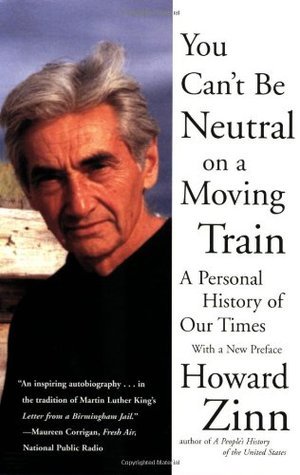
Howard Zinn, author of A People's History of the United States, tells his personal stories about more than thirty years of fighting for social change, from teaching at Spelman College to recent protests against war. A former bombardier in WWII, Zinn emerged in the civil rights movement as a powerful voice for justice. Although he's a fierce critic, he gives us reason to hope that by learning from history and engaging politically, we can make a difference in the world.

No other radical historian has reached so many hearts and minds as Howard Zinn. It is rare that a historian of the Left has managed to retain as much credibility while refusing to let his academic mantle change his beautiful writing style from being anything but direct, forthright, and accessible. Whether his subject is war, race, politics, economic justice, or history itself, each of his works serves as a reminder that to embrace one's subjectivity can mean embracing one's humanity, that heart and mind can speak with one voice. Here, in six sections, is the historian's own choice of his shorter essays on some of the most critical problems facing America throughout its history, and today.

“Professor Zinn writes with an enthusiasm rarely encountered in the leaden prose of academic history....[His] chapter on Vietnam—bringing to life once again the fire-free zones, secret bombings, massacres, and cover-ups—should be required reading.”— New York Times Book Review Containing just the Twentieth Century chapters from Howard Zinn’s bestselling A People’s History of the United States , this reissue is brought up-to-date with coverage of events and developments since 2001, analyzing such incidents in modern political history such as the Gulf War, the post-Cold War “peace dividend,” and the continuing debate over welfare, the Clinton presidency, and the “war on terrorism.” Highlighting not just the usual terms of presidential administrations and congressional activities, this book provides readers with a “bottom-to-top” perspective, giving voice to our nation’s minorities and letting the stories of such groups as African Americans, women, Native Americans, and the laborers of all nationalities be told in their own words. Challenging traditional interpretations of U.S. history, The Twentieth Centur y is the book for readers interested in gaining a more realistic and complete picture of our world."

A Power Governments Cannot Suppress is a major new collection of essays on American history, class, immigration, justice, and ordinary citizens who have made a difference. Zinn addresses America's current political/ethical crisis using lessons learned from our nation’s history. Zinn brings a profoundly human, yet uniquely American perspective to each subject he writes about, whether it’s the abolition of war, terrorism, the Founding Fathers, the Holocaust, defending the rights of immigrants, or personal liberties. Written in an accessible, personal tone, Zinn approaches the telling of U.S. history from an active, engaged point of view. "America's future is linked to how we understand our past,” writes Zinn; "For this reason, writing about history, for me, is never a neutral act."Zinn frames the book with an opening essay titled "If History is to be Creative," a reflection on the role and responsibility of the historian. "To think that history-writing must aim simply to recapitulate the failures that dominate the past," writes Zinn, "is to make historians collaborators in an endless cycle of defeat." "If history is to be creative, to anticipate a possible future without denying the past, it should, I believe, emphasize new possibilities by disclosing those hidden episodes of the past when, even if in brief flashes, people showed their ability to resist, to join together, and occasionally win. I am supposing, or perhaps only hoping, that our future may be found in the past’s fugitive moments of compassion rather than in its solid centuries of warfare."Buzzing with stories and ideas, Zinn draws upon fascinating, little-known historical anecdotes spanning from the Declaration of Independence to the USA PATRIOT Act to comment on the most controversial issues facing us today: government dishonesty, how to respond to terrorism, the wars in Iraq and Afghanistan, the loss of our liberties, immigration, and the responsibility of the citizen to confront power for the common good.Considered a "modern-day Thoreau" by Jonathon Kozol, Zinn's inspired writings address the reader as an active participant in history making. "We live in a beautiful country,” writes Zinn, in the book’s opening chapter. “But people who have no respect for human life, freedom, or justice have taken it over. It is now up to all of us to take it back."Featuring essays penned over an eight-year period, A Power Governments Cannot Suppress is Howard Zinn’s first writerly work in several years, an invaluable post-9/11-era addition to the themes that run through his bestselling classic, A People’s History Of the United States.Howard Zinn is a veteran of World War II and author of many books and plays, including the million-selling classic, A People’s History of the United States. "Thank you, Howard Zinn. Thank you for telling us what none of our leaders are willing to: The truth. And you tell it with such brilliance, such humanity. It is a personal honor to be able to say I am a better citizen because of you."--Michael Moore, director of the film Fahrenheit 9/11, and author of the New York Times bestseller, Stupid White Men ...and Other Sorry Excuses for the State of the Nation!"Find here the voice of the well-educated and honorable and capable and human United States of America, which might have existed if only absolute power had not corrupted its third-rate leaders so absolutely."-- Kurt Vonnegut, author of A Man Without a Country

The acclaimed author of "A People's History of the United States" (more than 200,000 copies sold) presents an honest and piercing look at American political ideology."A shotgun blast of revisionism that aims to shatter all the comfortable myths of American political discourse." "--Los Angeles Times"

"Political power," says Howard Zinn, "is controlled by the corporate elite, and the arts are the locale for a kind of guerilla warfare in the sense that guerillas look for apertures and opportunities where they can have an effect." In Artists in Times of War, Zinn looks at the possibilities to create such apertures through art, film, activism, publishing and through our everyday lives. In this collection of four essays, the author of A People's History of the United States writes about why "To criticize the government is the highest act of patriotism." Filled with quotes and examples from the likes of Bob Dylan, Mark Twain, e. e. cummings, Thomas Paine, Joseph Heller, and Emma Goldman, Zinn's essays discuss America's rich cultural counternarratives to war, so needed in these days of unchallenged U.S. militarism.

Don't you ever wonder: why is it necessary to declare me dead again and again? The premise of this witty and insightful "play on history" is that Karl Marx has agitated with the authorities of the afterlife for a chance to clear his name. Through a bureaucratic error, though, Marx is sent to Soho in New York, rather than his old stomping ground in London, to make his case.Zinn introduces us to Marx's wife, Jenny, his children, the anarchist Mikhail Bakunin, and a host of other characters.Marx in Soho is a brilliant introduction to Marx's life, his analysis of society, and his passion for radical change. Zinn also shows how relevant Marx's ideas are for today's world.Historian and activist Howard Zinn is the author of the bestselling A People's History of the United States and numerous other writings. He recently received the Eugene V. Debs and Lannan Foundation awards for his writing and political activism. He is also the author of Emma, a play about Emma Goldman, in the anthology Playbook (South End Press).Praise for Marx in Soho:"An imaginative critique of our society's hypocrisies and injustices, and an entertaining, vivid portrait of Karl Marx as a voice of humanitarian justice - which is perhaps the best way to remember him."-Kirkus Reviews"A cleverly imagined call to reconsider socialist theory... Zinn's point is well made; his passion for history melds with his political vigor to make this a memorable effort and a lucid primer for readers desiring a succinct, dramatized review of Marxism."-Publishers Weekly"Even in heaven it seems, Karl Marx is a troublemaker. But in the deft and loving hands of activist/author/historian Howard Zinn, the historical figure... is also a father, a husband and a futurist possessing a grand sense of humor."-ForeWord"A witty delight that will engage both new and old acquaintances of the Marxian corpus.... Even conservatives will find Zinn's [book]... an intelligent and diverting read. Recommended for academic and public libraries alike."-Library Journal

Truth—as Zinn shows us in the interviews that make up Terrorism and War—has indeed been the first casualty of war, starting from the beginnings of American empire in the Spanish-American War. But war has many other casualties, he argues, including civil liberties on the home front and human rights abroad. In Terrorism and War, Zinn explores the growth of the American empire, as well as the long tradition of resistance in this country to U.S. militarism, from Eugene Debs and the Socialist Party during World War One to the opponents of U.S. military intervention in Afghanistan today.

A People's History of the United States: Highlights from the Twentieth Century
by Howard Zinn
Rating: 4.1 ⭐
Known for its lively, clear prose as well as its scholarly research, Zinn's A People's History of the United States is the only volume to tell America's story from the point of view of -- and in the words of -- its women, factory workers, African-Americans, Native Americans, working poor, and immigrant laborers. Here we learn that many of our country's greatest battles -- labor laws, women's rights, racial equality -- were carried out at the grassroots level, against steel-willed resistance. This edition of A People's History of the United States features insightful analysis of some of the most important events in this country in the past one hundred years.Featuring a preface and afterword read by the author himself, this audio continues Howard Zinn's important contribution to a complete and balanced understanding of American history.

As a World War II combat soldier, Howard Zinn took part in the aerial bombing of Royan, France. Two decades later, he was invited to visit Hiroshima and meet survivors of the atomic attack. In this short and powerful book, Zinn offers his deep personal reflections and political analysis of these events, their consequences, and the profound influence they had in transforming him from an order-taking combat soldier to one of our greatest anti-authoritarian, antiwar historians. This book was finalized just prior to Zinn's passing in January 2010, and is published on the sixty-fifth anniversary of the bombing of Hiroshima.

Howard Zinn on War is Zinn’s choice of the writing that represents his thinking on a subject that concerned and fascinated him throughout his career. He reflects on the wars against Iraq, the war in Kosovo, the Vietnam War, World War II, and on the meaning of war generally in a world of nations that can't seem to stop destroying each other. These readings appeared first in magazines and newspapers including the Progressive and the Boston Globe, as well as in Zinn's books, Failure to Quit, The Logic of Withdrawal, The Politics of History, and Declarations of Independence.Here we see Zinn’s perspective as a World War II veteran and peace activist who lived through the most devastating wars of the twentieth century and questioned every one of them with his combination of integrity and historical acumen. In his essay, "Just and Unjust War," Zinn challenges us to fight for justice "with struggle, but without war." He writes in "After the War" (2006) that while governments bring us into war, "their power is dependent on the obedience of the citizenry. When that is withdrawn, governments are helpless." In Howard Zinn on War, his message is "The abolition of war has become not only desirable but absolutely necessary if the planet is to be saved. It is an idea whose time has come."

“A shotgun blast of revisionism that aims to shatter all the comfortable myths of American political discourse.” — Los Angeles Times From the bestselling author of A People's History of the United States comes this selection of passionate, honest, and piercing essays looking at American political ideology. Howard Zinn brings to Passionate Declarations the same astringent style and provocative point of view that led more than a million people to buy his book A People's History of the United States. He directs his critique here to what he calls "American orthodoxies" —that set of beliefs guardians of our culture consider sacrosanct: justifications for war, cynicism about human nature and violence, pride in our economic system, certainty of our freedom of speech, romanticization of representative government, confidence in our system of justice. Those orthodoxies, he believes, have a chilling effect on our capacity to think independently and to become active citizens in the long struggle for peace and justice.

Collected here is a brief history of America told through stories applauding the enduring spirit of dissent. To celebrate the millionth copy sold of his book A People's History of the United States , Howard Zinn drew on the words of Americans—some famous, some little known—across the range of American history. These words were read by a remarkable cast at an event held at the 92nd Street Y in New York City that included James Earl Jones, Alice Walker, Kurt Vonnegut, Alfre Woodard, Marisa Tomei, Danny Glover, Harris Yulin, Andre Gregory, and others. From that celebration, this book was born. Here in their own words, and interwoven with commentary by Zinn, are Columbus on the Arawaks; Plough Jogger, a farmer and participant in Shays' Rebellion; Harriet Hanson, a Lowell mill worker; Frederick Douglass; Mark Twain; Mother Jones; Emma Goldman; Helen Keller; Eugene V. Debs; Langston Hughes; Genova Johnson Dollinger on a sit-down strike at General Motors in Flint, Michigan; an interrogation from a 1953 HUAC hearing; Fannie Lou Hamer, a sharecropper and member of the Freedom Democratic Party; Malcolm X; and James Lawrence Harrington, a Gulf War resister, among others.
Howard Zinn’s cogent defense of civil disobedience, with a new introduction by the author. In this slim volume, Zinn lays out a clear and dynamic case for civil disobedience and protest, and challenges the dominant arguments against forms of protest that challenge the status quo. Zinn explores the politics of direct action, nonviolent civil disobedience, and strikes, and draws lessons for today.

The acclaimed historian and author of the classic A People’s History of the United States offers a deeply personal look at the events, issues, and people that matter to us all Based on Howard Zinn's interviews on public radio with host David Barsamian, Original Zinn brings into focus a wide range of foreign policy and domestic issues central to our lives today and showcases Zinn at his most engaging and provocative. Touching on such diverse topics as the American war machine, civil disobedience, the importance of memory and remembering history, and the role of artists—from Langston Hughes to Dalton Trumbo to Bob Dylan—in relation to social change, Original Zinn is Zinn at his irrepressible best, the acute perception of a scholar whose impressive knowledge and probing intellect make history immediate and relevant for us all.

Howard Zinn on History brings together Zinn's shorter writings on activism, electoral politics, the Holocaust, Marxism, the Iraq War, and the role of the historian, as well as portraits of Eugene Debs, John Reed, and Jack London, effectively showing how Zinn's approach to history evolved over nearly half a century, and at the same time sharing his fundamental thinking that social movements—people getting together for peace and social justice—can change the course of history. That core belief never changed.Chosen by Zinn himself as the shorter writings on history he believed to have enduring value—originally appearing in newspapers like the Boston Globe or the New York Times; in magazines like Z, the New Left, the Progressive, or the Nation; or in his book Failure to Quit—these essays appear here as examples of the kind of passionate engagement he believed all historians, and indeed all citizens of whatever profession, need to have, standing in sharp contrast to the notion of "objective" or "neutral" history espoused by some."It is time that we scholars begin to earn our keep in this world," he writes in "The Uses of Scholarship." And in "Freedom Schools," about his experiences teaching in Mississippi during the remarkable "Freedom Summer" of 1964, he "Education can, and should, be dangerous."

In this play, historian and playwright Howard Zinn dramatizes the life of Emma Goldman, the anarchist, feminist, and free-spirited thinker who was exiled from the United States because of her outspoken views, including her opposition to World War I. With his wit and unique ability to illuminate history from below, Zinn reveals the life of this remarkable woman. As Zinn writes in his Introduction, Emma Godman "seemed to be tireless as she traveled the country, lecturing to large audiences everywhere, on birth control ("A woman should decide for herself"), on the falsity of marriage as an institution ("Marriage has nothing to do with love"), on patriotism ("the last refuge of a scoundrel") on free love ("What is love if not free?") and also on the drama, including Shaw, Ibsen, and Strindberg. This book will be of immense interest to feminists, American historians, and people interested in the long history of resistance and protest in the United States. Howard Zinn is professor emeritus at Boston University. He is the author of the classic A People’s History of the United States . A television adaptation of the book is currently being co-produced by Matt Damon, Ben Affleck, and Chris Moore for HBO. Zinn has received the Lannan Foundation Literary Award for Nonfiction and the Eugene V. Debs award for his writing and political activism. Zinn is the author of the internationally acclaimed play Marx in Soho , which has been touring the country in performance since its release.

There is no easy way out of the spiraling morass of terror and brutality that confronts the world today. It is time now for the human race to hold still, to delve into its wells of collective wisdom, both ancient and modern.--Arundhati RoyThe Power of Nonviolence, the first anthology of alternatives to war with a historical perspective, with an introduction by Howard Zinn about September 11 and the U.S. response to the terrorist attacks, presents the most salient and persuasive arguments for peace in the last 2,500 years of human history. Arranged chronologically, covering the major conflagrations in the world, The Power of Nonviolence is a compelling step forward in the study of pacifism, a timely anthology that fills a void for people looking for responses to crisis that are not based on guns or bombs.Included are some of the most original thinkers about peace and nonviolence-Buddha, Scott Nearing, Henry David Thoreau's "Civil Disobedience," Jane Addams, William Penn on "the end of war," Dorothy Day's position on "Pacifism," Erich Fromm, and Rajendra Prasad. Supplementing these classic voices are more recent advocates of Albert Camus' "Neither Victims Nor Executioners," A. J. Muste's impressive "Getting Rid of War," Martin Luther King's influential "Declaration of Independence from the War in Vietnam," and Arundhati Roy's "War Is Peace," plus many others.

يعد هذا الكتاب سفراً هاماً في دراسة التاريخ الأمريكي (طبع منه قرابة مليوني نسخة),، ليس بحجمه المكون من جزأين كبيرين، يغطيان تاريخ الولايات المتحدة منذ انطلاق حركة الكشوف الجغرافية في أواخر القرن الخامس عشر وحتي ثمانينات القرن العشرين، وليس أيضاً بقدر الجهد الموسوعي المبذول فيه والذي تنوء بكتابته العصبة أوليا القوة من الباحثين والمؤرخين، وإنما الأهم من هذا وذاك هو أن هذا الكتاب، الذي ترجمه شعبان مكاوي وصدر عن المجلس الأعلي للثقافة عام2005، يخالف المألوف والمعروف عن التاريخ الأمريكي، إذ يقدم المؤلف والمؤرخ الأمريكي هوارد زن، الذي رحل عن عالمنا في 27 يناير الماضي عن عمر يناهز87 عاما، رؤية مغايرة موازية تكشف وتعري الوجه الآخر لتاريخ الولايات المتحدة كما صاغته وباعته الرواية الرسمية الأمريكية.الطبعة العربية تتكون من جزأين .. وهذا الجزء الأول.
Never before published, an extraordinarily inspiring and radical conversation between Howard Zinn and PBS/NPR journalist Ray Suarez, wherein American history is turned upside down—published to coincide with the tenth anniversary of Zinn’s deathTruth Has a Power of Its Own is an engrossing collection of never-before-published conversations with Howard Zinn, conducted by the distinguished broadcast journalist Ray Suarez in 2007, that covers the course of American history from Columbus to the War on Terror from the perspective of ordinary people—including slaves, workers, immigrants, women, and Native Americans.Viewed through the lens of Zinn’s own life as a soldier, historian, and activist and using his paradigm-shifting People’s History of the United States as a point of departure, these conversations explore the American Revolution, the Civil War, the labor battles of the nineteenth and twentieth centuries, U.S. imperialism from the Indian Wars to the War on Terrorism, World Wars I and II, the Cold War, and the fight for equality and immigrant rights, all from an unapologetically radical standpoint. Admirers and a new generation of readers alike will be fascinated to learn about Zinn’s thought processes, rationale, motivations, and approach to his now-iconic historical work.Suarez’s probing questions and Zinn’s humane (and often humorous) voice—along with his keen moral vision—shine through every one of these lively and thought-provoking conversations, showing that Zinn’s work is as relevant as ever.

Howard Zinn on Race is Zinn’s choice of the shorter writings and speeches that best reflect his views on America’s most taboo topic. As chairman of the history department at all black women’s Spelman College, Zinn was an outspoken supporter of student activists in the nascent civil rights movement. In "The Southern Mystique," he tells of how he was asked to leave Spelman in 1963 after teaching there for seven years. "Behind every one of the national government’s moves toward racial equality," writes Zinn in one 1965 essay, "lies the sweat and effort of boycotts, picketing, beatings, sit-ins, and mass demonstrations." He firmly believed that bringing people of different races and nationalities together would create a more compassionate world, where equality is a given and not merely a dream. These writings, which span decades, express Zinn’s steadfast belief that the people have the power to change the status quo, if they only work together and embrace the nearly forgotten American tradition of civil disobedience and revolution. In clear, compassionate, and present prose, Zinn gives us his thoughts on the Abolitionists, the march from Selma to Montgomery, John F. Kennedy, picketing, sit-ins, and, finally, the message he wanted to send to New York University students about race in a speech he delivered during the last week of his life.

La obra de Howard Zinn ha inspirado a estudiantes y activistas de todas las edades, afirmando que la gente tiene el poder de cambiar la historia. En La otra historia de los Estados Unidos, la version definitiva en español del clásico de Zinn La historia del pueblo de los Estados Unidos, Zinn asume la narrativa típica de la historia americana y nos muestra la mentira que se esconde detrás de la historia "oficial" -- revelando a Cristóbal Colón no como descubridor sino como asesino; los fundadores de la nación norteamericana no como liberadores sino como la fundación de una nueva elite adinerada -- y a la vez aboga por héroes americanos alternativos, desde Bartolomeo de las Casas hasta Tecumseh y César Chávez, quienes desafiaron el poder norteamericano imperialista y vencieron.Actualizado y ampliado incluyendo la presidencia de Bush, La otra historia de los Estados Unidos nos vuelve a recordar que la grandeza verdadera de America se encuentra no en los generales militares, sino en sus voces disidentes.

Howard Zinn tells the story of one of the most important political groups in American history. SNCC: The New Abolitionists influenced a generation of activists struggling for civil rights and seeking to learn from the successes and failures of those who built the fantastically influential Student Nonviolent Coordinating Committee. It is considered an indispensable study of the organization, of the 1960s, and of the process of social change. Includes a new introduction by the author.

Three Strikes: Miners, Musicians, Salesgirls, and the Fighting Spirit of Labor's Last Century
by Howard Zinn
Rating: 3.8 ⭐
Three renowned historians present stirring tales of Howard Zinn tells the grim tale of the Ludlow Massacre, a drama of beleaguered immigrant workers, Mother Jones, and the politics of corporate power in the age of the robber barons. Dana Frank brings to light the little-known story of a successful sit-in conducted by the 'counter girls' at the Detroit Woolworth's during the Great Depression. Robin D. G. Kelley's story of a movie theater musicians' strike in New York asks what defines work in times of changing technology.

A wide-ranging collection of speeches—many published here for the first time—by the historian and author of A People’s History of the United States . Howard Zinn has illuminated our history like no other US historian. This collection of his speeches on protest movements, racism, war, and American history covers more than four decades of his active engagement with the audiences he inspired with his humor, insight, and clarity. This volume features Zinn’s impassioned and erudite statements on the war in Vietnam, abolishing the death penalty, the legacy of Emma Goldman, the myth of American exceptionalism, the Obama Administration, and much more. “Reading Howard’s spoken words, I feel that I am almost hearing his voice again—his stunning pitch-perfect ability to capture the moment and the concerns and needs of the audience, whoever they may be, always enlightening, often stirring, an amalgam of insight, critical history, wit, blended with charm and appeal.” —Noam Chomsky, leading public intellectual and author of Hopes and Prospects “With ferocious moral clarity and mischievous humor, Howard turned routine antiwar rallies into profound explorations of state violence and staid academic conferences into revival meetings for social change.” —Naomi Klein, author of No Is Not Enough and The Battle For Paradise

This title includes a series of classic case studies and thought-provoking essays arguing for a radical approach to history and providing a revisionist interpretation of the historian's role. In a new introduction, Zinn responds to critics of the original work and comments further on the radicalization of history.

Howard Zinn's life and work are the stuff of legend. His People's History of the United States has sold over two million copies and has altered how we see and teach history. A hero in word and deed, Zinn's views on freedom, fairness, history, democracy, and our own human potential are educational and transformative. In few places is the genius of his voice more crystallized and accessible than in the dozens of articles he penned for The Progressive magazine from 1980 to 2009, offered together here in book form for the first time. Whether critiquing the Barack Obama White House, the sorry state of US government and politics, the tragic futility of US military actions in Afghanistan and Iraq, or the plight of working people in an economy rigged to benefit the rich and powerful, Zinn's historical clarity, unflappable optimism, and unshakable questions reverberate throughout The Historic Unfulfilled Promise: "Have our political leaders gone mad?" "What kind of country do we want to live in?" "What is national security?" "Do we have a right to occupy a country when the people of that country obviously do not want us there?" "Is not war itself terrorism?" "Should we not begin to consider all children, everywhere, as our own?" "Has the will of the people been followed?" The Historic Unfulfilled Promise is a genuine work of conscience, rich in ideas, charged with energy; an invaluable introduction for the uninitiated and a must-have for Zinn's fans.

A selection of Howard Zinn’s most popular and accessible essays on history and politics. In this lively collection of essays, now with a new afterword, Zinn discusses a wide range of historical and political topics, from the role of the Supreme Court in U.S. history to the nature of higher education today.