
Herodotus
Herodotus (Greek: Ηρόδοτος) (c. 484 – c. 425 BC) was a Greek historian and geographer from the Greek city of Halicarnassus, part of the Persian Empire (now Bodrum, Turkey) and a later citizen of Thurii in modern Calabria, Italy. He is known for having written the Histories – a detailed account of the Greco-Persian Wars. Herodotus was the first writer to perform systematic investigation of historical events. He has been described as "The Father of History", a title conferred on him by the ancient Roman orator Marcus Tullius Cicero. The Histories primarily cover the lives of prominent kings and famous battles such as Marathon, Thermopylae, Artemisium, Salamis, Plataea, and Mycale. His work deviates from the main topics to provide a cultural, ethnographical, geographical, and historiographical background that forms an essential part of the narrative and provides readers with a wellspring of additional information. Herodotus has been criticized for his inclusion of "legends and fanciful accounts" in his work. The contemporaneous historian Thucydides accused him of making up stories for entertainment. However, Herodotus explained that he reported what he could see and was told. A sizable portion of the Histories has since been confirmed by modern historians and archaeologists.
33 Books Written

From the editor of the widely praised The Landmark Thucydides, a new Landmark Edition of The Histories by Herodotus, the greatest classical work of history ever written.Herodotus was a Greek historian living in Ionia during the fifth century BCE. He traveled extensively through the lands of the Mediterranean and the Black Sea and collected stories, and then recounted his experiences with the varied people and cultures he encountered. Cicero called him “the father of history,” and his only work, The Histories, is considered the first true piece of historical writing in Western literature. With lucid prose that harks back to the time of oral tradition, Herodotus set a standard for narrative nonfiction that continues to this day.In The Histories, Herodotus chronicles the rise of the Persian Empire and its dramatic war with the Greek city-states. Within that story he includes rich veins of anthropology, ethnography, geology, and geography, pioneering these fields of study, and explores such universal themes as the nature of freedom, the role of religion, the human costs of war, and the dangers of absolute power. Ten years in the making, The Landmark Herodotus gives us a new, dazzling translation by Andrea L. Purvis that makes this remarkable work of literature more accessible than ever before. Illustrated, annotated, and filled with maps, this edition also includes an introduction by Rosalind Thomas and twenty-one appendices written by scholars at the top of their fields, covering such topics as Athenian government, Egypt, Scythia, Persian arms and tactics, the Spartan state, oracles, religion, tyranny, and women.Like The Landmark Thucydides before it, The Landmark Herodotus is destined to be the most readable and comprehensively useful edition of The Histories available.

An alternative cover edition for this ASIN can be found here.La Perse et l'Egypte antique, comme si vous y étiez, telles qu'elles ont été décrites au Ve siècle avant notre ère par Hérodote d'Halicarnasse. Si vous voulez savoir ce que furent les folies de Cambyse et les mœurs du crocodile nilotique, reportez-vous à l'Enquête. Lire Hérodote, c'est voyager dans le monde ancien, en compagnie d'un esprit aimable et curieux de tout, apprendre ce que l'on disait à Sardes, Suse, Memphis, Milet ou Athènes, ce que les conteurs dans les rues, les guides dans les sanctuaires narraient aux passants ; c'est voyager en compagnie d'un auteur qui est pour nous le père de l'ethnographie, de la géographie, du reportage et du roman, comme il est, pour nous comme pour toute l'Antiquité, le père de l'Histoire.

This book was converted from its physical edition to the digital format by a community of volunteers. You may find it for free on the web. Purchase of the Kindle edition includes wireless delivery.

Selections from Herodotus' History which follow the events of the great war between the Greeks and the Persians. The translated extracts include Herodotus' descriptions of the preparations for war and of the great land- and sea-battles which took place. Linking commentaries explain Greek and Persian strategies and battle manoeuvres. Background information on the ships and on the soldiers fighting in the war is also given.

Herodotus was a 5th century Greek philosopher. He is the "Father of History".. Herodotus was the first historian to collect materials, check them for accuracy and them place them in chronological order. His writings give the reader a sense of the nature of the world and of science during his time. Herodotus wrote a nine volume series called The Histories. An Account of Egypt or Euterpe is the second in the series. This is an eyewitness account of life in Egypt written in a simple style which is pleasing to read.

'Do you see your son, standing over there, in the antechamber? Well, I am going to shoot him.' The story of the great and mad Cambyses, King of Persia, told by part-historian, part-mythmaker Herodotus of Halicarnassus. Introducing Little Black Classics: 80 books for Penguin's 80th birthday. Little Black Classics celebrate the huge range and diversity of Penguin Classics, with books from around the world and across many centuries. They take us from a balloon ride over Victorian London to a garden of blossom in Japan, from Tierra del Fuego to 16th-century California and the Russian steppe. Here are stories lyrical and savage; poems epic and intimate; essays satirical and inspirational; and ideas that have shaped the lives of millions. Herodotus (c.484-425 BCE) Herodotus's The Histories is also available in Penguin Classics.

This book was converted from its physical edition to the digital format by a community of volunteers. You may find it for free on the web. Purchase of the Kindle edition includes wireless delivery.

Herodotus the great Greek historian was born about 484 BCE, at Halicarnassus in Caria, Asia Minor, when it was subject to the Persians. He travelled widely in most of Asia Minor, Egypt (as far as Assuan), North Africa, Syria, the country north of the Black Sea, and many parts of the Aegean Sea and the mainland of Greece. He lived, it seems, for some time in Athens, and in 443 went with other colonists to the new city Thurii (in South Italy), where he died about 430. He was 'the prose correlative of the bard, a narrator of the deeds of real men, and a describer of foreign places' (Murray).Herodotus's famous history of warfare between the Greeks and the Persians has an epic dignity which enhances his delightful style. It includes the rise of the Persian power and an account of the Persian empire; a description and history of Egypt; and a long digression on the geography and customs of Scythia. Even in the later books on the attacks of the Persians against Greece there are digressions. All is most entertaining and produces a grand unity. After personal inquiry and study of hearsay and other evidence, Herodotus gives us a not uncritical estimate of the best that he could find.The Loeb Classical Library edition of Herodotus is in four volumes.
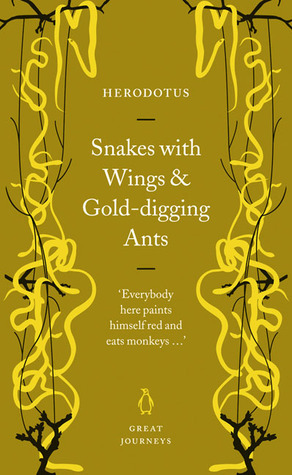
Inspired by PenguinÂ's innovative Great Ideas series, our new Great Journeys series presents the most incredible tours, voyages, treks, expeditions, and travels ever written—from Isabella BirdÂ's exaltation in the dangers of grizzlies, rattlesnakes, and cowboys in the Rocky Mountains to Marco PoloÂ's mystified reports of a giant bird that eats elephants during his voyage along the coasts of India. Each beautifully packaged volume offers a way to see the world anew, to rediscover great civilizations and legends, vast deserts andunspoiled mountain ranges, unusual flora and strange new creatures, and much more.

This work talks about a king who would be worshipped as a god. When Xerxes, King of Persia, crosses the Hellespont at the head of a formidable army, it seems inevitable that Greece will be crushed beneath its might. But, the Greeks are far harder to defeat than he could ever have imagined. As storms lash the Persian ships, and sinister omens predict a cruel fate for the expedition, Xerxes strives onward, certain his enemies will accept him as their king. But as he soon discovers, the Greeks will sacrifice anything, even their lives, to keep their liberty.

Comme il hésitait à entrer en conflit avec Cyrus, Crésus, roi de Lydie, consulte l’oracle qui l’assure de la fin d’un grand empire. Par la suite, pieds et poings liés sur le bûcher destiné au vaincu, Crésus comprend, un peu tard, que l’empire voué à la catastrophe était le sien. L’anecdote, extraite du livre I, est aussi célèbre que propice à la méditation. Elle illustre la toute aussi fameuse réflexion du préambule, « la prospérité humaine ne demeure jamais fixée au même endroit » : splendeurs et misères des régimes politiques, tel pourrait être le sous-titre de ce premier livre, dédiés successivement aux premiers conflits entre Grecs et Barbares, aux histoires de Crésus et à celles de Cyrus. Moins connu que le livre II, le livre I n’en est pas moins riche d’anecdotes édifiantes et délicieuses : les songes des rois et leurs interprétations farfelues, Gygès l’imposteur, le courage de Cleobis et Biton et la naissance de Cyrus, autant d’ »histoires » que le lecteur trouvera dans ce premier livre, sous la plume malicieuse et clairvoyante d’Hérodote.Notre édition présente en un volume à part le livre I des Histoires. Pour faciliter la lecture, le texte est divisé en trois parties, le prologue, les histoires lydiennes et l’ascension de Cyrus, chacune précédée d’une notice introductive. Celle-ci met en évidence la composition du récit et propose de judicieux parallèles avec des auteurs traitant du même sujet. La question des sources, et celle de la méthode historique sont analysées en détail. Des notes, fournissant toutes les informations nécessaires à la bonne intelligence du texte accompagnent la lecture.


يعد كتاب "تاريخ هيرودوت" من أقدم الكتب التاريخية فى العالم ، وقد حفل بالكثير من الوقائع والأحداث الممتدة على مساحة مترامية الأطراف فى اليونان وفارس ومصر والشام وبلاد العرب ، وكان كاتبه "هيرودوت" شاهداً على كثير منها ، والأحداث التى لم يشاهدها فقد رواها له أناس عاينوها وعاصروها...

Herodotus the great Greek historian was born about 484 BCE, at Halicarnassus in Caria, Asia Minor, when it was subject to the Persians. He travelled widely in most of Asia Minor, Egypt (as far as Assuan), North Africa, Syria, the country north of the Black Sea, and many parts of the Aegean Sea and the mainland of Greece. He lived, it seems, for some time in Athens, and in 443 went with other colonists to the new city Thurii (in South Italy), where he died about 430. He was 'the prose correlative of the bard, a narrator of the deeds of real men, and a describer of foreign places' (Murray).Herodotus's famous history of warfare between the Greeks and the Persians has an epic dignity which enhances his delightful style. It includes the rise of the Persian power and an account of the Persian empire; a description and history of Egypt; and a long digression on the geography and customs of Scythia. Even in the later books on the attacks of the Persians against Greece there are digressions. All is most entertaining and produces a grand unity. After personal inquiry and study of hearsay and other evidence, Herodotus gives us a not uncritical estimate of the best that he could find.The Loeb Classical Library edition of Herodotus is in four volumes.

Herodotus the great Greek historian was born about 484 BCE, at Halicarnassus in Caria, Asia Minor, when it was subject to the Persians. He travelled widely in most of Asia Minor, Egypt (as far as Assuan), North Africa, Syria, the country north of the Black Sea, and many parts of the Aegean Sea and the mainland of Greece. He lived, it seems, for some time in Athens, and in 443 went with other colonists to the new city Thurii (in South Italy), where he died about 430. He was 'the prose correlative of the bard, a narrator of the deeds of real men, and a describer of foreign places' (Murray).Herodotus's famous history of warfare between the Greeks and the Persians has an epic dignity which enhances his delightful style. It includes the rise of the Persian power and an account of the Persian empire; a description and history of Egypt; and a long digression on the geography and customs of Scythia. Even in the later books on the attacks of the Persians against Greece there are digressions. All is most entertaining and produces a grand unity. After personal inquiry and study of hearsay and other evidence, Herodotus gives us a not uncritical estimate of the best that he could find.The Loeb Classical Library edition of Herodotus is in four volumes.

This work has been selected by scholars as being culturally important and is part of the knowledge base of civilization as we know it.This work is in the public domain in the United States of America, and possibly other nations. Within the United States, you may freely copy and distribute this work, as no entity (individual or corporate) has a copyright on the body of the work.Scholars believe, and we concur, that this work is important enough to be preserved, reproduced, and made generally available to the public. To ensure a quality reading experience, this work has been proofread and republished using a format that seamlessly blends the original graphical elements with text in an easy-to-read typeface.We appreciate your support of the preservation process, and thank you for being an important part of keeping this knowledge alive and relevant.

This volume presents a selection of typically anecdotal 'history' from Herodotus. His Ionic dialect has been changed into the Attic familiar to early Greek learners, and notes and vocabulary are provided to suit the student at that stage. The selection was first published by Macmillan in 1963 and has proved useful at GSCE level.

Contents:The History of HerodotusThe History of the Peloponnesian War by Thucydides

Alternate cover edition of ASIN 2070382230Dans la première partie de l'Enquête (livres I à IV), Hérodote a relaté la naissance et le développement de la puissance perse avec le roi Cyrus et ses successeurs Cambyse puis Darius. Au livre V commence le conflit qui, de 511 à 479 avant notre ère, oppose les Perses à la Grèce. Dans ce passionnant récit - la première grande œuvre en prose de la littérature grecque -, Hérodote nous dit pourquoi et comment les deux mondes de son temps, l'Est et l'Ouest, se sont toujours heurtés et puis, deux générations avant lui, se sont engagés dans la plus grande guerre de leur histoire, les guerres Médiques. Le conflit de l'Est contre l'Ouest, des Barbares contre les Grecs, de l'Orient contre l'Occident, a des résonances très actuelles, et ce n'est pas la moindre raison de lire la dernière partie de cette étonnante " Enquête ".

The Battle of Salamis was the first great (and unexpected) victory of the Greeks over the Persian forces under Xerxes, whose defeat had important consequences for the subsequent history and self-image of Europe. This battle forms the centre-piece of book VIII of Herodotus' Histories. The book also illuminates Greek views of themselves and of peoples from the East, the problematic relationships between different Greek states in the face of the invasion, and the role of the divine in history. This introduction and commentary pays particular attention to the history and culture of Achaemenid Persia and the peoples of its empire. It offers much help with the language of the text (which has been prepared for ease of reading), and deals with major literary and historical questions. It will be of especial use to intermediate and advanced Greek students, but also provides up-to-date scholarly materials for graduate students and professional classicists.

Le livre IV des Histoires est par bien des aspects le livre des extrêmes, aussi bien géographiques que littéraires : à la frontière de l’histoire, Hérodote évoque autant les peuples mythiques telles les Amazones, que les menées de Darius, bien réelles, contre le pays des Scythes. Dans l’économie générale de l’œuvre, le livre IV est aussi à la limite du sujet : dans le récit des conflits entre Grecs et Barbares, cette description des « Barbares des Barbares » a souvent été considérée comme une parenthèse. Cependant, cette digression est loin d’être superflue tant elle constitue l’un des plus beaux, et des plus surprenants, passages des Histoires. Le lecteur y découvre, sous l’œil moqueur d’Hérodote, les coutumes étranges et extraordinaires des Callipides, des Alazons ou des habitants de Libye, tandis que sont évoquées, tantôt de manière sarcastique, tantôt avec stupéfaction, ces contrées terribles où l’hiver dure huit mois, où l’on boit dans les crânes de ses défunts les plus proches, et où les femmes ont les mêmes droits que les hommes.Notre édition présente en un volume le tome IV des Histoires. Le livre est divisé en deux mouvements correspondant aux récits libyens et à ceux centrés sur la Scythie. Chacune de ces deux parties est précédée d’une riche notice introductive. Celle-ci replace le passage dans la logique narrative et historique des Histoires et met en relief les passages les plus importants. Une abondante documentation est mise à la disposition du lecteur, tandis que les sources qu’aurait utilisées Hérodote, notamment la Périégèse d’Hécatée, sont analysées en détail. Des notes accompagnent la lecture.

This work has been selected by scholars as being culturally important, and is part of the knowledge base of civilization as we know it. This work was reproduced from the original artifact, and remains as true to the original work as possible. Therefore, you will see the original copyright references, library stamps (as most of these works have been housed in our most important libraries around the world), and other notations in the work.This work is in the public domain in the United States of America, and possibly other nations. Within the United States, you may freely copy and distribute this work, as no entity (individual or corporate) has a copyright on the body of the work.As a reproduction of a historical artifact, this work may contain missing or blurred pages, poor pictures, errant marks, etc. Scholars believe, and we concur, that this work is important enough to be preserved, reproduced, and made generally available to the public. We appreciate your support of the preservation process, and thank you for being an important part of keeping this knowledge alive and relevant.

This work has been selected by scholars as being culturally important, and is part of the knowledge base of civilization as we know it. This work was reproduced from the original artifact, and remains as true to the original work as possible. Therefore, you will see the original copyright references, library stamps (as most of these works have been housed in our most important libraries around the world), and other notations in the work.This work is in the public domain in the United States of America, and possibly other nations. Within the United States, you may freely copy and distribute this work, as no entity (individual or corporate) has a copyright on the body of the work.As a reproduction of a historical artifact, this work may contain missing or blurred pages, poor pictures, errant marks, etc. Scholars believe, and we concur, that this work is important enough to be preserved, reproduced, and made generally available to the public. We appreciate your support of the preservation process, and thank you for being an important part of keeping this knowledge alive and relevant.

Considered one of the most important works of history in Western literature, Herodotus's Histories is a key text for the study of ancient Greece and the Persian Empire. Book V not only describes the revolt of the east Greeks against their Persian masters, which led to the great Persian Wars of 490-479 BC, but also provides fascinating material about the mainland Greek states in the sixth century BC. The importance of Herodotus as the freshest and liveliest of all classical Greek prose authors and the historical centrality of the period covered are the main reasons for studying Book V. This is an up-to-date edition and commentary on the Greek text of the book, providing extensive help with the Greek and basic historical information, as well as new insights on more advanced matters.

La genialidad de Heródoto consistió en aunar una larga tradición –relatos genealógicos, narraciones fundacionales, noticias de periplos, especulaciones geográficas y relatos etnográficos– para poner al ser humano en el centro de reflexión del nuevo género de la historiografía.El libro tercero de la Historia se ocupa de la triunfal campaña de Cambises en Egipto, con cuya dominación los persas pasan a ser dueños de toda el Asia conocida por los griegos, y, ya en plena África, contra Etiopía y el oasis de Sivah. Heródoto subraya la causa remota de las Guerras Mé el propósito persa de hacerse con un imperio universal y sus ansias de conquista que les llevarán al fatal enfrentamiento con los griegos. Se pone de manifiesto el carácter perverso de Cambises, que en Egipto arrasa con lo sagrado y lo profano. El resto del libro narra la conquista persa de la isla de Samos, la muerte accidental de Cambises, la entronización de su sucesor Darío y las primeras medidas organizadoras y represivas del nuevo monarca.En el libro cuarto prosigue el expansionismo Darío ya expresa su deseo de atacar a Grecia, pero antes sojuzga a escitas y libios. En la descripción de ambas campañas Heródoto aplica una técnica ternaria, recurrente en todo el libro y ya en los libros segundo y tercero en el caso de Egipto, con arreglo a la cual se indican en primer lugar las causas de la campaña, se exponen después la etnografía y la geografía del país y se concluye con el desarrollo de las operaciones militares.

Book IX of Herodotus' Histories is the conclusive climax to his work, as the victories at Plataea and Mycale complete the improbable Greek victory over Persia. This English commentary treats Herodotus' work as historical narrative and as literature, incorporating the results of recent scholarly research in Greek history and historiography. It contains a Greek text and detailed philological, literary, and historical notes designed to assist the intermediate Greek student.

In this combat, after fighting bravely, Leonidas fell, and with him many other illustrious Spartans whose names I have managed to find out ... Book of the Teselas collection consisting of extracts from classic texts narrating a specific event, as in this case The Battle of Thermopylae.

Herodotus the great Greek historian was born about 484 BCE, at Halicarnassus in Caria, Asia Minor, when it was subject to the Persians. He travelled widely in most of Asia Minor, Egypt (as far as Assuan), North Africa, Syria, the country north of the Black Sea, and many parts of the Aegean Sea and the mainland of Greece. He lived, it seems, for some time in Athens, and in 443 went with other colonists to the new city Thurii (in South Italy), where he died about 430. He was 'the prose correlative of the bard, a narrator of the deeds of real men, and a describer of foreign places' (Murray).Herodotus's famous history of warfare between the Greeks and the Persians has an epic dignity which enhances his delightful style. It includes the rise of the Persian power and an account of the Persian empire; a description and history of Egypt; and a long digression on the geography and customs of Scythia. Even in the later books on the attacks of the Persians against Greece there are digressions. All is most entertaining and produces a grand unity. After personal inquiry and study of hearsay and other evidence, Herodotus gives us a not uncritical estimate of the best that he could find.The Loeb Classical Library edition of Herodotus is in four volumes.


On the War for Greek Freedom: Selections from The Histories (Hackett Classics) by Herodotus
by Herodotus
On the War for Greek Freedom: Selections from The Histories (Hackett Classics) by Herodotus
by Herodotus